Year: 2007
The Centrality of the Cross
On Galatians 1:3-9 …
“Were the atonement not the principal matter of the gospel, and the highest exhibition of the united wisdom, love and faithfulness of God, — in a word, the greatest act of God in the universe, — that terrible anathema on its subverters would seem to us something inexplicable, if not intolerable. …
[The Apostles’] symbol was the cross; their boast was the cross: they could not live without it; they could not die without it … In preaching such a doctrine they exposed themselves to the loss of reputation, to hardships and peril, to persecution and death. But they held their way, undeterred and undaunted.”
– George Smeaton, The Apostles’ Doctrine of the Atonement (1870; reprint, Banner of Truth, 1991) pp. 19, 16, 20.
Who is George Smeaton?
 After reading the following quote from Jerry Bridges and Bob Bevington in The Great Exchange, a TSS reader asks, “Who is George Smeaton?”
Great question!
I know Smeaton authored two books on the atonement — The Apostles’ Doctrine of the Atonement (1870/1991) and Christ’s Doctrine of the Atonement (1870/1991). Both were reprinted by the Banner of Truth in 1991 but neither appear to be in print and at least one is in print. Neither of these books (not even Smeaton himself) appear in the book or lengthy bibliography of Pierced For our Transgressions by Steve Jeffery, Michael Ovey and Andrew Sach. So who is George Smeaton?
Listen to Bridges and Bevington’s comments from the intro of The Great Exchange:
“This book is patterned after a nineteenth-century classic, The Apostles’ Doctrine of the Atonement, written by Scottish theologian George Smeaton. While our book is neither an abridgment nor a modernization, it is nevertheless designed to make the brilliance and depth of Smeaton’s work accessible to mainstream readers …
There are two features of Smeaton’s book The Apostles’ Doctrine of the Atonement that make it relevant and important to us today. First, he examines and expounds every passage of Scripture from Acts through Revelation that deals with the atonement. Because of Smeaton’s design to address every passage dealing with the subject, the book is redundant in a wonderfully effectual manner — the reader keeps getting the same message from slightly different perspectives so as to enhance, embellish, and deepen his or her understanding of the gospel. And with that comes passion for the person of Christ and gratitude for his finished work on the cross.
Second, Smeaton provides excellent description and emphasis on the believer’s union with Christ as the basis for our ability to enjoy the benefits of Christ’s atoning work. Today, for example, some people ask how it can be just for God to punish an innocent man, Jesus, for the sins of other people. The answer, which is clearly taught in Scripture, is found in the believer’s legal union with Christ; that is, because Christ was our representative in his life and death, it was just of God to punish him for our sins. As the prophet Isaiah said, “The Lord has laid on him the iniquity of us all” (Isa. 53:6).
Before Christ died for our sins, however, he lived a perfectly obedient life. He fully obeyed the moral will of God every second of his life. And just as our sins were charged to him so that he justly paid their penalty, so Christ’s perfect obedience, which culminated in his obedience unto death on the cross, is credited to all who trust in him—once again because of our legal union with him. And it is Smeaton’s grasp of this truth and his continual emphasis of it that makes his book so exciting. …
George Smeaton also authored a companion volume to The Apostles’ Doctrine of the Atonement entitled Christ’s Doctrine of the Atonement, which examines similar Bible texts in the Gospels of Matthew, Mark, Luke, and John, and in which Christ personally explains the scope, nature, and outcome of his upcoming death on behalf of sinners. Smeaton examines how Jesus explains his death and resurrection as the guarantee that God indeed forgives those sinners who trust in his substitutionary death for the resolution of their personal sin dilemma. In these gospel accounts, Jesus offered insight into the divine view of the cross.”
So can you help us out? Who is George Smeaton? Are these works in print?
————-
UPDATE: Also in TGE, Sinclair Ferguson writes in the forward: “Smeaton was an outstanding scholar with a brilliant mind and a deep love for Christ. My own conviction is that these two great volumes [on the atonement] should regularly be in the hands of every person who teaches and preaches the gospel of Christ. They are treasure troves” (p. 12).
If women don’t find you handsome …
… at least they’ll find you orthodox.
It’s true! The more attractive, the more likely you are to be unbiblical. That’s the conclusion of this statistical report. And we all know statistics are irrefutable.
Sincerely,
2.75 2.85
Comparing John Owen volumes

Puritan John Owen (1616-1683) is an esteemed and prolific Christian author. His complete works of 24 volumes rightly remain in print today. On topics like the identification and mortification of remaining sin in the believer’s heart, or the glory of Christ, or communion with God in His Triunity, Owen is a giant in Church history. Likewise, Owen’s defense of justification by faith alone and particular atonement are classics that remain in print in various forms.
Over the past several years, John Owen has become a small publishing industry unto himself. Just in 2007 we’ve seen Kelly Kapic’s Communion with God: The Divine and the Human in the Theology of John Owen (Baker Academic) and Carl Trueman’s John Owen: Reformed Catholic, Renaissance Man (Ashgate). Reformation Heritage Books reprinted The Doctrine of Justification by Faith by John Owen with an intro essay by Trueman (this edition is not retypeset). And this Fall, two publishers released retypeset and edited (though unabridged) versions of Owen’s classic, Communion with God including Communion with God (Christian Focus) and Communion with the Triune God (Crossway).
That’s quite a lot of volumes published in one year about, or by, a Puritan born nearly 400 years ago!
Comparing Communion
This year I’ve received a lot of emails from readers asking me to compare and contrast the two editions of Communion with God and that’s my intention today.
But first, let me say I am grateful to publishers like the Banner of Truth, Christian Focus, and Crossway for continuing to publish Owen’s older works and abridgments (Banner and CF) and for those retypsetting and editing Owen’s works for a new generation (CF and Crossway). These are hardly endeavors that will land big publishing profits, and the editors can tell you how tough and time-consuming a project Owen proves to be. So from TSS we thank each of you for your diligent work!
Now, let’s compare the two volumes strictly by the numbers (notice the volumes are ordered different than the above photo):
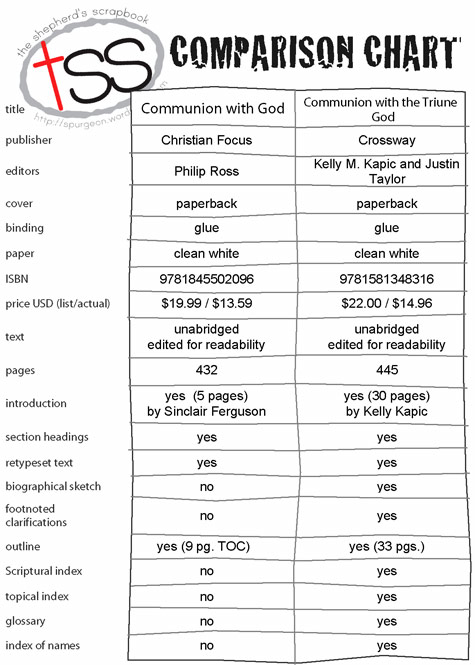
Both volumes are relatively close in size, price and construction quality. In both volumes the text has been edited and updated very well, and they read very similarly. Both works are the product of laborious editing.
Christian Focus edition
In the Christian focus edition, there are a few omissions (listed above) and one obvious weakness — Owen should never be dressed in pink and purple! Apart from that, there are some rather strong features to the Christian Focus edition. Especially noteworthy are the frequent headings and subheadings that break up the long text and help the reader along, making the text more visually appealing. And the Christian Focus edition has chosen to keep the Greek and Hebrew fonts whereas the Crossway edition has transliterated all the Greek and Hebrew (depending upon your view, this may be a strength or weakness). Albeit stripped of some features we see in the other volume, Christian Focus has produced a nice, high quality and very readable edition of Communion.
Crossway edition
But in a straight comparison, the Crossway volume impresses on many levels. The long introduction by Kelly Kapic is exceptional. The extensive (33 page!) outline is very helpful to browse Owen’s arguments and digressions. The footnotes provide helpful clarifications throughout, as does the glossary of terms in the back. But what really separates the two volumes are the indexes at the end. Crossway has made certain to include a detailed Scriptural index and lengthy topical index, making Owen’s classic more accessible than ever before. As a bonus, if you buy through Crossway they include a free electronic PDF version of the book that can be searched on your computer. Never has John Owen been more accessible and searchable.
Conclusion
Following in the footsteps of last year’s Overcoming Sin and Temptation (2006) Crossway is setting new standards for excellence in the publishing of John Owen works — making their books easier to navigate, useful for busy pastors, and exceptionally well outlined to help readers trace Owen’s arguments. Other publishers of Puritan works should make special note their priority on Scriptural and topical indexes. But where Crossway has not ventured, the Christian Focus works remain the best unabridged, retypeset editions of Owen available (these volumes include The Glory of Christ and The Holy Spirit). Both publishers are to be commended for their work, but we hope in the future their efforts will not be so unfortunately duplicated.
——————
Related: Read our full review of Communion with the Triune God (Crossway: 2007).
Related: Read our interview with Derek Thomas on the topic of John Owen and Communion with God.
Related: It’s not just Justin Taylor and Kelly Kapic! Another excellent Puritan reprint will be found in James Durham’s classic, Christ Crucified, recently reprinted by Naphtali. More info here.

A kinder, gentler path to legalism
Last night 60 Minutes aired a segment on popular pastor and author Joel Osteen. Michael Horton, Professor of Theology and Apologetics at Westminster Seminary California, appeared briefly. Horton has spoken out with concern over Osteen’s message. Here’s one concern that strikes me:
“There is no condemnation in Osteen’s message for failing to fulfill God’s righteous law. On the other hand, there is no justification. Instead of either message, there is an upbeat moralism that is somewhere in the middle: ‘Do your best, follow the instructions I give you, and God will make your life successful.’ …
Instead of accepting God’s just verdict on our own righteousness and fleeing to Christ for justification, Osteen counsels readers simply to reject guilt and condemnation. Yet it is hard to do that successfully when God’s favor and blessing on my life depend entirely on how well I can put his commands to work. ‘If you will simply obey his commands, He will change things in your favor.’ That’s all: ‘…simply obey his commands.’
Everything depends on us, but it’s easy. … Osteen seems to think that we are basically good people and God has a very easy way for us to save ourselves — not from his judgment, but from our lack of success in life — with his help. ‘God is keeping a record of every good deed you’ve ever done,’ he says — as if this is good news. ‘In your time of need, because of your generosity, God will move heaven and earth to make sure you are taken care of.’
It may be ‘Law Lite,’ but make no mistake about it: behind a smiling Boomer Evangelicalism that eschews any talk of God’s wrath, there is a determination to assimilate the gospel to law, an announcement of victory to a call to be victorious, indicatives to imperatives, good news to good advice. The bad news may not be as bad as it used to be, but the good news is just a softer version of the bad news: Do more. But this time, it’s easy! And if you fail, don’t worry. God just wants you to do your best. He’ll take care of the rest.
So who needs Christ? At least, who needs Christ as ‘the Lamb of God who takes away the sin of the world’ (Jn 1:29)? The sting of the law may be taken out of the message, but that only means that the gospel has become a less demanding, more encouraging law whose exhortations are only meant to make us happy, not to measure us against God’s holiness.
So while many supporters offer testimonials to his kinder, gentler version of Christianity than the legalistic scolding of their youth, the only real difference is that God’s rules or principles are easier and it’s all about happiness here and now, not being reconciled to a holy God who saves us from ourselves. In its therapeutic milieu, sin is failing to live up to our potential, not falling short of God’s glory. We need to believe in ourselves and the wages of such ‘sins’ is missing out on our best life now. But it’s still a constant stream of exhortation, demands, and burdens: follow my steps and I guarantee your life will be blessed.”
– Michael S. Horton article, Joel Osteen and the Glory Story: A Case Study
Horton’s comments are reminiscent of J. Gresham Machen’s view that the theological liberalism of his own day was not a new path of freedom but a “sublimated form of legalism” [see Christianity and Liberalism (Eerdmans: 1923) pp. 143-156].
Instead of preaching that God “has blessed us in Christ with every spiritual blessing in the heavenly places,” the popular trend says, “God blesses you with all physical blessing because you have asked enough and obeyed a certain way to unleash the blessing.”
Horton and Machen both recognize that while contemporary shifts in preaching may seem to liberate the believer, the opposite happens — God’s promised blessing becomes contingent on personal obedience. This is the very bondage to the Law Christ frees us from!
So why has God blessed your life? Why do you have life? A job? Money? Food? Clothes? Are your successes expected because God likes you more than others? Are you blessed because your obedience is superior? The proper answer is that all of God’s blessing comes to us in Christ. We don’t get what we deserve (His wrath), we get what we don’t deserve (grace, forgiveness and blessing from God through the death of Christ).
At the end of the day the prosperity gospel is a radical break from Scripture that tells us we have already received everything necessary from God in Christ.
The Gospel – the message that sinners are justified by faith alone in the perfect life and work of Christ alone – is the true path to eternal blessing and freedom. When this Gospel is clouded (or even forgotten), we no longer get a clear view of God or eternal reality by which we interpret our world, our job, our pain, our successfulness.
In the end, to presume God’s blessing is an award for obedience is bondage to age-old legalism, albeit with a kinder and gentler face.
———–
RELATED POST: A short essay answering the question, What is legalism? (5/22/07)
RELATED POST: “Like pangs of death”: Letting go of legalism (3/19/07)
RELATED POST: Cross-centered obedience (08/16/07)
RELATED POST: Deeper into the Glories of Calvary (09/03/07)
RELATED POST: Sinclair Ferguson on supporting the imperatives to holiness (07/23/07)
RELATED: What constitutes ‘relevant preaching’? … “The Christian is in the midst of a sore battle. And as for the condition of the world at large — nothing but the coldest heartlessness could be satisfied with that. It is certainly true that the whole creation groaneth and travaileth in pain together until now. Even in the Christian life there are things that we should like to see removed; there are fears within as well as fightings without; even within the Christian life there are sad evidences of sin. But according to the hope which Christ has given us, there will be final victory, and the struggle of this world will be followed by the glories of heaven. That hope runs all through the Christian life; Christianity is not engrossed by this transitory world, but measures all things by the thought of eternity.” Machen in Christianity and Liberalism (Eerdmans: 1923) pp. 147, 149.
 Tony Reinke