
In the first post, I passed along a recommendation for a book that serves as an overview of the intellectual and spiritual composition of the patristic authors. Personally, I want to learn enough about patrology to roll up my sleeves and begin excavating for myself gems from the original writings.
So today we turn to a recommendation on original source reading.
There is widespread agreement on one valuable collection of writings from the apostolic period (ca. AD 70-150), a volume edited by J. B. Lightfoot (1828-1889), compiled by his student J. R. Harmer, and now skillfully updated and edited by Michael W. Holmes titled The Apostolic Fathers: Greek Texts and English Translations, Third Edition (Baker Academic, 2007).
Holmes has done a nice job of keeping the scholarship up to date, adding very helpful book introductions. The 800+ page book includes several short letters preserved from the infancy of the Church. Though academic, the book is well-written and assembled for general readership. In the introduction to the Letters of Ignatius, for example, Holmes writes, “Just as we become aware of a meteor only when, after traveling silently through space for untold millions of miles, it blazes briefly through the atmosphere before dying in a shower of fire, so it is with Ignatius, bishop of Antioch in Syria. We meet him for the first and only time for just a few weeks not long before his death as a martyr in Rome early in the second century” (p. 166).
And Baker should be commended for their work, retypesetting and printing it on nice thin Bible paper. To think of it, The Apostolic Fathers has a similar look and feel to the beautiful NA27 Greek New Testament. Overall, I love the size, feel, and features of this volume. It comes with one of those built-in bookmark ribbons, and the dark green cover with the gold embossing is sharp.
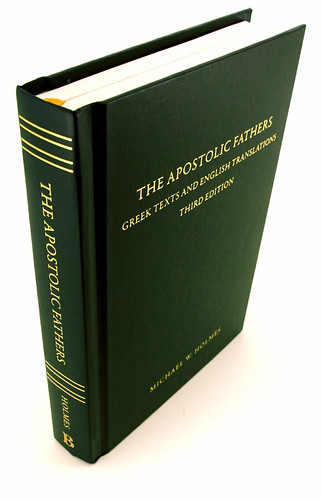 On to a few excerpts.
In my evening reading I’ve been especially impressed with two excerpts from Ignatius’s letter to the Ephesians, written on or before 117 AD (pp. 182-201). Two themes emerge; the centrality of the cross and cautions to cultural adaptation.
1. Centrality of the Cross. This first excerpt has a lot to exegete. Listen to the known dangers of false teaching in this passage, where we see the Pauline warnings of the dangers of false teaching here echoed by a later generation of Christians.
But more specifically, notice the centrality of the cross in building the Church.
9:1 But I have learned that certain people from elsewhere have passed your way with evil doctrine, but you did not allow them to sow it among you. You covered up your ears in order to avoid receiving the things being sown by them, because you are stones of a temple, prepared beforehand for the building of God the Father, hoisted up to the heights by the crane of Jesus Christ, which is the cross, using as a rope the Holy Spirit; your faith is what lifts you up, and love is the way that leads up to God. 2 So you are all participants together in a shared worship, God-bearers and temple-bearers, Christ-bearers, bearers of holy things, adorned in every respect with the commandments of Jesus Christ. I too celebrate with you, since I have been judged worthy to speak with you through this letter, and to rejoice with you because you love nothing in human life, only God.
Ignatius beautifully captures the centrality of the cross in building the church.
2. Darkening lines in cultural engagement. And I find the patristic authors to be stimulating on the issue of cultural engagement. Try and isolate Ignatius’s warning amidst all the commands to relate to those in the world.
10:1 Pray continually for the rest of humankind as well, that they may find God, for there is in them hope for repentance. Therefore allow them to be instructed by you, at least by your deeds. 2 In response to their anger, be gentle; in response to their boasts, be humble; in response to their slander, offer prayers; in response to their errors, be steadfast in the faith; in response to their cruelty, be civilized; do not be eager to imitate them. 3 Let us show by our forbearance that we are their brothers and sisters, and let us be eager to be imitators of the Lord, to see who can be the more wronged, who the more cheated, who the more rejected, in order that no weed of the devil may be found among you, but that with complete purity and self-control you may abide in Christ Jesus physically and spiritually.
In light of the harsh pagan culture, Ignatius reminds the Christian Ephesians, “do not be eager to imitate them.” This is a helpful reminder for us today. Love those in the world? Yes. Love in word and deed? Yes. Respond to sin with kindness? Yes. See them as your equals, as brothers and sisters? Yes. Imitate the rough and crass edges of culture? No.
Be “OK” with not following and imitating their roughness. This excerpt is an interesting warning for early Christians struggling with loving those in the world without inadvertently absorbing the roughness of culture. This balance of engagement without conformity is still a tough question to answer nearly 2,000 years later. It’s helpful to see how these early Christians tried to understand the issues and set their parameters.
I could go on, there are other excellent passages. But my intent here is to recommend these books, stir a desire to read them, and let you spend less time on this blog and more time discerningly reading the patristic authors for yourself.
Please take with you one caution. Although this book looks, smells, and feels like a New Testament—even has verse numbers like a Bible!—it’s not Scripture. I receive emails and comments frequently from folks who say patrology transformed their understanding of Christianity. Statements like these read as though patrology and canonical scripture are equally shaping for these folks. They are not. So if your reading schedule is tight, you should never substitute time in Scripture with reading the early church fathers.

——————
Title: The Apostolic Fathers: Greek Texts and English Translations, Third Edition
Editors: J. B. Lightfoot, J. R. Harmer, and Michael W. Holmes
Boards: hardcover (not cloth)
Pages: 808
Volumes: 1
Dust jacket: no
Binding: sewn
Paper: thin, slightly yellowed, Bible paper
Topical index: yes, a thematic analysis
Scriptural index: no
Text: retypeset
Publisher: Baker Academic
Year: 2007
Price USD: $29.00
ISBNs: 080103468X, 9780801034688
 Tony Reinke
Any thoughts on how this volume compares to Schaff’s version?
Thanks for this recommendation. I won’t be able to purchase it, but the excerpts you provided have been a blessing to me.
Thanks Tony- my copy has just arrived from Amazon. Can I recommend another couple of books on patristics?
“Creeds, Councils, and Christ- did the early Christians misrepresent Jesus” (Christian Focus) by Gerald Bray, formerly of Beeson Divinity School, and now back here in England with the Latimer Trust.
“Reading Scripture with the Church Fathers” (IVP) by Christopher Hall- an introductory volume to the “Ancient Christian Commentary on Scripture” series.
Tony….job well done on this wonderful tome.
ChrisB….I find this version much more user friendly. Schaff, while excellant in his own right, is a bit dated in his syntax and language structure, in my opinion. If we only had a ‘modern version’ makeover of that great historian’s works.