Adoption in Context

J. I. Packer rather famously wrote, “were I asked to focus the New Testament message in three words, my proposal would be adoption through propitiation, and I do not expect ever to meet a richer or more pregnant summary of the gospel than that” (Knowing God, 214). Adoption is precious, and that line from Packer is worth memorizing.

But there’s a much broader historical-redemptive context for understanding our adoption as David B. Garner explains in his excellent chapter, “The First and Last Son: Christology and Sonship in Pauline Soteriology,” published in Resurrection and Eschatology (P&R, 2008).

Here is Garner’s thick-and-rich-like-dark-chocolate conclusion. Best enjoyed in small bites:

Behind the creation of the cosmos—and most relevantly here, behind the creation of man—exists the archetypal, eternal sonship of Christ. Man, made in the image of God, a finite replica (ectype) of the eternal, ontologial Son (archetype), is, at creation, necessarily a son of God.

While the fall skewed sonship and alienated the relationship of the created son with the Father, just as man did not completely lose the divine image, he likewise did not lose the broad sense of his sonship. Still sons, but alienated and depraved, the first man and his progeny stood under the curse of their Creator/Father, and were in need of the judicial declaration of God to rectify their sonship status, and the redemptive power of God to restore their sonship constitution, indeed to vouchsafe their eschatological familial telos.

In view of the failure of the first son of God, the realization of this declaration and redeeming power by God’s grace came through the Last Adam, the Son of God par excellence, whose redemptive work provided the reversal of the curse on man and the attainment of adoption for the fallen sons of Adam. In Christ, created sons of Adam become the adopted sons of God.

While the entire redemptive-historical development and realization of redemptive sonship organically derive from his messianic sonship, Christ’s pre-temporal constitution plays the prior, ultimate role. In fact, all biblical sonship flows from an anterior, ontological principium—the eternal Son of God, in whom the ectypal, typological, and antitypical sonships find their raison d’être.

This principium of christological sonship unites the sonships of Adam, of Israel, of the incarnate Christ, and of the eschatologically adopted believer in covenantal, redemptive-historical continuity. The first Adam finitely replicates the First Son; the Last Adam fulfills the telos of the first created son. In this way, Christ is not only the eternal Son, he is also the archetypal Adam. Further, by his covenantal obedience as the Last Adam, he became the glorious, exalted, eschatological Son of God in power (Rom. 1:4).

We see therefore in Pauline soteriology an exhaustively christological cast, wherein the filial, ontological, and redemptive-historical are securely tethered in Christ the Son of God, the Source, Epicenter, and Consummator of all reality. He is the Alpha and the Omega, the Beginning and the End, the First Son and the Last. (279)
Speech-Act in the Psalms

“Speech-act theory [SAT] insists that language does not exist idly to make certain sounds, but is always language in action, and usually communicative action” (Briggs). SAT can be taught well or poorly and the difference is how clearly the teacher brings to bear the “so what” of why it matters in the first place.

If you’re going to explain the “so what” of SAT, and you want to avoid abstractions, the psalms are a great place to do it. By praying or sing the psalms we are not merely reciting idle sounds with our tongues. We are performing. This is especially true because language is part of our covenant relationship, as we will see shortly.

I appreciate how Gordon Wenham explains the “so what” in his forthcoming book, The Psalter Reclaimed: Praying and Praising with the Psalms (Crossway, Feb. 2013). Here’s a spattering of quotes. Perhaps it will spark more interest in the book or in SAT and its implications for our devotions, our local churches, and all forms of corporate speech.

Page 27:

Promises change a situation by imposing obligations on the speaker and creating expectations in the listener. A promise is an example of a speech act. Wedding vows are speech acts too. The key words in a marriage ceremony are spoken publicly and before God. “I A take you B to be my wedded wife/husband, to have and to hold from this day forward, for better for worse, for richer for poorer, in sickness and health, to love and to cherish, till death us do part.”

One trusts that brides and grooms pronounce these words after careful thought beforehand and with complete sincerity on the big day. The words themselves transform their status: the two become man and wife. Thus the words are performative.

Page 120:

To say, “I give thanks to Thee, O Lord, with my whole heart” is not merely informing God about one’s feelings, but also performing an act of thanksgiving in itself.

Pages 34–35:

To sum up, singing or praying the psalms is a performative, typically a commissive, act: saying these solemn words to God alters one’s relationship in a way that mere listening does not. This is not a new insight. St. Paul saw confession of faith as altering one’s status before God: “If you confess with your mouth that Jesus is Lord and believe in your heart that God raised him from the dead, you will be saved. For with the heart one believes and is justified, and with the mouth one confesses and is saved” (Rom. 10:9–10).

Paul’s argument may be applied to the Psalms. Throughout the Psalter one is confessing that the Lord is God, and as the Psalms often insist, this is supposed to be a confession that comes from a pure and sincere heart. And it is certainly salvation that the Psalmist seeks: time and again he pleads to God to save him, to deliver him, to hear his prayer, and so on. Whether or not this always occurs is not my purpose to discuss now. I simply want to draw out some of the similarities between taking an oath, making a vow, confessing faith, and praying the psalms. I think these parallels may help us to see how powerful the commitment is that the psalms demand of their user. In singing the psalms, one is actively committing oneself to following the God-approved life.

Tim Keller on J. R. R. Tolkien

John Ronald Reuel Tolkien would have turned twelfty-one (121) today, an age not entirely unreachable for a hobbit of course. In an interview Tim Keller said the following about Tolkien’s influence on his spiritual life:

Tolkien has helped my imagination. He was a devout Catholic — and I am not. However, because he brought his faith to bear into narrative, fiction, and literature, his Christianity — which was pretty ‘mere Christianity’ (understanding of human sin, need for grace, need for redemption) — fleshed out in fiction, has been an inspiration to me.

What I mean by inspiration is this: he gives me a way of grasping glory that would otherwise be hard for me to appreciate. Glory, weightiness, beauty, excellence, brilliance, virtue — he shows them to you in some of his characters.

When people ask me how often I have read The Lord of the Rings, the answer is, I actually never stop. I’m always in it.

As an aside, if you’d like to purchase a copy of LOTR, an edition that will withstand repeated use, Westminster Books now carries a gorgeously illustrated box set. I bought two sets last week and was really impressed with the quality. Find details here.

Taxes and the Soul

Speaking of taxes, John Piper writes this in his book What Jesus Demands from the World:

It is risky for Jesus to say, “Render to Caesar the things that are Caesar’s.” That puts a high premium on obedience to the demands of Caesar. One of the realities that warrants this risk is that the heart of rebellion is more dangerous in us than the demands of Caesar outside of us. Jesus wants us to see that the danger to our soul from unjust, secular governments is nowhere near as great as the danger to our soul from the pride that kicks against submission. No mistreatment from Caesar or unjust law from Rome has ever sent anyone to hell. But pride and rebellion is what sends everyone to hell who doesn’t have a Savior. Therefore, the subordinate authorities of the world are warranted by God’s will in two senses. On the one hand, he wills that we recognize that these authorities are indeed subordinate and that we glorify him as the only supreme sovereign. On the other hand, he wills that we recognize these authorities as God-ordained and that we not proudly kick against what he has put in place.

On Prose Flow (Writing)

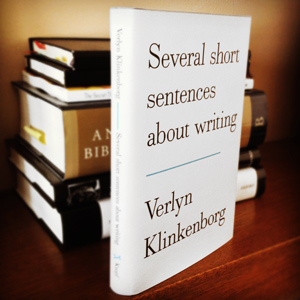
Writes non-fiction author and editor Verlyn Klinkenborg in his insightful new book Several Short Sentences About Writing (Knopf, 2012), page 67:

Your job as a writer is making sentences.
Your other jobs include fixing sentences, killing sentences, and arranging sentences.
If this is the case — making, fixing, killing, arranging — how can your writing possibly flow?
It can’t.

Flow is something the reader experiences, not the writer.

A writer may write painstakingly,
Assembling the work slowly, like a mosaic,
Fitting and refitting sentences and paragraphs over the years.
And yet to the reader the writing may seem to flow.

The reader’s experience of your prose has nothing to do with how hard or easy it was for you to make.
You’re not writing for a reader in the mirror whose psychological state reflects your own.
You have only your own working world to consider.
The reader reads in another world entirely.

Happy New Year!

A prayer for everyone launching out into unknown waters of 2013, from The Valley of Vision:

O Lord,

Length of days does not profit me except the days are passed
in thy presence, in thy service, to thy glory.
Give me a grace that precedes, follows, guides, sustains,
sanctifies, aids every hour,
that I may not be one moment apart from thee,
but may rely on thy Spirit
to supply every thought,
speak in every word,
direct every step,
prosper every work,
build up every mote of faith,
and give me a desire
to show forth thy praise,
testify thy love,
advance thy kingdom.

I launch my bark on the unknown waters of this year,
with thee, O Father, as my harbour,
thee, O Son, at my helm,
thee, O Holy Spirit, filling my sails.

Guide me to heaven with my loins girt,
my lamp burning,
my ear open to thy calls,
my heart full of love,
my soul free.

Give me thy grace to sanctify me,
thy comforts to cheer,
thy wisdom to teach,
thy right hand to guide,
thy counsel to instruct,
thy law to judge,
thy presence to stabilize.

May thy fear be my awe,
thy triumphs my joy.