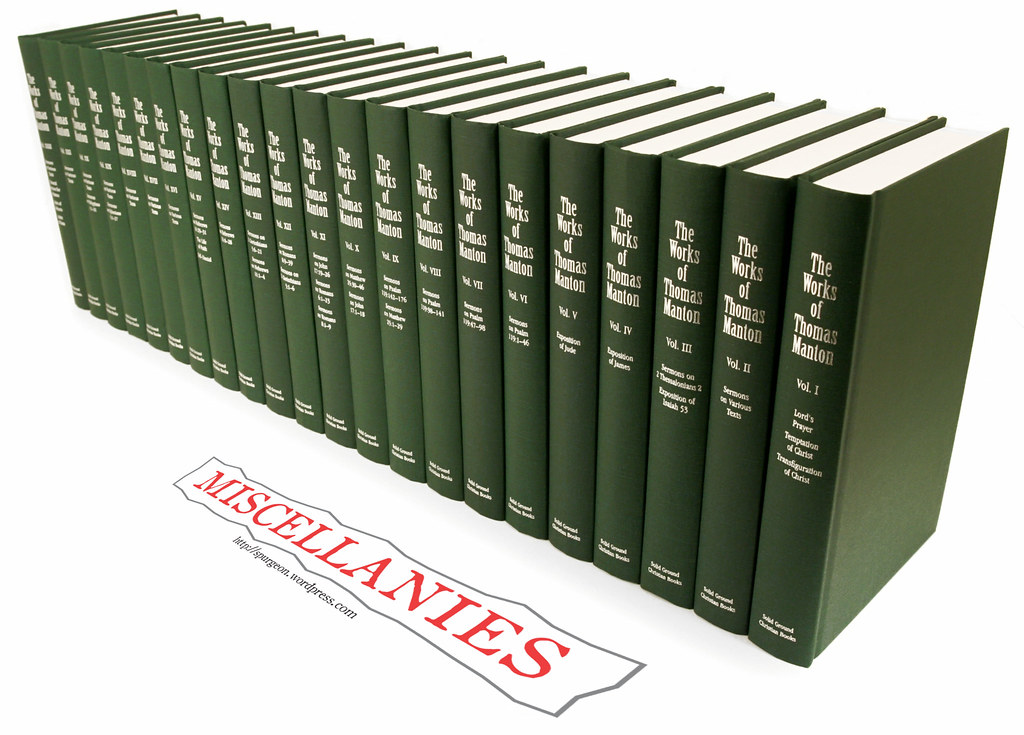
Review: Complete Works of Thomas Manton

For each of the past several years, we’ve been blessed with at least one monumental publishing achievement that further exposes contemporary readers to the exegetical and theological gems of the Puritan literary legacy. In 2006, Reformation Heritage Books reprinted the 12-volume Works of Thomas Goodwin. And over the last two years Justin Taylor and Kelly Kapic have blessed us with carefully edited and re-typeset versions of John Owen classics—Overcoming Sin and Temptation (Crossway, 2006) and Communion with the Triune God (Crossway, 2007).

But 2008 will be known for its own monumental achievement, in the reprinting of what I consider to be one of the leading collections of Puritan sermons. Solid Ground Christian Books has printed and is now shipping a new photolithographed, cloth-covered, sewn-bound, edition of the 22-volume, 10,500 page, Complete Works of Thomas Manton. And today I want to tell you about it.

Thomas Who?

Two years ago I compiled a list of most helpful Puritan resources for expositional, theological, and pastoral research. That list placed at #5 a man named Thomas Manton. Some of you were perplexed that I ranked this more obscure Puritan above those of more repute—John Owen, John Flavel, Richard Sibbes, Jeremiah Burroughs, Thomas Brooks, Thomas Goodwin, and Edward Reynolds. Each of these men represent exceptional gifting in the Puritan period; and if you disagree that Manton deserves to be above them, I think we can agree Rev. Manton belongs among them.

Compared to other favorite Puritans, Manton’s bibliography lacks pizzazz. Apart from two commentaries on James and Jude (both of which are excellent), he chose not to write books. Which explains why 20 of 22 volumes are stuffed full of expositions of Scripture. To the core of his life and ministry, Manton was a preacher of God’s Word, an able expositor who walked slowly through large sections of scripture in a very thorough and deliberate fashion. Dr. Joel Beeke writes, “Manton presents us with the best that English Puritans had to offer in careful, solid, warmhearted exposition of the Scriptures.”

The value of Manton’s works is discovered in the value of Manton the expositor.

So what type of preacher is Manton? Where does he rank among the other Puritan preachers? In assessing the value of Manton’s sermons, I find the careful thoughts of 19th century preacher Charles Haddon Spurgeon especially insightful. Spurgeon, in his commentary on Psalm 119, speaks fondly about a season of focused reading in Manton’s Works. Here is Spurgeon’s experience:

While commenting upon the one hundred and nineteenth Psalm, I was brought into most intimate communion with Thomas Manton, who has discoursed upon that marvelous portion of Scripture with great fullness and power. I have come to know him so well that I could pick him out from among a thousand divines if he were again to put on his portly form, and display among modern men that countenance wherein was ‘a great mixture of majesty and meekness.’ His works occupy twenty-two volumes in the modern reprint—a mighty mountain of sound theology. They mostly consist of sermons; but what sermons! They are not so sparkling as those of Henry Smith, nor so profound as those of Owen, nor so rhetorical, is those of Howe, nor so pithy as those of Watson, nor so fascinating as those of Brooks; and yet they are second to none of these. For solid, sensible instruction, forcibly delivered, they cannot be surpassed. Manton is not brilliant, but he is always clear; he is not oratorical, but he is powerful; he is not striking, but he is deep. There is not a poor discourse in the whole collection—they are evenly good, constantly excellent. Ministers who do not know Manton need not wonder if they are themselves unknown.

Don’t you love the way Spurgeon slaps ministers around who are unfamiliar with the Puritans? Spurgeon has a great respect for the Puritan preachers, and an appreciation for their consistent value for the Church. Manton is not the most brilliant of the Puritans, but he certainly is one of the most readable—and thereby one of the most valuable—of all the Puritan authors. Manton’s sermons are marked by clarity, doctrinal precision, and simplicity. And that places Manton right along with the very best of them.

Spurgeon understood that Manton was a preacher concerned to connect the deep truths of scripture to common audiences. His preaching was not glamorous in the day, and thereby unstained with the contemporary oratorical decorations and superfluous adornments that would have surely dated his language. Spurgeon loved to recount one story that showcases Manton’s care to preach in a manner suitable to the common Christian.

While Dr. Manton was minister at Covent Garden he was invited to preach before the Lord Mayor and Court of Aldermen, and the Companies of the City, upon a public occasion, at St. Paul’s. The doctor chose a very difficult subject, in which he had an opportunity of displaying his judgment and learning, and appearing to the best advantage. He was heard with the admiration and applause of the more intelligent part of the audience; and was invited to dine with my Lord Mayor, and received public thanks for his performance.

But upon his return in the evening to Covent Garden, a poor man following him, gently plucked him by the sleeve of his gown, and asked him if he were the gentleman who had preached that day before the Lord Mayor. He replied, he was.

“Sir,” says he, “I came with an earnest desire after the word of God, and in hope of getting some good to my soul, but I was greatly disappointed, for I could not understand a great deal of what you said: you were quite above me.”

The doctor replied, with tears in his eyes, “Friend, if I did not give you a sermon, you have given me one; and, by the grace of God, I will never play the fool by preaching before my Lord Mayor in such a manner again.”

Well Manton did not play the fool and his volumes of sermons testify to Manton’s desire to communicate to and edify the common Christian audience of his day. There is sweet consistency throughout his many sermons, or as Spurgeon puts it, “There is not a poor discourse in the whole collection they are evenly good, constantly excellent.”

But these sermons are slightly different than other collections of sermons I have purchased and read over the years. Unlike Spurgeon’s sermons, Manton is much less wordy, making me think these printed sermons are more likely his sermon manuscripts than edited transcripts (as in the case of Spurgeon). This means Manton’s sermons, by comparison, have a sweet concentration about them. And each sermon is very carefully outlined with use of clear points and subpoints, which make his sermons very easy to follow. Take Manton’s concentrated sermon form and well-outlined structure, multiply this by several sermons per volume, multiply that by 20 volumes, and you get a lifetime of sermon gems to feast the soul.

22-Volume Works

Recently Solid Ground Christian Books has served the Church by reprinting and shipping the entire 22-volume Complete Works of Thomas Manton. Currently the set is available through Reformation Heritage Books for $320.00 (plus a free copy of Meet the Puritans on each set). After some time reading and getting familiar with this new set, I offer my thoughts.

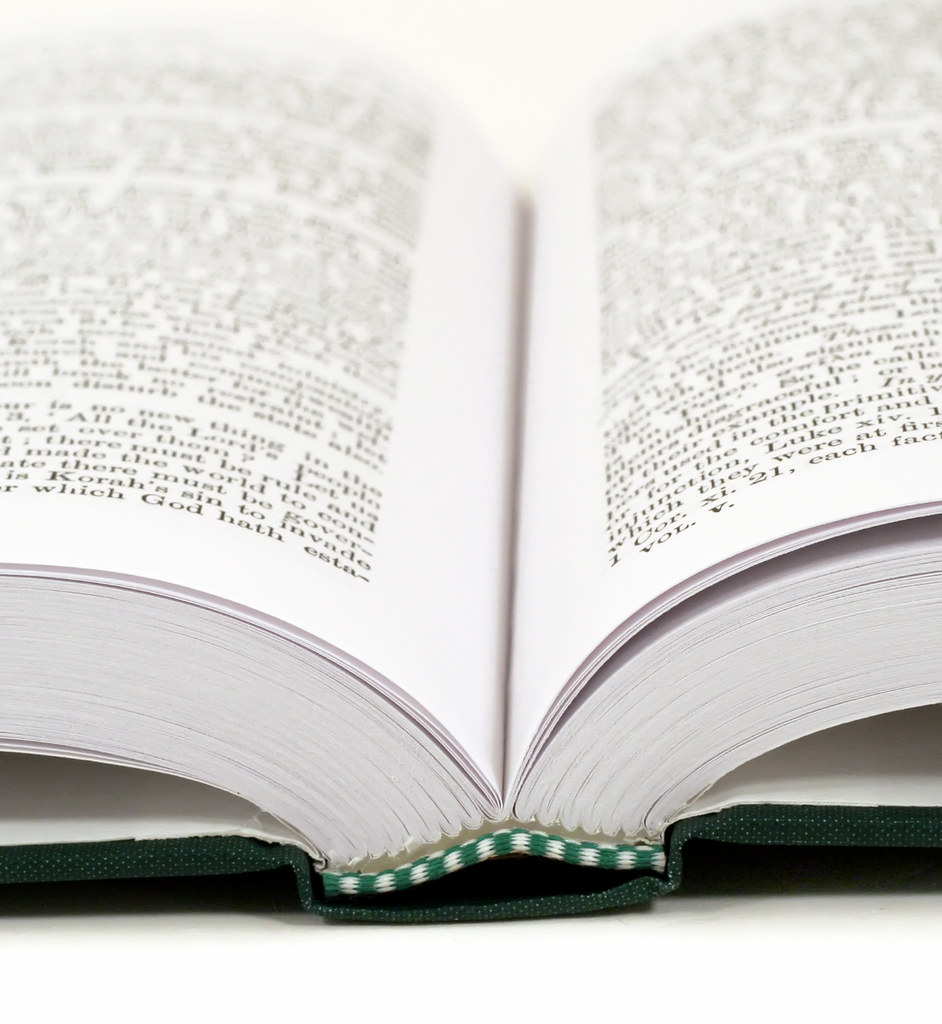
The new Manton set bears an obvious resemblance to the Banner’s edition of John Owen’s Works. Each volume is identical in height and depth, and has the same paper thickness, sewn binding, and photolithographed 19th century typeset. They are also nearly twins in beautiful genuine green cloth covers (Manton being slightly darker). There are two differences. The Manton volumes are not clothed in dust jackets. But on the other hand, the pages in Manton are bleach white, making them clearer and easier to read than the yellow paper of the Owen set.

Here are two detail photos of the set, one a close-up picture of the binding, cover, and paper color and another of the photolithographic text and paper color (click pictures for larger).
And this leads me to my favorite feature of the Manton set.

What determines the usefulness of a prolific Puritan writer? For busy pastors under the time crunch of sermon preparation, or for the common Christian reader looking to be fed devotionally on a specific topic or passage, the answer often boils down to one feature—indexing. Has the Puritan set been carefully indexed for ease-of-use? And there are, in my opinion and experience, no Puritans that have been more exhaustively or carefully indexed than this set of Manton works! The whopping 306 pages(!) of topical and scriptural indices take up most of the final volume in the Manton set, putting at your fingertips all 10,500+ pages of theological, expositional, and pastoral wealth.

There may be no better way to catch a glimpse into the priorities and usefulness of Manton than to peruse this massive index for yourself. So for your convenience I have converted these 306 pages into a single PDF, which you can download by clicking here (30.8MB file). I think by perusing the index you will gain a vision for the topics covered and the usefulness of Manton.

Conclusion

In late October of 1870, J.C. Ryle wrote a foreword to commemorate the first modern printing of Manton’s Works. In it Ryle wrote:

In days like these, I am thankful that the publishers of Manton’s Works have boldly come forward to offer some real literary gold to the reading public. I earnestly trust that they will meet with the success which they deserve. If any recommendation of mine can help them in bringing out the writings of this admirable Puritan in a new form, I give it cheerfully and with all my heart.

Today, I simply echo the recommendations of Spurgeon, Ryle, and Beeke. There are few, if any, Puritan sets that will provide you a more consistent and bountiful source of spiritual food for your soul than The Complete Works of Thomas Manton. And that is why I am so grateful for the Puritan preacher and so indebted to Solid Ground Christian Books for investing the time and money to offer this literary gold once again to the reading public.

——————

Title: The Complete Works of Thomas Manton
Author: Thomas Manton
Boards: hardcover; green cloth and silver gilding
Pages: 10,500
Volumes: 22
Dust jackets: no
Binding: sewn
Topical index: yes (extensive!; 224 pages)
Scriptural index: yes (extensive!; 80 pages)
Text: Photolithograph of 1870 James Nisbet & Co. edition
Publisher: Solid Ground Christian Books
Year: 2008
Price USD: $1,000.00 / $320.00 at RHB
ISBN: 978-1-59925-159-2

on Evaluating Books

I recently completed The Road by Cormac McCarthy. What do I think of the book? Well, the dust has yet to settle.

I’ve learned to take a day or a month to step back from a book, go about normal business, and let “the dust settle.” This patient wait for clarity is a lesson I learned in college from the writings of Virginia Woolf (1882–1941).

I’m no fan of Virginia Woolf, but her understanding of how the mind evaluates books—especially novels and poetry—has taught me patience when I find myself surrounded by the blizzard of details to wait until all has settled on the floor of my mind. Resisting the impulse of immediate critique allows a critical brain-simmer between the period a book is competed and when the book’s value becomes clear. This wait allows for a constructive subconscious process where fragmented thoughts are reshaped into a unified whole.

And Woolf encourages us to critique slowly because this process provides the necessary continuity to evaluate new books to the very best old books. Such is logical. Why would we ever read new books without reference to the superior books of the past?

Enough of me. Here’s how Woolf articulates these ideas:

The first process, to receive impressions with the utmost understanding, is only half the process of reading; it must be completed, if we are to get the whole pleasure from a book, by another. We must pass judgment upon these multitudinous impressions; we must make of these fleeting shapes one that is hard and lasting. But not directly. Wait for the dust of reading to settle; for the conflict and the questioning to die down; walk, talk, pull the dead petals from a rose, or fall asleep. Then suddenly without our willing it, for it is thus that Nature undertakes these transitions, the book will return, but differently. It will float to the top of the mind as a whole. And the book as a whole is different from the book received currently in separate phrases. Details now fit themselves into their places. We see the shape from start to finish; it is a barn, a pigsty, or a cathedral. Now then we can compare book with book as we compare building with building.

But this act of comparison means that our attitude has changed; we are no longer the friends of the writer, but his judges; and just as we cannot be too sympathetic as friends, so as judges we cannot be too severe. Are they not criminals, books that have wasted our time and sympathy; are they not the most insidious enemies of society, corrupters, defilers, the writers of false books, faked books, books that fill the air with decay and disease? Let us then be severe in our judgments; let us compare each book with the greatest of its kind. There they hang in the mind the shapes of the books we have read solidified by the judgments we have passed on them— Robinson Crusoe, Emma, The Return of the Native. Compare the novels with these—even the latest and least of novels has a right to be judged with the best.

And so with poetry—when the intoxication of rhythm has died down and the splendour of words has faded, a visionary shape will return to us and this must be compared with Lear, with Phèdre, with The Prelude; or if not with these, with whatever is the best or seems to us to be the best in its own kind. And we may be sure that the newness of new poetry and fiction is its most superficial quality and that we have only to alter slightly, not to recast, the standards by which we have judged the old.

-Virginia Woolf, “How Should One Read a Book?”

Cloth or Paper? Bavinck RD Cover Concerns

[The definition of a bibliophile is “one who loves books, but especially for qualities of format.” I admit to being one. This post is intended for my fellow bibliophiles.]

Cloth-covered books are durable, resilient, and protect valuable books for decades of use, so I appreciate publishers who print books in cloth and find it easy to pay extra few bucks for these volumes.
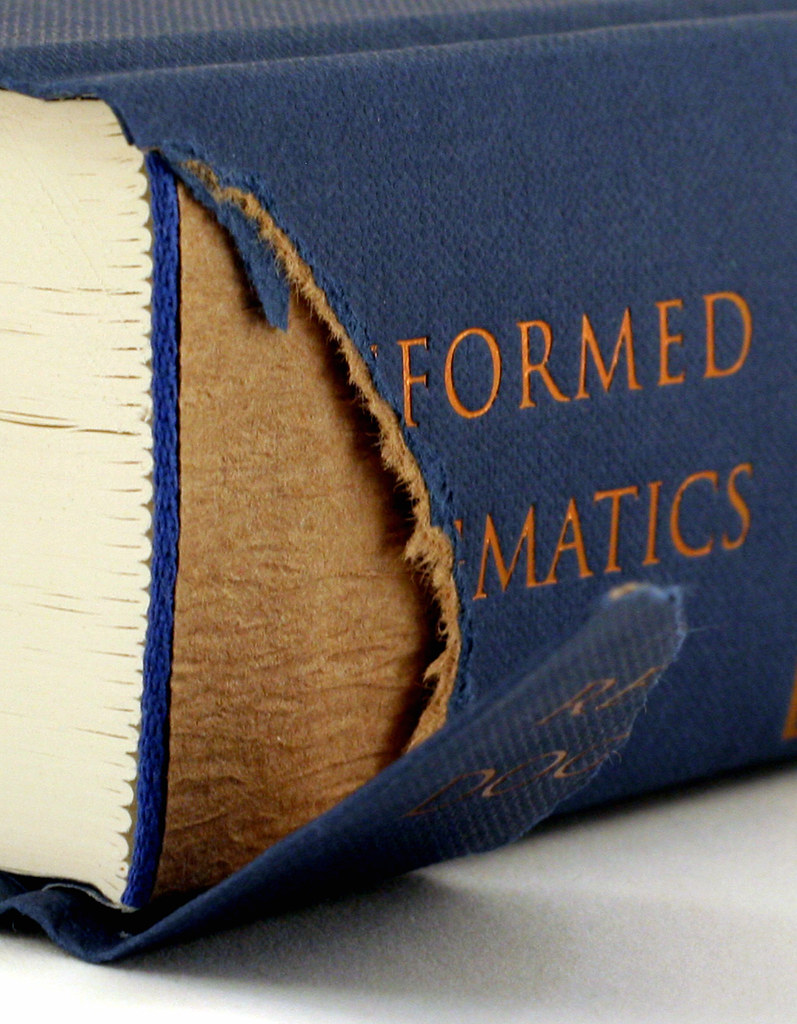
However, not everything that looks like “cloth” is genuine cloth. Publishers have become advanced with using faux cloth covers, which amount to pressed and texturized paper used as an inexpensive way to add grain to a hardcover book without the added cost of real cloth. But those volumes are typically not sold as “cloth.”

Which brings me to yesterday when I received my long-awaited copy of Herman Bavinck’s Reformed Dogmatics, Volume Four (Baker Academic, 2008). J.I. Packer says this work “remains after a century the supreme achievement of its kind.” Now completely translated from Dutch, it stands as one of the great reformed systematic theologies in the English language, and sports a hefty list price ($180.00)—a small price for a set I intend to use the rest of my life and one day pass to my children.

The first three of my volumes—all recently purchased—were genuine cloth covered (as advertised). Or so I assumed. But my curiosity was raised yesterday when my fourth and final volume arrived. I removed the dust jacket and noticed the cover on the final volume lacked the same depth of texture as the first three volumes. And it didn’t have the same laminated matte finish over the cloth but the feel of, well, paper. That’s when I decided to tug on the spine. [For those of you longtime TSS readers you will not be surprised at my biblio-destructive tendencies]. I pinched the cover over the spine, and with little effort, the cover tore like a piece of newspaper. Cloth doesn’t rip (at least not diagonally).

As you can see from the pics, the cover on my volume is nothing more than pressed paper—a cloth-like feel, a cloth-like appearance, but without any cloth.


My tinge of guilt for tearing Bavinck (gasp!) was overcome by the feeling of adrenaline a muscle man must experience tearing phone books. So I decided to test my three other Bavinck volumes. I discovered two volumes were genuinely cloth (absolutely would not rip even under intense pressure), and a second volume that was paper. Here’s what I found:

Volume 1 – May 2007 printing – cloth
Volume 2 – August 2006 printing – paper
Volume 3 – July 2007 printing – cloth
Volume 4 – 2008 printing – paper

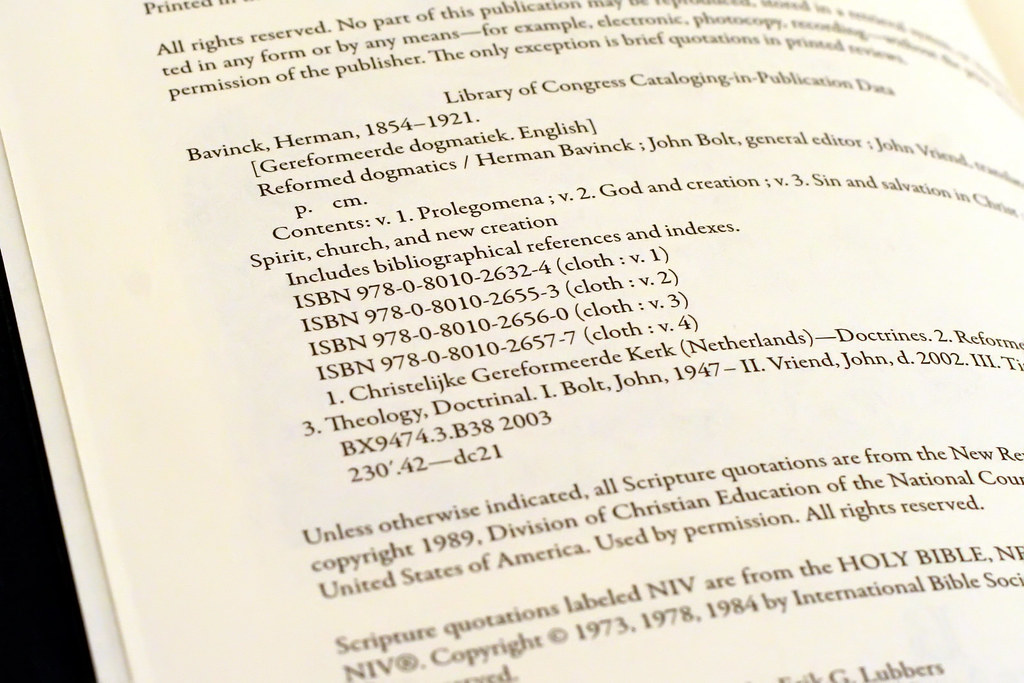
As you can see from the table of contents page in volume 4, Baker claims all four volumes were printed in cloth.

I’ve contacted Baker Academic and will pass along updates as I receive them, especially if I can find a way to replace the paper editions with cloth editions.

Some questions for TSS readers:

(1) Do you own copies of Baker’s printings of Reformed Dogmatics? Which volumes? What are the print dates?

(2) Does the copyright page claim the volume is cloth?

(3) If so—and if you dare—pinch the top of the cover over the spine and try ripping it (ever so slightly) to see if you, too, have a “paperback”. And let me know in the comments. [No need for any more examples.]

Perhaps—and let’s hope—my two copies are aberrations.

2007 TSS Books of the Year Award

2007tssboy.jpg

The stack of excellent Christian books published in 2007 would reach at least 5 feet in the air. So while I’m privileged to have read so many great books, whittling down my top 30 favorites is no easy assignment.

In the past, some TSS readers have asked what criteria I use in making this determination and I admit it’s very subjective. My list of top books is based upon a personal opinion of the overall value of individual volumes. Which volumes pioneer new territory? Which books clarify topics of great importance? Which books from 2007 will my kids read in 10 years?

Included in the list are complex doctrinal books, academic polemics, historical biographies, children’s books, marriage books, exegetical guides, etc. My reading interests are wide open, and so is the TSS book of the year competition. There are book recommendations for pretty much all readers.

Themes in 2007

Topically, 2007 will be remembered as the year where precious doctrines like justification and the atonement took rightful center stage (see The Truth of the Cross by R.C. Sproul, The Great Exchange by Bridges and Bevington, and also #3, #12, and #25 on the top-30 list). The doctrine of assurance was the focus of two excellent new volumes (see #13 and #23). Church history and the events of the Reformation found themselves in three excellent volumes (see #8, #11, and #30). But 2007 will also be remembered as the year of John Owen, reformed spirituality, and communion with God (see #6, #14, #15, and #21). We also saw the publishing of one of the best new children’s books (see #4). All around, it was a very fruitful year for some very important topics.

2007 Books of the Year

But two books stand apart from the rest in 2007, because they are volumes that promise to shed a wealth of understanding over large sections of Scripture. They captured my attention because I know I myself have some work to do in discovering the richness of God’s revealed truth in Scripture (and especially in the Old Testament narratives).

So today I happily announce the 2007 TSS books of the year – The ESV Literary Study Bible by Leland and Philip Ryken and An Old Testament Theology by Bruce Waltke.

TSS top-30 books from 2007

1 (tie). ESV Literary Study Bible edited by Leland and Philip Ryken (Crossway). Getting readers comfortable enough to read large selections of Scripture was formerly the work of dynamic equivalent translations like The Message. But the Rykens establish a framework for readers to comprehend large sections of Scripture for themselves by introducing each chapter, exposing the literary style of the work, and providing a general outline of what to expect. Then readers can jump into the literature of Scripture to experience the text for themselves. In the end, the Rykens have produced a Bible that retains the “word-for-word” literal language of the ancient Scriptures (ESV) while helping readers along in fruitful comprehension. Readers who have never enjoyed the Bible from cover-to-cover will especially benefit and find the biblical storyline easier to follow. This is no ordinary study Bible, and it is one that will be cherished by the church long into the future. We wrote a full review of the LSB and also talked with Leland Ryken about it this Summer. $31.49

1 (tie). An Old Testament Theology: An Exegetical, Canonical, and Thematic Approach by Bruce Waltke (Zondervan). Some of the details of the Old Testament appear to simply hang suspended for the modern reader. Let’s take Exodus 2:11 for example: Why is it important that Moses became angry when he saw the harsh treatment of the Israelite by an Egyptian? Why did Moses kill the Egyptian? Why would the biblical author record this event in the first place? Some events in the Old Testament don’t entirely make sense on the surface. Waltke takes these events from the biblical narratives and weaves them into the bigger storyline of Scripture. For this specific example, it helps to understand that Moses was in transition from his identity in Pharaoh’s palace to his new identity with Israel (p. 352). Exodus 2:11 is actually critical in establishing Moses’ transition from Egyptian-raised to Israel’s front-man in the Exodus. And this is just one itsy-bitsy detail from the Old Testament. By taking these seemingly disconnected events and connecting them into the bigger picture of Scripture, Waltke has given us a very helpful guide to understanding the Old Testament. And his insights into the Ten Commandments are worth the price of the volume (see pp. 415-433). In the end, Waltke’s clear articulation of the Old Testament informs the church of her past and thereby informs her present identity. This is a volume you will want to read slowly and digest fully, perhaps within a group of fellow Christians. It will open up the theology and storyline of the Old Testament like no other book I’ve seen. Read more about this volume in our full review. $29.69

3. Pierced for our Transgressions: Rediscovering the Glory of Penal Substitution (UK:IVP/US:Crossway). Written by Steve Jeffery, Michael Ovey, and Andrew Sach, this book has proven to be a huge success in both the UK and the US in defending the core of the atonement of Jesus Christ. If you want to understand the Cross at a deeper level (don’t we all) you will cherish this volume. It will go on my shelf along with some of the giants on this topic (like Stott). But what makes this volume especially important is the central role it represents in bringing together a worldwide brotherhood of Christians who believe and cherish the penal substitutionary atonement of the Cross. What Together for the Gospel and the Gospel Coalition conferences have done to unify American churches and ministries around these precious truths, Pierced for Our Transgressions has accomplished on an international scale. $16.50

4. The Jesus Storybook Bible: Every Story Whispers His Name by Sally Lloyd-Jones (Zondervan). Finding children’s books that introduce little ones to the major stories of the Bible while simultaneously pointing their souls to the Cross is a rarity. This is perhaps the best children’s storybook Bible on the market, and a must-have for any parent of young children. Incredible illustrations, too. $11.65

5. When Sinners Say “I Do”: Discovering the Power of the Gospel for Marriage by Dave Harvey (Shepherd Press). Harvey has blessed couples with an excellent book for connecting the Cross to the daily trials and triumphs of marriage. Don’t attempt marriage without the Gospel. Bring Harvey along to explain why. $11.16

6. Communion with the Triune God by John Owen (Crossway). The classic book written by English Puritan John Owen resurfaced in 2007, in a new edition edited by Kelly Kapic and Justin Taylor. It’s unlikely I can overstate the importance of Taylor and Kapic’s editorial work in introducing Owen to the new generation of young, reformed Christians. An excellent follow-up to last year’s Overcoming Sin and Temptation (Crossway). $14.96

7. Doing Things Right in Matters of the Heart by John Ensor (Crossway). Ensor provides an excellent introduction to biblical manhood and femininity that will help engaged or married couples understand their God-ordained roles. This book is perhaps the best introductory volume on these often controversial topics. $9.59

8. The Reformation: How a Monk and a Mallet Changed the World by Stephen Nichols (Crossway). With brevity, pictures, call-out boxes and humor, Stephen Nichols walks through the highlights of the Reformation to help us see that “the Reformers saw nothing less than the gospel at stake” (p. 21). It’s cliché, but true: I couldn’t put this volume down. Nichols is always good, but especially here. $10.39

9. The Reading and Preaching of the Scripture in the Worship of the Christian Church: The Modern Age by Hughes Oliphant Old (Eerdmans). This is volume six of Old’s large series tracing out the history of preaching from the Biblical era (vol. 1; 1998), the Patristic age (vol. 2; 1998), the Medieval church (vol. 3; 1999), the Reformation period (vol. 4; 2002), during Moderatism, Pietism and Awakening (vol. 5; 2004) and now the most recent volume covering the modern age of 1789-1989. Volume six alone is about 1,000 pages and covers preachers like Broadus, Kuyper, Maclaren, Moody, Spurgeon and Lloyd-Jones. Very insightful work on the history of preaching that has replaced Dargan on my shelves. $36.50

10. Signs of the Spirit: An Interpretation of Jonathan Edwards’ ‘Religious Affections’ by Samuel Storms (Crossway). Edwards’ work is classic, and Storms helps the contemporary reader glean its gold. Excellent commentary on one of Edwards’ most valuable works. $10.87

11. Church History: A Crash Course for the Curious by Christopher Catherwood (Crossway). Catherwood sets out the history of the Church from a global perspective, and at all times relays the implications of history to contemporary events. This “crash course” is another volume published this year for a popular audience that will help readers grown in appreciation for developments in the church’s history. $12.99

12. The Future of Justification: A Response to N.T. Wright by John Piper (Crossway). Piper excels with a clarification on justification in light of the contemporary debate. $12.23

13. Assured by God: Living in the Fullness of God’s Grace by Philip Graham Ryken, Al Mohler, Joel Beeke, Sinclair Ferguson, John MacArthur, Jerry Bridges and R.C. Sproul (P&R). This collaborative effort is a very helpful collection of essays on the topic of the reformed doctrine of assurance. How do we know that we know God? (see Tullian Tchividjian’s work later.) $12.24

14. Sweet Communion: Trajectories of Spirituality from the Middle Ages through the Further Reformation (Baker Academic). Written originally in Dutch by Arie de Reuver, this academic work was made available in English in 2007. It traces the influences of Bernard of Clairvaux (1090-1153) and Thomas à Kempis (1379-1471) upon the “Dutch Puritans” like Willem Teellinck, Herman Witsius and Thodorus and Wilhelmus à Brakel. The seven biographies that fill this volume are excellent. This volumes helps us develop a “reformed spirituality,” a seeking after God’s presence illuminated by genuine theology. $21.89

15. The Inner Sanctum of Puritan Piety: John Flavel’s Doctrine of Mystical Union with Christ (Reformation Heritage Books). Flavel is one of the most valuable Puritans, and this study by Stephen J. Yuille looks at one facet of his theology. The doctrine of the believer’s union with Christ lies at the heart of the Puritan pursuit of godliness, and this small but wonderful outline traces the doctrine generally and highlights Flavel’s rich teaching specifically. $12.00

16. Chosen for Life: The Case for Divine Election (Crossway) by Sam Storms. Originally published in 1987 by Baker under the title, Chosen for Life: An introductory guide to the doctrine of divine election, Storms’ work was republished in 2007 and remains one of the clearest defenses for reformed soteriology. $12.23

17. Respectable Sins: Confronting the Sins We Tolerate by Jerry Bridges (NavPress). Hitting from all sides, Bridges confronts all those sins we would rather not talk about, and provides a very Cross-centered approach to killing the flesh. $12.91

18. B.B. Warfield: Essays on His Life and Thought edited by Gary L.W. Johnson (P&R). Part biography, part theology, this new book on Warfield provides a treasure of essays on the thought and life of the outstanding theologian. $15.59

19. A Sweet Flame: Piety in the Letters of Jonathan Edwards by Michael A.G. Haykin (Reformation Heritage Books). A short but excellent collection of Edwards’ most important and moving personal letters, this little volume makes a great gift. $7.50

20. By Faith Alone: Answering the Challenges to the Doctrine of Justification edited by Gary L.W. Johnson and Guy P. Waters (Crossway). Including chapters by David Wells, Cornelius Venema and Al Mohler, this work tackles contemporary attacks upon the gospel (and especially those of N.T. Wright). $12.23

21. Communion with God: The Divine and the Human in the Theology of John Owen by Kelly Kapic (Baker Academic). The long-awaited printing of Kapic’s research did not disappoint. On these same lines, Kapic also wrote the introduction to Communion with God (see #6). $18.47

22. The Expository Genius of John Calvin by Steven J. Lawson (Reformation Trust). This short work traces out 32 distinctives from the expositional ministry of the great Reformer, and sets them out as patterns for contemporary preachers. A short and encouraging work for pastors.

23. Do I Know God? Finding Certainty in Life’s Most Important Relationship by Tullian Tchividjian (Random House). An understanding of assurance written from a very personal and compelling vantage point. Excellent in content, but I especially appreciate the format that other writers can follow in communicating biblical doctrine to a new generation of readers. $11.55

24. Interpreting the Psalms: An Exegetical Handbook by Mark D. Futato (Kregel). Excellent little handbook in helping expositors pull all the meat from the Psalms for their their sermon preparations. Not just exegetical, but also helpful in determining the overall theology of the Psalms. $14.27

25. Justified in Christ: God’s Plan for us in Justification (Christian Focus). Edited by K. Scott Oliphant this compilation includes an intro by Sinclair Ferguson and chapters by men like Carl Trueman, William Edgar and Peter Lillback on the importance of justification by faith alone, in Christ alone. Looks at traditional problems with Roman Catholic theology and contemporary concerns with N.T. Wright on union and imputation. $12.99

26. The Majesty of God in the Old Testament: A Guide for Preaching and Teaching (Baker Academic). Renowned Old Testament scholar Walter C. Kaiser Jr. says we should preach more of the Old Testament and in his newest book he takes the preacher by the hand and shows them exactly how. Walking through 10 texts, Kaiser models exegesis and outlining of each specific texts. But in it’s easy-to-read format and concluding application questions in each chapter, this book will double as a group study of God in the Old Testament. $11.55

27. Preaching the Cross: Together for the Gospel (Crossway). The transcripts from the 2006 Together for the Gospel conference written and delivered by Ligon Duncan, Al Mohler, Mark Dever, C.J. Mahaney, John MacArthur, John Piper and R.C. Sproul. An all-star lineup and one of the best compilation on the topic of preaching the gospel. $13.59

28. Revelation and Reason: New Essays in Reformed Apologetics (P&R). Edited by K. Scott Oliphint and Lane G. Tipton. Yet another excellent collection of essays from P&R that captured my attention and helped me work through various difficulties in apologetics. $18.24

29. The Faithful Preacher: Recapturing the Vision of Three Pioneering African-American Pastors by Thabiti Anyabwile (Crossway). Highlights Lemuel Haynes (1753-1833), Daniel A. Payne (1811-1893) and Francis J. Grimké (1850-1937). The book contains one short biography of each man, but is largely comprised of sermon transcripts. Anyabwile’s book is especially important because he is challenging the contemporary African-American churches to consider the gospel of first importance and is thereby calling for large-scale reform. $10.87

30. Reformation Heroes: A Simple, Illustrated Overview of People Who Assisted in the Great Work of the Reformation by Joel R. Beeke and Diana Kleyn (Reformation Heritage). The men, women and events of the Reformation written for older children and teens to boost their appreciation for the church. $18.00

And here are some other titles that are likely worthy of the above list, and I wish I made time to read:

So these are my favorite books of 2007. I hope this list serves you in your book-purchasing for the glory of Christ!

Blessings to you all and Merry Christmas from your friends at TSS,

Tony

What say you?

tssbooks.jpgLast month we gave you our thoughts on the new ESV The Literary Study Bible. After a few weeks of delay, customers are finally receiving their personal copies in the mail. Did you get one? What are your initial thoughts on the new study Bible? We’d love to get your feedback in the comments.

But even more broadly, we exist (among other things) to serve you by reviewing the most important Christian books as they are released from publishers. Please use the comments in this post to tell us how we’re doing. How can we better serve you, the reader / book buyer? How can our reviews better explain products? What do we miss?

Any comments or suggestions are valuable to us here at TSS. Thanks for the input!

Tony

Morning Thoughts and Evening Thoughts by Octavius Winslow

Book review (from 2007)
Morning Thoughts and Evening Thoughts
by Octavius Winslow

Over the past five years, Reformation Heritage Books (Grand Rapids, MI) has become a household name in reformed publishing. It was RHB, under the direction of Dr. Joel Beeke, that brought us the Works of Thomas Goodwin 12 volume reprint (2006), The Inner Sanctum of Puritan Piety by J. Stephen Yuille (2007), Jeremiah Burrough’s commentary on Hosea (2006), The Path of True Godliness by William Teellinck (2003), A Sweet Flame: Piety in the Letters of Jonathan Edwards (2007) and the other ‘Profiles in Reformed Spirituality.’ RHB produced the 2006 TSS book of the year, Meet the Puritans, by Beeke and Randall Peterson.

Another noteworthy achievement from this five-year span is the re-typeset and newly reissued devotionals written by Octavius Winslow — Morning Thoughts (2003) and Evening Thoughts (2005). These two volumes, first published 150 years ago, should be considered some of the best devotional literature in print today.

Octavius Winslow (1808-1878)

Winslow enjoyed a lengthy ministry as a pastor and writer. His many books all rise to peak expressions of the beauty of our Savior. Rich reformed spirituality saturates each page and few authors have risen to his levels of sustained doxological expression of thanks for the Cross, of sobering real-life reminders of living under the Cross, and helping the reader draw spiritual strength from the Cross.

Several years ago, at a time when I needed to learn how to affectionately respond to my growing theology, I was told to read The Precious Things of God (incredibly it remains out-of-print). This was my introduction to Winslow and it made a significant impact on my soul. became, from that point onward, one of my favorite books apart from Scripture. It continues to be–I think–Winslow’s greatest achievement although it’s one of the most difficult of his books to find in printed form [although it is available as online text, at Google books, the Internet Archive, and now on the Kindle].

Morning Thoughts and Evening Thoughts both capture this same warm spirituality of Winslow. It’s no surprise his many works are accessible online for free. Thankfully this has not prevented many of his works to be reprinted by multiple publishers like Banner of Truth and Tentmaker. Just recently RHB has edited, re-typset and reprinted The Fullness of Christ (2006) and Our God (2007). Both are classics!

Morning and Evening

A morning with Christ is the best way to begin a day with Christ. But the evening devotions – oftentimes overlooked – play an important role as well. Winslow begins the second volume by looking to the evening temple lamb sacrifice as our pattern. “The one lamb shalt thou offer in the morning, and the other lamb shalt thou offer at even” (Num. 28:4 KJV).

“The devout Israelite was thus taught to close the day as he began it: with a sacrifice for sin” Winslow writes in the preface to Evening Thoughts. “Jesus, the sacrificial Lamb of God, meets this new and depressed condition of the believer. To Him how blessed, before slumber seals the eyelid, to take all the sins, the imperfections, the wanderings of the day, and with a fresh believing view of the cross lie down peacefully and repose beneath a loving, forgiving Father’s care!”

Specs

These two devotionals were originally published in 1856 and 1858. The selections are hand-picked by Winslow from his pre-existing works. They begin with a passage (KJV) and then expound one or two principles from the text at hand. The text has been re-typeset and slightly edited to increase the readability of Winslow’s writing.

Morning Thoughts was originally published in a larger print to accommodate an elderly audience (approximately 14 pt font). The text in the second volume, Evening Thoughts, was shrunk because of space limitations (approximately 12 pt font). The sharp re-typeset editions make them easy to read in either size.

The readings are short (2+/- pages each) and I normally read them slowly, and always I read them twice.

Both volumes are similar in size and construction. Morning Thoughts is 788 pages and Evening Thoughts is 733 pages in length. Both are hardcover and feature durable Smyth-sewn binding and very clean white paper. An index to all main Scripture citations is found at the end of the second volume. There is no topical index, which would have been helpful for preachers and readers using the devotionals as a reference.

Editing

The text is only slightly edited and eliminates minor hindrances to readability. One example will highlight this. Here is the original text from the morning of January 7th:

“The Atonement itself precludes all idea of human merit, and, from its very nature, proclaims that it is free. Consider the grandeur of the Atonement- contemplate its costliness: incarnate Deity- perfect obedience- spotless purity- unparalleled grace and love- acute and mysterious sufferings- wondrous death, resurrection, ascension, and intercession of the Savior, all conspire to constitute it the most august sacrifice that could possibly be offered.”

And here is the edited RHB text:

“The atonement itself precludes all idea of human merit, and, from its very nature, proclaims that it is free. Consider the grandeur of the atonement, contemplate its costliness: incarnate Deity, perfect obedience, spotless purity, unparalleled grace and love, acute and mysterious sufferings, wondrous death, resurrection, ascension, and intercession of the Savior. All conspire to constitute it the most noble sacrifice that could possibly be offered.”

Notice the many dashes are removed for commas and “august” is replaced with a more contemporary word “noble.” On the whole, the editing is minimal but effective.

Benefits

Winslow was particularly skilled at broad application to hit each reader. He would apply one theme across a wide spectrum of saints in various life situations – the joyful, the suffering, the lazy, the struggling, the young and the old. These volumes will appeal to a broad readership and will make great general gifts for Christian friends. The choice selections are easy-to-read and will suit family reading times. Even small children can easily follow the beautiful selections. And family prayer will be compelled from these powerful readings. Pastors will find here a wealth of quotable material.

It’s with great joy I recommend Morning Thoughts and Evening Thoughts.

——————

Title: Morning Thoughts (1856) / Evening Thoughts (1858)
Author: Octavius Winslow (1808-1878)
Editors: Joel R. Beeke and Kate DeVries
Reading level: 1.5/5.0 > excellent editing makes them very readable
Boards: hardcover (not cloth)
Pages: 788 / 733 = 1,521
Volumes: 2
Dust jacket: no
Binding: Smyth-sewn
Paper: very white and clean
Topical index: no (would be helpful)
Scriptural index: yes (for both volumes at end of Evening Thoughts)
Text: perfect type, re-typeset
Publisher: Reformation Heritage Books
Year: 1856 and 2003 / 1858 and 2005
Price USD: $20.00 from RHB / $20.00 from RHB
ISBNs: 1892777290 / 1892777452