QA: Organizing a library

tssqa.jpgNoah writes: Tony, I know you read LOTS of books and probably have lots of books. I have somewhere around 2,500 to 3,500 books in my personal library. It has gotten so big I can’t use it effectively. I am trying to organize it but don’t know how. How would you suggest organizing a library? I don’t want something as detailed as the Dewey Decimal system, but I need something more than ‘Commentaries’ and ‘Christian Living’ as categories. Also, how do you know which category a book belongs in? For example, R.C. Sproul’s stuff is written on a popular level and could be classified as ‘Christian Living’ or as ‘Theology’ as in the case of The Last Days According to Jesus. Thanks for your help. Noah

TSS says: Hello, Noah! This is a great question I get a lot. First, scrap the idea that your books are best organized physically on shelves. This is a big mental hindrance, as you know. Sadly a number of computer and online programs are better suited for book collectors rather than detail-minded Christian readers.

The physical location is important only so far as is makes each title (not each topic) easy to find. I arrange my topical and theological books by author, and commentaries by the biblical book covered (i.e. all commentaries on Romans are grouped together). Commentaries are easy, topical and theological books are tricky. Let’s talk about theose tricky topical books.

The key to organizing topical and theological books is electronic. I find electronic databases critical because (as you mentioned) most books fit multiple categories.

It’s very easy. Here’s what I do…

I start with a Microsoft Excel spreadsheet. I run five columns across (A-E). The first three are topical (A-C) and grow increasingly specific as you move to the right. The fourth column (D) is the author and the final column (E) is the book title and page number where the specific subject is addressed. Once I input my data for each subject on a horizontal line, I sort the data into alphabetical order.

Here is one example. For our purposes I have taken 3 books and begun my spreadsheet. It looks like this:

  • Biography > 19th century > Robert Murray M’Cheyne > Iain Murray > The Banner of Truth Magazine: Issues 1-16 (pages)
  • Christian living > Prayer > Call to diligence > J.I. Packer > Growing in Christ (pages)
  • Christian living > Evangelism > [undefined] > J.I. Packer > Evangelism and the Sovereignty of God
  • Ecclesiology > Outreach > Evangelism > J.I. Packer > Evangelism and the Sovereignty of God
  • Theology > Calvinism > Defense of > Iain Murray > The Banner of Truth Magazine: Issues 1-16 (pages)
  • Theology > Nature of God > Sovereignty > J.I. Packer > Evangelism and the Sovereignty of God (pages)
  • Theology > Soteriology > Union with Christ > J.I. Packer > Growing in Christ (pages)

I hope this makes sense, Noah. The key is to use electronic tagging system like this that allows you unlimited breakdowns of each book. Establishing this system takes some work on the front but will be worth it in the end. Feel free to modify the system to your own preferences!

Blessings to you, Noah! May God bless your reading and thank you for reading The Shepherd’s Scrapbook!

Tony

—————-

ADDENDUM: A second post was added to answer some common questions raised in the comments of this post. Click here.

—————

Have a question of your own? Pass it along via email (tony AT takeupandread DOT com). Thanks for reading! Tony
On buying books

tsslogo.jpgChristianity Today says ‘Christian’ book sales are in a lull as readers await the next blockbuster. It’s not just the Christian publishers that are slow. Publisher’s Weekly is reporting that overall book sales continue to decline each of the first five months of 2007 despite an overall increase in retail sales. Michael Hyatt, President and CEO of Thomas Nelson Publishers, has some ideas on the decline of Christian books. Competing media — television, movies, music, computer games, live events and the Internet – seem to play a big role. He also suggests that ‘Christian’ blockbusters get people into bookstores and than helps the sales across the board because “while they are buying that big book, they often pick up other books on their way to the cash register.” So here is the pressing problem in ‘Christian’ publishing: There are no huge blockbusters driving people in the local Christian bookstores. This all suggests that readers in general — and Christians in particular – wait until the mass hype to buy books. To hedge against the hype this is a good time to ask ourselves two questions: What books best care for my soul? And how am I watching for these books? On the outside it may appear Christian publishing is having an ‘off’ year when in fact great titles abound in 2007.

Miscellaneous Monday

Miscellaneous Monday

Good morning friends! I’ve got a list of things I need to write on and figured these would be best expressed in some miscellaneous notes.

——————

Resources for children

First off this Monday morning I want to recommend some excellent resources for children. My wife and I made a commitment last year to package our television away. We had grown lazy and began extending our time in front of the tube so we decided to wrap it up and put it out of sight. Now we spend a lot more time together reading, listening to music, and watching DVD movies on our computer (we’re much less prone to laziness with a computer and limited DVDs). Much of what we’ve read, listened to and watched we do not recommend. But here are three resources we’ve tested and found to be excellent.

Reading. Communicating the substitutionary atonement of Christ to appease the wrath of a holy God is a concept parents must work at communicating to little souls. Yet, many resources for children fail to communicate this theme. C.S. Lewis’, The Lion, the Witch and the Wardrobe presents the work of Aslan (Christ) as the appeasement the White Witch (Satan) sounding more like Origen’s “Ransom to Satan Theory” than the Biblical Gospel. I think this shows just how tough it really is to present to children the substitution of Christ as the appeasement of God’s justice (even the literary genius struggles here). This is why Caleb’s Lamb by Helen Santos remains one of our family-favorite books. Santos succeeds at clarifying the atonement for children and keeping it within the context of the holiness of God. In the beginning a young boy rescues a spotless lamb and in the end the spotless lamb rescues the boy. It’s set in the historical time of the Exodus. We reviewed this book in months past but a book I recommend time and time again.

Listening. Our family has enjoyed Hide the Word CDs by Mark Altrogge that take biblical passages and set them to music. We just came across a new series of CDs written with the same purpose called Seeds Family Worship. After listening to two albums (Seeds of Courage and Seeds of Purpose) we are very impressed with the quality of this project. The Seeds series music was recorded with a full band and is of the same musical quality as the best contemporary recordings. It would, however, be nice to hear more songs centered on the Gospel, so I’ll continue highly recommending the Hide the Word series where children are constantly pointed back to the Cross. Nevertheless, I would put the Seeds CDs on a wishlish. You can listen to excerpts and get more information here.

Watching. As much as my children love vegetables, I try to expose them also to biographical videos. The Torchlighters: Heroes of the Faith series does this very well. These are animated movies of about 30 minutes each. They contain very accurate historical details that you may not catch until you compare these movies with books. The William Tyndale Story and the John Bunyan Story are our favorites. Tyndale worked on (and died for) translating the Bible into English. The video portrays his struggles, successes and eventual martyrdom. Because I love Bunyan, The John Bunyan Story was my personal favorite. It revealed a gentle man driven out of a love for souls and firmly committed to preaching the Word of God to that end. My son loved the fight with the dragon in the Pilgrim’s Progress flashback scenes. These are children’s movies with plenty of action but also loaded with historical content and come with study guides for further use in homeschooling or Sunday school classes. In passing, I would recommend two documentary DVDs for adults. First was the interview with Dr. David Daniell titled William Tyndale: Man with a Mission. Daniell is a top Tyndale scholar and filled with interesting historical details of Tyndale’s life. The John Bunyan: The Journey of a Pilgrim DVD was an interesting tour of the life of Bunyan by John Prestell who works at the Bunyan Museum in Bedford, England. My wife and I enjoyed watching the animations with the kids and then the documentaries after the kids were in bed. Date nights the Calvinist way.

——————

Interview

Ever headed over to desiringGod.com and found the Piper sermon you were looking for? It’s a breeze because of the diligent work of website manger Joshua Sowin. When he’s not indexing and making accessible the life works of John Piper he directs the Fire and Knowledge blog/website. Today at his site he posted an interview with myself. We talked about life, books and reading. You can read the interview here.

——————

Review

Today over at TakeUpAndRead.com I published John Tweeddale’s review of Post-Reformation Reformed Dogmatics by Richard Muller. I would recommend you check it out. I asked John to write a review focused on how educated laypersons and pastors could effectively use this excellent work and he did not disappoint! Read the review here. Note that Monergism has dropped the price of this set down to just $79.00!

——————

New Winslow

As many of you know, my favorite author is Octavius Winslow (1808-1878). I like to track when his books are printed. The latest is Our God a study of the communicable attributes of God. Chapters include topics of God’s love, hope, patience, comfort, grace, holiness, peace and light. You can read many of Winslow’s books online for free here but I always recommend the dead tree version as best for posterity and reflection.

——————

Well, I think that’s it for now. Have a great Monday in Christ! Tony

Book review > Chosen for Life by Sam Storms (1581348436, 9781581348439)

Book review
Chosen for Life
by Sam Storms

One of the best defenses of the sovereign election of God in salvation comes from the pen of Sam Storms in his classic book, Chosen for Life: The Case for Divine Election. Crossway just released the revised and expanded version, 20 years after it was first published by Baker.

Chosen for Life is a humble and deeply biblical look at the controversial subject of God’s sovereign election of sinners. Storms excels at incorporating illustrations that make the concepts easy to comprehend for those who are new to the discussion.

While there are many books on the doctrine of election, (to my knowledge) no others emphasize God’s unmerited delight in His chosen! That’s right, God delights in the elect. Building off Ephesians 1:11-18, Storms writes,

“God didn’t predestine us unwillingly, grudgingly, or reluctantly. He wanted to do it. He delighted to do it. God has an emotional life. There is immense and unfathomable complexity in his feelings: He delights in some things, and despises others. He loves and hates. He rejoices and judges. Choosing hell-deserving sinners to spend an eternity with him as his beloved children is uniquely joyful and pleasing and delightful and exciting and satisfying to the heart of God! … God not only delights in the act of election, he also delights in the objects of election: us! … God wants us to fully understand and grasp and experience what we are to him! But note well: the glory and honor of being elect is not why we are elect. Rather, there is glory and honor because we are elect. Election bestows glory and honor, but is not based upon it” (p. 188, 191-192).

What Humble Calvinists we would become if we truly grasped this concept. God rejoices over us and exults over us with loud singing (Zeph. 3:17)! He delights in His elect. If you were elected by God, His heart rejoices, delights, is excited and satisfied over you.

But we are totally depraved sinners deserving only of God’s wrath?!? Yes, but God delights. Never does God delight in us because we are delightful. He delights in us because He has freely chosen us. We are the depraved prodigal son, God is our father who lavishes unmerited righteousness, joy and delight over us (Luke 15:11-32).

Few truths will better encourage us, help us to battle the sin of condemnation in our hearts, focus our corporate worship upon God’s grace or truly bring humility to our hearts. God sings over me. Amazing truth!

If you are opposed to Calvinism or if you’ve been a Calvinist for 50 years, this book will be a great challenge and encouragement. Even better it will stir your affections because Chosen for Life is really a wonderful book about the motives and character of our great electing God!

Title: Chosen for Life: The Case for Divine Election
Author: Sam Storms
Boards: paperback
Pages: 237
Volumes: 1
Dust jacket: no
Binding: glue
Paper: normal
Topical index: yes
Scriptural index: yes
Text: perfect type
Publisher: Crossway
Year: 2007 (expanded from 1987 Baker ed.)
Price USD: $17.99 / $12.99 at CBD
ISBNs: 1581348436, 9781581348439

————————–

Click here to access previous posts in the Humble Calvinism index.

————————–

TSS book photo archive

Hello everyone. Over the past few months I have been photographing books for this blog. There are a number of pictures I have used, some I have not, but all of them I want to put to work. So, if you have a use for them, please feel free to copy them and use them. If you don’t have use for the pictures, you may (at the least) pick up some great Christmas book ideas.

Enter The Shepherd’s Scrapbook book photo archive here.

DIY: Blank Bible (part 3) Slicing and Stuffing

DIY: Blank Bible (part 3) Slicing and Stuffing

[read parts 1 and 2 here]

By this point you have cut the binding off your bible. It now sits in a pile of loose pages. The next two steps are slicing and stuffing.
Slicing

We need to get blank pages cut exactly to fit our bibles. So measure the size of your loose pages. A good and accurate dimension is essential for the office supply store to cut blank pages. For the interlinear, I will need paper cut exactly 6-5/16” by 9-5/16.” If you are unsure how to measure (or if you are not skilled in fractions) you can take your bible into the store and let the friendly associate take the measurements.

If your bible is 1,000 pages long (and double-sided) there are 500 individual sheets of paper. You will need 500 blank sheets if you insert a blank page between each bible page. The total size of the bible would be 2,000 pages. Don’t even try carrying that to church!

On to paper… I am not too picky on the paper I use. Just make certain it’s acid-free. The thinnest paper I can easily access is 20 lb, and the ream comes in 500 sheets. Brightness does not matter because most bibles are off-white anyways.

Now to the office supply store. If your blank pages are less than half the size of a sheet of paper (8-1/2”x11”) you can get 1,000 sheets out of one ream. The classic reference ESV in the first project was like this. However, the interlinear pages are larger. I will need 550 blank sheets and so I will need to purchase two reams.

Using a paper cutter, the office supply store can cut the ream of paper down to your exact dimensions. Once you have them cut, it’s time to return home.

Stuffing

It’s time to assemble your blank bible. For the first blank bible I did not put a blank page in every page of the Old Testament narratives, and I put 2 blank pages in the books of Romans, Galatians and Ephesians. It just depends upon the density of note taking you are going to need. For the interlinear I will be inserting one blank page between every bible page.

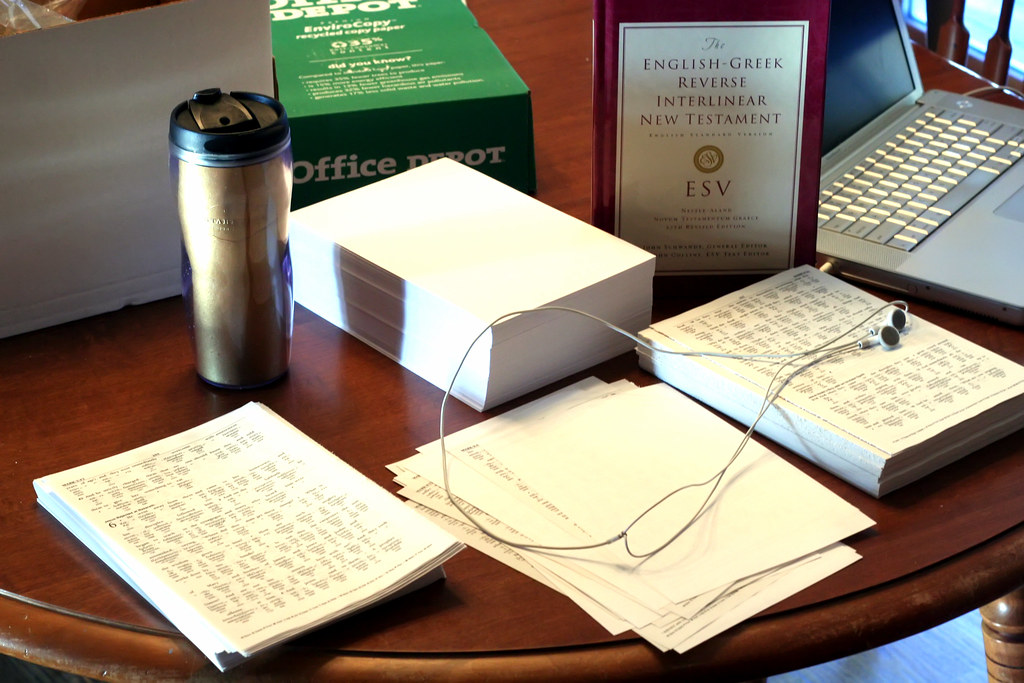
I usually set up something like this…

As you can see I have coffee and iTunes (these help deaden the painful shoulder cramps). To the back-center I place my stack of blank pages from the office supply store.

Closest to me I make three piles. To the right are the bible pages themselves. The middle pile is where I bring the blank pages and the bible pages together. With my left hand I pull down a blank page onto the pile and simultaneously with my right hand I flip a bible page from the right stack down on top of the blank page. When I’ve stacked 40-50 pages I neatly align them and stack them (without flipping them) to the pile on the far left. Because the bible paper is thinner than the blank pages, its necessary to occasionally take time to carefully align the pages together.

It’s important to always be aware of the binding edge of the bible pages. In the far right the binding edge is on the left. The middle pile its on the right. And on the far left stack its also on the right. The bible pages flow from right to left. From the first stack they are turned (like a book) onto the middle pile. But the stacks are not turned again when going from the middle to the left piles. In other words, page one of the bible would be on the top of the right pile, but the bottom of the middle and left piles. Make sense? Good.

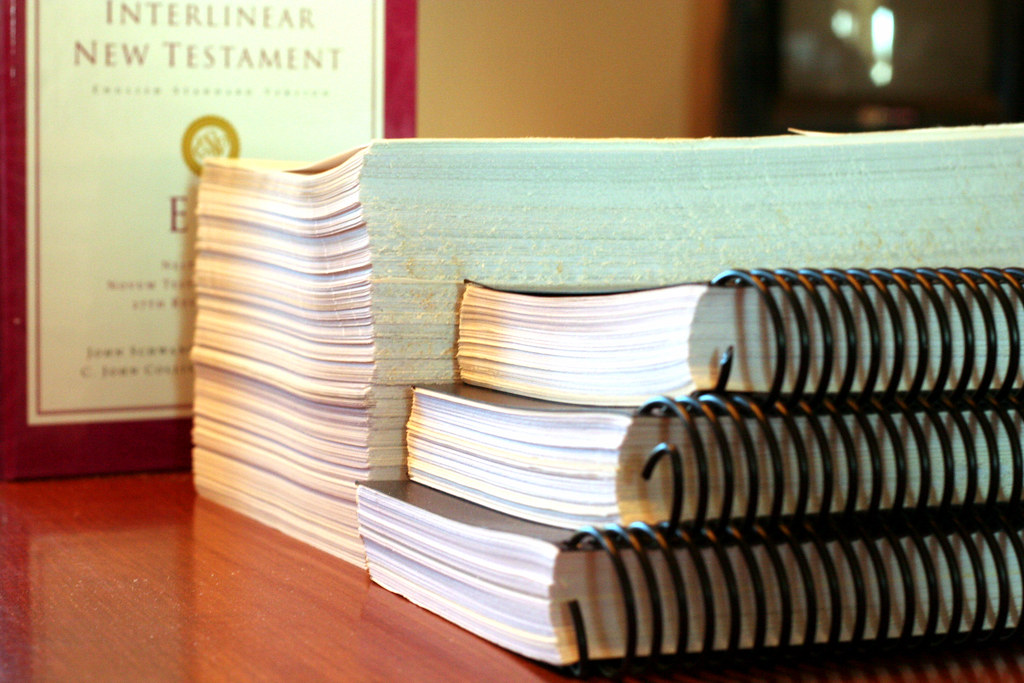
As you can see, the interlinear bible is going to be much larger than the 3 volume blank bible we made earlier. This will be a New Testament for the serious bible student!

It is awesome to know that God, through His Spirit, can fill every blank page through humble meditation as the “living and active” Word of God comes alive. Each blank page represents our anticipation that God will open up His Word to reveal more of the width and height and depth and length of God’s love in the Cross!

——————————–

Coming up next, the conclusion … DIY: Blank Bible (part 4) Punching and Binding