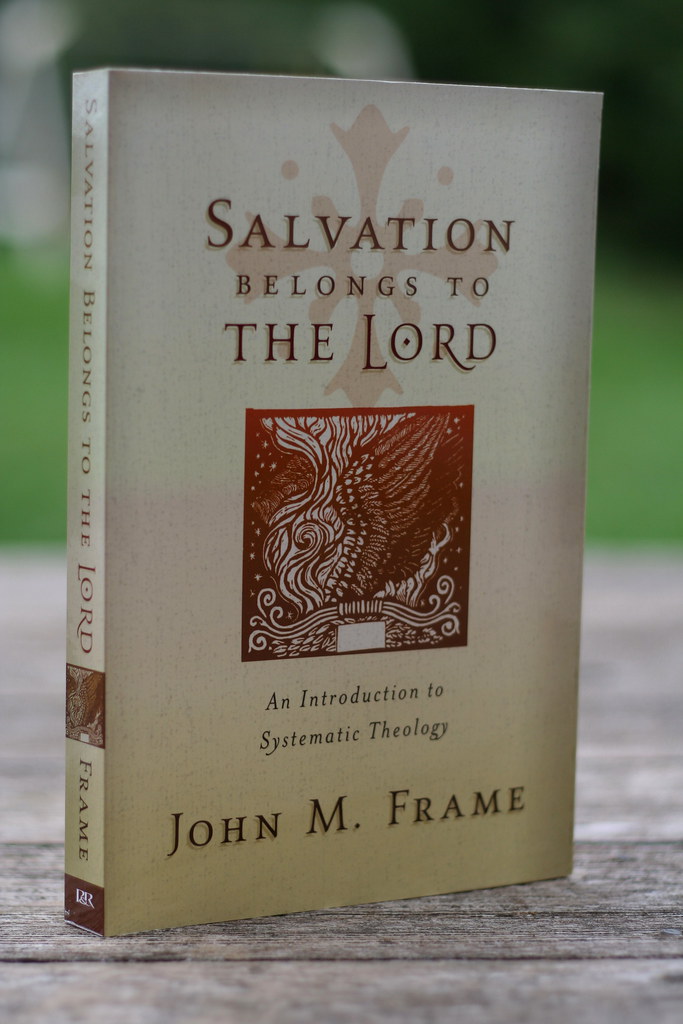
Book review: Salvation belongs to the Lord by John M. Frame (1596380187)

Book review:

Salvation belongs to the Lord by John M. Frame

God is in sovereign control. He has the right to tell people what to do and what not to do. He is powerful, wonderful, holy and awesome (in the true sense of the word). This big-God matrix frames everything else in John Frame’s new systematic theology, Salvation Belongs to the Lord.

Written in a warm, conversational, and engaging style for readers, Frame explains the main subjects of systematic theology. It is a great book for beginners, though the content is consistent with seminary level courses.

The content is very similar to Wayne Grudem’s, Systematic Theology. Frame considers Grudem “The best one-volume systematic theology written in recent years” (p. 351), and quotes him in many areas. The two however, do not agree on all things. Frame writes from a cessational perspective and Grudem from the charismatic.

The book is divided into two halves: (1) objective and unrepeated and (2) the subjective and the repeated. For example, the division is between the incarnation of Christ (unrepeated in history) and regeneration (repeated over and over in history with each believer).

I especially enjoyed the section on the church. He argues for a plurality of elders in each church, and his section on church discipline is very clear and helpful. Frame explains not only how to do church discipline, but why church discipline is important. He writes,

“There are at least three purposes of discipline. The first is to restore a sinning believer (Matt. 18:15; 1 Cor. 5:5; Gal. 6:1; 1 Tim. 1:20; James 5:20) … church discipline is not a cruel thing but a loving thing. Second, discipline exists to deter such sins by others, to instruct the congregation as to what is and is not acceptable (Heb. 12:15; 1 Cor. 5:2, 6-7; 1 Tim. 5:20). Third, discipline exists to protect the honor of Christ and his church (Rom. 2:24; 1 Cor. 6:6; Eph. 5:27). When churches ignore sin, the world despises them and the reputation of Jesus Christ himself is dragged through the mud” (p. 243).

This excerpt reveals the biblical depth, firm convictions, and pastoral concern of Frame in engaging and contemporary words. The entire book is marked with these characteristics.

The book is solidly reformed, quotes frequently from the Westminster Confessions, and uses the ESV translation. Frame is not shy about rebuffing falsehoods like Roman Catholic ‘justification’ and annihilationalism. He argues for padobaptism and sides with Postmillinialists. Frame displays a full awareness of the distinctions between errors that undercut the central tenants of biblical Christianity (justification) from secondary issues (like spiritual gifts and eschatology). He is strong and resolute on the first, and open and fair on the second.

John Frame has given us a wonderful gift. Such a high view of God’s holiness and Lordship; such a reminder of God’s presence with us; such an enjoyable read! I heartily recommend John Frame’s Salvation Belongs to the Lord.

Binding: Paperback
Pages: 383
Topical Index: yes (excellent)
Textual index: yes (excellent)
Bibliography: yes (excellent)
Photos: 0
Charts: 1
Reading level: Adult / moderate
Publisher: P&R
Price: $24.99
Where this book fits into my library:
(1) Systematic Theology > General

Salvation belongs to the Lord, John M. Frame, 978-1-59638-018-9, 9781596380189, 1596380187, 1-59638-018-7

Book review: Caleb’s Lamb by Helen Santos (1892777703)

Book review
Caleb’s Lamb by Helen Santos

The long-running children’s show Sesame Street once wrote and filmed an entire episode around Big Bird’s search for a real name. Every one else had names (Bert, Ernie, Oscar, etc.). But “Big Bird” is just a description, not a name. The episode never aired because the theme did not make sense to children. Isn’t “Big Bird” his/her/its name? Why search for another name? Doesn’t the old name work just fine?

Communicating to children is no easy task and yet is one of the most critical tasks for Christian parents. And this is because there are no more important (or often more difficult) concepts to explain to children than the substitutionary atonement of Jesus Christ.

Caleb’s Lamb by Helen Santos will help parents succeed in this task.

Set in the Old Testament era of the plagues in Egypt and the Passover, this 93-page chapter book is the story of a young boy named Caleb and his reluctant life as a shepherd. He does not like sheep and hates being a shepherd. The sheep are dumb and high-maintenance, and a burden for the young boy. One day a pregnant sheep wanders into the wilderness and Caleb is sent to find her.

After a dark night alone he finds the ewe dead. But hidden safely in a thatch of thorns he finds a newborn spotless lamb. He takes this weak and famished animal home. From here the book focuses around Caleb’s relationship with his beautiful new lamb.

In the end, word spreads to the shepherds of the coming exodus. God is coming to kill the firstborn male of every house. The race begins for the Jewish people in Egypt to sacrifice a spotless lamb as God’s judgment draws near.

Caleb’s Lamb is very well written. There are multiple themes throughout the book including life in Old Testament times, life as a shepherd, the often-repeated significance of Abraham’s near-sacrifice of Isaac, and especially the blood required to atone for sin.

The book was full of plot-line twists and vivid imagery. It will prove an excellent bedtime read for young children and a very helpful homeschool resource for older children. But most importantly, the book is filled with references to the substitutionary atonement of Jesus Christ in a storyline well-suited for children and useful for Cross-centered parenting.

Binding: Paperback
Pages: 93
Topical Index: no
Textual index: no
Bibliography: no
Photos: 0
Charts: 0
Reading level: Child. Great reading for younger children and written for an udience of readers in the 9-11 yr. category.
Publisher: Reformation Heritage
Price: $10.00/$7.50
Where this book fits into my library:
(1) Children’s books > Fiction > nature of the atonement
(2) History > Life in Old Testament times
(3) Shepherding > The nature of

Book review: Caleb’s Lamb by Helen Santos, 1892777703, 1-892777-70-3

The Puritan Study (Part 5) Print book searches

Part 5: Print book searches

We have spoken much about the Puritan literature; today we begin looking at real research. In the next post we will specifically cover e-Puritan searches, but today we are concerned with using printed Puritans.

Printed indexes

One of the most important resources available to the Puritan researcher are the printed indexes. This is true in both the works of a single author and in the Puritan index by Robert Martin (A Guide to the Puritans).

Thomas Manton

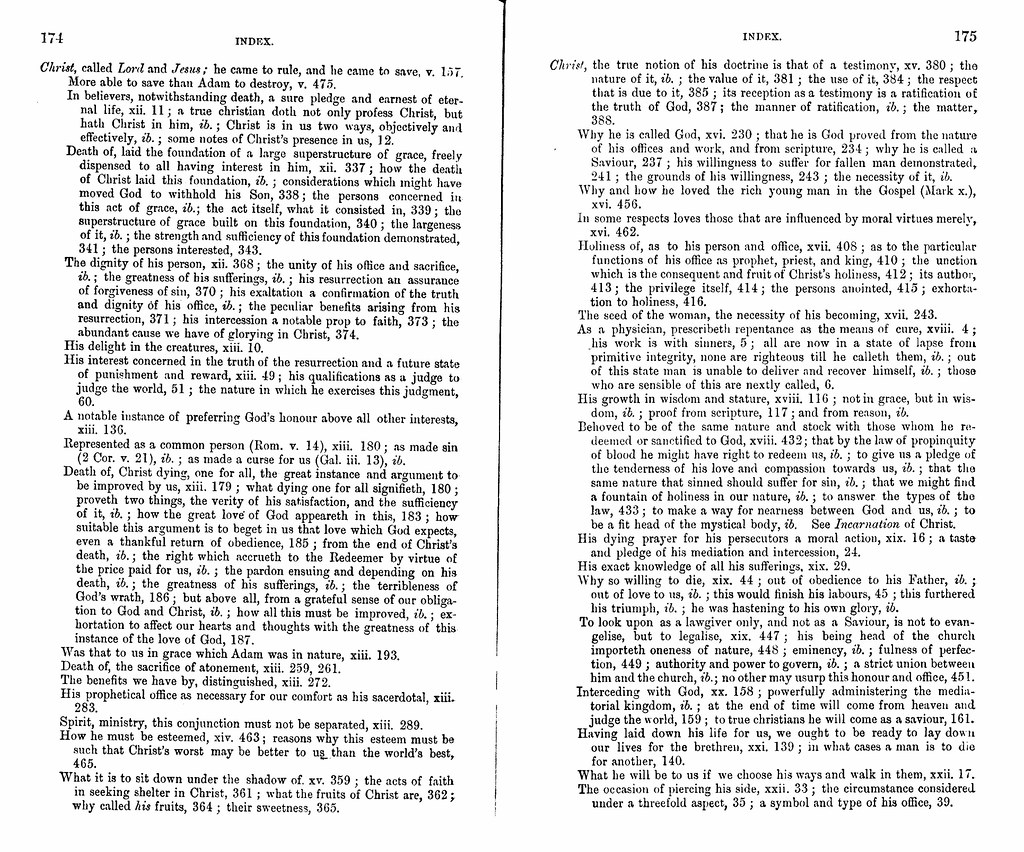
There are two reasons why Puritan Thomas Manton is my homeboy. First, his sermons are filled with rich exposition and pastoral warmth. When I really need a quote to convey a deeper truth, Manton is my source. And second, whoever edited his complete works did an incredible job (and an incredible service to preachers today) by including a detailed index. His 22-volume works (available on CD-Rom) conclude with over 300 pages of textual and topical indexes! A dream for the researcher.

From the screenshot to the right, you can see two pages from Manton’s topical index.

But Manton is not alone. The Complete Works of John Bunyan, Thomas Brooks, John Flavel and Richard Sibbes all come with excellent topical indexes.

Topical index

As an aside, I was speaking with a close friend recently who admitted that keeping a list of quotations was very difficult for him. One of the great difficulties to making an effective index of quotations is an inability to view an individual quote within the big framework. Some will read a quote about the power of the Cross without thinking how it would be properly indexed (ex. Christ > the Cross > effects of > power in believer).

To me, this is why the Puritans are liberating. Once you determine the general content of your sermon, you can go searching for great quotations! Surrounding yourself with quality Puritan literature will lessen the importance of a lengthy quote index.

As another example, I don’t have many quotations indexed on the sobering topic of God’s eternal judgment upon sinners. And I don’t need to. All I need to remember is that Jonathan Edwards preached a few incredible sermons (like Sinners in the Hands of an Angry God) and John Bunyan preached another very quotable sermon on the same subject (A Few Sighs from Hell). Allow a little time to read and soak these sermons in and you will have all the quotes you could imagine on the subject.

This makes the topical Puritan index by Robert Martin, A Guide to the Puritans, especially important. Because while I knew that Edwards and Bunyan preached on the subject of God’s judgment, I was unaware that John Flavel (3:129-153), Thomas Boston (8:347-375) and Thomas Brooks (5:113-145) had also preached important sermons on the subject.

The wealth of Puritan sermons make personal quote indexes unnecessary.

Back to Psalm 16:11

As we began in Part 4, we are researching Psalm 16:11 as an example. And in studying our text we have three avenues of research open to us with these printed volumes.

(i) Primary text as sermon text
. Of our 14 top Puritans, none preached sermons where Psalm 16:11 was their primary passage (Why not? I cannot say). If you are searching on a text and you find two or more sermons where your text is the primary text, you may have all the content necissary for your Puritan research. But our problem here is a common one. On Psalm 16:11 we will need to dig deeper.

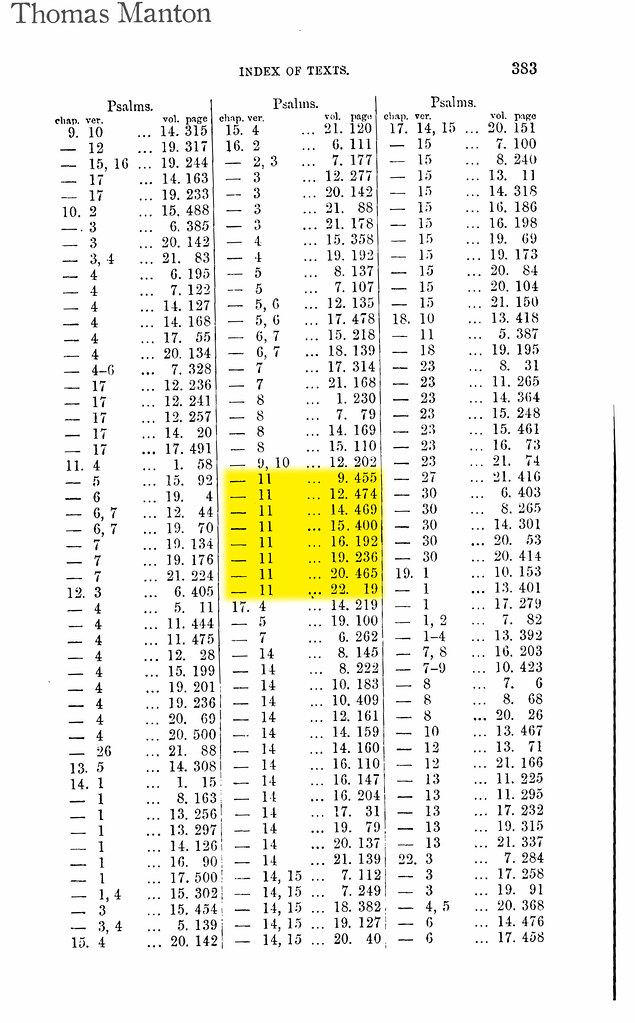
(ii) Primary text as indexed text. I will use the scripture index from Manton as an example. If you look to the screenshot to the right you will see that Psalm 16:11 was a topic of concern for Manton throughout his ministry. We see this especially in the following works in the following places: (volume: printed page) 9:455; 12:474; 14:469; 15:400; 16:192; 19:236; 20:465; 22:19. And these references come from just one of our 14 Puritan friends.

(iii) Cross-reference text as sermon text. If you need more information from the cross-references, follow the steps for (ii) except with other texts like Ps. 36:8.

You can use these principles on any text or topic study. Just find the biblical passages and track down the references in the scripture index or look up the topic in the topic index. The printed editions of the Puritan works remain important for these indexes.

Examples

Now a few references from Manton that I found as a result of my research.

Manton, 9:455 – “What can be found in the creature is but a drop to the ocean in comparison of what a believer findeth in God himself. God is to them an overflowing fountain of all felicity … Here (in this life) it admits of increase and decrease; but there the soul is so filled that it cannot receive any more: Ps. xvii. 15, ‘As for me, I will behold thy face in righteousness; I shall be satisfied when I awake with thy likeness.’ … In heaven the soul shall be filled with unspeakable joy and delight. What delight is to the sense, that joy is to the mind. Three things are necessary to delight – a faculty, or power of the soul capable of pleasure; and then the thing itself; which being brought to the mind, doth stir up delight. As in bodily things, colors, fruits, tastes, pleasure consists in the near union and conjunction of these things. The more noble the faculty, the more excellent the object; the nearer the conjunction, the greater the delight and pleasure. Now in heaven our faculties are perfected: God is the subject, and there is a near conjunction. Oh! What embraces between him and the soul!”

Manton, 22:19 – “The tree of life is gone, when paradise was defaced by the flood; but God hath provided a better life by the death of his Son, that we should live for ever, both in body and soul, eternally in heaven. Nothing else be this deserveth to be called life. The bodily life is short; it is a dying life or a living death. It floweth from us as fast as it cometh to us; but this never fadeth, but endureth for ever. The bodily life is subject to pain and misery, but the heavenly, full of joy and endless glory. The bodily life is supported with meats and drinks, but there God is all in all. The bodily life is consistent with sin, but this life is pure and perfect” (references to 1 John 3:2, Jude 2-4 and Psalm 16:11).

The options of what we now do with the quotations will be the subject of a later post. My point here is to show that it took just five minutes to find these two references from the works of Manton. I have six others references remaining in the works of Manton and another 13 Puritans I have yet to open.

By using these printed scriptural and topical indexes, it should be obvious that Puritan sermons provide the valuable depth we need in our sermon preparation.

—————
Next time … Part 6: Electronic searches.
—————

The Puritan Study (Part 4) Why our effective use of the Puritans begins with our Bibles

Part 4: Why our effective use of the Puritans begins with our Bibles

In this installment I will be showing you how the Puritans are made useful by our initial use of the bible. In the next two parts we will be looking more specifically at how to search printed books and then how to search electronic books.

Starting with the bible

The big problem with Puritan sermons is that most of us preach differently than the Puritans. They preached on one verse and often jumped all over scripture. We seek to preach through books of the bible and in 4-8 verses (or more) at a time.

A proper use of the bible is really one of the most important keys to unlocking the wisdom of the Puritans.

King James Version

Whether you use the KJV in your sermons or not, use of the Puritans requires an understanding of the KJV. No exceptions. The wording of this translation permeates all Puritan language.

Here is an example of how important the KJV is in Puritan research.

Psalm 16:11

I personally preach from the ESV. But when I study the Puritan sermons, I keep the KJV close.

For today, and in the following weeks, I selected Psalm 16:11 as the example passage we will be researching.

ESV Psalm 16:11 You make known to me the path of life; in your presence there is fullness of joy; at your right hand are pleasures forevermore.

KJV Psalm 16:11 Thou wilt shew me the path of life: in thy presence is fulness of joy; at thy right hand there are pleasures for evermore.

When we look at electronic searches, I will break these translation distinctions down a little more. But what is important here is to note the difference in language. First, the Puritans would not say “in your presence” (ESV) but “in thy presence” (KJV). And even the spelling is different (“fullness” vs. “fulness” or “forevermore” vs. “for evermore”). These may seem like small distinctions, but they make a huge difference in electronic searches. Being aware of this will greatly enhance your Puritan research accuracy.

Breaking the passage down

The Puritans often scatter biblical phrases in their works. So while the Puritans only preached on one text, by the time they were done preaching the sermon on that one verse, several dozen other references were been brought in. In other words, a sermon on Psalm 36:8 (“They shall be abundantly satisfied with the fatness of thy house; and thou shalt make them drink of the river of thy pleasures”) will probably reference Psalm 16:11 (“in thy presence is fulness of joy; at thy right hand there are pleasures for evermore”).

Before we find these cross-references, we need to break our sermon text into its various parts. In Psalm 16:11 I see three principles that are especially interesting to me …

KJV Psalm 16:11 (a) Thou wilt shew me the path of life: (b) in thy presence is fulness of joy; (c) at thy right hand there are pleasures for evermore.

(a) What is the nature of this path of life? Why does God have to show it to me?
(b) What does it mean to be in God’s presence? Can I live in His presence now?
(c) What are these pleasures forever? Can I find an illustration? Can I experience these pleasures now?

You may have many more questions but these are the three questions I will ask my Puritan friends as I study Psalm 16:11.

But we are not yet ready to invite our Puritan friends over.

Cross-references

I don’t use the Puritan sermons for their keen exegetical insights into the text (I let contemporary Hebrew and Greek scholars make those). My main use of the Puritans is for their explanation and application of broad biblical themes. They make concepts come alive in cross-referencing, illustration and application.

It is especially important that we find other biblical texts that say the same thing. The Puritans can make the same conclusion from many different angles using many different texts. Their one-text-at-a-time preaching style is misleading. The Puritans were experts at keeping the big picture in view and bringing in other passages from Genesis to Revelation.

Here are some cross-references that I believe will help me understand Psalm 16:11 better and will open up new paths in my Puritan research. I found them using the Thompson’s Chain Reference Bible and the Treasury of Scripture Knowledge.

(a) The path of life… Prov. 2:19; Prov. 5:6; Prov. 12:28; Matt. 7:14; Acts 2:28
(b) To be in God’s presence… Ps. 17:15; Ps. 21:6; Matt. 5:8; Eph. 3:19; Jude 24; Rev. 7:15-17
(c) The pleasures forever… Ps. 36:8

The Puritans

Now we are ready to search the Puritan sermons. From our observations of the biblical text we have four research options. Beginning with the most important to the least, here are the four research options in order.

(i) Primary text as sermon text. Example: A full sermon on Psalm 16:11.
(ii) Primary text as indexed text. Example: A sermon on Ps. 38:6 that references Ps. 16:11.
(iii) Cross-reference text as sermon text. Example: A full sermon on Ps. 38:6.
(iv) Cross-reference text as indexed text. Example: A sermon on Jude 24 that references Ps. 38:6.

Printed volumes are most helpful for my research in levels (i), (ii) and (iii). I can comfortably read a full sermon on a text (i and iii). And the text index at the end of a printed volume helps a lot in the search (ii). Electronic searches are helpful in all four, but especially in search (iv) when I want to search several resources quickly.

[Note: Often I have enough research material from searches (i) and (ii) that I don’t need to proceed into levels (iii) and (iv).]

Two searches

There are two types of searches … We can search printed works (or those .pdf picture files) and we can also perform electronic text searches. Depending upon your library, you may have more printed works or more electronic books (ideally we want both electronic files and the printed books together).

In the next two posts we will discuss the specifics of the print and electronic searches.

—————
Next time … Part 5: Print book searches.
—————

The Puritan Study (Part 3) The People of a Puritan Library

Part 3: The People of a Puritan Library

So far we’ve talked vaguely about some group of people named ‘The Puritans.’ Today we name names.

Like I said, this list does not include Puritan commentaries. You should consider getting Matthew Henry’s commentary on the bible. It is very useful and mature in its biblical application. And of course (Reformer) John Calvin’s commentaries are likewise valuable. Both are available in print for a reasonable price and online for free.

The list

I have used the following 14 Puritans in a number of situations but mostly in expositions. These men are faithful and trustworthy friends. I have been pushed deeper into scripture as these men faithfully expound and apply the bible. Many of their sermon illustrations have been reworded for my hearers. I have shared hundreds of quaint and beautiful quotations from these men. And I have personally been fed and refreshed as each of these men exalt in the glory of Jesus Christ, teach me to conquer (mortify) sin, and steer my affections away from the temporary and towards the eternal.

The Shepherd’s Scrapbook is proud to offer this list of Puritans (ordered by each author’s usefulness and availability. See pictures of these sets). …

1. Charles Haddon Spurgeon (63 sermon vols.; CD-Rom). Not a Puritan (obviously) but he is the great synthesizer of the best of the Puritan literature (see the Treasury of David for example).
2. Jonathan Edwards (2 vol. works; printed)
3. John Bunyan (3 vol. works; printed)
4. Thomas Boston (12 vol. works; printed)
5. Thomas Manton (22 vol. works; printed)
6. John Owen (16 vol. works; but especially vols. 1,2 and 6; printed)
7. John Flavel (6 vol. works; printed)
8. Richard Sibbes (7 vol. works; printed)
9. Jeremiah Burroughs (misc. books; printed)
10. Thomas Brooks (6 vol. works; printed)
11. Thomas Goodwin (12 vol. works; printed)
12. John Newton (6 vol. works; printed)
13. David Clarkson (3 vol. works; printed)
14. Edward Reynolds (vols. 1,4,5,6 of 6 vol. works; printed)

(Note: Spurgeon’s sermons work better in electronic format because of their sheer size and cost in print format.)

At the close of this series on building a Puritan Library, I will be reviewing each set in order to highlight the strengths. Plus, I will share a few tricks necessary to exhaust each of these incredible resources.

Honorable mention

The following Puritans are very helpful. However, these men are either poorly indexed or hard to find (or both). These include the works of William Ames, William Bates, Stephen Charnock, William Perkins, Samuel Rutherford and Thomas Watson.

The bottom line

The bottom line is this: God’s grace is magnificent. He alone allows the funding for these Puritans to be reprinted. He gives publishers the burden to print them today (although these efforts bring very little, if any, profit). He gives men like Robert Martin the generosity to share his Puritan index so we can all benefit from his work.

Before we consider the costs of such a library and the tricks to using one effectively, we should take time this weekend to thank God. His Spirit makes these ancient resources available so the Word can go out into the world today with the earnestness worthy of the Gospel.

————-
Next time … Part 4: Why our effective use of the Puritans begins in the bible
————-

The Puritan Study (Part 2) The Rules of a Puritan Library

Part 2: The Rules of a Puritan Library

In the remaining weeks we will be spending a lot of time discussing how to efficiently use the Puritans. In this and the next post, I want to take some time to define what a solid Puritan library looks like. Today we lay the ground rules for what follows.

It is my view that the most useful Puritan Study (or Library) will be well-indexed and use both printed volumes and electronic files.

E-books vs. Print books

Open this question, and memories of Ali vs. Frazier or Tyson vs. Holyfield come to mind. Debate whether the Puritans will endure in e-books or print books, and the two sides strap on the gloves and enter the ring for a showdown.

Let’s step back from the debate and make some clarifications.

No question, the computer has changed the way we pass words around. More and more Puritan books are being scanned into .pdf format for use on a computer, and many of these are being converted into text files for easy searching.

Here’s a little more info about the two types of electronic Puritan books commonly available today.

PDF picture files. Some electronic publishers take the Puritan texts and scan them into a computer as a picture file. The pictures can be seen on your computer and are an identical copy of the book page. Usually these are not text-recognized so you cannot conduct a text search or copy and paste. These files are very common with the Puritans but they also make for large and cumbersome files. (My powerful Apple PowerBook G4 can hardly keep up with a 100 MB file off the hard drive.) So unless you have the most powerful computer on the market, it is hard to efficiently use these large .pdf files.

Text files. These are more rare because they demand careful editing of the raw text. The raw text is generated by a computer deciphering words from the printed page through a scan of the page. Because many Puritan books are old editions, the computer doesn’t perfectly transcribe the words and so time-consuming editing is critical. This text file makes for much smaller and convenient file. But even better, they are searchable. There is a growing collection of these files freely available at www.CCEL.org . The Puritans are in the public domain so anyone can scan and distribute the texts freely. More about that later.

Back to the ring. Who is going to win the fight? The old dusty volume or the energetic young e-book? If we look at e-books and print books honestly, we see that they are more compatible than at first glance. In fact, I would argue that e-books and print books make a better matrimonial match than a boxing match.

For example, print books travel easily. A volume travels in the airport and across the country, without plugs or electricity. You can underline in it and write marginal notes. On the other side, the e-book text can be searched in seconds. But who spends hours at their computer reading through a Puritan e-book? (Ouch, my eyes water at the thought.) Print books are much easier to read. Print books usually include very helpful indexes at the end and since e-books are often repaginated, those indexes become worthless in text files. With e-books, I can keep hundreds of volumes on my laptop when I’m out of town.

My point: We need both e-books and printed books. Let them live in peace.

One example

Probably the best example I can give you is my use of the 2-volume Works of Jonathan Edwards. (No preacher should be without them, Martyn Lloyd-Jones said.) And no preacher should be without the free text files either.

The two work beautifully together. The text file is easy to search and the print volume is nice to read.

Let’s say we are preaching through Ephesians chapter 2, and we want to see what Edwards had to say. We open the text file to the first volume. And since the text file uses Roman numerals we do a quick search on “Eph. ii.”. We see there are 35 references to Ephesians 2 in the first volume of Edwards’ Works in about 3 seconds.

The reference you see on the screen shot looks like an interesting one. Notice this text file (from the CCEL) includes the printed page number in the left column. I open the Banner of Truth volumes in my library to page 628. Where was this reference by Edwards? A sermon? A book? What was Edward’s main point in using Ephesians 2 here? These questions are more easily answered by reading the printed book.

Wasn’t that easy?

Now here is the shocker: I personally believe e-books actually make the printed books MORE valuable! They certainly make the printed volumes more useful. [One idea: Puritan publishers should consider bundling their printed volumes with a free CD of electronic volumes.]

Remember Thomas Edison who invented the phonograph (‘sound’ + ‘writing’) in 1876? Well Edison proudly predicted that by the year 2000 audio books would eliminate the need for printed books. He was wrong. Printed books, like diamonds, are forever.

Q: Should I pay for Puritan CD-Roms?

Generally speaking I say “No,” don’t buy Puritan CD-Roms. As you will see there are exceptions to this rule but most Puritans are going online at an amazing rate. Just look at the files available on Puritan John Owen from CCEL (here). And all these are free.

Because almost all of the Puritans (including Spurgeon) are public domain, nobody has the rights to the text itself. Anyone can take the text and publish them as they wish. And that is what people are doing online.

Wait patiently. Pretty much all the important Puritan files you see on these expensive CD-Roms sets will be available for free (and in searchable text form) in the coming years. So if you own the CD-Roms already consider unloading them on Ebay while they still have value. Invest your money in printed books.

Indexes

Indexes are the key to the Puritan Study I am laying out before you. I don’t have the time to sift through 100,000 pages of Puritan literature to create my own index (and I’m certain you don’t either). So the best Puritan Study will be built from the indexes currently available.

The following two indexes are especially valuable. (Ironically, one is electronic and one printed.)

1. A free online index. This index lists the Puritan sermons by sermon text. It’s especially valuable because it includes an index to the sermons of Charles Spurgeon. There is no topical index. Later in the series I’ll show you how to get around this hitch.

2. A Guide to the Puritans by Robert P. Martin (Banner of Truth, 0851517137). This volume comprises two indexes (by text and by topic). Like the free resource above, this book is a handy textual reference to the Puritan sermons (minus Spurgeon). But what makes this especially valuable is the topical index of the sermons. You can look up any topic – like ‘Christ > Pre-incarnation existence of’ – and see that both Flavel and Manton preached sermons on the subject. No true Puritan researcher should be without this volume.

So these are the ground rules for my Puritan Study. I value both the e-books and printed volumes. And a good index is critical.

Tomorrow we will look specifically at the most useful (and best indexed) of the Puritans.

————-

Next time … Part 3: The People of a Puritan Library

————-