Interview: Leland Ryken on the ESV LSB

IMG_7009.ed.jpgInterview with Dr. Leland Ryken

WHEATON, IL — Last Thursday afternoon I walked across the campus of Wheaton College and up the stairs of Blanchard Hall for a rare opportunity to sit down with a favorite contemporary author, Dr. Leland Ryken.

Ryken serves as the Clyde S. Kilby Professor of English at Wheaton College. He has written many excellent books, but especially The Word of God in English: Criteria for Excellence in Bible Translation (Crossway: 2002), which carefully critiques contemporary translation philosophies and builds a strong case for literal translations like the ESV. It’s an excellent, pointed book that remains on a short list of my personal favorites. Ryken also served as Literary Stylist on the ESV translation committee (more on this later).

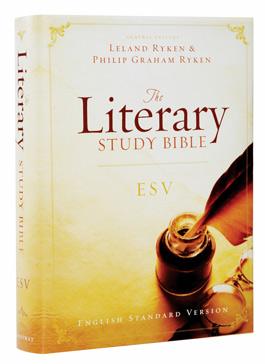
Ryken’s son, Dr. Philip Graham Ryken, is a prolific author, pastor, and preacher. Together with his son, Dr. Ryken edited the soon-to-be-released ESV Literary Study Bible (read our full review here). The LSB was the focus of our interview.

1. Thank you for your time, Dr. Ryken! … Where did the idea for The Literary Study Bible originate? Has this been a long-awaited project?

2. Explain for us the essential features that distinguish a literary study Bible?

3. There are a number of contemporary translations seeking to paraphrase the Bible and make it easier to read. You have confronted the dangers of this methodology in The Word of God in English. Is the LSB, in any way, a response to these contemporary translations in showing that a literal translation can be effectively used by general readers without a paraphrased text?

4. How will the LSB benefit the preacher, especially in expositional preparations?

5. You state in the LSB, “The goal of literature is to prompt a reader to share or relive an experience. The truth that literature imparts is not simply ideas that are true but truthfulness to human experience.” Explain further how the literature of Scripture invites us to experience Scripture.

6. Can you give us some specific, concrete examples of this?

7. What differentiates the LSB from other available study Bibles? And how will general readers benefit?

8. Quite obviously, the Psalmists, prophets, and other authors of Scripture did not write using a literary guide to genres. Much of the literary discussion in the LSB draws from a host of modern literary terms to interpret the ancient literature of Scripture. How do you defend this approach?

9. In the past, Bibles have been effectively used in home schooling education. Can the LSB be used as a textbook of sorts to learn literary genres, styles, and forms?

10. Some readers, I’m sure, are unaware of your role in the translation of the English Standard Version itself. Explain this role for us.

11. Now the ESV LSB is complete, and serves as a culmination of your translation efforts and literary commentary efforts. It must be quite fulfilling to see this Bible together and completed.

Thank you, Dr. Ryken, for your time. Congratulations to you and your son on the completion of such an incredible project. The ESV Literary Study Bible will greatly bless the Church by helping us read Scripture more competently for ourselves. Is there a more precious gift from the career of a literary scholar?

Blessings to you and your future ministry!
IMG_7026.ed.jpg

———–

Related: Read our full review of the ESV Literary Study Bible here. Also, from our day-long trip to Wheaton, Illinois (Sept. 13, 2007) we photographed our way through Crossway Books and Justin Taylor’s office (see here) and visited two local museums (see here).

Photo tour through Crossway Books

tss-road-trip.jpgWHEATON, IL — Behind the books on our shelves are dozens of visionaries, writers, editors, graphic artists, printers, and marketers hard at work. One goal of The Shepherd’s Scrapbook is to introduce the people and organizations behind the books.

This Spring we traveled to Pennsylvania to see the American office of the Banner of Truth Trust. Another favorite publisher is the Good News Publishers or Crossway Books — or simply known as the ones who publish the English Standard Version. Look on your shelves and count how many Crossway books and Bibles you own. Likely you have a bunch. These originate in Wheaton, IL.

And 2007 looks to be a monumental publishing year for Crossway. Along with the ESV The Literary Study Bible edited by Ryken and Ryken, our friends have produced The Reformation by Stephen Nichols, Sam Storm’s two excellent books Chosen for Life and Signs of the Spirit and will soon be printing the edited version of Communion with the Triune God by John Owen. Yet this Fall and Winter we look forward to John Piper’s response to N.T. Wright on justification, and the American edition of a great book published in the U.K. earlier this year — Pierced for Our Transgressions by Steve Jeffery, Michael Ovey and Andrew Sach. Each of these volumes (and several others) are grand accomplishments.

Crossway / ESV

The Crossway office and warehouse are within walking distance from the SE corner of Wheaton College, across a set of very busy train tracks. The office and warehouse are housed in one building. In many ways, the interior of the building is reminiscent of a church building with dark brick, embroidered cloth banner, tall ceilings and many windows. The main level perimeter offices are large, bright and with open ceilings.

IMG_7007.ed.jpg

IMG_6998.ed.jpg

Last Thursday morning I had the joy of joining the Crossway staff for chapel, a time to give thanks to God, reflect on His grace, and to pray for needs (both personal and professional). The various Crossway authors at work and under deadline were prayed for specifically. The chapel service brought a surprisingly personal context for all the other publishing work and revealed a community of editors caring for their writers and one another beyond the business context.

Warehouse

Crossway books are printed off-site, but warehoused on-site. I took the camera back for a few shots of the warehouse operations. You can see the line where orders are filled. As with the Banner of Truth, all noticeably damaged and defective books are pulled from circulation. Both publishers are perfectionists.

IMG_6989.ed.jpg

IMG_6988.ed.jpg

IMG_6987.ed.jpg

IMG_6981.ed.jpg

IMG_6985.ed.jpg

Justin Taylor

Justin Taylor is the main reason I came over to Crossway. Justin is a busy editor, writer, and blogger. His official duties center around editing the ESV Study Bible due out late next year and his blog, Between Two Worlds, is considered one of the best on the Internet (one I check daily and highly recommend).

IMG_6961.ed.jpg

Justin Taylor has also edited many books, including new versions of John Owen with Dr. Kelly Kapic (Overcoming Sin and Temptation and Communion with the Triune God). Communion is due out in mid-October, so Justin’s work has been especially busy. His diligent labors are amazing, considering he works 9-5 on the ESV Study Bible and his other writing projects (like Communion) are completed in his personal time in the evenings!

A proof of Communion sits on his desk with some final edits before it’s printed.

IMG_6958.ed.jpg

IMG_6959.ed.jpg

IMG_6979.ed.jpg

Justin’s office is on the main level and has no ceiling. He has a modest library on hand and has minimal decorating (please leave decorating ideas for Justin in the comments).

IMG_6972.ed.jpg

IMG_6974.ed.jpg

IMG_6992.ed.jpg

Justin blogs, edits and emails with his John Owen coffee mug handy. His monitor is lifted with two ESV Bible boxes, a copy of The Book of Great Books and a hardcover ESV. His timeliness can be attributed to a nifty Dunder-Mifflin calendar.

IMG_6967.ed.jpg

All Justin’s emails and calls are screened by his personal office assistant, Dwight Schrute.

IMG_6971.ed.jpg

Conclusion

Obviously, I captured only a few highlights. It was great meeting Lane Dennis, the man behind Crossway (sorry, no pics). But it was also great to see Crossway behind the scenes and the humble prayerfulness of editors coming together at the throne of mercy.

Time is running short and I have one final stop. Back at Wheaton College campus I walk up to Blanchard Hall to meet Dr. Leland Ryken. …

IMG_7002.ed.jpg
————-

Related: Photo tour of Banner of Truth warehouse in Carlisle, PA (here).

Interview: Derek Thomas on John Owen

tss-interview.jpgJohn Owen and Communion with the Triune God
Interview with Dr. Derek Thomas

What comes to mind when you think of communion? Bread, wine, and religious ordinance? The following interview is for fellow 21st century pilgrims unfamiliar with the term ‘communion’ and specifically ‘communion’ with God.

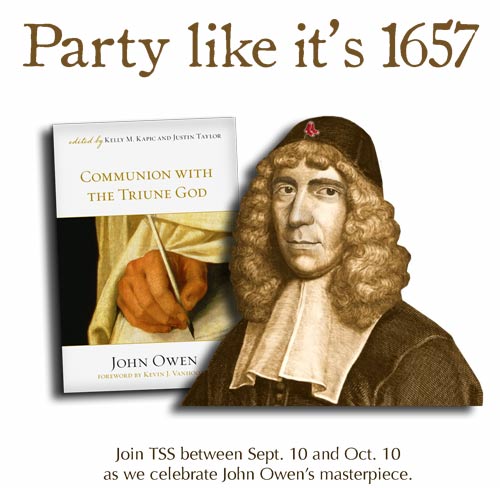
October 12th is the scheduled release date of Justin Taylor and Kelly Kapic’s newest volume in the writings of Puritan John Owen, Communion with the Triune God (Crossway: 2007). Communion was first published in 1657. The original edition is in the public domain, has been printed in various shapes and sizes, and is available for free online. In the past 50 years this work has been known as the second volume of The Works of John Owen (Banner of Truth).

The 2007 Crossway edition includes several enhancements like helpful indexing, introductions, extensive outline and glossary. Owen’s work has never been more accessible for readers (see our review here).

IMG_3036.ed.jpgFor the next month we are taking some time to highlight Owen’s masterpiece. Today we talk with Dr. Derek Thomas to discuss John Owen and better understand communion with God.

Introduction

Dr. Thomas is from Wales and currently serves as John E. Richards Professor of Systematic and Practical Theology at Reformed Theological Seminary in Jackson, Mississippi. After pastoring for 17 years in Belfast, Northern Ireland, Dr. Thomas returned to the United States in 1996 and also serves as the Minister of Teaching at First Presbyterian Church in Jackson. He has lectured extensively on Owen (listen to his lectures on Owen here).

TSS: Dr. Thomas, it is always an honor to have you join us here on The Shepherd’s Scrapbook! Being a scholar of John Owen and well-acquainted with his works, what are your initial thoughts of this classic, Communion with the Triune God?

DT: Thank you, Tony. It is a great honor for me to join you here at The Shepherd’s Scrapbook. It is one of my favorite sites to visit.

I am also delighted to speak about John Owen. Along with John Calvin, he has been the most influential theologian in my life (at least, among dead ones!). I think I “commune” with him most days about something. That’s the great value of books. The authors may have died, but their writings live on.

I’m as excited as you about the forthcoming publication of Communion with the Triune God, after the splendid job they did with Overcoming Sin and Temptation (Crossway, 2006).

What comes to mind about Owen’s volume, Communion with the Triune God, is its essential Trinitarianism. Owen does a number of things that are important for us to see.

First, he is thoroughly indebted to Calvin and the Fathers in his Trinitarian theology. In an age when the church would find it difficult to expound the Trinity in any meaningful way, Owen assumes a line of theological continuity from the early centuries to his own day (thereby removing the charge made by Rome that Protestantism was ‘new’ and therefore suspect). He cites, for example, the classic formula of Augustine that the external acts of the Trinity cannot be divided (opera ad extra Trinitatis indivisa sunt) without any embarrassment! And, if my memory serves me correctly, we’re only a few pages into the volume!

The second thing about this volume is not only its catholicity (linking with the Fathers), but its centrality. In focusing on the believer’s fellowship with God (Father, Son and Holy Spirit), Owen is picking up what Calvin had insisted lay at the heart of the all theology – union with Christ. Owen is doing so in a more overtly Trinitarian fashion than perhaps Calvin did; but he is bringing to surface what is at the heart of God’s covenant relationship with redeemed sinners. In doing so, of course, Owen can’t help but be experiential in his theology. In that sense, Owen is a perfect example of the puritan oeuvre.

TSS: At first glance of the title people may confuse this book as a long work on prayer or the spiritual disciplines. Or it may be shelved in bookstores with purely subjective books on how to experience some divine warm-fuzzy. Communion with the Triune God is very unique. What does Owen mean when he talks about “communion”?

DT: This is a really good question! And if the publication of this volume can do something to displace these unhelpful books to which you refer, then all the better for it!

Why is the reformed church so confused about reformed spirituality? This is where a volume like Owen’s Communion with the Triune God is so valuable at this present time.

Owen has a fairly complicated view of what communion in this context means. It begins with the idea of what “communion” or “fellowship” in Greek (koinia) means: to share in common with. This raises some important theological (and practical) distinctions: union and communion are not synonyms for Owen. Our union with Christ, brought about by God’s initiative and covenant. It introduces into a status from which flows (as fruit) communion with God. Kelly Kapic summarizes it this way:

  • God communicates of himself to us.
  • Union with Christ establishes our relationship with God.
  • The resulting overflow of union is our returning unto God what is both required and accepted by him (i.e. communion). [endnote 1]

The union with Christ is brought about unilaterally; the communion on the other hand is a bi-lateral issue. Our communion with God can be affected by our sin, unresponsiveness, and especially neglect of the ordinary means of grace.

It is Owen’s Trinitarian emphasis, based to be sure on a disputed text (1 John 5:7), that enables him to expound a multi-faceted dimension to communion. Communing with the Father helps us appreciate the nature of love and reciprocate it; fellowshipping with the Son helps us appreciate and reciprocate grace; fellowshipping with the Holy Spirit encourages assurance as he draws us back to the embrace of Jesus Christ offered to us in the gospel of the Father’s love.

TSS: Communion with the Triune God is rightly hailed as a masterpiece on the Triunity of God. Why is this Triune distinction important in Owen’s understanding of communion?

DT: I have preempted this question somewhat already. But allow me to narrow the focus a little.

The obvious place to begin is to state that for Owen God is Trinitarian in nature. The only fellowship with God that is possible is with the entirety of the Godhead and therefore with each Person that constitutes the One God. If the place of any of the three persons is misconceived or denied, the gospel falls. Thus Jehovah’s Witnesses or Mormons or liberal Protestants who deny the Trinity as empty verbiage can never state the gospel properly because their view of God is all wrong.

The gospel in both its accomplishment and application involves a salvation planned, an atonement made and a salvation applied and none of these are possible apart from the work of all three Persons. For Owen, then, communion with all three keeps the gospel straight and the Christian life in good shape. From it flowed all manner of issues relating to the assurance of salvation – too often argued subjectively without recourse to the nature of salvation itself.

TSS: I’ve watched enough YouTube videos to notice that a large segment of professing Christianity in America dogmatically assert that Christianity is a relationship whereas theology is peripheral. For Owen, experiencing God personally and knowing God accurately are inseparable. Can you explain further how this is revealed in Owen’s thought and why this is important for us to grasp today?

DT: I’ll have to take your word about YouTube, but it is time for us to announce a Declaration of War against the creeping influence of Schleiermacher on modern evangelicalism.

I draw your attention to an essay by Carl Trueman called “John Owen as a Theologian” in a volume of essays on Owen, John Owen: The Man and His Theology (P&R and EP, 2002). These were lectures delivered at a conference on Owen in 2000. It says everything that needs to be said, first of all, about Owen’s distinctive theological emphases, and secondly why theology must be in the service of the experiential and not vice versa.

Owen was no different here than his Calvinstic predecessors, or for that matter, John Calvin himself. From Calvin’s opening sentence of the Institutes, which declared that nearly all the wisdom we possess consists in knowing God and knowing ourselves, comes the distinction that knowledge of God is more than knowing about God. There is a difference between knowledge by description and knowledge by acquaintance.

I had a student in my office recently who obviously loves Sinclair Ferguson. He had listened to what sounded like hundreds of Ferguson’s taped messages. I listened with interest and then (half anticipating the reaction), I said with cool detachment, “I’ve known Sinclair for 30 years and he’s a close, personal friend.” There was an awed silence! “Really!”

Well, Owen would say, Christians brought into a saving relationship with God through faith in Jesus Christ can say, “I know God – personally.” True, the descriptive “personally” is a modern one and not one the seventeenth century would have employed in quite the same way, but the intent is precisely the same.

For Owen, as for Calvin, there is no sense in trying to talk about knowing God by experience if we don’t know how to articulate who God is! The only God there is has revealed himself to us in creation and providence, but supremely in the Scriptures and in his Son’s incarnation. But to have those things clear in our minds and be able to articulate them is not yet to know God. To know God, cognitio Dei is relational knowledge, knowledge that comes to us, in the relationship of faith.

TSS: You mention the “personal” aspects of a relationship with God would have been stated differently by Owen and the Puritans. Explain this further. How is this differently stated? Why?

DT: Well, forgive me, but I think we tend to use the word “personally” in some quasi-therapeutic sense, often at some disparagement to anything cerebral or structured. The puritans adopted (on the whole) a very definite faculty-psychology in which the mind must govern the will and the affections. Personal knowledge of God comes through the integration of this faculty psychology and through some back door to the heart.

TSS: This is very helpful in light of earlier questions. Thank you! … Owen seems to balance well an understanding of our Father who remains transcendent, majestic and holy but for the saint is also their loving, adoptive Father who “from eternity … laid in his own bosom a design for our happiness.” Owen calls us to “rejoice before him with trembling” and of course says if we don’t understand the deep love of the Father we will not draw to Him in communion. Owen writes, “So much as we see of the love of God, so much shall we delight in him, and no more. Every other discovery of God, without this, will but make the soul fly from him; but if the heart be once much taken up with this the eminency of the Father’s love, it cannot choose but be overpowered, conquered, and endeared unto him” (p. 128). How does Owen excel in this theme of communion with the Father?

DT: Of course, ravishing as this language is, it should be recalled that Owen is expounding the Father’s love for us employing the Song of Solomon (Canticles) as background. This was typical of the puritans as a whole to view the Song as an allegory of salvation.

Owen is dealing with a surprisingly modern problem at this point: that in communing with Jesus it is all too possible to draw the conclusion that whereas the Son loves us, the Father is angry with us. From such a distorted view emerges a misshaped view of the gospel, of course. Jesus has no need to make the Father love us because his coming into the world is evidence of it. The Father is the “fountain” or “source” of love.

“Though there be no light for us but in the beams, yet we may by beams see the sun, which is the fountain of it. Though all our refreshments actually lie in the streams, yet by them we are led up unto the fountain. Jesus Christ, in respect of the love of the Father, is but the beam, the stream; wherein though actually all our light, our refreshment lies, yet by him we are led to the fountain, the sun of eternal love itself. … (Communion with the Father) begins in the love of God, and ends in our love to him” (2:23-24).

TSS: That’s a helpful quote that captures Owen well. Thank you! … A year ago I interviewed Kris Lundgaard, an author who has taken John Owen and rewritten his books for contemporary audiences. He said he was surprised that sales of his book on overcoming sin (The Enemy Within) far outsold his book on the beauty of Christ (Through the Looking Glass). This was to him a surprise because seeing the glory of Christ is critical in the fight against sin (2 Cor. 3:18)! It’s likely that the overtly practical Overcoming Sin and Temptation from last year will outsell Communion with the Triune God (or any other Owen titles for that matter). What are the practical implications of Communion with the Triune God to the mortification of sin and the pursuit of holiness?

DT: Well, there’s no way I can come up to Kris standard, but I along with others am so grateful for his love for Owen and his publication. He manages to make Owen appear user-friendly to those who might otherwise be intimated.

I think I can understand why a volume on mortifying sin and dealing with temptation outsells because we all feel the need for help in this area. But perhaps this is a reflection of what another theologian-preacher once called, “sanctification by vinegar,” meaning we are sometimes forced into a set of behavioral responses by the fear of being caught or the being punished rather than because we have a desire to do it.

Only by a grasp of the true nature of God and the delights of communing with him can we really respond in the way we should. Owen, as all good theologians of Paul, observed what we might call gospel grammar. The imperative must follow the indicative. Holiness follows from what grace has reckoned us to be in Christ. What this volume does is tell us who we are. It solves the identity crises which sin can so easily bring. The volumes ought to be read in that order – Communion with the Triune God followed by Overcoming Sin and Temptation. It would be the Bible’s way.

TSS: Dr. Thomas, I love this: “What this volume does is tell us who we are”! This is a helpful observation on the importance of Communion with the Triune God. … Again, thank you for joining on TSS. You are a valued friend in our ministry. Blessings to you!

—————

Related: Read our full review of Communion with the Triune God.

—————

[endnote 1] Kelly Kapic, Communion with God: The Divine and the Human in the Theology of John Owen [Baker Academic, 2007], 157.

ESV Literary Study Bible

tsslogo.jpgBook review
ESV The Literary Study Bible
edited by Leland Ryken and Philip Graham Ryken

Some of the best Christian scholarship aims to unfold the beauty of Scripture for general readers. The new ESV Literary Study Bible is one excellent example.

Editor Dr. Leland Ryken is a top-notch literary scholar, noted for his many books (like a personal favorite The Word of God in English) and his work as literary stylist for the ESV. His son, Dr. Philip Graham Ryken, is a noted author and preacher known for excellent books like The Doctrines of Grace.

Together, their work has produced a masterful study Bible.

Size, price, purpose

tssesvlsb.jpgThe printed ESV LSB will be available on Sept. 14th 23rd in a hardcover format, 6×9 inches in size (slightly smaller than the reverse interlinear and slightly larger than the classic reference edition) and nearly 2,000 pages in length (700 pages longer than the reverse interlinear and classic reference edition). The LSB will retail for about $50.00.
The twofold goal of the ESV Literary Study Bible is clearly stated, “(1) to make the Bible reader friendly and (2) to show how application of literary tools of analysis helps in reading and understanding the Bible” (xvii).

We’ll look at each goal individually.

Scripture as Literature

The premiere benefit of the LSB is viewing Scripture as literature, without reducing Scripture to the level of mere literature. In Leland Ryken fashion, rebuttals are given to show that viewing Scripture as literature (1) does not show a liberal bias, (2) reinforces Scripture’s view of itself as literature, (3) does not reduce Scripture to fiction, (4) does not reduce Scripture to another mere piece of literature, (5) nor deny the inspiration of Scripture. In fact, the editors argue that an accurate interpretation of Scripture first requires an understanding of the many literary features of Scripture.

“To approach the Bible as literature as this literary Bible does is not like dessert — something pleasurable to add to more important aspects of the Bible. The literary approach is the first item on the agenda — the starting point for other approaches to the Bible. This has been a point of neglect among Bible readers and Bible scholars that this literary Bible aims to correct” (ix).

Because, the editors make clear, “meaning is conveyed through form, starting with language itself but moving beyond that to a whole range of literary forms and genres” and “There is no meaning without the form in which a piece of writing is expressed” (vii). Forms directly impact interpretation.

The number of identifiable biblical genres in Scripture “readily exceeds one hundred” and that does not include archetypes, motifs, styles, rhetoric, and artistry (x). Scripture is a wonderfully diverse collection of literature with great variety. None are better qualified to bring these to the surface than Leland Ryken.

But this study Bible does not require an advanced degree in literature. Every term from “antithetic parallelism” to “dramatic monologue” to “theophany” is defined in the 17-page glossary of genres and literary terms.

Perhaps, like the Self-Interpreting Bible by John Brown of Haddington in the 18th century, this ESV LSB will become a primary literature text in homeschool education? Something to consider.

Reader-friendly

The goal is not to weigh the reader down in definitions and genres, but to provide helpful guidance for the reader to comprehend large swoops of biblical text. Many features make this an excellent reader’s Bible.

1. Format. The ESV text is single-column, black text set in 8.5-point Veritas font. Very clean and easy to read.

2. Introductions and overviews. Each book of Scripture receives a detailed introduction and content overviews. The overall literary genres and styles are summarized at the beginning. Ryken and Ryken bring great balance between the literary context and the content/outline of Scripture. We’ll see this later.

3. Subsection prenotes. Before each subsection of Scripture (normally one chapter in OT and every half chapter in NT), the editors provide important literary notes and an overall snapshot of the upcoming content. These are like prenotes, compared to the footnotes common in study Bibles. These prenotes peak interest and drive the reader into the text. “This literary Bible is a guide to the Bible that pushes the reader into the text instead of providing mere summaries of the content that readily become substitutes for reading the Bible” (xvii). These chapter notes reinforce the literary styles mentioned in the book introductions, provide overviews of upcoming Scripture content, and function well in helping the reader chomp through large sections of Scripture in single settings.

4. New reading plan. The annual reading plan of the LSB is quite innovative. The daily readings include one section from each of the four categories: Psalms and Wisdom Literature; Pentateuch and the History of Israel; Chronicles and Prophets; and Gospels and Epistles. But four important books – the Psalms, Isaiah, Luke and Romans – are read twice annually! The readings through the OT are arranged chronologically, and the NT readings by author. For example, readers progress from the Gospel of John to 1 John, 2 John, 3 John and conclude with Revelation.

5. Designed for group study. The LSB was designed purposefully for group studies. As stated in the introduction, the editors intend to help discussion leaders formulate application questions. The reading schedule, literary notes, and outlines are very thoughtful and will foster fruitful group study.

Example

The value of this LSB can be illustrated with one chapter prenote from the Psalms. First, take up a favorite Bible and read Psalm 38. Now read the prenote and see how the literary backdrop changes your interpretation of Psalm 38:

“I confess my iniquity [Psalm 38]. This is the third of the church’s traditional penitential psalms. Penitential psalms are a variation on the conventional lament psalm. In them, the poet defines a dire crisis and asks for God’s deliverance. But the twists on the lament form are these: the speaker’s antagonist is not an external enemy but himself; the threat is not physical threat or slander but spiritual guilt; the petition is to be delivered not from a threat to life or political oppression but from peril of soul. The outline is as follows: introductory cry to God (v. 1); definition of the crisis, a highly metaphoric portrayal of the effects of guilt, including physical symptoms (vv. 2–10); as an extension of the crisis, a picture of the isolation of the speaker from others, in a manner reminiscent of the more customary lament psalms (vv. 11–14); statement of confidence in God (vv. 15–16); confession of sin (vv. 17–18); a return to the portrait of the speaker’s enemies (vv. 19–20); prayer to God for deliverance (vv. 21–22)” (p. 787).

You can see that both the genre and general outline of the contents are mixed together well (as you would expect from a literary scholar/pastor team). Phrases like “My wounds stink and fester, because of my foolishness” (v. 5) take on new spiritual meaning in light of the genre. The reader is now well equipped to read the Psalm for herself and glean valuable wisdom. Without any open application questions, the LSB note has brought the reader to the brink of rich application.

If you’re like me, you want more than one excerpt and a review before investing in a new Bible. Here’s a suggestion: In a few weeks, find a local bookstore that carries the Bible and set aside 1-2 hours some weekend to read the book of Job, notes and all (pp. 684-743). Start at the beginning and read it through. Don’t stop to understand every detail in the text, just keep reading to catch the overall flow and direction. Here in Job, the features and strengths of the LSB are on full display.

Literature as Experience

Which brings me to a final point. I am aware of my personal tendency to reduce passages Scripture to nice, indexed, systematic categories (no wonder I personally struggle through Job!). Systematizing ideas is easier for me, compared to reading narrative literature and poetry. By viewing Scripture first as literature (and secondarily as theological content to fill a systematic outline), something important surfaces. Scripture is experienced.

“The goal of literature is to prompt a reader to share or relive an experience. The truth that literature imparts is not simply ideas that are true but truthfulness to human experience. The implication for interpretation is that Bible readers, teachers, and expositors need to be active in re-creating experiences in their imagination, identifying the recognizable human experiences in a text (thereby building bridges to life in the modern world), and resisting the impulse immediately to reduce a biblical passage to a set of theological ideas” (xi).

It occurs to me that once we experience literature, literature becomes integrated into our experience. For example, Augustine’s Confessions are saturated with the Psalms because the Psalms saturated Augustine’s experience. The LSB encourages me to further experience Scripture by using the literary composition as a door into experiencing the text for myself. If you read Job, you’ll likely experience this firsthand (as I did).

Conclusion

If the boom in abridged Bibles and contemporary dynamic equivalence translations tell us anything, it’s this: Our church culture is noticeably uncomfortable with the literal text of Scripture. With the ESV LSB, Ryken and Ryken highlight the beautiful intricacies of Scripture and preview content to help readers navigate through the literal, unabridged text of the ESV. The product of their scholarship is both a study Bible and reading Bible, centering around a literal translation that accents the literary beauty of the Bible and invites readers to experience Scripture firsthand.

In a word, the ESV Literary Study Bible is masterful and will serve those who seek daily nourishment from the pure milk of God’s Word.

For Us and for Our Salvation by Stephen Nichols

tsscertified.jpgBook announcement
For Us and for Our Salvation by Stephen Nichols

Conservative Evangelical publishers are placing a greater emphasis on patristics, the study of the early church fathers. It’s no surprise. Prominent figures have been jumping off the Evangelical bus and walking towards Rome and frequently (we are told) because Rome better stresses the church fathers. In particular, the Reformed community is reclaiming its rich patristic heritage. For Us and for Our Salvation: The Doctrine of Christ in the Early Church (Crossway: 2007) by Stephen J. Nichols is one great example.

At 37 years old, Nichols has written everything but a cookbook. He is known as a master storyteller and a prolific writer, the author of several biographies and a lively overview of the Reformation – The Reformation: How a Monk and a Mallet Changed the World – the most exciting book we’ve seen in 2007! On top of patristic theology and the Reformation history, Nichols recently published an excellent essay on J. Gresham Machen, B.B. Warfield and Fundamentalism and is now working on a book connecting theology and the blues.

Due out on August 13th, Nichols’ latest release is yet another of his excellent historical studies. Now Nichols travels back into the first five centuries to rediscover the debates and characters who fought and defended a true understanding of Christ in His glory.

“Perhaps in no area of theology is this more necessary or beneficial than in the doctrine of Christ in the early church. … The early church fathers wrestled with the same problems presented by The Da Vinci Code phenomenon and its fanciful speculations about Jesus. They wrestled with the same problems presented by Islam and its adamant denial of the deity of Christ. And they wrestled with the same problems presented by the scholars working in the Jesus Seminar or in Gnostic texts like the Gospel of Judas who quickly dismiss the four canonical Gospels as God’s true revelation to humanity. In the days of the early church, the names of the opponents were different from those faced by us today, but the underlying issues bear a striking resemblance. When the church fathers responded with the orthodox view of Christ, they did the church of all ages a great service” (p. 14).

Contents

The book development is split into three historical eras: the first three centuries, the fourth century, and the fifth century. Nichols is a master tour guide through the significant theological works of Church history and sufficient room is provided for the church fathers to speak in their own words. Nichols provides an concise breakdown of the content:

“This book explores these controversies over Christ faced by the early church. This book also looks to tell the story of the people involved – Arius and Eutyches, Ignatius and Irenaeus, Athanasius and Leo. These may or may not be known to contemporary evangelicals, but they should be. The following chapters unfold this struggle in the early church chronologically. Chapter 1 starts with one foot in the pages of the New Testament and stretches to the first decade of the 300s. Chapter 3 tells the story of Athanasius and his arch-nemesis Arius, the two figures behind the Nicene Council in 325 and the Council of Constantinople in 381. Chapter 5 unfolds the events of the 400s, focusing on Leo I and the Chalcedonian Council in 451. In an unprecedented event, no fewer than 520 bishops met and actually agreed on a very nuanced and sophisticated theological statement that we know as the Chalcedonian Creed. The intervening chapters, 2, 4, and 6, all break from the narrative to provide primary source documents, allowing the major figures in this struggle to tell the story in their own words. A brief epilogue explores the variations on these themes that have occurred in the life of the church since Chalcedon in 451” (pp. 15-16).

TSS Certified Cross-Centered

Nichols’ historical illumination of the church fathers is excellent but more excellent is the Cross-centered focus. Nichols is not content sharpening orthodox Christology until the Cross is brought into focus. At each point Nichols reminds us the greatest danger of misunderstanding Christ is a misunderstanding of the Cross. This repeated emphasis warrants the “TSS Certified Cross-Centered” stamp.

Conclusion

In The Glory of Christ, John Owen said a hearty gaze at the glory of Christ is exactly what we need to cure our spiritual declension and spur us to new levels of Christian maturity. Owen was right (see 2 Cor. 3:18). In For Us and for Our Salvation, Nichols leads us to a great view overlooking the valley of patristic Christology. But more importantly he has led us to a place where we can better behold the life-transforming glory of Christ.

———–

Title: For Us and for Our Salvation: The Doctrine of Christ in the Early Church
Author: Stephen J. Nichols
Reading level: 2.0/5.0 > very readable
Boards: paperback
Pages: 172
Volumes: 1
Dust jacket: no
Binding: ? (reviewed electronically)
Paper: ?
Topical index: ?
Scriptural index: ?
Text: perfect type
Publisher: Crossway
Year: 2007
Price USD: $14.99 (w/free PDF edition)
ISBNs: 9781581348675