Review: Church History by Christopher Catherwood

Book Review
Church History: A Crash Course for the Curious
by Christopher Catherwood

Christopher Catherwood is a tutor for the Cambridge University Institute of Continuing Education and the maternal grandson of preacher Martyn Lloyd-Jones (1899-1981). You may own more of Catherwood’s books than you realize because while being recognized for his own authored books, he has edited a number of his grandfather’s sermons into printed volumes (Life in Christ: Studies in 1 John being one example of his editorial work). His latest book is titled Church History: A Crash Course for the Curious (Crossway: 2007) and I recommend it for several reasons.

As you can tell from its title, this book is a very easy-to-read history of the developments of the church from Christ until today. It is useful as a brief but engaging overview of church history and will fit well into a home schooling curriculum.

In Church History, he paints an engaging picture of the contemporary, global Christian church. For example, he lets the reader peak into Chinese Christian culture and the struggle between the underground church and the state-approved “Three-Self Patriotic Church.” Are Christians compromising their beliefs to be in the state-approved church? Questions like this specifically, and the state of the church in the East generally, are very interesting and worldview broadening.

Catherwood carefully explains the ever-changing contours of global Christianity. For example he reminds us of the North Africa town of Hippo – which was once an “overwhelmingly Christian” town made famous by Augustine – is now “overwhelmingly Muslim.” “We are so used to thinking of places such as Iraq (then called Mesopotamia), Egypt, and Syria as Muslim, we forget that they were once the heartland of the Christian world” (50). The shifting contours of the global Christian community are directly tied to waves of Islamic invasions that began in the seventh century. The influence of Islam upon church development is reiterated throughout.

Catherwood pinpoints key events in church history and lets them run out into contemporary lessons. For example, in 312 Constantine legalized Christianity in the Roman empire, making it both safe and publicly fashionable to be Christian. However, negatively this act wed politics to the church. This danger continues to hold when (as in the United States) the church is regularly identified by its political clout (41-42). The reader may not agree with all the conclusions but there is no question Catherwood excels at tying key events in the long history of the church with contemporary events. He will make you think.

Being a reformed historian, Catherwood is theologically careful. He clearly defines the continuing doctrinal dangers of Roman Catholicism especially its “hagiolatry” (worship of saints) and its “Mariolatry” the teaching that Mary was the Mother of God, something that has only recently — since 1950 — become official dogma in Roman Catholicism (81). And, to my knowledge, this is the first Christian history that accurately categorizes Mother Theresa as a universalist (202). Even in light of Vatican II (1962-1965), “Theologically, from a biblical point of view, nothing really changed since the key Catholic doctrines to which Protestants have objected since the Reformation did not change” (198). But Catherwood also reminds us that each and every heart is susceptible to giving undue honor and worship to someone other than God. He calls us to search our own hearts, lest we be committing hagiolatry with St. Spurgeon or St. Calvin (80).

But for me this book is most helpful because it understands Christian history from a reformed perspective, making God’s sovereign grace central to the development of the church. While some historians point to the printing press or German nationalism for the spread of the Protestant Reformation, Catherwood understands “they are all secondary to the main reason – the work of God” (89). And later, “the return to biblical truth in the reformation was a wonderful act of God” (105). The reader comes away from this book with a deeper sense that God’s hands have shaped the church into what she is today.

Call me curious, but once I picked this book up I couldn’t put it down. Catherwood is downright engaging. You will not agree at every turn, but he will make you think as he broadens your perspective of the global church and how God has shaped the church by key events and people over the past 2,000 years.

———-

Title: Church History: A Crash Course for the Curious
Author: Christopher Catherwood
Reading level: 1.75/5.0 > easy
Boards: paper
Pages: 224
Volumes: 1
Dust jacket: no
Binding: glue
Paper: normal
Topical index: yes
Scriptural index: no (unnecessary)
Text: perfect type
Publisher: Crossway
Year: 2007
Price USD: $12.99 from Crossway
ISBNs: 9781581348415, 158134841x
ESV Journaling Bible

ESV Journaling Bible

The last time we announced a new ESV Bible it was a joke meant to be a late April fools trick (and it worked). But today’s post is no joke.

Because so many readers of the Blank Bible series simply don’t have the equipment or time to make their own, I’ve received a lot of emails about my thoughts on the ESV Journaling Bible. So I finally decided to get a copy and try it out myself (this one came safely to my home in cardboard through FedEx).

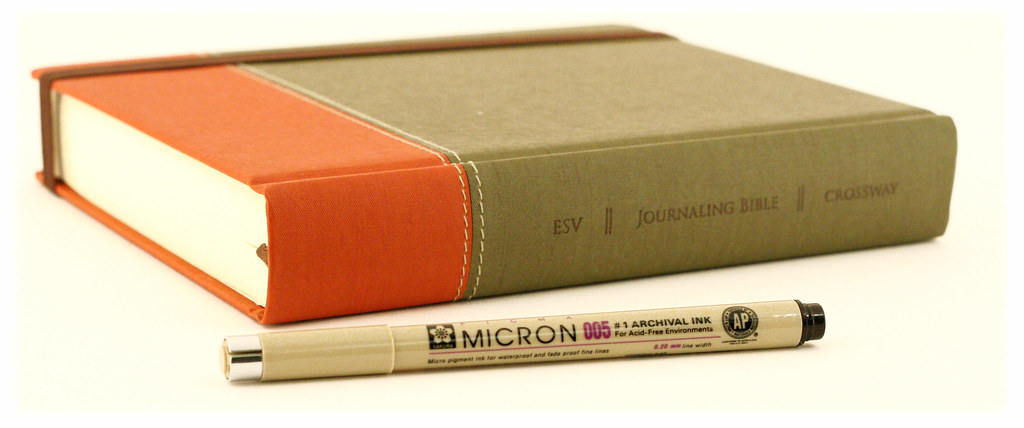
After opening the box I had three immediate thoughts: “It’s a lot smaller than I expected” … “It’s more portable than I expected” … and finally, “It’s much more durable than I expected.”

Here are more notes after further reflection (and some field-testing).

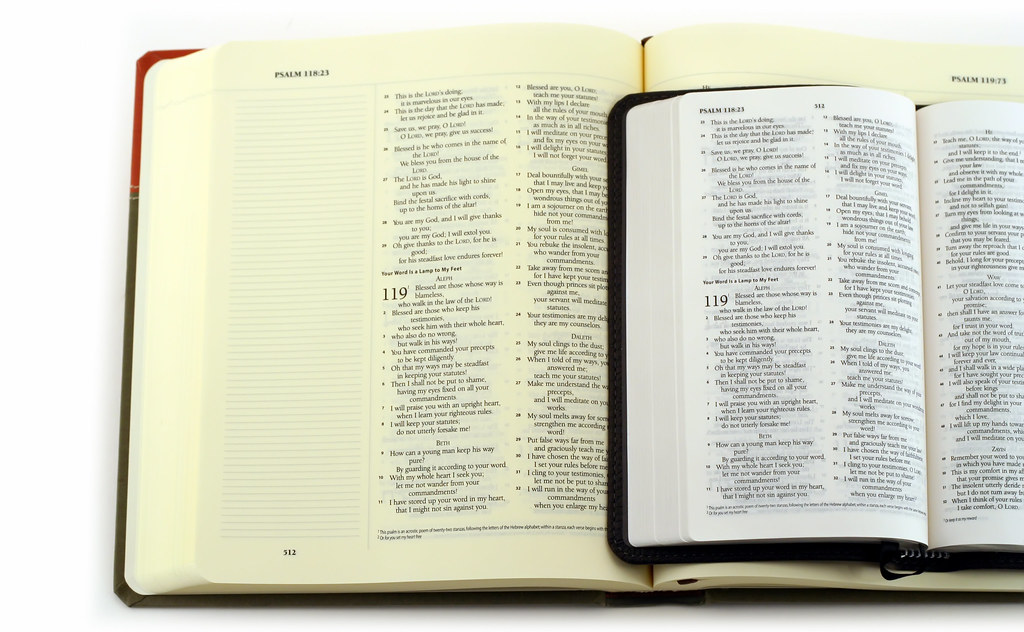
1. Size. The font size is small but (as you can see in the picture) slightly larger than the ESV Compact TruTone edition. The marginal note areas are lined for a note taker with small handwriting. The top margin can also be used for notes.

2. Paper color. Also in this comparison you can see that the Journaling Bible features an off-white paper color compared to other ESV Bibles. This may not be a big deal but it does seem to make the already small font a bit tougher to read (by decreasing the contrast of the paper/text).

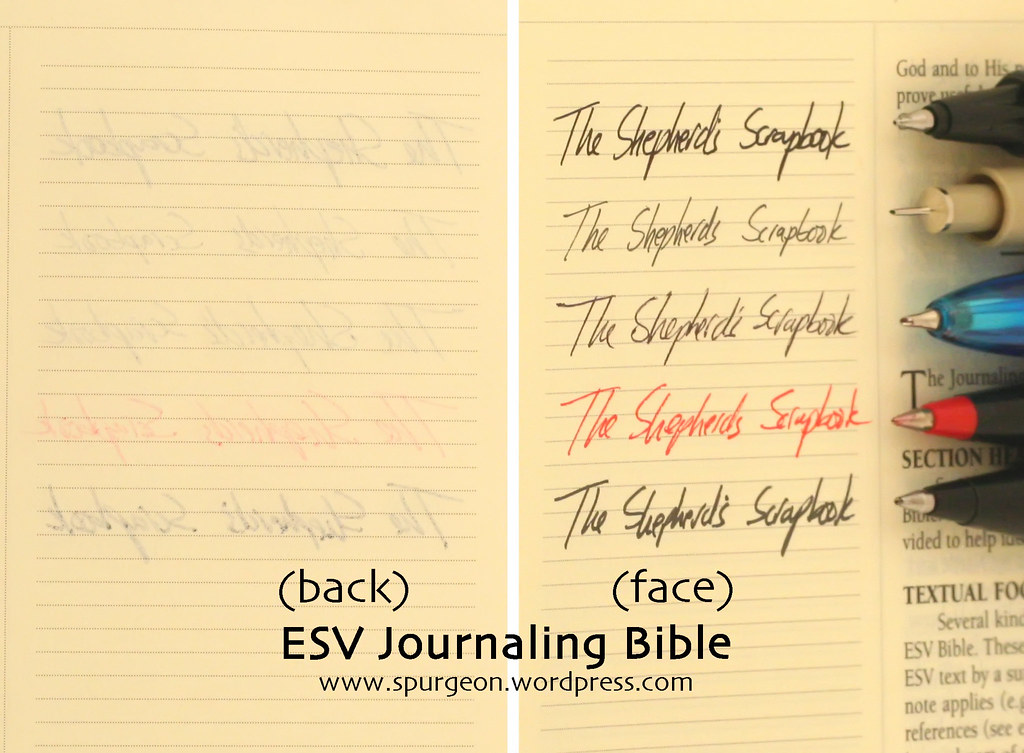
3. Pen bleed. The biggest factor in determining which Bibles can or cannot be written in comes down to how likely the pages are to bleed (pencils are not my thing). We put our safety goggles on, unlocked the door to our underground TSS testing laboratory and — with my poor handwriting skills and five different pens — we put this new ESV Bible to the test.

From top-to-bottom we used the following pens: a black Pilot Vball extra fine roller, a black Pigma Micron 005, an everyday black ballpoint, a red uni-ball micro roller and one big black uni-ball Deluxe roller (an ink pouring pen I wouldn’t consider for a Bible).

The results were fairly surprising because none (not even the uni-ball Delux roller) bled through the paper. No surprise, the best pen for this Bible was the Pigma Micron 005 available at scrapbook and craft stores. The regular ballpoint pen comes in second. But the bigger point is that these pages successfully absorbed all five inks without bleeding.

Join us tomorrow when we run the Journaling Bible through several more tests: The “Flame Retardant?” test, the “Ran Over By Car” test and (my personal favorite) the “Will It Float?” test. Actually, if I were serious this sturdy Bible would probably fare better than expected.

Unlike the blank Bibles I’ve created in the past, the Journaling Bible is compact and portable. It’s a good substitute if making a Blank Bible is out of the question. If you don’t mind the small font and the paper color, it is a very durable ESV with excellent margins and paper for note taking. You can get the black Journaling Bible for about $18 and the fancy calfskin version for about $41. A small price considering it enables you to carry your Bible and your reflections in one compact volume.

—————————-

[NOTE: For our review we used the Terra Cotta/Sage edition of the Journaling Bible – ISBN: 1581348959]

Evangelicals and Mormons Together?

Evangelicals and Mormons Together?

After your heart rate returns to normal, know that this is not real. At least not yet. Gary L.W. Johnson warns in a new book, By Faith Alone: Answering the Challenges to the Doctrine of Justification (Crossway; 2007) that EMT may be just around the corner. In his chapter, Johnson responds to a 1994 book by Keith Fournier entitled A House United: Evangelicals and Catholics Together: A Winning Alliance for the 21st Century (NavPress; 1994). Fournier claims to be a both Evangelical and Roman Catholic. Johnson responded by writing,

“According to him [Fournier], an evangelical is one who knows Christ as Savior and Lord and tells others about him. If this is all it takes to be considered one of today’s evangelicals, we should prepare ourselves to be accosted by evangelical Mormons or Moonies, each clamoring to be recognized at such. And why not? They can easily subscribe to Fournier’s definition…” (By Faith Alone, p. 194).

And that’s exactly what’s beginning to happen. Johnson uses the Fournier book as a backdrop to introduce a newer book by Robert Millet a Mormon professor at BYU. His book is titled, A Different Jesus? The Christ of the Latter-Day Saints (Eerdmans, 2005) and is endorsed by Richard Mouw, the president of Fuller Seminary. Mouw, a professed Calvinist, wrote the foreword and afterward. He writes, “a genuine personal relationship with Jesus Christ does not require that we have all our theology straight” (195). Of course he is right that our relationship with God (thankfully) does not wait until “all our theology” is straight. But Paul is also clear that getting the essential doctrines of the gospel wrong is to be a “foolishly-bewitched-fool” (Galatians 3:1-4).

If the mainline evangelical community backs away from a clear public defense of the gospel and fails to uphold the doctrine of a sinner being made right with God through justification (the legally imputed righteousness of Christ) alone, it’s not a stretch to think Evangelicals and Mormons will eventually come together, too. Al Mohler closes the book with these words: “We can only hope and pray that contributions like this important volume can help to awaken evangelicalism to its doctrinal peril. Otherwise, nothing genuinely evangelical will remain of evangelicalism” (208).

Beneath the Greek references and complex debates this book is a great reminder of the gospel’s simplicity and that makes it a great reminder how, apart from God’s sovereign grace, we walk around in the rut of this world, blindfolded to gospel of life. Oh, how we all need God’s illuminating grace to break into our spiritual blindness and raise our dead hearts! Thank you Jesus!

Check it out for yourself. By Faith Alone: Answering the Challenges to the Doctrine of Justification is a collection of articles by writers like David Wells and Al Mohler on the topic of justification. They discuss current controversies over the gospel and deal with E.P. Sanders, James D.G. Dunn and N.T. Wright (just like the Crossway release earlier this year, Jesus’ Blood and Righteousness by Brian Vickers).

Title: By Faith Alone: Answering the Challenges to the Doctrine of Jusitification
Authors: Gary L.W. Johnson and Guy P. Waters, editors
Reading level: 3.5/5.0 > moderately difficult
Boards: paper
Pages: 214
Volumes: 1
Dust jacket: no
Binding: glue
Paper: normal
Topical index: yes
Scriptural index: yes
Text: perfect type
Publisher: Crossway
Year: 2007
Price USD: $17.99/$12.99 from Monergism
ISBNs: 9781581348408, 1581348401

Review: Breathing Grace by Harry Kraus, M.D.

tsscertified.jpgBook review
Breathing Grace by Harry Kraus, M.D.

It’s a nice surprise to find contemporary books that clearly define the true gospel and insist I look again at the cross for spiritual refreshment. None have done it better than C.J. Mahaney’s Living the Cross Centered Life (my review was posted at takeupandread.com today). This weekend I discovered a new release from Crossway with a similar purpose.

Harry Kraus is a surgeon (currently a missionary surgeon in Africa) who has authored eight novels. His latest is a non-fiction book titled Breathing Grace. Kraus uses the metaphors from his medical background to illustrate the centrality of the cross and our need for daily grace. “Just as every cell (one hundred trillion in one human body!) requires a constant supply of oxygen, so every spiritual, emotional, and social aspect of our lives need a constant saturation with the gospel of grace” (22). Hence the title Breathing Grace.

Kraus presents the gospel clearly and accurately, using medical terms and exciting surgical situations. The medical stories are intense and, at points, a bit technical (“An arterial blush clouded the area lateral to the internal carotid artery, an indication of bleeding, a serious injury that was partially contained, a situation that needed stat attention before the artery free-ruptured, ensuring exsanguination and death”).

He argues that after conversion, believers continue discovering deeper levels of God’s holiness and their own sinfulness but often without a similar growth in the gospel. “When our understanding of the adequacy of the gospel doesn’t keep pace with our appreciation for God’s holiness or our own need, gospel debt results” (38). This “gospel debt” is then filled in with “false gospels” like trying to downplay our own sinfulness or making ourselves look better than we are. In other words, when we take our eyes off the gracious gospel in the Christian life we open ourselves to pride, man-pleasing and a host of other spiritually deadening diseases. The solution to these “false gospels” is a fresh return to the gospel. This excellent book points our focus back towards the love of God, to daily feed upon His life-giving grace.

Early on Kraus provides this concise purpose:

“This book is all about moving our concept of the gospel from grace notes to the major chord of our lives, something that undergirds the melody every day, every hour. This book is about moving our understanding of grace from one of God’s minor attributes to the central feature of his posture toward his children, the quality that governs his every action towards us on the road of redemption” (15).

This book contains references to the teaching of John Piper, many biblical references from the ESV and a study guide for personal reflection or group discussion. If you are looking for an excellent (and at times exciting) tour through God’s graciousness I would recommend Breathing Grace. Your spiritual life will be resuscitated by a renewed sense of God’s unconditional favor and — at the very least — you’ll more fully appreciate the dangers of acute arterial occlusions.

Title: Breathing Grace
Author: Harry Kraus, M.D.
Reading level: 2.0/5.0 > easy
Boards: hardcover (baby blue with silver embossing)
Pages: 170
Volumes: 1
Dust jacket: yes
Binding: glue
Paper: normal
Topical index: no
Scriptural index: yes
Text: perfect type
Publisher: Crossway
Year: 2007
Price USD: $19.99 from Crossway (available as an audiobook)
ISBN:
9781581348583, 1581348584

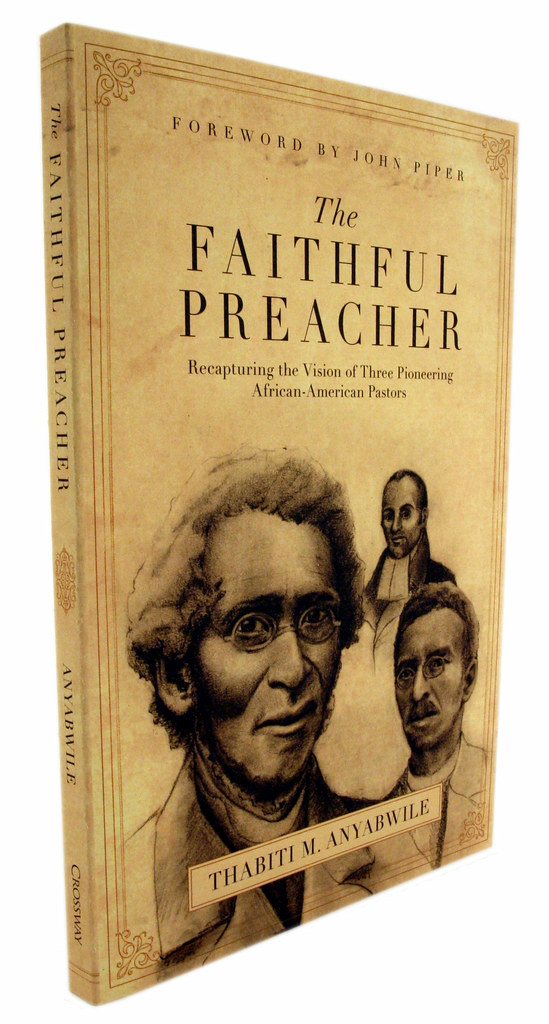
The Faithful Preacher by Thabiti Anyabwile (1581348274)

Book announcement
The Faithful Preacher
by Thabiti Anyabwile

Talking about the faith with my African-American pastor friends are some of the more awkward conversations I experience. We come from totally different backgrounds, with totally different perspectives, and that leaves very little common ground. So I am greatly encouraged to see blogger, pastor, and author Thabiti Anyabwile taking the time to address the nature and status of the black church in a series of blog posts titled, Can the Predominantly African-American Church Be Reformed? I have learned a lot about why my friends and I have a hard time discussion the nature of the church. These blog posts are interesting and engaging.

In seeking the reformation of the “predominantly African-American church” Anyabwile has also set out to present the lives of three black pastors. He does this in his new book from Crossway titled, The Faithful Preacher: Recapturing the Vision of Three African-American Pastors. The pastors highlighted are Lemuel Haynes (1753-1833), Daniel A. Payne (1811-1893) and Francis J. Grimké (1850-1937). The book contains one short biography of each man but is largely comprised of sermon transcripts.

Here is one short example from a sermon by Francis J. Grimké from 1919. Addressing the reconstruction of the damages done by World War I, he says,

“As a minister of Jesus Christ in this co-called work of spiritual reconstruction, I have nothing new to offer, nothing better to offer than I have been offering for the last forty years – the gospel of the grace of God in Christ Jesus; the taking of Christ’s yoke upon us and learning of Him; denying ourselves and taking up our cross daily and following Him through evil report as well as good. Others may have something new, something better to offer, but I have not, and I have no disposition to seek for anything else or any desire to offer anything else. So far as the world has been saved, the gospel preached and lived is the only thing that has saved it, and the only thing that will continue to save it” (p. 169).

“They were Puritans,” Anyabwile writes of the three preachers. “They committed themselves to sound theology in the pulpit, theologically informed practice in the church, and theologically reformed living in the world.”

Thabiti Anyabwile is serving the greater church well by asking some hard questions but also – building from the lives and preaching of three African-American preachers – presenting a vision for black pastors to be radically Cross-centered. And that’s a vision predominantly white churches can learn from, too.

——————

Title: The Faithful Preacher: Recapturing the Vision of Three African-American Pastors
Reading level: 2.0/5.0 > easy
Boards: paperback
Pages: 191
Volumes: 1
Dust jacket: no
Binding: glue
Paper: normal
Topical index: yes
Scriptural index: yes
Text: perfect type
Publisher: Crossway
Year: 2007
Price USD: $15.99
ISBNs: 1581348274, 9781581348279