The Future of Justification by John Piper

Book review
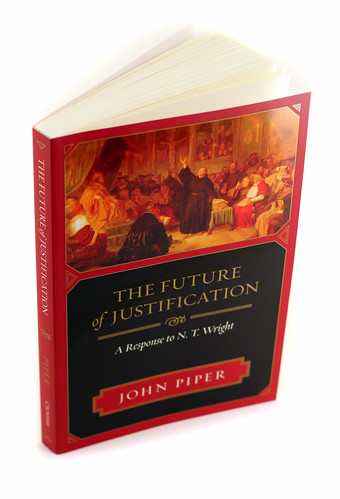
The Future of Justification: A Response to N.T. Wright
by John Piper
N.T. Wright is a British New Testament scholar and the Anglican Bishop of Durham, England. He’s become known for his controversial teaching on justification and for his statements like: “The discussions of justification in much of the history of the church, certainly since Augustine, got off on the wrong foot – at least in terms of understanding Paul – and they have stayed there ever since.”

Enter pastor and scholar John Piper.

Piper’s highly anticipated new book The Future of Justification: A Response to N.T. Wright (Crossway: 2007) is framed around eight fundamental questions raised in the theology of Wright:

  • The gospel is not about how to get saved? (ch. 5)
  • Justification is not how you become a Christian? (ch. 6)
  • Justification is not the gospel? (ch. 6)
  • We are not justified by believing in justification? (ch. 5)
  • The imputation of God’s own righteousness makes no sense at all? (ch. 8 )
  • Future justification is on the basis of the complete life lived? (ch. 7)
  • First-century Judaism had nothing of the alleged self-righteous and boastful legalism? (chs. 9, 10)
  • God’s righteousness is the same as His covenant faithfulness? (ch. 11)

Obviously these are monumental questions, bearing heavy consequences for the Church.

As expected, Piper walks slowly through these questions raised in Wright’s theology and returns frequently to biblical exegesis for his responses. Piper remarks in the intro that he dialogued with Wright during the process of writing the volume, even receiving an 11,000-word response on the first draft to clarify and prevent distortions (p. 10).

Before engaging

But before jumping into the debate, Piper opens the book with very humble words. He is too close to glory to waste his time winning debates and scoring publicity points. It’s a beginning that we can all learn from (see p. 13). This humble introduction is followed by an entire chapter – “On Controversy” – to explain why true Christian unity is not to be found in avoiding disagreements. Taking his cue from Machen, the Church has risen to new heights when celebrating truth within the context of controversy (p. 29).

Where Wright is right

Piper is clear and quick to point out areas of agreement. These include mutual convictions of Scriptural authority, the resurrection of Christ, the deity of Christ, the virgin birth of Christ, the opposition to homosexuality, and a big-picture understanding of the Abrahamic Covenant (pp. 15-16). And even in elements more closely related to the Gospel, Piper points out continuity. Piper writes, “There is nothing unclear about Wright’s commitment to penal substitution” (p. 48). And later, “Wright’s own words concerning penal substitution seem clear and strong” (p. 52).

Where Wright is wrong

The debate may appear to some as a trifle between one pastor/scholar and another pastor/scholar. But the implications run deep for all Christians. “This book took its origin from the countless conversations and e-mails with those who are losing their grip in this great gospel” (p. 10). Piper’s overriding argument is not that the gospel is being lost by outright dismissal, but in a gradual, incremental relaxing of the gospel due to a blurring of the biblical understanding of justification. So dangerous is this blurring, according to Piper, that at the end of the day, Wright may in fact be reinforcing Roman Catholic soteriology (p. 183)!

Piper is concerned that Wright’s biblical theology has become a grid that brings in too many extra-biblical resources to make interpretive decisions. Piper believes this approach, when it comes to understanding justification, “has not been as illuminating as it has been misleading, or perhaps, confusing” (p. 38).

Wright’s removal of justification from the gospel is also a big problem. Piper writes, “I find it perplexing that Wright is so eager not to let the message of justification be part of the gospel” (p. 82) and “Wright’s zeal to remove justification from the event of becoming a Christian” is “remarkable” (p. 95). Later, Piper highlights the missing element of Christ’s imputed righteousness in Wright’s theology.

Piper takes time clarifying the nature of legalism and the careful distinction of works and justification, a distinction not easily seen in Wright’s writings. In the end, Piper is forced to make the following clarification:

“If we make the mistake of thinking that our works of love (the fruit of God’s Spirit) secure or increase God’s commitment to be completely for us, now and in the last judgment, we compromise the very reason that these works of love exist, namely, to display the infinite worth of Christ and his work as our all-sufficient obedience and all-sufficient sacrifice.

Our mind-set toward our own good works must always be: these works depend on God being totally for us. That’s what the blood and righteousness of Christ have secured and guaranteed forever. Therefore, we must resist every tendency to think of our works as establishing or securing the fact that God is for us forever. It is always the other way around. Because he is for us, he sustains our faith. And through that faith-sustaining work, the Holy Spirit bears the fruit of love” (p. 186).

Piper devotes many pages to the Law-Court theme in justification, where great disparity between Piper and Wright becomes obvious. The book gives the reader a great overview of the most important features of the biblical gospel. A series of six related and helpful appendices conclude the book (pp. 189-225).

I’m thankful for the care taken by Piper to stay close to the issues that directly impact the clarity of the gospel message.

‘Paralyzing perplexity’

The overriding concern for Piper is not that Wright has evil intentions or is viciously dangerous. The problem is that Wright’s message confuses the gospel and breeds confusion where the Church needs to be strongest.

“I am not optimistic that the biblical doctrine of justification will flourish where N. T. Wright’s portrayal holds sway. I do not see his vision as a compelling retelling of what Saint Paul really said. And I think, as it stands now, it will bring great confusion to the church at a point where she desperately needs clarity. I don’t think this confusion is the necessary dust that must settle when great new discoveries have been made. Instead, if I read the situation correctly, the confusion is owing to the ambiguities in Wright’s own expressions, and to the fact that, unlike his treatment of some subjects, his paradigm for justification does not fit well with the ordinary reading of many texts and leaves many ordinary folk not with the rewarding ‘ah-ha’ experience of illumination, but with a paralyzing sense of perplexity” (p. 24).

Later Piper writes, “This book exists because of my own concern that, specifically in the matter of justification by faith, Wright’s approach has not been as illuminating as it has been misleading, or perhaps, confusing.” (p. 38). Even the most straightforward passages on imputation (like 2 Corinthians 5:21) are “shrouded in Wright’s misleading comments” (p. 178).

And most notably, the gospel in its application to sinners becomes vague.

“But there is a misleading ambiguity in Wright’s statement that we are saved not by believing in justification by faith but by believing in Jesus’ death and resurrection. The ambiguity is that it leaves undefined what we believe in Jesus’ death and resurrection for. It is not saving faith to believe in Jesus merely for prosperity or health or a better marriage. In Wright’s passion to liberate the gospel from mere individualism and to make it historical and global, he leaves it vague for individual sinners” (pp. 85-86).

Piper is rightly concerned that this vagueness will spread into the pulpit. “Following N.T. Wright in his understanding of justification will result in a kind of preaching that will at best be confusing to the church” (p. 165).

A fitting summary of Piper’s entire case is found early in the book.

“My conviction concerning N.T. Wright is not that he is under the curse of Galatians 1:8-9, but that his portrayal of the gospel – and of the doctrine of justification in particular – is so disfigured that is becomes difficult to recognize as biblically faithful. It may be that in his own mind and heart Wright has a clear and firm grasp on the gospel of Christ and the biblical meaning of justification. But in my judgment, what he has written will lead to a kind of preaching that will not announce clearly what makes the lordship of Christ good news for guilty sinners or show those who are overwhelmed with sin how they may stand righteous in the presence of God” (p. 15).

Conclusion

It’s right for the Church to jealously guard the clear and biblical understanding of how sinners are brought into a right relationship with God. And it’s at this critical place, over the battle for our understanding of justification as the personal application of Christ’s work to a sinner’s soul, where Wright’s theology simply falls apart. This is an error the Church cannot afford to entertain.

Whether Piper has clearly and fairly represented Wright at every detail is a conclusion I’ll leave for those more connected to the discussion. What is certain is that The Future of Justification: A Response to N.T. Wright is a book thoroughly centered on clear exegesis of Scripture on the topic of justification. You don’t need a background in the Wright/Piper debate to gain a better appreciation of – and a firmer hold on – the biblical message of the gospel.

IMG_9259.ed.jpg

Title: The Future of Justification: A Response to N.T. Wright
Author: John Piper
Reading level: 3.0/5.0 > moderately difficult at times
Boards: paperback
Pages: 239
Volumes: 1
Dust jacket: no
Binding: glue
Paper: white and clean
Topical index: yes
Scriptural index: yes
Text: perfect type
Publisher: Crossway
Year: 2007
Price USD: $11.99 from Monergism
ISBN
: 9781581349641, 1581349645

Critical but gracious

tsslogo.jpgAdrian Warnock has an excellent post modeling how Mark Driscoll publicly pointed out theological error and the gracious and humble manner in which he did it. Very helpful.

————–

Related: Grace and the Adventure of Leadership message by C.J. Mahaney. Correction must be done in deep humility and thankfulness. The book of 1 Corinthians — where Paul is about to correct the great errors of the Corinthians — begins with these (almost unbelievable) words: “I give thanks to my God always for you because of the grace of God that was given you in Christ Jesus” (1 Cor. 1:4). “Paul was more aware of evidences of grace than areas in need of growth.” One of Mahaney’s most important messages and a must-listen for pastors.

Our holiness and zeal purchased in the Cross

tsslogo.jpgI’ll never forget the glorious day God opened my eyes to see that everything in the Christian life centers around the Cross. It was reminiscent of viewing the massive Rocky Mountains for the first time — having my breath taken away by the size and grandeur of their jagged features, snow-topped summits, and cloud-ripping peaks.

About four years after my conversion, I was preparing to deliver a short message on Titus 3:4-7. The intention was to study this passage to prepare an evangelistic message on a local college campus. The passage reads:

4 But when the goodness and loving kindness of God our Savior appeared, 5 he saved us, not because of works done by us in righteousness, but according to his own mercy, by the washing of regeneration and renewal of the Holy Spirit, 6 whom he poured out on us richly through Jesus Christ our Savior, 7 so that being justified by his grace we might become heirs according to the hope of eternal life.

God’s glorious grace saves us purely on the basis of His own mercy, apart from anything we could ever merit from Him. The works we do in ‘righteousness’ are nothing in His sight. We are redeemed in Christ alone, and we can be justified in Him alone. On the basis of the Cross and God’s grace alone, we can possess the hope of eternal life.

These glorious truths sounds pretty evangelistic. Well, kinda.

As an expositor I was trying to come to grips with this passage and the context (which did not seem evangelistic). These passages are embedded between a call for obedience before and a call for obedience after. Listen to the next verse: “The saying is trustworthy, and I want you to insist on these things, so that those who have believed in God may be careful to devote themselves to good works. These things are excellent and profitable for people” (v. 8).

Over the course of that week of study and meditation, God kindly revealed to me that the Cross is bigger than evangelism and conversion! Being reminded of the Cross is for “those who have believed.” From here God showed me the dangers of forgetting the Cross and how the Cross is central to the everyday life of the Christian, producing joy and earnest obedience.

As you can imagine, I was shocked and surprised at these discoveries. Preparation on the passage continued but within a new understanding of the Cross in the Christian life. I would later title the message, A Gospel Tract for Believers.

When I want to be amazed at the Cross, I return to Titus.

The Purchase of the Cross

Recently I was back in Titus, being amazed again. This time our gracious God opened my eyes to the beauty of the completed work of Christ on the Cross. Listen to Titus 2:11-14:

11 For the grace of God has appeared, bringing salvation for all people, 12 training us to renounce ungodliness and worldly passions, and to live self-controlled, upright, and godly lives in the present age, 13 waiting for our blessed hope, the appearing of the glory of our great God and Savior Jesus Christ, 14 who gave himself for us to redeem us from all lawlessness and to purify for himself a people for his own possession who are zealous for good works.

That final verse made my jaw drop because here Paul unfolds the purchase of Christ at the Cross. These are what Christ bought in His sacrificial death for sinners! We are told that Christ “gave Himself” in order to redeem and purify a people zealous for good works. In other words, our redemption, sanctification and even our zeal-ification were all purchased in the Cross!

1. Purchased holiness

Titus 2 seems to parallel Ephesians 5:25-26, “Husbands, love your wives, as Christ loved the church and gave himself up for her, that he might sanctify her, having cleansed her by the washing of water with the word.” Here is Christ purifying His Bride (the Church). This model for husbands in the spiritual leadership of their wives shows that our sanctification is not merely the fruit of hard work. Our sanctification is the fruit of Christ’s direct work.

Puritan John Owen recognized a pattern in the NT picture of sanctification, that our washing/sanctification is through blood (Heb. 9:13-14; 1 John 1:7; Rev. 1:5). Not only at the beginning of the Christian life and in justification does blood cleanse us, but at all points of sanctification Christ’s blood sanctifies us. Which means the Cross is ever at the center of our sanctification.

And so in his commentary on Hebrews 2, Owen attacks those who believe holiness is attained merely by following the moral example of Christ. “And they who place this sanctification merely on the doctrine and example of Christ, besides that they consider not at all the design and scope of the place, so they reject the principal end and the most blessed effect of the death and blood-shedding of the Lord Jesus.”

Christ is certainly our example, but all of our moral purity is (most importantly) the purchase of Christ on the Cross!

I find it interesting that this theme of Christ purchasing our sanctification is not a major one in Owen’s works on mortification and indwelling sin, nor a major theme in Communion with God or the Glory of Christ. The theme does find prominence – of all places – in Owen’s classic defense of definite atonement in The Death of Death.

To show the atonement cannot have been achieved for all sinners, Owen argues the application of the atonement would also be applied to all. “So that our sanctification, with all other effects of free grace, are the immediate procurement of the death of Christ. And of the things that have been spoken this is the sum: Sanctification and holiness is the certain fruit and effect of the death of Christ in all them for whom he died.”

I know some of you will disagree with Owen’s overall argument on limited atonement. What I want you to see instead here is the precious wisdom Owen understands so well — that the work of the atonement reaches far beyond mere redemption and justification. Whoever Christ died for will be sanctified and will be holy because this sanctification and holiness has been purchased at the Cross.

Thus we can say with Paul, Christ is our righteousness and sanctification (1 Cor. 1:30). Christ purchased it all.

2. Purchased zeal-ification

And not only our sanctification and mortification (death to sin), but all of our Christian zeal was also purchased in the Cross!

Jonathan Edwards preached a sermon on Titus 2:14 and his overall point was to reveal that all genuine Christians are zealous people. At the beginning he says, “Zeal is an essential virtue of a Christian. This is evident from the text because in the text it is mentioned as what belongs to the description of a true Christian and part of his distinguishing character. Also because it’s mentioned as a virtue that Christ purchased for all his elect.”

Edwards understood that ministry zeal is not the product of our self-sustained efforts, nor the effect of getting ourselves emotionally pumped up before a sermon, or pep-talking a congregation into service and evangelism. Ultimately, all zeal in the Christian life is purchased at the Cross.

How sad is our tendency to separate the work of Christ on the Cross from our ministry zeal and faithfulness. I know I’m guilty here. Examples of this can be seen in contemporary writings. On 1 Thessalonians 2:19, one author writes:

“This is why, when Paul looks ahead to the future and asks, as well one might, what God will say on the last day, he holds up as his joy and crown, not the merits and death of Jesus, but the churches he has planted who remain faithful to the gospel. The path from initial faith to final resurrection (and resurrection we must remind ourselves, constitutes rescue, that is salvation, from death itself) lies through holy and faithful Spirit-led service, including suffering” (N.T. Wright, Fresh Perspective, 148).

This could not be further from the truth. Paul understood the faithful ministry zeal of churches to be the working out of a zeal Christ purchased at the Cross. The Cross will be forever the centerpiece of glory because without it there would be no ministry zeal, no successful church plants, no faithfulness to the message of the Cross. We must resist the temptation to disconnect the merits of Christ from our ministry zeal.

Without the Cross, there is no zeal.

Conclusions

1. Self-sufficiency abated. This understanding of our mortification, sanctification and zeal-ification protects us from self-sufficiency. Our sufficiency is from God (2 Cor. 3:5). Or to put it another way, our sufficiency is in God’s grace, by His Spirit, and through the work of His Son on the Cross.

2. Confidence engendered. Few things more encourage ministry zeal and the pursuit of sanctification than the knowledge that Christ already purchased these gifts of grace! We have the confidence to pursue and kill sin because we are being washed in His blood. We have the confidence to pray for fervent zeal because it’s a zeal already fully purchased by Christ.

3. Legalism killed. Legalism is seeking to appease God through personal obedience. At its heart is the awful idea that I bring to God something I’ve achieved in my own strength that pleases Him more than His Son. This legalism is killed when we reflect on the Cross of Christ, where He purchased all our holiness and zeal.

It sounds awkward, but the bottom line is that we are simply becoming what’s already been paid for. We should continue praying for holiness, sanctification, victory over indwelling sin, and that God would inflame our passions and zeal. But in these prayers we are merely asking that God would apply, by His Holy Spirit, what Christ has already purchased for us on the Cross.

——————–

Related post: What is Legalism? (a very simple, working definition)

Related post: Cross-centered obedience (how the diligent pursuit of personal obedience presses us into the Cross and comforts our souls)

The Apostles’ Doctrine of the Atonement by George Smeaton

tsslogo.jpgLast week we played the game, Who is George Smeaton? To be honest, I had not heard of him until recently. Now I know more about the 19th century Scottish theologian and that’s all thanks to the input of TSS readers, the most knowledgeable blog readers on the planet (illustrated by the fact that many of them roast their own coffee beans). Helpful input came flowing from Scottish readers and Brazilian readers and really from readers all over. So thank you!

As you now know, Smeaton’s two books on the atonement serve as the foundation for Jerry Bridges’ new book, The Great Exchange: My Sin for His Righteousness (Crossway: 2007). In the foreword, Sinclair Ferguson says Smeaton’s volumes should be on the shelves of every preacher. “They are treasure troves,” he writes.

Just yesterday in the mail arrived my copy of Smeaton’s 1870 work, The Apostles’ Doctrine of the Atonement (the second volume, Christ’s Doctrine of the Atonement, is currently out of print). As expected, the Smeaton volume was beautifully bound by the Banner in this 1991 reprint featuring a Smyth-sewn binding and cloth cover (remove the unsightly dust cover to see this delicious goodness). The text is a facsimile reproduction of the 1870 edition (see picture). There are brief Scriptural and topical indexes in the back.

To my pleasant surprise, the volume contains a lengthy appendix covering the history of the atonement from the first century through the Reformation period (pp. 479-544). Smeaton begins his historical study this way, “We find, when we make due allowance for erratic tendencies, either of individuals or of sects, through all this time, one harmonious testimony to divine justice and the judicial aspect of Christianity” (p. 480).

As time allows, I plan to write a fuller review, but this quote from the introduction to Apostles’ is a great one, illustrating the ever-present tendency within the church to neglect the doctrine of the penal substitutionary atonement of Christ. The quote stresses our need to linger often at the Cross in our studies, never assuming the importance of the Cross. Written 130 years ago, it’s ever fresh today.

“The design of this work is mainly to demonstrate, in the only way in which this is to be done, the pure biblical doctrine of the atonement. But polemical references are by no means withheld; that is, applications, necessarily brief, of ascertained truth to germinant errors, especially to those subtle forms of error which, in an evangelical guise, and not seldom with exegetical appliances, tend wholly to subvert the elements of substitution and penal visitation, which constitute the very essence of the atonement. It is a remarkable fact that since the Reformation no article has been so much impugned in every variety of form. Till recently this was uniformly done by a class of men who had forfeited all claim to be regarded as either evangelical in sentiment or biblical in doctrine. Within recent memory, however, a new phenomenon has presented itself to the attention of Christendom — a sort of spiritual religion or mystic piety, whose watchword is, spiritual life, divine love, and moral redemption, by a great teacher and ideal man, and absolute forgiveness, as contrasted with everything forensic. It is a Christianity without an atonement; avoiding, whether consciously or unconsciously, the offence of the cross, and bearing plain marks of the Rationalistic soil from which it sprung; and it has found a wide response in every Protestant land.”

George Smeaton, The Apostles’ Doctrine of the Atonement (Banner of Truth: 1870/1991), vi.

Spurgeon on the Substitutionary Atonement

tss-john-calvin-coffee.jpg“If you take away the blood of sprinkling from the gospel, you have silenced it. It has no voice if this be gone. ‘Oh,’ they say, ‘the gospel has lost its power!’ What wonder when they have made it a dumb gospel! How can it have power when they take away that which is its life and speech?

Unless the preacher is evermore preaching this blood, and sprinkling it by the doctrine of faith, his teaching has no voice either to rouse the careless or to cheer the anxious. If ever there should come a wretched day when all our pulpits shall be full of modern thought, and the old doctrine of a substitutionary sacrifice shall be exploded, then will there remain no word of comfort for the guilty or hope for the despairing.

Hushed will be forever those silver notes which now console the living, and cheer the dying; a dumb spirit will possess this sullen world, and no voice of joy will break the blank silence of despair. The gospel speaks through the propitiation for sin, and if that be denied, it speaketh no more. Those who preach not the atonement exhibit a dumb and dummy gospel; a mouth it hath, but speaketh not; they that make it are like unto their idol. …

Would you have me silence the doctrine of the blood of sprinkling? Would any one of you attempt so horrible a deed?

Shall we be censured if we continually proclaim the heaven-sent message of the blood of Jesus? Shall we speak with bated breath because some affected person shudders at the sound of the word ‘blood’ or some ‘cultured’ individual rebels at the old-fashioned thought of sacrifice?

Nay, verily, we will sooner have our tongue cut out than cease to speak of the precious blood of Jesus Christ. For me there is nothing worth thinking of or preaching about but this grand truth, which is the beginning and the end of the whole Christian system, namely, that God gave his Son to die that sinners might live.”

– C.H. Spurgeon, sermon 1888, “The Blood of Sprinkling” in volume 32 of sermons (1886).

The Centrality of the Cross

On Galatians 1:3-9

“Were the atonement not the principal matter of the gospel, and the highest exhibition of the united wisdom, love and faithfulness of God, — in a word, the greatest act of God in the universe, — that terrible anathema on its subverters would seem to us something inexplicable, if not intolerable. …

[The Apostles’] symbol was the cross; their boast was the cross: they could not live without it; they could not die without it … In preaching such a doctrine they exposed themselves to the loss of reputation, to hardships and peril, to persecution and death. But they held their way, undeterred and undaunted.”

– George Smeaton, The Apostles’ Doctrine of the Atonement (1870; reprint, Banner of Truth, 1991) pp. 19, 16, 20.