The Atheist Within

The Atheist Within

Recently I engaged with an atheist in a short dialogue. I was drawn into the conversation because of the young man’s honesty and from a sense of love towards him and his soul. He stumbled into this blog by “accident” and he started asking some very good questions. But he also came in with a lot of presumptions, expecting responses from me like “of course you must believe because X, Y and Z are true.”

Instead, I felt led to share the struggles of unbelief in my Christian heart. I could tell that my response shocked him. He was saying he could not believe and I was saying — because of my sin — I too find it hard to believe. He assumed, as many atheists do, that faith is easy. In a sinful world that is a false assumption. Faith is not easy. Apart from God’s grace, faith is impossible.

Three interesting (and unexpected) conclusions resulted from this conversation.

First, because of the climate in our culture, the difference between atheists and Christians seems suited for a debate. Truly one is right, one is wrong. God is or He isn’t. Both opinions cannot be correct. But while I agree with this, the public polarization of the debate makes arbitrary distinctions between faith and reason, religion and science. Rather, the debate is solved by both faith and reason. God is not unreasonable. To ultimately conclude there is no God is not to lack faith, but to be a fool without knowledge (Ps. 14).

Secondly, belief is not easy or natural. He staked his claim in atheism and I stake my faith in the Cross, but there was a common conclusion: there is nothing easy about faith. The atheist assumes, for those living in a culture projecting Christianity, that faith is the easy response. Faith is never easy.

We assert with Peter, “Lord, I will never deny You” and then in our actions deny Him three times over. “I believe; help my unbelief!” is our cry (Mark 9:24). Christians transgress the greatest commandment every day by living in unbelief because at some level, all sinners (whether redeemed or unredeemed) are atheists. Atheism is not only a supposedly rational conclusion that a god does not exist, but also the practical conclusion that God is unworthy of my affection. The idols of my own heart reveal the depth of remaining atheism!

Look at your commitment to private prayer. Does it show a lack of faith in God’s existence? And only remaining unbelief would permit sin to continue our hearts. Each sin communicates the unworthiness of God. Paul says atheism is revealed by sexual sin, covetousness, envy, strife, lying, pride, disobedience to parents, being unloving, untrustworthy, unforgiving and unmerciful (Rom. 1:18-32). As long as sin remains, a level of atheism remains.

Third, the atheist assumed that God is pleased with me because I believe. This, too, is incorrect. God is pleased with me because His pleasure has been purchased in the blood of Jesus Christ! The blood of Christ shed on the Cross, not my faith, merits salvation from the guilt of sin and perfect righteousness. I have been embraced as the prodigal son into the arms of my adoptive Father through Christ (Luke 15:11-32).

What a glorious Savior that He saves even through faith the size of a mustard seed (Luke 17:6). By this, Jesus reminds us our salvation is not through great faith but through the great Savior. In the age of the telegraph C.H. Spurgeon said,

“There is no difference between one believer and another as to justification. So long as there is a connection between you and Christ the righteousness of God is yours. The link may be very like a film, a spider’s line of trembling faith, but, if it runs all the way from the heart to Christ, divine grace can and will flow along the most slender thread. It is marvelous how fine the wire may be that will carry the electric flash. We may want a cable to carry a message across the sea, but that is for the protection of the wire, the wire which actually carries the message is a slender thing. If thy faith be of the mustard-seed kind, if it be only such as tremblingly touches the Savior’s garment’s hem, if thou canst only say ‘Lord, I believe, help thou mine unbelief,’ if it be but the faith of sinking Peter, or weeping Mary, yet if it be faith in Christ, he will be the end of the law for righteousness to thee as well as to the chief of the apostles.”

Unbelief is a very serious sin, a sin Christians grieve over in their own hearts. This personal struggle equips believers to be especially sensitive and knowledgeable of atheism. Added to this, atheistic chatter always reaches a pinnacle near presidential elections. This discussion will continue heating up and provide excellent opportunities to share the greatness and beauty of Jesus Christ and His Cross that redeems us from our sin. It just may be that a slender wire of faith, rather than a polemical debate, separates our hearts.

When we as Christians see the atheist within our hearts we begin to understand the glorious greatness our Savior! What a beautiful Savior that holds on to sinners and never lets go.

My sheep hear my voice, and I know them, and they follow me. I give them eternal life, and they will never perish, and no one will snatch them out of my hand. My Father, who has given them to me, is greater than all, and no one is able to snatch them out of the Father’s hand. I and the Father are one.” (John 10:27-30)

Review: Breathing Grace by Harry Kraus, M.D.

tsscertified.jpgBook review
Breathing Grace by Harry Kraus, M.D.

It’s a nice surprise to find contemporary books that clearly define the true gospel and insist I look again at the cross for spiritual refreshment. None have done it better than C.J. Mahaney’s Living the Cross Centered Life (my review was posted at takeupandread.com today). This weekend I discovered a new release from Crossway with a similar purpose.

Harry Kraus is a surgeon (currently a missionary surgeon in Africa) who has authored eight novels. His latest is a non-fiction book titled Breathing Grace. Kraus uses the metaphors from his medical background to illustrate the centrality of the cross and our need for daily grace. “Just as every cell (one hundred trillion in one human body!) requires a constant supply of oxygen, so every spiritual, emotional, and social aspect of our lives need a constant saturation with the gospel of grace” (22). Hence the title Breathing Grace.

Kraus presents the gospel clearly and accurately, using medical terms and exciting surgical situations. The medical stories are intense and, at points, a bit technical (“An arterial blush clouded the area lateral to the internal carotid artery, an indication of bleeding, a serious injury that was partially contained, a situation that needed stat attention before the artery free-ruptured, ensuring exsanguination and death”).

He argues that after conversion, believers continue discovering deeper levels of God’s holiness and their own sinfulness but often without a similar growth in the gospel. “When our understanding of the adequacy of the gospel doesn’t keep pace with our appreciation for God’s holiness or our own need, gospel debt results” (38). This “gospel debt” is then filled in with “false gospels” like trying to downplay our own sinfulness or making ourselves look better than we are. In other words, when we take our eyes off the gracious gospel in the Christian life we open ourselves to pride, man-pleasing and a host of other spiritually deadening diseases. The solution to these “false gospels” is a fresh return to the gospel. This excellent book points our focus back towards the love of God, to daily feed upon His life-giving grace.

Early on Kraus provides this concise purpose:

“This book is all about moving our concept of the gospel from grace notes to the major chord of our lives, something that undergirds the melody every day, every hour. This book is about moving our understanding of grace from one of God’s minor attributes to the central feature of his posture toward his children, the quality that governs his every action towards us on the road of redemption” (15).

This book contains references to the teaching of John Piper, many biblical references from the ESV and a study guide for personal reflection or group discussion. If you are looking for an excellent (and at times exciting) tour through God’s graciousness I would recommend Breathing Grace. Your spiritual life will be resuscitated by a renewed sense of God’s unconditional favor and — at the very least — you’ll more fully appreciate the dangers of acute arterial occlusions.

Title: Breathing Grace
Author: Harry Kraus, M.D.
Reading level: 2.0/5.0 > easy
Boards: hardcover (baby blue with silver embossing)
Pages: 170
Volumes: 1
Dust jacket: yes
Binding: glue
Paper: normal
Topical index: no
Scriptural index: yes
Text: perfect type
Publisher: Crossway
Year: 2007
Price USD: $19.99 from Crossway (available as an audiobook)
ISBN:
9781581348583, 1581348584

Cross-Centered Puritans: Stephen Charnock

The Cross as the ‘spring of our happiness’
by Stephen Charnock (1628-1680)

Let us delight in the knowledge of Christ crucified, and be often in the thoughts and study of him. Study Christ, not only as living but dying, not as breathing in our air, butcrosscenteredpuritans.jpg suffering in our stead; know him as a victim, which is the way to know him as a Conqueror. Christ as crucified is the great object of faith. All the passages of his life, from his nativity to his death, are passed over in the creed without reciting, because, though they are things to be believed, yet the belief of them is not sufficient without the belief of the Cross; in that alone was our redemption wrought. Had he only lived, he would have not been a Savior. If our faith stops in his life, and does not fasten upon his blood, it will not be a justifying faith. His miracles, which prepared the world for his doctrine, and his holiness, which fitted himself for his suffering, would have been insufficient for us without the addition of the Cross. Without this, we had been under the demerit of our crimes, the venom of our natures, the slavery of our sins, and the tyranny of the devil; without this, we should forever have had God for our enemy, and Satan for our executioner; without this, we had lain groaning under the punishment of our transgressions, and despaired of any smile from heaven. It was this death as a sacrifice that appeased God and as a price redeemed us. Nothing is so strong to encourage us; nothing so powerful to purify us; how can we be without thinking of it? …

This will be the foundation of all our comforts. What comfort can be wanting, when we can look upon Christ crucified as our surety, and look upon ourselves as crucified in him, when we can consider our sins as punished in him, and ourselves accepted by virtue of his Cross? It was not an angel which was crucified for us, but the Son of God; one of an equal dignity with the Father; one that shed blood enough to blot out the demerit of our crimes, were they more than could be numbered by all the angels of heaven, if all were made known to them. He was not crucified for a few, but for all sorts of offenses. When we shall see judgment in the world, what comfort can we take without a knowledge and sense of a crucified Christ? What a horror is it for a condemned man to see the preparation of the gibbets, halters and executioners? But when he shall see a propitiation made for him, the anger of the Prince atoned, the Law some other way satisfied, and his condemnation changed into remission; all his former terrors vanish, and a sweet and pleasing calm possesses him… When we tremble under a sense of our sins, the terrors of the Judge and the curses of the Law, let us look upon a crucified Christ, the remedy to all our miseries. His Cross has procured a crown. His passion [death] has expiated our transgressions. His death has disarmed the Law. His blood has washed a believers soul. This death is the destruction of our enemies, the spring of our happiness, the eternal testimony of divine love. We have good reason, as well as the apostle Paul, to determine with ourselves to know nothing but Jesus Christ, and especially him crucified.

-Transcribed from “A Discourse of the Knowledge of Christ Crucified,” taken from the 2 volume Works of Stephen Charnock (London: 1684) pp. 844-845

“Like pangs of death”: Letting go of legalism

“Like pangs of death”: Letting go of legalism
by Tony Reinke

What is “legalism?” Legalism is an attempt to please God through self-righteous obedience, a counterfeit replacement to the merits and works of the perfect Son. You can be legalistic by not drinking alcohol and thinking God is more pleased with you and you can become legalistic by drinking alcohol and thinking God is more pleased with you. Legalism is not merely defined by specific rules or strictness. Legalism is all about seeking to please God with self efforts and we do that in our ‘looseness’ just as easily as our strictness. That’s the gist of a short post I wrote (“Understanding Legalism”) last September.

This past winter I heard two separate public statements to the effect that if you read a lot of Puritan literature you will grow legalistic. Certainly there is a danger in all Christian literature to do what I did before I was a Christian — highlight all the passages of books and Scripture that give a command, seek to obey and appease God in the end. That’s legalism and it doesn’t matter what you read, our hearts fall into this legalism naturally.

The criticism of the Puritans however is overall unfounded simply on the basis of the Cross-centered focus of the Puritans. You cannot exalt in the sufficient work of the Son without striking legalism at the root.

But this criticism is also unfounded because the Puritans attacked legalism directly.

This weekend I was reading through an excellent systematic theology written by John Brown of Haddington (1722-1787). On the covenant of works, Brown launched into a lengthy paragraph on the nature of legalism and why all unregenerate sinners – and even converted Christians – are lured by legalism. Listen carefully to his arguments.

“All men by nature, and even believers, in so far as they are unrenewed, desire to be under the covenant of works, and to obtain happiness by their own righteousness, or the condition of it. 1. It is natural to men, and hence men of every form or religion, station, office, education, or manner of life, agree in it (Romans 9:31,32; 10:3; Jonah 1:16; Matthew 19:16; John 6:28; Acts 2:37; Luke 15:19). 2. Our own working or suffering, in order to obtain happiness from God, is exceedingly suited to the pride of our corrupt nature, and makes us to look on God as our debtor (Romans 10:3; 7:9,13; John 5:45; Isaiah 58:3). It is like pangs of death to quit our hold of the law (Romans 7:4,9; Galatians 2:19). 3. Men’s ignorance of the extensive and high demands of the broken law, and of their own utter inability to keep it, — or their care to abridge their apprehensions of them, and to enlarge their conceit of their own ability, mightily promote their desire to be under it (Romans 7:9-13; 10:3; Galatians 4:21). 4. Men have naturally a peculiar enmity against God and his gracious method of redemption, — against Jesus Christ and his whole mediation, particularly his sacrificing work; and hence love to oppose the honor of it be cleaving to legal methods of obtaining happiness (Romans 8:7; John 15:24; Romans 10:3; 9:32; 5:21; Galatians 2:21; 5:2,4).”
The Systematic Theology of John Brown of Haddington [Reformation Heritage Books: 2002] p. 212 (updated spellings and formatting).

Not only were the Puritans aware of the dangers of legalism, they understood legalism to be a false understanding of the appeasement of God. That is, they rightly understood legalism to be a false gospel. And what’s more, the Puritans were fully aware of the battle waging in the soul of the Christian that “it is like pangs of death to quit our hold of the law.” We must die to the Law, not because the Law is bad, but because all sinners are naturally inclined to think appeasing God is possible through Legal obedience. We think that we will find life in obedience to the Law when in fact the Law is really only eternally useful after it kills us in our self-righteousness. “The very commandment that promised life proved to be death to me” (Romans 7:10).

The Puritans were fully aware of the heart’s addiction to self-righteousness and they responded by attacking legalism directly and indirectly (by rejoicing in the perfect work of Jesus Christ). To conclude that Puritan literature births legalism is very clearly a broad statement without foundation.

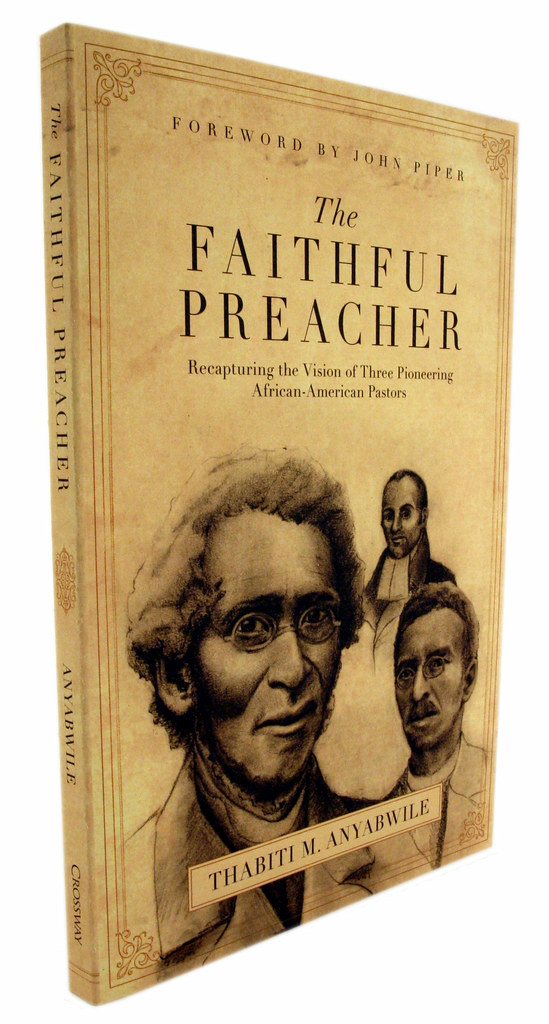
The Faithful Preacher by Thabiti Anyabwile (1581348274)

Book announcement
The Faithful Preacher
by Thabiti Anyabwile

Talking about the faith with my African-American pastor friends are some of the more awkward conversations I experience. We come from totally different backgrounds, with totally different perspectives, and that leaves very little common ground. So I am greatly encouraged to see blogger, pastor, and author Thabiti Anyabwile taking the time to address the nature and status of the black church in a series of blog posts titled, Can the Predominantly African-American Church Be Reformed? I have learned a lot about why my friends and I have a hard time discussion the nature of the church. These blog posts are interesting and engaging.

In seeking the reformation of the “predominantly African-American church” Anyabwile has also set out to present the lives of three black pastors. He does this in his new book from Crossway titled, The Faithful Preacher: Recapturing the Vision of Three African-American Pastors. The pastors highlighted are Lemuel Haynes (1753-1833), Daniel A. Payne (1811-1893) and Francis J. Grimké (1850-1937). The book contains one short biography of each man but is largely comprised of sermon transcripts.

Here is one short example from a sermon by Francis J. Grimké from 1919. Addressing the reconstruction of the damages done by World War I, he says,

“As a minister of Jesus Christ in this co-called work of spiritual reconstruction, I have nothing new to offer, nothing better to offer than I have been offering for the last forty years – the gospel of the grace of God in Christ Jesus; the taking of Christ’s yoke upon us and learning of Him; denying ourselves and taking up our cross daily and following Him through evil report as well as good. Others may have something new, something better to offer, but I have not, and I have no disposition to seek for anything else or any desire to offer anything else. So far as the world has been saved, the gospel preached and lived is the only thing that has saved it, and the only thing that will continue to save it” (p. 169).

“They were Puritans,” Anyabwile writes of the three preachers. “They committed themselves to sound theology in the pulpit, theologically informed practice in the church, and theologically reformed living in the world.”

Thabiti Anyabwile is serving the greater church well by asking some hard questions but also – building from the lives and preaching of three African-American preachers – presenting a vision for black pastors to be radically Cross-centered. And that’s a vision predominantly white churches can learn from, too.

——————

Title: The Faithful Preacher: Recapturing the Vision of Three African-American Pastors
Reading level: 2.0/5.0 > easy
Boards: paperback
Pages: 191
Volumes: 1
Dust jacket: no
Binding: glue
Paper: normal
Topical index: yes
Scriptural index: yes
Text: perfect type
Publisher: Crossway
Year: 2007
Price USD: $15.99
ISBNs: 1581348274, 9781581348279