Journaling … A Day in the Life of a Humble Calvinist

Journaling > A Day in the Life of a Humble Calvinist

Calvinism is big. It’s a worldview that embraces God’s sovereignty over every event in world history. God is over the shifting of political powers, the immigration of people, the establishment of cultures, natural calamities, and even down to the fact that you are reading this right now. By nature, Calvinism is concerned with everything because God is concerned with everything. So how can we allow the biblical theology of Calvinism and the Cross to penetrate our daily living so that dry, stoic, intellectual Calvinism becomes living and breathing Humble Calvinism?

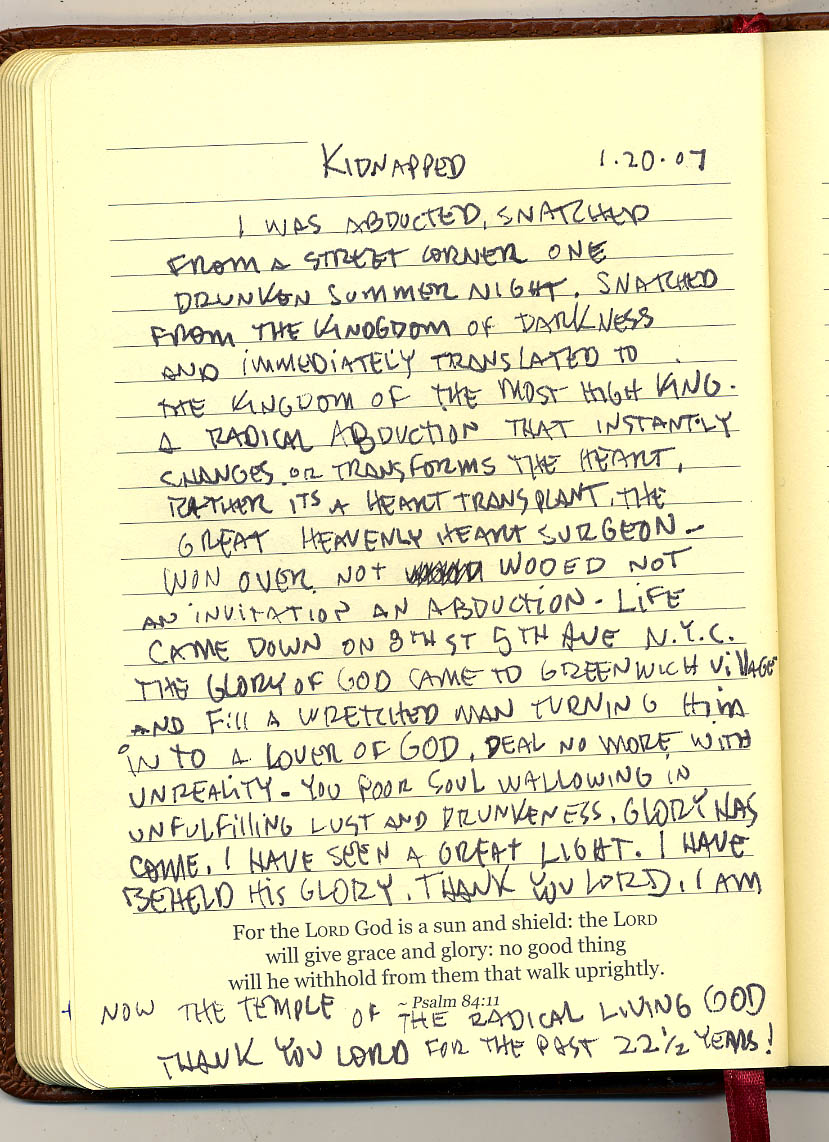
Well, one of my dear friends has helped me see what this looks like. Tom Fluharty is an tomflu.gifincredible artist. His talents are phenomenal. But even more phenomenal is God’s grace that allows him to focus his mind, will and affections on Gospel in his daily devotional times. I get to read some of these journal articles that he sends my way on occasion. I wanted to share a recent journal entry.

We’ve been talking recently about God’s abduction. Sinners like us don’t want God. We all naturally turn away from Him, fail to do anything to glorify Him, and thus we all become worthless to Him (Rom. 3:12). God must abduct us! He must chose for us something better than we’ve chosen for ourselves. This thought caught the attention and affections of Tom in his recent journal entry. This is what he wrote,

Kidnapped 1.20.07

I was abducted, snatched from a street corner one drunken Summer night. Snatched from the kingdom of darkness and immediately translated to the kingdom of the Most High King. A radical abduction that instantly changes or transforms the heart. Rather it’s a heartabducted.jpg transplant by the great heavenly heart surgeon. Won over not wooed. Not an invitation, an abduction. Life came down on 8th st 5th Ave N.Y.C. The glory of God came to Greenwich Village to fill a wretched man, turning him into a lover of God. Deal no more with unreality. You poor soul wallowing in unfulfilling lust and drunkenness. Glory has comes. I have seen a great light. I have beheld His glory. Thank you Lord. I am now the temple of the radical living God. Thank you Lord for the past 22 1/2 years!

“Won over not wooed. Not an invitation, an abduction.” That thought flows from a radical, Humble Calvinism. Tom encourages me through his example. Our communion with God should be saturated with the Cross, saturated with an awareness of our depravity, the personal election of God, God’s strength to uphold us and the glory of God’s sovereign majesty! This is a reminder that Humble Calvinism should transform every area of my life, and even show itself in my journal entries. We build off theology. But let’s not stop by saying “Isn’t it amazing that God elects sinners?” Let’s move beyond this and say, “Isn’t it amazing that God elected such a sinner as I when I was … ?” Humble Calvinism must penetrate our hearts and reveal itself in how we worship the Sovereign Lord and this will show itself in our daily journals.

———————–
UPDATE: I wrote this post Sunday morning only to find out that Tom and his precious family were invited over for the surprise birthday bash my wife pulled off that afternoon. Well, he shows up with a present. It was obvious that it was a painting he was giving me (that alone was and amazing). I open it to find one of my favorite paintings published on the cover of the Weekly Standard called Master & Commander.

I’m not really a political guy myself, more drawn to the phenomenal character and detail of the painting (like Condi’s pearl necklace). Because of these factors, this magazine cover sat above my desk for several months in Omaha — long before I ever met Tom. To know Tom and now to have the actual painting are both amazing gifts. You can see the painting here and you can read more about how he drew it here. But if you’re a friend, you can see it in person, featured at the Tony Reinke Museum of Art in Bloomington, MN. An amazing birthday gift from a very gracious man. Thank you Tom!

[You can watch Tom integrate art, Humble Calvinism and an amazing Cross-centered life here at his blog Amazed by Grace!]

Humble Calvinism: (8) The Institutes > Radical depravity and an inner-body experience (1.5)

02spurgeonhumcalvinism.jpg

Part 8: ‘Radical’ depravity (1.5)

Calvin has already covered two important points: First, the wisdom of God is displayed for all to see (like in lightening storm) and secosatellite.gifnd, sinners naturally suppress this truth for the sake of preserving their own sinful lifestyles. But he wants to cover these themes one more time before moving on to the importance of Scripture. So chapter five is a lengthy clarification.

1. All see the wisdom of God

It doesn’t matter if you are a renowned scholar in the natural sciences, astronomy, or medicine, or if you are skilled in the arts or a simple “unlearned stupid folk,” no one can “open their eyes without being compelled to see him” (52). And later, “there is no spot in the universe wherein you cannot discern at least some sparks of his glory” (52). And still later he broadens the language to say “there is no one to whom the Lord does not abundantly show his wisdom” (53).

Taking his cue from Psalm 104, the wisdom of God is “abundantly” displayed throughout the heavens for all to see. The ordering of the universe – and especially the things we take for granted – is a lesson in God’s wisdom.

But Calvin goes beyond the natural order. Using Psalm 107, Calvin understood that God reveals His sovereignty over the world in His relationship to us. He helps the troubled and humbles the proud. That God interacts with His creatures is unmistakable and obvious for all to see. He raises up the needy (Ps. 113:7) and confoundlight.gifs the wisdom of the world (1 Cor. 1:20; 3:19; Job 5:13).

Whether we are looking to the lightning storm, listening to the deafening power of a waterfall, looking at a satellite image of the earth, watching our hands work meticulously; or as we see God’s providence in caring for the needy and humbling the proud, all display God’s wisdom.

2. God’s wisdom in our bodies

Specifically, Calvin is blown away by the “articulation, symmetry, beauty and use” of the human body (54). To understand the wisdom of God, we don’t need an out-of-body experience. It’s right here.

Our own mouths, eyes and even our “toenails” display the wisdom of God (“toenail” is Calvin’s own word!). And what about dreams and the subconscious mind, ever working even when our bodies are asleep? What wondrous divine wisdom that as our bodies lay silent our souls are fully engaged! Look down at the hand scrolling through this blog post. You can command this hand from your brain and instantaneously your hand will move. Now fix your eye on the period at the end of this sentence. Amazing! What complexity is there in our bodies, even in voluntarily moving or stopping our eyes and hands. We should be amazed by God’s wisdom simply in the composition of our complex bodies.

Calvin builds from Acts 17:26-28 where he understands that even a blind man can search and find evidences of God when he says, “there is no need to go outside ourselves to comprehend God” (54). We descend into our composition to see God’s wisdom. This is not saving revelation, but it’s certainly enough to cause us to humble ourselves, seek and thank Him!

That sinners look for more evidences of God’s existence is proof of our sinful stupidity. We’ve missed it! “For the Lord manifests himself by his powers, the force of which we feel within ourselves and the benefits which we enjoy … we ought more to adore than meticulously to search out” (62). God’s wisdom was right there all along, woven into you.

That God’s revelation is right under our noses makes us even more guilty of not ‘finding’ Him. In his commentary he writes, “For God hath not darkly shadowed his glory in the creation of the world, but he hath everywhere engraven such manifest marks, that even blind men may know them by groping. Whence we gather that men are not only blind but blockish, when, being helped by such excellent testimonies, they profit nothing.” We are not blind, we are sinfully hard.

3. Sinfully guilty

Although we walk around showered in the wisdom of God, we repel this wisdom by our own sinfulness. This is one of the most heartbreaking truths of Scripture. “Yet after we rashly grasp a conception of some sort of divinity, straightaway we fall back into the ravening or evil imaginings of our flesh, and corrupt by our vanity the pure truth of God. In one respect we are indeed unalike, because each one of us privately forges his own particular error; yet we are very much alike in that, one and all, we forsake the one true God for prodigious trifles. Not only the common folk and dull-witted men, but also the most excellent and those otherwise endowed with keen discernment, are infected with this disease” (64).

For Calvin, the tendency of philosophy to birth man-made mental gods is a perfect illustration of the smartest men living with the disease of atheism. The longer philosophers contemplate God, the further away from Him they end up, until they have twisted and extinguished Him into nothing but a figment and a dream. We are all ravaged by this theological ‘disease.’

So where do we end up when our sin-filled search for God is not governed by divine revelation? We universally – scientist, artist and “stupid folk” – end up with a twisted, ignorant, demonic, futile, empty shadow of worship (1 Cor. 10:20, Eph. 2:12-13, Rom. 1:21, John 4:22).

Thus the wisdom of God in nature speaks to depraved sinners in vain. Without God breaking into our ‘disease’-laden interpretation of reality, we suffocate God’s wisdom with our foolishness.

And our blindness is our guilt. We exchange the knowledge of God for our own sin and thereby become God’s enemies (Rom. 1:18-32; 5:6-11). And Calvin has shown conclusively that (apart from the Cross) none are excluded from this condemnation. That includes you and me.

But there is hope. God is sovereign and His Word and Spirit are set to work. In the next two chapters Calvin will confront us with some of the most profound theology our little minds can hold. New and unstoppable wisdom is about to break into our deafness!

Calvinistic meditations …

1. The perfect knowledge of God is our goal! Our remaining atheistic tendencies (or ‘disease’) cause believers to look forward to a time when we will see God perfectly. Alluding to John 17:3, Calvin began this chapter by writing, “The final goal of the blessed life … rests in the knowledge of God” (51). Enjoying pleasure perfectly has everything to do with knowing God perfectly! And someday, though now we see dimly as in a reflection, our eyes will soon be filled with the untainted knowledge of God. What we ran from (the knowledge of God) will be our great and eternal delight!

2. There is nothing more sobering than our ‘radical’ depravity. We live scattered lives running towards sin and away from God. To even say the words “God does not exist” requires millions of brain cells, electrical reactions and muscle movements to produce, all of which display divine wisdom! We substitute God’s holiness for the off chance that it’s all coincidence.

There is a 100-percent chance our world was created by One with a Master plan (and we know it!). But in sin we cling to the 0-percent chance that everything came from nothing, and the even more unlikely and absurd idea that all of life originated from non-life.

We may not be full-throttled atheists, but we are all guilty of atheism. We are all theologically ignorant of God, turning our backs on Him (Rom. 3:10-12). Although we all continue in religion, we have become futile in our thinking and our foolish hearts are further darkened (Rom. 1:21). Only under this steeping pile of ignorance can we foster the courage to live in autonomy. We would rather worship our bodies (by clothing, weight loss, fitness, intelligence) the natural world (through astronomy, medicine, science, outdoors) and art (paintings, movies, music) than the One who made our bodies, the whole natural world and all our artistic senses! It is further evidence that as sinners “we grow increasingly dull” and the testimonies of God “flow away without profiting us” (63).

It’s hard to even contemplate the next point, but it’s true: It is for the sinful neglect of God (not for a lack of Election or Predestination) that sinners are justly condemned to hell forever. We deserve judgment for our ignorance and blindness. We are guilty.

And so this ‘radical’ depravity is a fitting Calvinistic title for us all. We become ‘radically’ blind to God and ‘radically’ given to sinfulness and self-righteousness. It’s no surprise that sinners are saved only through ‘radical’ repentance (Luke 18:9-14). And our ‘radical’ sin and just condemnation being removed by the perfect sacrifice of Christ becomes ‘radical’ grace!

But our church culture defines sinners as broken people who need healing not depraved sinners who are hopeless. According to the bible, “to be a sinner is not merely to be morally imperfect or to be unable to achieve one’s full potential without God. It is rather a description of human beings in an utterly ruined state, a state from which we are unable to deliver ourselves and in which we might all have been left to perish, and justly so” (Boice and Ryken, Doctrines of Grace, p. 72).

You will not read of this ‘radical depravity’ in N.T. Wright, John Eldredge, Joel Osteen, Rick Warren or most pop-Christian books. No matter how cool the cover looks, depravity doesn’t sell. But Calvin reminds us that this ‘radical’ truth about sin must be central to everything else. ‘Radical’ depravity must rest heavily upon us. It must weigh heavily in our churches, our friendships, our blogs, our evangelism and our sermons. I am convinced that Calvin presses us on this topic early and repeatedly in the Institutes because unless and until we comprehend our utter helplessness under our own sin, we will never understand God and His ‘radical’ grace. We will find grace “helpful,” but not truly amazing!

3. Our only hope is a God who overcomes our wills and invades our ignorance. Sinners, bound to their sinfulness, have no free will. The deception of our hearts is a bottomless pit of wickedness (Jer. 17:9). I cannot change my skin color, a leopard cannot change the color of its spots and a sinner cannot replace this ‘radical’ depravity (Jer. 13:23).

We cannot choose God. In fact, our problem is more that we would never want to choose Him on our own! He must choose us (John 15:16). As Dr. D. Clair Davis wrote, “The Lord doesn’t talk about your sin so you’ll think you’re trash. He talks about it just because you’re not. He talks about it because he made you in His own image, with an infinitely higher and brighter plan for you than the one you chose for yourself” (The Practical Calvinist, p. 28). God must come and invade the plan we have chosen for ourselves!

I close with Spurgeon’s personal account of this ‘radical’ grace: “There is a power in God’s gospel beyond all description. Once, I, like Mazeppa, bound on the wild horse of my lust, bound hand and foot, incapable of resistance, was galloping on with hell’s wolves behind me, howling for my body and my soul, as their just and lawful prey. There came a mighty hand which stopped that wild horse, cut my bands, set me down, and brought me into liberty… There was a time when I lived in the strong old castle of my sins, and rested in my works. There came a trumpeter to the door, and bade me open it. castle.gifI with anger chided him from the porch, and said he never should enter. There came a pleasant person, with loving countenance; his hands were marked with scars, where nails were driven, and his feet had nail-prints too; he lifted up his cross, using it as a hammer. At the first blow the gate of my prejudice shook. At the second it trembled more. At the third down it fell, and in he came, and he said, ‘Arise, and stand upon thy feet, for I have loved thee with an everlasting love.’ A thing of power! Ah, the gospel is a thing of power. I have felt it here, in this heart. I have the witness of the Spirit within, and know it is a thing of might, because it has conquered me. It has bowed me down.” (C.H. Spurgeon, Christ Crucified, sermon #7-8)

We have all chosen to turn away from God (Rom. 3:12). O, how God must save us from ourselves, our own wills, our own desires, our own pursuits! In our ‘radical’ depravity, God must “conquer” us. Lord, let this ‘radical’ message weigh heavily upon us as we pursue Humble Calvinism.

————————–

Click here to access previous posts in the Humble Calvinism index.

————————–
What’s so good about being a Calvinist?

What’s so good about being a Calvinist?

By Dr. D. Clair Davis

What’s so good about being a Calvinist? Well, it’s good for nostalgia. If your people came from Scotland, then you can put on your tartan bathrobe, play a bagpipe record, and say the first question of the Catechism. But then you’re only playing a game. You’re not a Scot, you’re a Tarheel. Grits beat oatmeal anytime.

It gives you something special to do while everyone else is into Halloween. You can have a Reformation Day slide show of the pastor’s wife in front of the John Calvin statue, which does brighten it up! Back in college we used to bring out a history prof to talk about Luther with a Norwegian catch in his voice. Then he disappeared for another year. He was the only Lutheran we had and we treasured him. Calvinists are rare too, but are you ready to be a prized antique?

You can hear far-out sermons on the Five Points of Calvinism … But basically the Five Points tell you how God saves people, and you’ve been saved for years. What you need to know is how to be a better wife and mother. You need to know how to get ready for your next mid-life crisis. You need to know how to pray when the pain gets sharper. How does being a Calvinist help then?

It helps because underneath all those questions about how to live is a much bigger, much more essential one: Why bother? How do you know the Lord really cares?

You don’t ask that one out loud in your Sunday-school class. But you know you’re eaten up with worry. You’ve gotten used to being bored with the Bible. You can’t identify with the things the other Christians talk about. You need a fresh start with the Lord. But where do you begin?

Now that’s where Calvinism really comes through for you. It applies the Bible where you need it the most. Think through the basics. Jesus died for you personally (Personal Atonement). He loves you, not what he can get out of you (Unconditional Election). He pours out his love on every bit of you, not just on what you think is your sweeter and nicer side (Total Depravity). His love is stronger than all your doubt and foolishness and fear put together (Irresistible Grace). He keeps on loving you, all the way through to the end (Perseverance of the Saints). That’s the Five Points of your Father’s love!

When you’ve digested how much the Lord has done for you, then you’ll know what you’re doing. That’s why the Lord kept telling his people, ‘Remember the Exodus!’ In the middle of the clutter and snarls in your life, keep in mind the Lord’s mighty, loving arm that lifted you out of slavery into the Land of Promise. ‘He who did not spare his own Son, but gave him up for us all – how will he not also, along with him, graciously give us all things?’ (Rom. 8:31-32).

Pondering the five points of God’s grace isn’t a nostalgia trip. When you’re alert about your salvation, then you know what life is all about. When you see how your salvation comes only from the Lord and not a bit from yourself, then you understand a lot of other things too. You know what’s really important and what to do next…

But don’t stop there. Orthodox Presbyterian minister Henry Coray once told his congregation to turn 360 degrees from sin, and it took them five minutes to figure out where that would take them. But your problem isn’t in going too far, but in not going far enough. After turning away from glorying in yourself, be sure to start glorying in Jesus Christ. If you stop half-way, all you have left is apathy. But the Lord has called you to enjoy him forever. You do that by looking at Philippians 2 and doing some solid thinking about what Jesus gave up for you. Weigh what it means for him to be a servant. Consider his obedience all the way to death. Try to grasp Jesus Christ crucified, crying out, ‘My God, my God, why have you abandoned me!’ Now you’re ready to start telling yourself and the Lord how wonderful and glorious Jesus Christ is.

And then worship him in the Spirit. Only the Holy Spirit can turn your foolish heart away from that list of achievements to the cross of Christ. Only the Spirit can show you Jesus in his glory. Only the Spirit can focus your whole heart and life and hope upon your Savior.

That’s what so good about being a Calvinist. You have a way to apply the splendor of God’s love to the nitty-gritty of your life. Go on taking the Lord seriously, in all his grace and mercy. Go on living before his face with joy.

Dr. D. Clair Davis, published in the Presbyterian Journal (Dec. 3, 1986) and republished in The Practical Calvinist: An Introduction to the Presbyterian and Reformed Heritage in Honor of Dr. D. Clair Davis (Mentor/Christian Focus; Great Britain) 2002, pp. 47-49.


(Published on the TSS blog with permission of Christian Focus).

————————–

Click here to access previous posts in the Humble Calvinism index.

————————–

Humble Calvinism: (7) The Institutes > Weaving a wicker basket god (1.4)

02spurgeonhumcalvinism.jpg

Part 7: Weaving a wicker basket god (1.4)

The knowledge of God is freely available to anyone with a microscope, telescope or just the naked eye. But we commit something awfully criminal to this knowledge. We see the image of God displayed in the universe, but similar to a weaver twisting wicker into a basket, we twist theweaving.gif inclination towards Him into our own image of who we think He should be. Our twisting and distorting of God produces our own flimsy and crunchy god.


The knowledge of God is all around us. Our consciences tell us He exists. We cannot run away from Him. So what causes us to twist the knowledge of God? This is the next step in Calvin’s thought.

Calvin says every sinner twists the knowledge of God because we don’t want to humble ourselves to fear and love the God who is holy, just and absolute.

1. All sinners weave their own god (1.4.1)

Calvin writes, hardly one in a hundred sinners fosters the knowledge of God implanted within, and for these few that do, there is no permanent fruit that results. At best, the sinner’s search to know God is fruitless. Sinners compare and contrast themselves to the god of their imagination and seek to make a god in their own image.

Sinners “do not therefore apprehend God as he offers himself, but imagine him as they have fashioned him in their own presumption” (47). We naturally measure God in our “by the yardstick” of our own “carnal stupidity” (47). In the end, the sinner does not worship God but a “figment and a dream of their own heart” (48). Or to say it another way, sinners like myself, worship our own twisted wicker baskets.

2. Weaving an unjust and untrue god (1.4.2-3)

Here Calvin begins to talk of atheism, but not because God’s reality is in question. Remember Calvin showed us (and Scripture defends) that no eraser can remove the knowledge of God etched into our hearts. True atheism is not possible. So why does Calvin here talk of the atheist?

For Calvin, “atheism” is not the erasing of all religious inclinations from the soul but stripping and twisting the character of God into a ‘new and improved’ non-god. The justice God displays in condemning sinners guilty of this is proof enough that it happens (Ps. 50:21). God hates it when we fashion our own understanding of who He should be.

Naturally, all sinners run away from God to avoid judgment for our wickedness, and all sinners run from the light of truth (see John 3:16-21). When we feel a religious inclination bubbling from our hearts, we weave a god who is not holy, who is not angry towards sinners and who rests content with sinners living in their own sin.

But God hates sin and judges sinners. As Calvinist D. Clair Davis wrote, “Don’t be misled by that talk about how the Lord hates sin, but loves the sinner. It’s people he gets angry with and sends to Hell, not boxes f01spurgeoncalvin5.jpgull of sin” (The Practical Calvinist, p. 31). All sinners know they should bow and worship the just God of creation. God has shown Himself to them (Rom. 1:19-20). But we do not honor Him or give thanks to Him and so our thinking becomes futile, our hearts grow darker, we create wicker gods and tumble further and further into sinfulness (Rom. 1:18-32). This is the radical depravity of the sinner’s soul.

The path towards atheism is clear to Calvin. First, a sinner indulges in sinful living. Second, the sinner must either be faced to repent and turn from that sin or weave a god who isn’t bothered by his sin. Once the sinner lives in sin and fashions a god who is “okay” with that sin, atheism is birthed. It’s not a total denial of the divine (that’s not possible) but because – in the mind of the sinner – the true God has been gagged and handcuffed. This is atheism!

Calvin writes, “whoever heedlessly indulges himself [in sin], his fear of heavenly judgment extinguished, denies that there is a God” (48). Atheism is a moral conclusion rooted in the sinner’s sought out freedom to sin (see Ps. 14:1; Matt. 13:14-15; Isa. 6:9-10; Ps. 36:1, 10:11). Yet God will constantly bring these sinners back to His judgment seat and ever remind them that He is here, He is un-gagged, He is just, and He is angry towards sinners.

So central to God is His perfect holiness and power to judge sinners that a denial of these is to be miles away from knowing Him. It is to be an atheist.

So don’t be deceived by religion. Sinners worship wicker-basket gods. We all naturally create gods suitable to our own sinfulness, fashioned in our own sinful suppression of the truth. False gods are non-gods (Gal. 4:8). And Humble Calvinism reminds us that atheism frequently disguises itself under a “zeal for religion” (49). Thus genuine religion must be determined by its truthfulness.

3. Weaving an easily-pleased god (1.4.4)

Sinners weave a god who is pleased with religious ritual. Calvin writes, “lest they should everywhere seem to despise him whose majesty weighs upon them, they perform some semblance of religion” (50). All sinners feel the weight of God, and we are driven to do something. But to preserve our sinfulness, we reduce religion to rituals. “Where we ought to serve him in sanctity of life and integrity of heart [that’s piety], they trump up frivolous trifles and worthless little observances with which to win his favor” (51).

Atheism flows from the desire to avoid God’s justice, but a true knowledge of God (you will remember) flows from genuine piety towards God. We must be driven towards God to find humility and victory over sin. If our god does not produce humility and give victory over sin, our god is “scarcely even worth being called a shadow” (50). Growth in godliness is not optional to the child of God, it’s a very tangible evidence of genuine piety. It’s the one certain evidence thatcalvininstitutes.jpg ‘religious atheism’ has been destroyed by the Gospel.

Our lives are transformed! Hopefully you love and fear God. He invaded our atheistic hearts by His sovereign grace. “Frivolous trifles” of religious devotion are now insufficient for our hearts. We want the Cross! We want to die to the world as the world died to us. We want to kill sin and boast in the foolishness of God! A fear and love of God drives our lives. This is to be bound to the genuine God!

The alternative is atheism – resting upon “frivolous trifles” of religion to please the wicker-basket god twisted into your own image. So to be religious but not godly is the hypocrisy of the ‘religious atheist.’

Calvinistic meditations …

1. Our natural atheistic hearts must drive us to the Word. I frequently think of bible reading as a hobby, of something I want to do more often (like playing more basketball). Scripture frequently becomes a routine. Humble Calvinism shows us the necessity of Scripture – we must be driven back to Scripture to understand the biblical God. Frequently we need Scripture to smash our wicker-basket-gods. Why do people not read the Old Testament? Because God seems to be different than we suppose He should be. Smash! We need to approach the Bible, not to be theologically comforted, but to receive theological correction. God hates it when sinners think He is just like us (Ps. 50:21). And that’s exactly what happens when sinners are left to their own. We cannot overstate the importance of Scripture to worshipping God in truth. We must humbly and persistently ask ourselves if the God of Scripture is the God we worship.

2. The gospel and the sinner are steaming towards a head-on collision!
Why is evangelism hard? Because we are breaking into sinners’ worlds with the message that they must give up the one thing that gives them pleasure (sin) because the Cross has something so much better for them! The gospel meets ‘religious atheism’ like a meat mallet coming towards a tough steak. The gospel (lovingly) pounds our hearts soft and this directly confronts our sinful addictions. Pray that God would sovereignly bless your evangelism to be fruitful, but don’t expect evangelism to be easy. And likewise we should never expect the church – which is the pillar and support of God’s knowledge in the world – to be a place where sinners feel comfortable to bring their wicker baskets. Invite sinners to church in the hopes that God will reach out His sovereign foot and step on their basket. As soon as we twist our evangelism and sermons because we think sinners will be offended, we’ve bowed in admiration to the wicker baskets coming in the front door. Let them collide.

3. Unbelievers are not unreligious.
We are all religious. The question is this: Are my religious beliefs confirmed by the revelation God gives us about Himself? In my experience people get really nervous when you look beyond the trifles of religious observance to look at the truth claims behind one’s beliefs. There is an overwhelming pull in the American church to separate life and doctrine, to say that one is a good and religious person without asking ‘what is the doctrine they believe?’ How many funerals have you attended where one’s life accomplishments were listed? How many funerals have you attended where one’s personal doctrines of God were listed out? Both are equally important in the end. Life and doctrine must go together: “Watch your life and doctrine closely. Persevere in them, because if you do, you will save both yourself and your hearers” (1 Tim. 4:16, NIV). Being religious without being humbled under the theology of God’s holiness, justice and wrath is ‘religious atheism.’

4. Churches that understand the inclination of the sinful heart will place great stress on biblical preaching and theology.
I fear many churches get bored with scriptural preaching and offer only ‘practical’ messages on finances, children, marriage, etc. because they fail to see the inclinationwilsongod.gif towards ‘religious atheism’ in our hearts. Nothing is more central to Christianity than a proper understanding of God that brings humility and fear of Him. Preaching about God’s wrath and holiness and judgment upon sinner, preaching about His Son Who lived a perfect life and died a wretched death because I lived a wretched life and want a glorious death … These doctrines bring us back to the love of God and humble us for a life of godliness. Theology – a true knowledge of God – requires a life-long re-calibration of the sinner’s mind and heart.

Humble Calvinism forces introspection. Have I been broken under the holiness, wrath and justice of God? Has God crushed my wicker-basket god? Have I been illuminated to the forgiveness and love of God in the Gospel? Do I boast in the Cross? Do I hate sin? Am I drawn to, or repelled by, the God of Scripture? These questions of Humble Calvinism are central to understanding our authenticity before God.

Humble Calvinism humbles, because it reminds sinners like myself of our theologically twisted past. In some landfill in Nebraska rots the crushed wicker basket I formerly called ‘god.’ Such amazing grace!

————————–

Click here to access previous posts in the Humble Calvinism index.

Humble Calvinism: (6) The Institutes > The implanted knowledge of God (1.3)

02spurgeonhumcalvinism.jpg

Part 6: The implanted knowledge of God (1.3)

There is no proper understanding of culture, man, belief, unbelief, evangelism, sin and preaching without a theological substructure. A truly effective methodology of ministry must begin with truly biblical theology. Calvin understood this well.01spurgeoncalvin4.jpg

If you are a pastor, evangelist, or just a Christian who loves the lost, your great conviction is to share the truth of God to others. Before we begin considering how others come to know God as their Savior (and even how we ourselves came to know God as Savior) it’s critical to understand how God communicates Himself to all sinners. In chapters 3-9, Calvin forces us to wrestle with a biblical understanding of the knowledge of God. If we miss this foundation, we will seek to communicate God to others in a way built upon a false method of ministry.

The knowledge of God is etched on every soul (1.3.1)

We will soon look at Calvin’s understanding of a universal knowledge of God in the hearts of all sinners. But first Calvin tells us why God has “etched” this knowledge into every heart. “To prevent anyone from taking refuge in the pretense of ignorance, God himself has implanted in all men a certain understanding of his divine majesty” (43).

The word “theology” literally means “knowledge of God.” I remember a pastor sitting in my living room just after God sovereignly saved my soul at the age of 22. I told the pastor I wanted to learn theology. He said, “you already have a theology, you mean you want to foster a biblical theology.” Yes! He was exactly correct. Since birth I have understood something of God. Theology is not a big book with lots of Scripture references, but something we are born with. Why?

God implants this knowledge in all sinners to “prevent anyone from taking refuge in the pretense of ignorance.” So ask a sinner, “Why do you not love and follow God?” Sinners can say they love sin more than God, they can say they hate God, they can say they want to live without God’s authority in their lives, but NO sinner can say ‘I don’t follow and love God because I don’t know anything about Him.’ The argument of ignorance is “pretense.”

Calvin writes, “a sense of deity” is “inscribed in the hearts of all” (p. 44). Thus, because “one and all perceive that there is a God and that he is their Maker, they are condemned by their own testimony because they have failed to honor him and consecrate their lives to his will” (p. 44).

As sinners, we are all aware of God and know we must submit and love Him. We respond by running away from Him. We, who are created to worship God, substitute Him with the worship of money, sex, alcohol, work, children, and religion.

Proven by the masses and wicked (1.3.2)

Because some knowledge of God is etched in the hearts of all men, women and children, it follows that we should see evidences of this in our culture. We see this first in the masses who are drawn to religion. The “inclination toward religion springs as from a seed” (p. 45).

Lenin and Marx both said religion is the “opiate of the people.” But religion would fall on deaf ears without first the seed of God implanted the heart. The most persuasive deceptions come from religious leaders (like some TV evangelists and all false religions) who foster lies from the religious inclinations of people. Masses of people will follow the “opiate,” false religions and deceptive false teachers, only because they first know God exists. (However, it should be noted that following false religions shows a sinner seeking to appease his conscience without repenting to the true God.) All sinners know something of God.

Second, Calvin says even the most wicked, God-ignoring sinners are (at times) overwhelmed with a sense of God’s judgment. They seek to erase the thought from their minds and run from God but the sense of His judgment ever returns into their conscience and “rushes in with new force” (p. 45). “The impious themselves therefore exemplify the fact that some conception of God is ever alive in all men’s minds” (p. 45).

Impossibility of atheism (1.3.3)

A sense of God is permanently etched into the souls of sinners. We cannot erase it! Atheism – being convinced God does not exist – may sound pleasing to the ear of the unrepentant sinner but it will never bring peace to the “etched” conscience.

The knowledge that God exists is “not a doctrine that must first be learned in school, but one of which each of us is master from his mother’s womb and which nature itself permits no one to forget, although many strive with every nerve to this end” (p. 46).

Sinners are fully aware that God exists, that by not submitting to Him we are all worthy of judgment. So what prevents every sinner from coming to God, repenting and worshipping Him? That’s what Calvin addresses in the next chapter.

Calvinistic meditations …

Like Calvin said, learning about God is unlike academic learning. For example, a biology student begins in ignorance and through training begins to understand more and more of the field. Knowledge of God is different because sinners begin with the knowledge of God etched within their hearts! We are all fully aware that God exists and that His judgments are real. Unlike academic studies, there is no true ignorance of the subject. Sinners suppress the truth of God in unrighteousness (Rom. 1:18-32). To say there is no God is not intellectually ignorant, but morally foolish (Ps. 14:1). Without this foundation, we will treat sinners as ignorant learners, like those entering Biology 101 for the first day of class.

Scripture prevents anyone from “taking refuge in the pretense of ignorance” (p. 43). The truth is that all sinners know of God, but push Him away in their sin. This pushing away truth in preference of sin is the basis for God’s judgment of all sinners (John 3:19-20). We are not ignorant people needing further proof of God, but sinners who need the power of God to break us under our sinfulness. Our failure to seek God and submit to Him is “without excuse” (Rom. 1:20).

When we treat sinners as largely good people who are indifferent towards God, we introduce significant lies into our methodologies. We forsake the preaching of truth on Sunday mornings and use it as a time to introduce non-Christians to fuzzy stories and vague principles. We begin treating sinners as largely ignorant of God, rather than fully aware of God. We begin thinking elementary knowledge and proofs of God’s existence can replace pleading with sinners to repent from their morally culpable suppression of God’s self-evidence.

The methodology of the church is always bound with the theology of the church. That God etched a knowledge of Himself into every heart must be at the foundation of everything we do and say.

Only when we stop treating sinners as first-year biology students will we seek the sovereign power of God to open hard hearts through His means alone! That is exactly what Calvin was driven towards. And it is exactly why (by God’s generous grace) Humble Calvinism is so necessary today.

————————–

Click here to access previous posts in the Humble Calvinism index.

Books > New book on Calvin: The preacher

New book on Calvin: The preacher

I am well aware that Calvin was not perfect but I find criticisms of his preaching style to be misleading. If you read Calvin’s sermons you will see that he is a very clear, powerful and persuasive preacher. In Lectures on the History of Preaching, John Broadus writes that Calvin’s preaching was “practically destitute of imagination” (p. 119). What?! These types of statements have historically cast Calvin’s preaching in a negative light and (in my opinion) makes him one of the most under-appreciated preachers in church history.

So I’m excited to see that Steven Lawson is coming to a defense of Calvin the preacher. In Lawson’s new book he writes,

“Although some think of him as stiff and awkward in his pulpit ministry, [are you ready for this?] Calvin was well-equipped in the creative aspects of effective communication. Although he was certainly not a great orator, he was more than just a skilled exegete. Standing in the pulpit with an open Bible, Calvin skillfully painted with many bold brushstrokes of colorful human language. The resplendent hues of effective communication were on his preaching palette, ready for his use. At his disposal was an array of vivid figures of speech, rhetorical questions, biting sarcasm, compelling language, colloquial expressions, and the like. Such are the tools of the art of vivid preaching, and their effective use often separates mediocre exposition from good and even great pulpit work.”

– Steven Lawson, The Expository Genius of John Calvin (Reformation Trust) pp. 84-85. [Note: The anticlimactic emphasis is mine, as is the bold lettering and special emphasis where both bold and italic are use on the word “creative.”]

The Expository Genius of John Calvin will be published in March by Reformation Trust (Ligonier). Preachers will find Lawson’s principles on exegesis and homiletics very helpful. Thank you Dr. Lawson for this encouraging (and history-straightening) book!

————————–

Click here to access previous posts in the Humble Calvinism index.

————————–