The Word in the Church

“…Without this transcendent Word in its life, the church has no rudder, no compass, no provisions. Without the Word, it has no capacity to stand outside its culture, to detect and wretch itself free from the seductions of modernity. Without the Word, the church has no meaning. It may seek substitutes for meaning in committee work, relief work, and various other church activities, but such things cannot fill the role for very long. Cut off from the meaning that God has given, faith cannot offer anything more by way of light in our dark world than what is offered by philosophy, psychology, or sociology. Cut off from God’s meaning, the church is cut off from God; it loses its identity as the people of God in belief, in practice, in hope. Cut off from God’s Word, the church is on its own, left to live for itself, by itself, upon itself.”

David F. Wells, God in the Wasteland: The Reality of Truth in a World of Fading Dreams (Eerdmans, 1994) p. 150.

Introverts in the Church [book review]

Imagine you are called to ministry, but you are introverted. What do you do? Do you choose academic ministry and a life of reading, writing, and libraries? Perhaps, but what if you discover that the academic road is a mismatch? What then? Wing it as an introverted pastor in a local church? Or do you simply resign and leave church leadership to the extroverts?

This was Adam McHugh’s dilemma.

Just as McHugh was about to drop his resignation letter in the mailbox to discontinue his ordination process and leave his ministry hopes in the dust he paused, put the envelope in his pocket, and began to rethink the place of introverts in the church. His heart struggle and the ensuing research on this topic are now available in his newly published book Introverts in the Church: Finding our Place in an Extroverted Culture (IVP, 2009).

He writes:

Even before I began pastoral ministry, I was convinced that my personality excluded me from it. There was no room in ministry for someone of my disposition—or so I thought. In my mind at that time, ideal pastors were gregarious, able to move through crowds effortlessly, able to quickly turn strangers into friends. They could navigate diverse social circles and chat about any number of topics. They thrived in the presence of people and were energized by conversation and social interaction. Though they could work alone, their pulses quickened when they mingled among the people of their communities. They were charismatic and magnetic, capable of drawing all kinds of people to themselves by virtue of their likeability and able to persuade people to follow them based on charm alone. I saw them surrounded by eager church members, percolating with warmth, streaked with the admiration of their community.

I, by way of contrast, relished times of solitude, reflection and personal study. I enjoyed people, and I found satisfaction in depth of relationship and conversation, but even when I spent time with people I liked, I looked forward to moments of privacy. I found crowds draining. I could stand up in front of hundreds of people and preach a sermon without nervousness, but I often stumbled through the greeting time afterward because my energy reserves were dry.

Though I did not know this eight years ago, there is a label for this personality feature that I once thought crippled my potential for ministry: introversion. (11–12)

Partly, McHugh writes to expose what he considers to be an extroverted bias in our culture and in the church. “In mainstream American culture (in schools, corporations, and social institutions), those who are talkative, outgoing, energetic and assertive have a decided advantage. People who enjoy reflection and solitude, and listen more than they speak, are often viewed as enigmatic, antisocial and passive” (16). He quotes The Atlantic writer Jonathan Rauch (another introvert) who writes that introverts are “among the most misunderstood and aggrieved groups in American, possibly the world” (17).

So what distinguishes the extrovert from the introvert? McHugh summarizes the extrovert/introvert distinction by three primary categories: (1) extroverts recharge around people; introverts recharge in solitude, (2) extroverts can receive a lot of input and can process this information on their feet; introverts retire to process input and collect their thoughts, (3) extroverts tend to be broader in their thinking, thriving on broad input; introverts tend to be more focused and research limited topics more meticulously. McHugh gives evidence that these distinctions may be rooted in biological and neurological differences (43–46).

McHugh seeks to employ the introverted strengths for the service of the church. His repeated conclusion: “In our day, I am convinced that introverts are an important ingredient in the antidote to what ails evangelism. Our slower pace of life, our thoughtfulness, our spiritual and intellectual depth, and our listening abilities are prophetic qualities for the evangelical community” (31). In other words, introverted pastors can provide a church with a level of theological and spiritual depth and are suited to strategically disciple young men in the church.

In the celebration of the introverted strengths, however, the author is careful to ensure that introverted tendencies are never used as an excuse to avoid uncomfortable self-sacrifice for others (63), never an excuse to avoid fellowship and community (86–112), and never an excuse to avoid personal evangelism (170–186).

McHugh—a Presbyterian pastor—is most persuasive when he argues that biblical pastoral qualifications (eg Titus 1:5–8, 1 Tim 3:2–7, 1 Pet 5:1–3) do not favor extroverts over introverts. “The mark of godly leadership is not a magnetic personality; it is discipline, because discipline develops character” (123). Jonathan Edwards is one historical example of introverted leader he focuses on. Edwards was a disciplined introvert who led by his “relentless, probing intellect” and his “powerful, personal devotion.” Such a man will “radiate both the light and the heat of the gospel” (133). But nothing is mentioned of Edwards’s clumsy relational flubs (like the “young folk’s Bible” episode).

Conclusion

McHugh’s book investigates new territory, and because of this will likely attract a lot of attention. It will at least begin to help clarify the value/role of introverted pastors today (and throughout history), the value/role of introverted church members, and even how to reach the lost introverts of our communities with the gospel.

But you may not agree with everything. At times sections of the book lacked theological precision, some examples revealed a fuzzy polity, there was a heavy use of non-theological sources, an eclectic mix of ministry examples (some of whom I find theologically disagreeable), and the predictable trappings of therapeutically-defined goals (e.g. “healing” and “self-acceptance”).

Ironically, for all the introvert/extrovert temperament talk and therapeutic labels, this book may actually provide what we need to redirect our attention to God’s priorities in leadership selection. A discussion such as the one in the book may help us to move away from “personality type” labels and to discover church leaders that (more importantly) conform to the biblical pattern of faithfulness and discipline. It’s not a definitive book, but Introverts in the Church: Finding our Place in an Extroverted Culture is thoughtful and will help us celebrate the diversity of gifts God has given to the church.
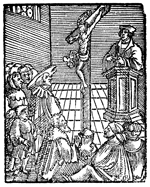
Preaching Christ

PreachingChrist“I sometimes feel as if what we need most is a sense of proportion in our presentation of the truth; a new sense of where the center of gravity in the gospel lies; a return to the ideal of Paul who determined not to know anything among the Corinthians save Jesus Christ and him crucified. This does not mean that every sermon which we preach must necessarily be what is technically called an evangelistic sermon. There may be frequent occasions when to do that would be out of place and when a discourse on some ethical or apologetic or social topic is distinctly called for. But whatever topic you preach on and whatever text you choose, there ought not to be in your whole repertoire a single sermon in which from beginning to end you do not convey to your hearers the impression that what you want to impart to them, you do not think it possible to impart to them in any other way than as a correlate and consequence of the eternal salvation of their souls through the blood of Christ, because in your own conviction that alone is the remedy which you can honestly offer to a sinful world.”

Geerhardus Vos, “A Sermon on 1 Corinthians 5:7” (October 1, 1902; Princeton Theological Seminary).

Preaching Christ

“Faith is not built by preaching introspectively (constantly challenging people to question whether they have faith); faith is not built by preaching moralistically (which has exactly the opposite effect of focusing attention on the self rather than on Christ, in whom our faith is placed); faith is not built by joining the culture wars and taking potshots at what is wrong with our culture. Faith is built by careful, thorough exposition of the person, character, and work of Christ….

We feed on Christ himself, and we do so not by some physical eating of his body, but through faith in the Christ proclaimed in Word and sacrament. These four alternatives [moralism, how-to, introspection, and social gospel] have left much of the evangelical and Reformed church malnourished. People know what they ought to do, but they are dispirited and lethargic, without the vision, drive, or impetus to live with and for Christ. And the reason for this dispirited condition is that the pulpit is largely silent about Christ. He is mentioned only as an afterthought or appendage to a sermon; in many churches, he is never proclaimed as the central point of a sermon, and surely not on a regular, weekly basis.”

—T. David Gordon, Why Johnny Can’t Preach: The Media Have Shaped the Messengers (P&R 2009) pp. 75—76, 88—89.

“love, love, love, love to thee”

In many ways, King Edward VI represented the Protestant hope of reformation in England. Edward was young, he was smart, he was sympathetic to the Protestants, and he put his royal money where his mouth was. But he was human, and a weak one. In the summer of 1553, at the age of 15, King Edward was struck ill and died. And so died much of the Protestant momentum.

Only a few days after his death, Edward’s sister, Mary I, became queen. Known as “Bloody Mary,” her first official acts were to reverse Edward’s pro-Protestant support, and for those laboring towards religious reform in England this meant that all hell was about to break loose.

John-Braford-preachingIn the week between the death of Edward VI and the beginning of Mary’s reign, John Bradford edited a sermon for the printer: “A Sermon of Repentance.” The death of Edward was a clear indication, Bradford wrote, that, “great and heavy is God’s anger against us.” If God took the life of their beloved king, what must God think of the sinfulness of the average man and woman? Bradford said, “now I beseech you all, all, all, and every mother’s child, to repent and lament your sin, to trust in God’s mercy, and to amend your lives.”

But that was all just a long intro to get to the sermon excerpt I want to feature today. The language is dated, but it’s worth your time to read it a few times. Toward the end of the sermon, as Bradford is calling sinners to trust in Christ he says the following about the grace and mercy of God in Christ:

O love incomprehensible! Who can otherwise think now but, if the gracious good Lord disdained not to give his own Son, his own heart’s joy, for us his very enemies, before we thought to beg any such thing at his hands, … who, I say, can think otherwise but that with him he will give us all good things? If, when we hated him and fled away from him, he sent his Son to seek us; who can think otherwise than that now we loving him, and lamenting because we love him no more, but that he will forever love us? He that gives the more to his enemies, will not he give the less, to you, to his friends? God hath given his own Son, than which thing nothing is greater, to us his enemies: and, we now being become his friends, will he deny us faith and pardon of our sins, which, though they be great, yet in comparison they are nothing at all? …

Jesus Christ gave his life for our evils, and by his death delivered us. O then, in that he lives now and cannot die, will he forsake us? His heart’s blood was not too dear for us when we asked it not: what can then be now too dear for us asking it? Is he a changeling? Is he mutable as man is? Can he repent him of his gifts? Did he not foresee our falls? Paid not he therefore the price? Because he saw we should fall sore, therefore would he suffer sore.

Yea, if his sufferings had not been enough, he would yet once more come again. God the Father, I am sure, if the death of his Son incarnate would not serve, would himself and the Holy Ghost also become incarnate, and die for us. This death of Christ therefore look on as the very pledge of God’s love towards thee, whosoever thou art, how deep soever thou hast sinned.

See, God’s hands are nailed, they cannot strike thee; his feet also, he cannot run from thee: his arms are wide open to embrace thee; his head hangs down to kiss thee; his very heart is open! So that therein see, search, look, spy; and you shall see nothing therein but love, love, love, love to thee. *

Under Mary’s reign, nearly 300 Protestants would by martyred. Bradford was one of them, burned at the stake in the summer of 1555. But not before Bradford traveled the country, proclaiming repentance and the free grace of our Savior Jesus Christ.

—–

NOTES:
* The Writings of John Bradford (Cambridge 1853), 1:75—76.

Preach Christ or go home—and 5 similar Spurgeon quotes I cherish

spurgeonI imagine pressurized steam shooting out of Charles Spurgeon’s ears at the mention of a preacher who neglects the topic of Calvary. Christless preaching was Spurgeon’s hot button. And on this topic he produced some choice quotes. Here are 6 of my favorites:

The motto of all true servants of God must be, “We preach Christ; and him crucified.” A sermon without Christ in it is like a loaf of bread without any flour in it. No Christ in your sermon, sir? Then go home, and never preach again until you have something worth preaching. [Exposition of Acts 13:13-49 published in 1904]

Leave Christ out? O my brethren, better leave the pulpit out altogether. If a man can preach one sermon without mentioning Christ’s name in it, it ought to be his last, certainly the last that any Christian ought to go to hear him preach. [sermon: “A Prayer for the Church” (1867)]

Leave Christ out of the preaching and you shall do nothing. Only advertize it all over London, Mr. Baker, that you are making bread without flour; put it in every paper, “Bread without flour” and you may soon shut up your shop, for your customers will hurry off to other tradesmen. … A sermon without Christ as its beginning, middle, and end is a mistake in conception and a crime in execution. However grand the language it will be merely much-ado-about-nothing if Christ be not there. And I mean by Christ not merely his example and the ethical precepts of his teaching, but his atoning blood, his wondrous satisfaction made for human sin, and the grand doctrine of “believe and live.” [sermon: “Christ the Glory of His People” (3/22/1868)]

Sooner by far would I go to a bare table, and eat from a wooden porringer something that would appease my appetite, than I would go to a well-spread table on which there was nothing to eat. Yes, it is Christ, Christ, Christ whom we have to preach; and if we leave him out, we leave out the very soul of the gospel. Christless sermons make merriment for hell. Christless preachers, Christless Sunday school teachers, Christless class leaders, Christless tract distributors—what are all these doing? They are simply setting the mill to grind without putting any grist into the hopper, all their labor is in vain. If you leave Jesus Christ out, you are simply beating the air, or going to war without any weapon with which you can smite the foe. [sermon: “Why the Gospel is Hidden” (2/11/1866)]

I know one who said I was always on the old string, and he would come and hear me no more; but if I preached a sermon without Christ in it, he would come. Ah, he will never come while this tongue moves, for a sermon without Christ in it—a Christless sermon! A brook without water; a cloud without rain; a well which mocks the traveler; a tree twice dead, plucked up by the root; a sky without a sun; a night without a star. It were a realm of death—a place of mourning for angels and laughter for devils. O Christian, we must have Christ! Do see to it that every day when you wake you give a fresh savor of Christ upon you by contemplating his person. Live all the day, trying as much as lieth in you, to season your hearts with him, and then at night, lie down with him upon your tongue. [sermon: “A Bundle of Myrrh” (3/6/1864)]

What was the subject? What was Peter preaching upon? He was preaching Christ and him crucified. No other subject ever does produce such effects as this. The Spirit of God bears no witness to Christless sermons. Leave Jesus out of your preaching, and the Holy Spirit will never come upon you. Why should he? Has he not come on purpose that he may testify of Christ? Did not Jesus say, “He shall glorify me: for he shall receive of mine, and shall shew it unto you”? Yes, the subject was Christ, and nothing but Christ, and such is the teaching which the Spirit of God will own. Be it ours never to wander from this central point: may we determine to know nothing among men but Christ and his cross. [sermon: “The Mediator, Judge, and Savior” (5/30/1880)]