Killing Sin: Crucify and Mortify

Killing Sin: Crucify and Mortify

“So bent is the great Apostle on our full salvation from all our sins that their mere crucifixion does not satisfy him. Nothing will satisfy him short of their full mortification. For crucifixion after all is only crucifixion. But mortification is more. Mortification is death. Mortification is absolute death. It is a complete and final and everlasting death. A crucified man may continue to live for hours and even for days after he has been nailed to his cross. But after he is dead, he is forever dead. And so it is with a sin. A sin may continue to live, and as a matter of fact is does continue to live for days and weeks and months and years after it has been crucified. But, when once it is dead, it is forever dead. Nailing a sin to its cross; denying it all its former freedom of action and all its former food and keeping it nailed on its cross, so that it cannot rob or murder anymore – that is its crucifixion. But all the time so to crucify a sin is not yet to mortify it, as Paul himself knew to his cost. For, if ever any man’s sins were crucified, it was the Apostle’s sins. But at the same time if ever any man’s sins were still alive and unmortified, to his unspeakable wretchedness, it was Paul’s sins. … while every saint’s self-crucifixion is his own immediate and ever-urgent duty, at the same time the full and final mortification of all crucified sin is the proper work of Almighty God alone.”

– Alexander Whyte, Thomas Shepherd: Pilgrim Father and Founder of Harvard (Reformation Heritage; Grand Rapids, MI) 1909/2007. Pp. 140-141.

Spiritual suicide and personal prayer

Spiritual suicide and personal prayer

“At the bottom and to begin with, there is some absolutely unaccountable alienation of our sinful hearts away from our Maker and our Redeemer. There is some utterly inexplicable estrangement from God that has, somehow, taken possession of your heart and mine. There is some dark mystery of iniquity here that has never yet been sufficiently cleared up. There is some awful ‘enmity against God,’ as the Holy Ghost has it: some awful malice that sometimes makes us hate the very thought of God. We hate God, indeed, much more than we love ourselves. For we knowingly endanger our immortal souls; every day and every night we risk death and hell itself [i.e. our greatest spiritual dangers] rather than come close to God and abide in secret prayer. This is the spiritual suicide that we could not have believed possible had we not discovered it in our own atheistical hearts. The thing is far too fearful to put into words. But put into words for once, this is what our everyday actions say concerning us in this supreme matter of prayer.
‘No; not tonight,’ we say, ‘I do not need to pray tonight. I am really very well tonight. My heart is much steadier in its beats tonight. And besides I have business on my hands that will take up all my time tonight. I have quite a pile of unanswered letters on my table tonight. And before I sleep I have the novel of the season to finish, for I must send it back tomorrow morning. And besides there is no such hurry as all that. I am not so old nor so frail as all that. Go thy way for this time, when I have a convenient season I will call for thee.’

But even when it is not so bad with us as that, at our very best there is a certain backwardness in prayer to which all praying men have to confess … There is no worse sign of our spiritual danger than the backwardness we have to pray. So weary are we of the duty, so glad are we to have it over, and so witty are we to find an excuse to evade it.”

– Alexander Whyte, Thomas Shepherd: Pilgrim Father and Founder of Harvard (Reformation Heritage; Grand Rapids, MI) 1909/2007. Pp. 55-56.

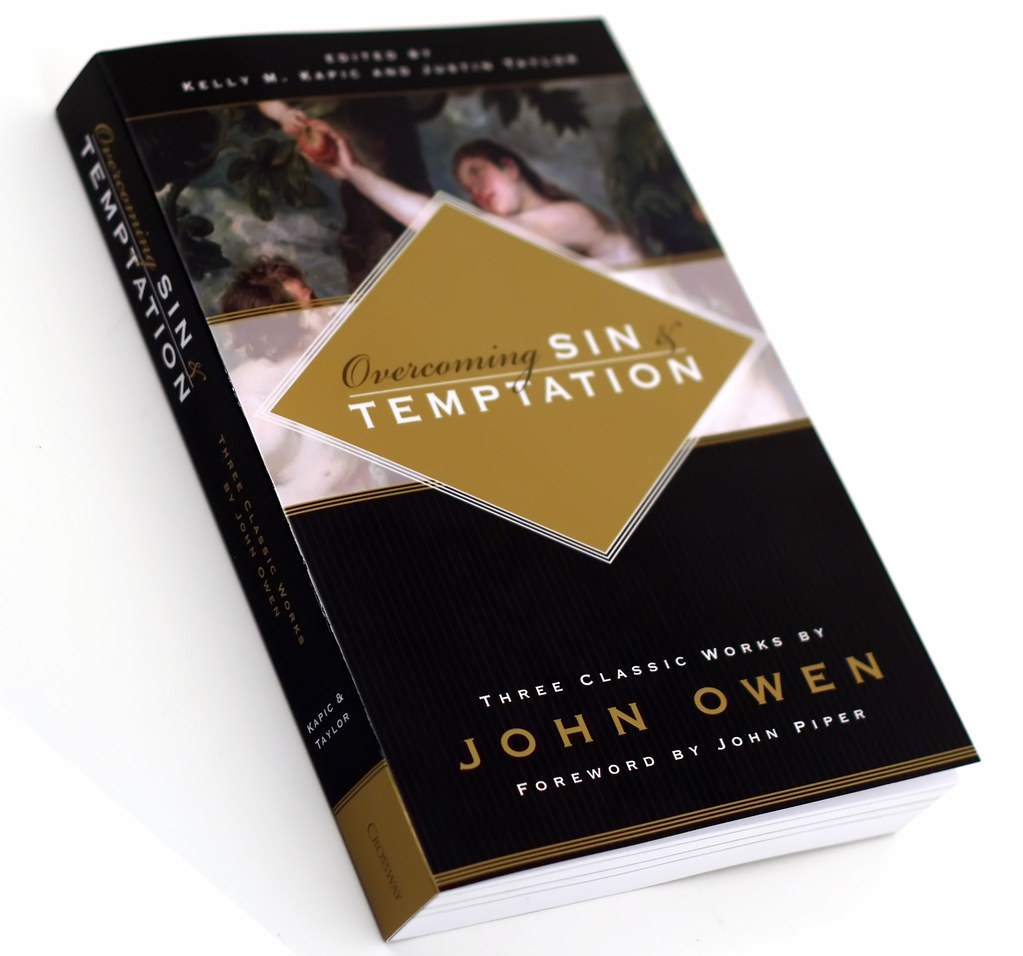
Overcoming Sin and Temptation by John Owen

Christmas gift idea:

Overcoming Sin and Temptation by John Owen

“As I look across the Christian landscape, I think it is fair to say con­cerning sin, ‘They have healed the wound of my people lightly’ (Jer. 6:14; 8:11, ESV). I take this to refer to leaders who should be helping the church know and feel the seriousness of indwelling sin (Rom. 7:20), and how to fight it and kill it (Rom. 8:13). Instead the depth and complexity and ugli­ness and danger of sin in professing Christians is either minimized—since we are already justified—or psychologized as a symptom of woundedness rather than corruption. This is a tragically light healing. I call it a tragedy because by making life easier for ourselves in minimizing the nature and seriousness of our sin, we become greater victims of it.”

– John Piper, foreword (p. 11)

—————————————————

Title: Overcoming Sin and Temptation
Author: John Owen [1616-1683]
Editors: Kelly M. Kapic and Justin Taylor
Contributors: John Piper
Rating (1-10): 10 (excellent)
Reading Level (1-10): 9 (tough)
Boards: paper
Pages: 462
Dust jacket: no
Binding: glue
Paper: normal
Topical index: yes
Scriptural index: yes
Text: perfect type
Extras: Excellent outlines, glossary, overviews, introductions and biography.
Publisher: Crossway
Price USD: $19.99
ISBNs: 9781581346497, 1581346492

Confess your sins to one another (part 8)

To whom should we make a confession?

At the instruction of Kris Lundgaard I began reading Life Together by Dietrich Bonhoeffer. It is filled with some wonderful principles on life within the Christian community. Written during the height of Nazi by Germany, Bonhoeffer reflects on the community of Christians he experienced with other men. What is the key quality of one who hears our confession, he asks? To be near the Cross.

“To whom should we make a confession? According to Jesus’ promise every Christian believer can hear the confession of another [John 20:23]. But will the other understand us? Might not another believer be so far beyond us in the Christian life that she or he would only turn away from us without understanding our personal sins? Whoever lives beneath the cross of Jesus, and as discerned in the cross of Jesus the utter ungodliness of all people and of their own hearts, will find there is no sin that can ever be unfamiliar. Whoever has once been appalled by the horror of their own sin, which nailed Jesus to the cross, will no longer be appalled by even the most serious sin of another Christian; rather they know the human heart from the cross of Jesus. Such persons know how totally lost is the human heart in sin and weakness, how it goes astray in the ways of sin – and know too that this same heart is accepted in grace and mercy. Only another Christian who is under the cross can hear my confession. It is not experience with life but experience of the cross that makes one suited to hear confession. The most experienced judge of character knows infinitely less of the human heart than the simplest Christian who lives beneath the cross of Jesus. The greatest psychological insight, ability, and experience cannot comprehend this one thing: what sin is. Psychological wisdom knows what need and weakness and failure are, but it does not know the ugliness of the human being. And so it also does not know that human beings are ruined only by their sin and are healed only by forgiveness. The Christian alone knows this. In the presence of a psychologist I can only be sick; in the presence of another Christian I can be a sinner. The psychologist must first search my heart, and yet can never probe its innermost recesses. Another Christian recognizes just this: here comes a sinner like myself, a godless person who wants to confess and longs for God’s forgiveness. The psychologist views me as if there were no God. Another believer views me as I am before the judging and merciful God in the cross of Jesus Christ. When we are so pitiful and incapable of hearing the confession of one another, it is not due to a lack of psychological knowledge, but a lack of love for the crucified Jesus Christ.”

– Dietrich Bonhoeffer, Life Together, Works 5:114-116

Confess your sins to one another (part 7)

With men it is confess and have execution,
but with God confess and have mercy.
We should never lay open our sins but for mercy.
So it honors God;
and when he is honored,
he honors the soul with inward peace and tranquility.
We can never have peace in our souls
till we have dealt roundly with our sins,
and favour them not a whit [bit];
till we have ripened our confession to be a thorough confession.
What is the difference between a Christian and another man?
Another person slubbers [is careless] over his sins
and he thinks if he comes to the congregation,
and follows the minister,
it will serve the turn [end].
But a Christian knows that religion is another manner of matter,
another kind of work than so.
He must deal thoroughly and seriously,
and lay open his sin as the chief enemy in the world,
and labor to raise all the hatred he can against it,
and make it the object of his bitter displeasure,
as being that that hath done him more hurt than all the world besides;
and so he confess it
with all the aggravations of hatred
and envy that he can…
That we in our confessions
(in our fastings especially)
ought to rank ourselves among the rest of sinners.
Perhaps we are not guilty of some sins that they have been guilty of.
God has been merciful to us and kept us in obedience in some things.
But, alas!
There is none of us all
but we have had a hand in the sins of the times.

Richard Sibbes, Works 6:188-189

Confess your sins to one another (part 6)

“Confession is an act of mortification,
it is as it were the vomit of the soul;
it breeds a dislike of the sweetest morsels
when they are cast up in loathsome ejections;
sin is sweet in commission,
but bitter in the remembrance.
God’s children find that their hatred
is never more keen and exasperated against sin
than in confessing.”

Thomas Manton, Works, 4:457

“Like a dog that returns to his vomit is a fool who repeats his folly.” (Proverbs 26:11, ESV)