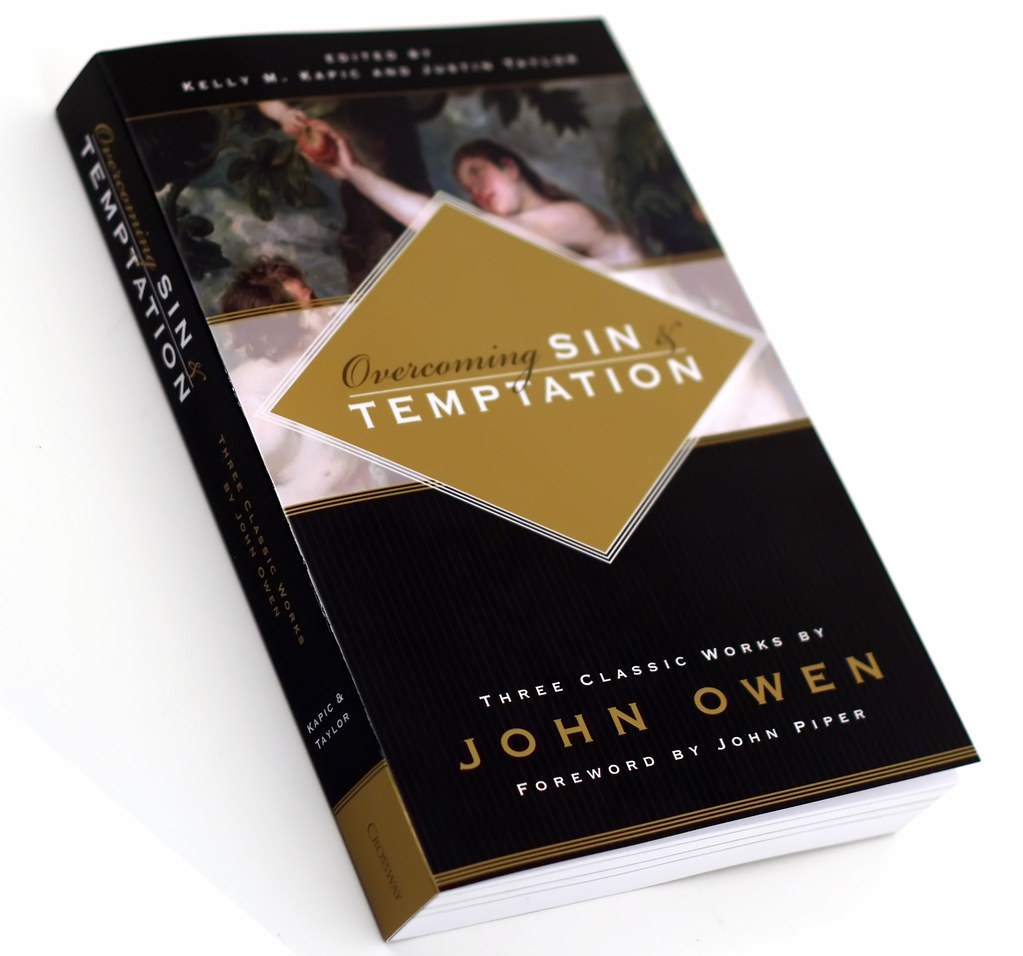
Overcoming Sin and Temptation by John Owen

Christmas gift idea:

Overcoming Sin and Temptation by John Owen

“As I look across the Christian landscape, I think it is fair to say con­cerning sin, ‘They have healed the wound of my people lightly’ (Jer. 6:14; 8:11, ESV). I take this to refer to leaders who should be helping the church know and feel the seriousness of indwelling sin (Rom. 7:20), and how to fight it and kill it (Rom. 8:13). Instead the depth and complexity and ugli­ness and danger of sin in professing Christians is either minimized—since we are already justified—or psychologized as a symptom of woundedness rather than corruption. This is a tragically light healing. I call it a tragedy because by making life easier for ourselves in minimizing the nature and seriousness of our sin, we become greater victims of it.”

– John Piper, foreword (p. 11)

—————————————————

Title: Overcoming Sin and Temptation
Author: John Owen [1616-1683]
Editors: Kelly M. Kapic and Justin Taylor
Contributors: John Piper
Rating (1-10): 10 (excellent)
Reading Level (1-10): 9 (tough)
Boards: paper
Pages: 462
Dust jacket: no
Binding: glue
Paper: normal
Topical index: yes
Scriptural index: yes
Text: perfect type
Extras: Excellent outlines, glossary, overviews, introductions and biography.
Publisher: Crossway
Price USD: $19.99
ISBNs: 9781581346497, 1581346492

Confess your sins to one another (part 8)

To whom should we make a confession?

At the instruction of Kris Lundgaard I began reading Life Together by Dietrich Bonhoeffer. It is filled with some wonderful principles on life within the Christian community. Written during the height of Nazi by Germany, Bonhoeffer reflects on the community of Christians he experienced with other men. What is the key quality of one who hears our confession, he asks? To be near the Cross.

“To whom should we make a confession? According to Jesus’ promise every Christian believer can hear the confession of another [John 20:23]. But will the other understand us? Might not another believer be so far beyond us in the Christian life that she or he would only turn away from us without understanding our personal sins? Whoever lives beneath the cross of Jesus, and as discerned in the cross of Jesus the utter ungodliness of all people and of their own hearts, will find there is no sin that can ever be unfamiliar. Whoever has once been appalled by the horror of their own sin, which nailed Jesus to the cross, will no longer be appalled by even the most serious sin of another Christian; rather they know the human heart from the cross of Jesus. Such persons know how totally lost is the human heart in sin and weakness, how it goes astray in the ways of sin – and know too that this same heart is accepted in grace and mercy. Only another Christian who is under the cross can hear my confession. It is not experience with life but experience of the cross that makes one suited to hear confession. The most experienced judge of character knows infinitely less of the human heart than the simplest Christian who lives beneath the cross of Jesus. The greatest psychological insight, ability, and experience cannot comprehend this one thing: what sin is. Psychological wisdom knows what need and weakness and failure are, but it does not know the ugliness of the human being. And so it also does not know that human beings are ruined only by their sin and are healed only by forgiveness. The Christian alone knows this. In the presence of a psychologist I can only be sick; in the presence of another Christian I can be a sinner. The psychologist must first search my heart, and yet can never probe its innermost recesses. Another Christian recognizes just this: here comes a sinner like myself, a godless person who wants to confess and longs for God’s forgiveness. The psychologist views me as if there were no God. Another believer views me as I am before the judging and merciful God in the cross of Jesus Christ. When we are so pitiful and incapable of hearing the confession of one another, it is not due to a lack of psychological knowledge, but a lack of love for the crucified Jesus Christ.”

– Dietrich Bonhoeffer, Life Together, Works 5:114-116

Confessing sin: series index

“confess your sins to one another …” (James 5:16, ESV)

Verbally confessing sin reminds us of the ugliness of sin. It is, as Richard Sibbes reminds us, the vomit of the soul. The sin that seemed so tasty is brought back to our remembrance as disgusting.

What makes sin so ugly (and confession so humbling) is to understand that each sin in our heart is worthy of eternal damnation. The failure to worship God with all of my heart and soul and mind (Matt. 22:37) is worthy of the cup of God’s wrath – to be trampled under the boot of God’s winepress of judgment.

Confessing this damning sin reminds me daily of Christ’s payment. He substituted Himself under the boot. He became sin, bore my sin, so I may be declared righteous in Christ (2 Cor. 5:21). And so to see the remains of ugly sin in my heart causes remorse and confession.

To confess is to verbally hate sin and to declare war against it. Confession is a verb that means much more than sitting in some booth with an anonymous figure sitting on the other side of an opaque opening. Confession for the Christian church is part of its daily life – it’s not only secret and hidden but also public!

Confession is personal (between me and God), interpersonal and heavenward (from me and my friend to God), interpersonal (to those I have wronged), and corporate (between my community of faith and God). Confession is the reminder that I am a sinner – wholly sustained by the sanctification, wisdom, righteousness, sanctification and redemption of Christ (1 Cor. 1:30). Confession proclaims, “Christ is our life” (Col. 3:4).

The current series focuses on the importance of confessing sin to one another. Here is the series outline:

1. Kris Lundgaard, Dietrich Bonhoeffer and confessing sins.
2. Richard Sibbes: Why do we confess sin?
3. Richard Sibbes: The church is comprised of humbled sinners
4. Stephen Charnock: Confessing in light of our Advocate
5. Anthony Burgess: Word convicts us of sin
6. Thomas Manton: Confession is the vomit of the soul
7. Richard Sibbes: Confess and find mercy
8. Bonhoeffer: To whom should we confess?
9. What exactly is confession (future)
10. Ezra and Nehemiah: The power of public confession (future)
11. Acts 19: Lessons from the Ephesian confession (future)
12. Dangers of concealing sin (future)
13. The power of confessed sin (future)
14. Shepherding as modeling confession (future)
15. Confession as commitment (future)
16. Concluding thoughts (future)

You can find the series (in descending order) << here >>

Confess your sins to one another (part 7)

With men it is confess and have execution,
but with God confess and have mercy.
We should never lay open our sins but for mercy.
So it honors God;
and when he is honored,
he honors the soul with inward peace and tranquility.
We can never have peace in our souls
till we have dealt roundly with our sins,
and favour them not a whit [bit];
till we have ripened our confession to be a thorough confession.
What is the difference between a Christian and another man?
Another person slubbers [is careless] over his sins
and he thinks if he comes to the congregation,
and follows the minister,
it will serve the turn [end].
But a Christian knows that religion is another manner of matter,
another kind of work than so.
He must deal thoroughly and seriously,
and lay open his sin as the chief enemy in the world,
and labor to raise all the hatred he can against it,
and make it the object of his bitter displeasure,
as being that that hath done him more hurt than all the world besides;
and so he confess it
with all the aggravations of hatred
and envy that he can…
That we in our confessions
(in our fastings especially)
ought to rank ourselves among the rest of sinners.
Perhaps we are not guilty of some sins that they have been guilty of.
God has been merciful to us and kept us in obedience in some things.
But, alas!
There is none of us all
but we have had a hand in the sins of the times.

Richard Sibbes, Works 6:188-189

Confess your sins to one another (part 6)

“Confession is an act of mortification,
it is as it were the vomit of the soul;
it breeds a dislike of the sweetest morsels
when they are cast up in loathsome ejections;
sin is sweet in commission,
but bitter in the remembrance.
God’s children find that their hatred
is never more keen and exasperated against sin
than in confessing.”

Thomas Manton, Works, 4:457

“Like a dog that returns to his vomit is a fool who repeats his folly.” (Proverbs 26:11, ESV)

Confess your sins to one another (part 4)

In a church, the sign that the wall of superficiality has been broken to pieces is when fellow Christians come together in humble confession (a goal that may take several years in some churches). Once the wall is broken down, another danger takes its place – the tendency to be blinded by personal sin.

Once we honestly look at our own hearts, we can quickly become overwhelmed in the dark cloud of our own remaining sin. The flesh and the spirit war on.

For some reason we naturally think that — while we are saved through no merits of our own — God’s acceptance of us as Christians is dependent upon our successes. And so under this legalism, the condemnation of our accuser and our own hearts becomes crippling.

In our repentance, Puritan Stephen Charnock reminds us to look beyond our sin to our Advocate in heaven (1 John 2:1). While we hate personal sin, and long for the moment we look Christ in the eye (1 John 3:2), “let us not be so dejected by them [sins], as cheered by the advocacy of our Savior.”
He writes,

“Hence arises comfort against
all the attempts and accusations of Satan
and the Rebellion of our own corruptions.

He [Christ] foresees all the ambushes of Satan,
searches into his intention,
understands his strategies,
and is as ready to speak to the Father for us,
as He was to turn back and look Peter into a recovery at the crowing of the cock.

The Devil accuses us when we fall,
but he has not so much on his side as we have.

All his strength lies in our sinful acts,
but the strength of our Advocate lies in His own infinite merit.

Satan has no merit of his own to enter as plea for vengeance.

When he pleads against us with our sins,
Christ pleads for us by His sufferings,
and if our adversary never ceases to accuse us,
our Advocate never ceases to defend us.

How comfortable it is to have One,
day and night,
before the throne to
control the charge of our enemy,
and the despondencies of our souls,
that Satan can no sooner open his mouth,
but He has one to stop and rebuke him,
Who has more favor in the Court than that malicious spirit,
and employs all His life and glory for our spiritual advantage,
Who will not upon such occasions want [lack] a good word for us!

And as to our corruptions,
He is in Heaven to make up all breaches.

His blood has the same design in His plea,
that it had in the sacrifice,
which was to purify us (Titus 2:4).

The difficulty of the cause does not discourage Him,
but honors both His skill in bringing us off,
and the merit of His blood which is the cause of our restoration.

Upon every occasion He steps in
to plead with the holiness of God
and pacify the justice of God
for our greater as well as lighter crimes.

While therefore we feelingly groan under our spiritual burdens,
let us not be so dejected by them,
as cheered by the advocacy of our Savior.”

Stephen Charnock
A Discourse of Christ’s Intercession
Works of Stephen Charnock [1684 ed.] pp. 2:1152-1153

It’s in this fog of self-condemnation that we help our brothers and sisters press closer to the Cross, and be “cheered by the advocacy of our Savior.”