Incarnation-Centered Christianity

Occasionally I’ll catch the Metro south and ride into the heart of D.C., jump off the train and hit the retro two-story Starbucks at 7th and E with just enough remaining time in my walk to finish my venti Americano before reaching the front door of the National Gallery of Art. It’s a great museum (over 30 Rembrandts, including a00015abThe Apostle Paul).

Inside the museum I’m struck by the number of paintings and sculptures that feature Christ, very often portraying Him as a baby. Popular are portraits of the nativity, and the virgin with the Child. This is a glimpse into church history. Study the writings of the early centuries and you’ll notice that the incarnation of Christ often trumps the crucifixion in its redemptive priority. But why? Why does the manger trump the cross?

The reason, says Reinhold Niebuhr, can be traced to the influence Greek and Hellenistic philosophy on the early theology of the Church. Greek philosophy centered man’s greatest need, not around freedom from personal sin nor freedom from God’s judgment, but around freedom from human finiteness. Man is limited in his humanity, and of course Jesus’s incarnation, rather than His atonement, answers this time-eternity question. Thus, being influenced by Greek philosophy, Christians like Gregory could write: “The word became man in order that thou mayest become a god.” It’s not uncommon to find Greek-influenced statements that point to the incarnational center of redemptive history and I believe you can pick up on this theme in modern literature like in the writings of Pope John Paul II (see his Redemptor hominis [Latin: “The Redeemer of Man”] for one example).

“The issue of Biblical religion,” Niebuhr writes, “is not primarily the problem of how finite man can know God but how sinful man is to be reconciled to God” (1:147). Very true. And when the center of redemptive history moves away from the atonement to anything else, we should be aware that secular philosophy is at the wheel determining the problem of man. And that problem will sound strangely different than the problem of personal sin, for which we need a crucified Savior.

You can read Niebuhr’s argument for yourself in The Nature and Destiny of Man (Westminster John Knox, 1941), in several places but especially in 1:144—147 and 2:59—60.

The incarnation, as glorious and magnificent as it is in the divine act is in itself, cannot be separated from the atonement. The connection between the two is unmistakable in passages like Matthew 1:21, John 3:16, Romans 8:3, and Galatians 4:4-5. Herman Bavinck insightfully wrote:

The incarnation is the beginning and introduction to the work of Christ on earth, it is true, but it is not the whole meaning, nor the most important meaning of that work. It is good to try to get a true understanding and a right idea about this, for there are those who think that the assumption of the human nature itself completes the full reconciliation and union of God and man. … The incarnation of the Son of God, without anything further, cannot be the reconciling and redeeming deed. It is the beginning of it, the preparation for it, and the introduction to it, but it is not that deed itself.

The nativity paintings are a good reminder of the historicity of Christ’s incarnation. But they are also a reminder that if we center redemptive history on the incarnation we will have missed the full scope of God’s redemptive plan, most likely misunderstood the holiness of God, and failed to understand man’s greatest problem and greatest need.

Book to watch for: God the Peacemaker

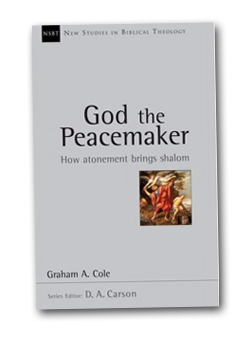
A very important book will be published this winter and should be on your radar. In December Graham Cole’s book, God the Peacemaker: How Atonement Brings Shalom (IVP, Dec. 2009; 320 pgs), will be published in the New Studies in Biblical Theology series. 9781844743964mThis will be a valuable contribution to the discussion of how God brings peace and justice to the world through Christ’s death. In discussions on the topic of Shalom I fear the atonement is often forgotten.

Here’s the publisher’s description:

What does God intend for his broken creation?

In this book Graham A. Cole seeks to answer this question by setting the atoning work of the cross in the broad framework of God’s grand plan to restore the created order, and places the story of Jesus, his cross and empty tomb within it. Since we have become paradoxically the glory and garbage of the universe, our great need is peace with God and not just with God, but also with one another. Atonement brings shalom by defeating the enemies of peace, overcoming both the barriers to reconciliation and to the restoration of creation through the sacrifice of Christ. The “peace dividend” that atonement brings ranges from the forgiveness of sins for the individual to adoption into the family of God.

Andy Naselli wonderfully introduced the book, and interviewed Cole about it, here.

D. A. Carson, from the preface: “Few if any themes are more central to the Bible than atonement. . . . My hope and prayer is that this volume will become a ‘standard’ contribution in the field, informing and enriching its readers as to what God achieved by sending his dear Son to the cross on our behalf. Eternity itself will not exhaust our wonder at these truths. This book, I am sure, will establish many in the right direction.”

Chapters:
1. The Righteous God of Holy Love
2. The Glory and Garbage of the Universe
3. The Great Need: Peace with God, with One Another and for the Cosmos
4. Foundations and Foreshadowings
5. The Faithful Son
6. The Death and Vindication of the Faithful Son
7. The ‘Peace Dividend’
8. Life Between the Cross and the Coming
9. The Grand Purpose: Glory
10. Conclusion
Appendix: Questioning the Cross: Debates, Considerations and Suggestions

Neil Postman: Technology and Society

The late Neil Postman—author of Amusing Ourselves to Death (1985)—spoke on the topic of technology and society in Grand Rapids early in 1998. His entire presentation is available on YouTube in seven parts. Postman was something of a modern prophet and his voice is worth returning to in our technology-centered society. In this presentation he makes some important points including this one: Every new technology solves problems (for some people); but each new technological advance also generates its own set of new problems. Thoughtful points like this are littered throughout his writings and this presentation.

Part 1:

Part 2:

Part 3:

Part 4:

Part 5:

Part 6:

Part 7:

What makes you happy?

This question is revealing, and it was the question one filmmaker recently posed to random sampling of people. The many answers were woven together into a diverse cross-section of common responses that include family, sunshine, beer, sex, and weed. You can watch the video on YouTube here [not for children].

I love the mix of personalities in this short. And I appreciate the honesty of the responses.

This video reminds me of the more intentional and thoughtful reflection of one author, a Harvard PhD, who wrote the book Seven Pleasures: Essays on Ordinary Happiness (Douglas & McIntyre 2009). Those seven pleasures include reading, walking, looking, dancing, listening, swimming, and writing. All good things, and all common joys we all experience to some degree. But like the majority of video responses, the book’s starting assumption is that happiness exists pretty much within the confines of physical experience.

See happiness, as understood by sinners, is virtually confined to the sensory; what can be watched, touched, tasted, heard, smelled, and so on. Even with fully functioning sensory experience, sin leaves something of blindness over the eyes of the heart, a veil to cover the spiritual eyes to eternal reality. Sadly for many, God’s divine source of joy is invisible and talk of it is considered nothing more than a fantasy of unreality. To reverse the spiritual blindness for them—for each of us—requires the activity of God upon the soul.

Sensory Joy

I’m not trashing sensory joy at all. Sensory joy was God’s idea. And it’s one way God distinguished man from beast in his creation. But sensory pleasure is meant by God to point toward something greater. Take wine for example. Wine is a beverage that, when consumed in moderation, has the power to cheer the heart (Ps 104:15, Pro 31:6). Of course, too much wine leads to drunkenness and evil (Pro 20:1). Wine, like all of the sensory joy God created, is a loaded gun, useful when handled righteously but open to misuse because of the evil in the human heart. Nevertheless, God thinks it good to have wine cellars be filled floor to ceiling (Pro 3:9—10). But wine points us upward, to something greater, to a joy that transcends the vineyard and the bottle. The heart-gladdening wine that we can see with our eyes and taste with our tongues is nothing compared to the abundant joy that God offers sinners to taste by faith (Ps 4:7). For some, wine is the highest happiness. For others, the wine points to something greater. (This is, in the words of C.S. Lewis, transposition.)

For the Christian, the highest happiness is rooted in God’s unseen work and His promises—promises already fulfilled, and promises yet unfulfilled. We no longer live merely by sight and sound and smell and biological impulse. We live by faith. Joy can freely pulse throughout our lives because God has taken his judgments away from us in the cross. We have been forgiven. Our transgressions have been covered. And we see an approaching day coming when God will judge the earth and separate all evil and sin from his eternal kingdom. As we anticipate that day, we rejoice. We rejoice to follow God’s Word. We rejoice when His Truth leads us into the temple and into the presence of God where we find joy now and the offer of true pleasures forever (Ps 16:11). Despite the cares of life, God continues to offer His joy.

My point should be obvious. The Christian’s experience of joy is not restricted to the limits of sensory experience. Experiences of sensory joy remain; they are refined, purified, and shaped into God-glorifying enjoyment. A greater joy, the joy alluded to in sensory delights, is added to the sinners whose sins have been covered. We can stock the cellar, pop the cork, and lift the cup of gladness. We rejoice in the greater joy.

I am not preaching to the choir. I’m preaching to myself. I need to be reminded that all my greatest joys are found in the presence of God, the promises of God, and the forgiveness and hope of eternal life. In other words, I need a continual reminder to find my happiness at the place where all the streams of eternal joy converge—in the cross of Jesus Christ.

One day, of course, we shall see Jesus as He is. Faith will be unnecessary. And on that day the unseen delights we experience by faith, and the delights we experience through our senses, will fully merge into a marriage feast. But until that day we have God’s Word, and within it a full spectrum of extra-sensory sources of happiness.

So many Psalms are relevant. I’ll close this post with a handful of favorite excerpts. These words can clear away the fog of our sense-driven world for a few moments, and allow us to enjoy looking upon Him who is invisible (Heb 11:27).

Ps 16:7—11

7 I bless the Lord who gives me counsel;
in the night also my heart instructs me.
8 I have set the Lord always before me;
because he is at my right hand, I shall not be shaken.

9 Therefore my heart is glad, and my whole being rejoices;
my flesh also dwells secure.
10 For you will not abandon my soul to Sheol,
or let your holy one see corruption.

11 You make known to me the path of life;
in your presence there is fullness of joy;
at your right hand are pleasures forevermore.

Ps 28:6—9

6 Blessed be the Lord!
For he has heard the voice of my pleas for mercy.
7 The Lord is my strength and my shield;
in him my heart trusts, and I am helped;
my heart exults,
and with my song I give thanks to him.

8 The Lord is the strength of his people;
he is the saving refuge of his anointed.
9 Oh, save your people and bless your heritage!
Be their shepherd and carry them forever.

Ps 32:1—2, 11

1 Blessed is the one whose transgression is forgiven,
whose sin is covered.
2 Blessed is the man against whom the Lord counts no iniquity,
and in whose spirit there is no deceit.

11 Be glad in the Lord, and rejoice, O righteous,
and shout for joy, all you upright in heart!

Ps 34:1—5, 8

1 I will bless the Lord at all times;
his praise shall continually be in my mouth.
2 My soul makes its boast in the Lord;
let the humble hear and be glad.
3 Oh, magnify the Lord with me,
and let us exalt his name together!
4 I sought the Lord, and he answered me
and delivered me from all my fears.
5 Those who look to him are radiant,
and their faces shall never be ashamed.

8 Oh, taste and see that the Lord is good!
Blessed is the man who takes refuge in him!

Ps 43:3—4

3 Send out your light and your truth;
let them lead me;
let them bring me to your holy hill
and to your dwelling!
4 Then I will go to the altar of God,
to God my exceeding joy,
and I will praise you with the lyre,
O God, my God.

Ps 65:3—4

3 When iniquities prevail against me,
you atone for our transgressions.
4 Blessed is the one you choose and bring near,
to dwell in your courts!
We shall be satisfied with the goodness of your house,
the holiness of your temple!

Ps 67:1—5

1 May God be gracious to us and bless us
and make his face to shine upon us, Selah
2 that your way may be known on earth,
your saving power among all nations.
3 Let the peoples praise you, O God;
let all the peoples praise you!

4 Let the nations be glad and sing for joy,
for you judge the peoples with equity
and guide the nations upon earth. Selah
5 Let the peoples praise you, O God;
let all the peoples praise you!

Ps 68:1—3

1 God shall arise, his enemies shall be scattered;
and those who hate him shall flee before him!
2 As smoke is driven away, so you shall drive them away;
as wax melts before fire,
so the wicked shall perish before God!
3 But the righteous shall be glad;
they shall exult before God;
they shall be jubilant with joy!

Ps 86:4—5

4 Gladden the soul of your servant,
for to you, O Lord, do I lift up my soul.
5 For you, O Lord, are good and forgiving,
abounding in steadfast love to all who call upon you.

Ps 92:4

For you, O Lord, have made me glad by your work;
at the works of your hands I sing for joy.

Ps 94:19

When the cares of my heart are many,
your consolations cheer my soul.

Ps 119:162

I rejoice at your word
like one who finds great spoil.

“Beat the gospel into heads continually”

coke-machine

To a group of pastors in London, Tim Keller explained the inner workings of an old Coke machine in his Manhattan apartment building. After inserting the proper coinage, Keller explained, you must pound the side of the machine with your fist. After a couple of smacks the coins can be heard trickling down into the heart of the machine. A Coke falls into the bottom tray. Without beating the side of the machine, the coins don’t settle and the Coke will not fall.

Keller takes this metaphor into the pulpit. While preaching, he thinks of his audience as an assembly of Coke machines. His audience needs a little pound on the side of the head to get the truth of the gospel to sink into the heart and to produce spiritual fruit. He laughs when he says this, but the point is true.

Luther knew this centuries ago. He wrote,

“Here I must take counsel of the gospel. I must hearken to the gospel, which teacheth me, not what I ought to do, (for that is the proper office of the law), but what Jesus Christ the Son of God hath done for me: to wit, that He suffered and died to deliver me from sin and death. The gospel willeth me to receive this, and to believe it. And this is the truth of the gospel. It is also the principal article of all Christian doctrine, wherein the knowledge of all godliness consisteth. Most necessary it is, therefore, that we should know this article well, teach it unto others, and beat it into their heads continually.” *

I am thankful to God that I am surrounded by pastors, friends, and a wife who are skilled at swinging the gospel hammer. I’m always in need of it.

So who swings the gospel hammer in your life?

———

* Martin Luther, St. Paul’s Epistle to the Galatians (Smith, English & Co. 1860), p. 206.

Photo © RedMorris