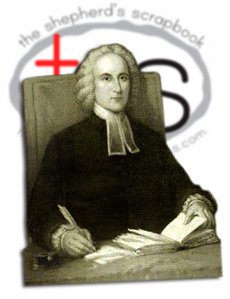
 One unmistakable indication that a preacher has placed the cross at the center of his life and preaching is when the cross remains central to successfully living out the Christian life. A cross-centered preacher extends the gospel’s centrality beyond the conveyance of salvation to all the sin struggles of the Christian life. He injects the gospel into parenting, marriage, and counseling—and brings the hope of the cross to all of life’s experiences.
And the cross-centered preacher understands that the gospel substantiates one of the deepest levels of Christian experience–God’s love to the Christian. As Jonathan Edwards aptly taught in a sermon,
So with what inexpressible joy may those that love Christ think of his bowing the heavens and coming down in the form of a servant: of his lying in a manger, of his suffering the reproach of men, of his agony and bloody sweat, of his dying on the cross for their sakes. How pleasing must it be to read over the history of all those wonderful [things] that their well-beloved has done for them while on earth, as it is recorded in the Scriptures, and to think that Christ has done all this for him: that he was born for his sake and lived for his sake, sweat blood for his sake and died for his sake. This must needs beget an uncommon delight.[1]
To take the cross of Christ and show a congregation that those were tears of sweat dripping down Christ’s face for them individually—for you! for me!—is enough to beget uncommon delight. The cross, truly understood personally, will fill your heart with joys that the fleeting offerings of this world cannot match.
Here on display is the cross-centered worldview of Edwards.
Earlier in the week I posted a cross-centered excerpt from a letter by Edwards written at the very end of his life to the trustees of Princeton. He attempted (unsuccessfully) to shake the possibility of presidential duties for a life of writing, and specifically to write a book to prove that all of God’s thoughts, actions, and intents center in the cross. He died soon thereafter.
But if we rewind his life to the warm summer of 1722 in New York City we peek into the early months of Edwards’s preaching career and see there a young, cross-centered teenager. It was during this summer in NYC that he penned his sermon “Glorious Grace,” a wonderful sermon centered based upon Zechariah 4:7. Edwards closes the message with these words of application:
Let those who have been made partakers of this free and glorious grace of God, spend their lives much in praises and hallelujahs to God, for the wonders of his mercy in their redemption. To you, O redeemed of the Lord, doth this doctrine most directly apply itself; you are those who have been made partakers of all this glorious grace of which you have now heard.
Tis you that God entertained thoughts of restoring after your miserable fall into dreadful depravity and corruption, and into danger of the dreadful misery that unavoidably follows upon it; ’tis for you in particular that God gave his Son, yea, his only Son, and sent him into the world; ’tis for you that the Son of God so freely gave himself; ’tis for you that he was born, died, rose again and ascended, and intercedes; ’tis to you that there the free application of the fruit of these things is made: all this is done perfectly and altogether freely, without any of your desert, without any of your righteousness or strength; wherefore, let your life be spent in praises to God.
When you praise him in prayer, let it not be with coldness and indifferency; when you praise him in your closet, let your whole soul be active therein; when you praise him in singing, don’t barely make a noise, without any stirring of affection in the heart, without any internal melody. … Surely, if the angels are so astonished at God’s mercy to you, and do even shout with joy and admiration at the sight of God’s grace to you, you yourself, on whom this grace is bestowed, have much more reason to shout.
Consider that great part of your happiness in heaven, to all eternity, will consist in this: in praising of God, for his free and glorious grace in redeeming you; and if you would spend more time about it on earth, you would find this world would be much more of a heaven to you than it is. Wherefore, do nothing while you are alive, but speak and think and live God’s praises.[2]
This second excerpt models the importance of the cross in the experience of the individual Christian. Grateful cross-centeredness should shape our prayers, our private worship, our public worship, and our lives in every way.
And Edwards models here a robust cross-centeredness, careful not to neglect important themes of the Father’s love, the incarnation, humiliation, death, resurrection, ascension, and intercessory role of Christ.
As I read more sermons by Edwards, I’m increasingly impressed with Edwards’s cross-centeredness–his ability to balance the work of Christ (what he accomplished on the cross in the past) with the person of Christ (where he is now and that we are going to see him in the future). This cross-centered balance on the work and person of Christ is quite obvious in Edwards’s sermons, even as a teenager.
Overall, Edwards is one of the finest examples of Puritan cross-centered preaching. He displayed his emphasis on the centrality of the death of Christ from the beginning of his ministry to the very end of his life. He is a man who believed a true understanding of the cross would (in experience) bring heaven down to us until the day we would be taken up to enter the eternal praise of Lamb.
——————
[1] Jonathan Edwards, The Works of Jonathan Edwards, Vol. 10, Sermons and Discourses 1720-1723 (Yale, 1992) p. 616.
[2] Jonathan Edwards, The Works of Jonathan Edwards, Vol. 10, Sermons and Discourses 1720-1723 (Yale, 1992) p. 399.
 notebooks were strategic. He used his blank bible, his collection of miscellanies, and his other notebooks as places to collect his thoughts. Later, he developed these thoughts into sermons and books [see diagram from the Yale works].
 Tom left a portion of this quote in the comments to a previous post. It’s worth pulling out.
 “The great gospel imperatives to holiness are ever rooted in indicatives of grace that are able to sustain the weight of those imperatives. The Apostles do not make the mistake that’s often made in Christian ministry. [For the Apostles] the indicatives are more powerful than the imperatives in gospel preaching. So often in our preaching our indicatives are not strong enough, great enough, holy enough, or gracious enough to sustain the power of the imperatives. And so our teaching on holiness becomes a whip or a rod to beat our people’s backs because we’ve looked at the New Testament and that’s all we ourselves have seen. We’ve seen our own failure and we’ve seen the imperatives to holiness and we’ve lost sight of the great indicatives of the gospel that sustain those imperatives. … Woven into the warp and woof of the New Testament’s exposition of what it means for us to be holy is the great groundwork that the self-existent, thrice holy, triune God has — in Himself, by Himself and for Himself — committed Himself and all three Persons of His being to bringing about the holiness of His own people. This is the Father’s purpose, the Son’s purchase and the Spirit’s ministry.”
 No doubt there are severe limitations to text searches. Research methods (like the one I’m showing you today) can be too mechanical and overly simplistic and therefore lacking in accuracy. However, I have found them to sometimes illuminate interesting themes and their prominence in literature.
 Tony Reinke