[The definition of a bibliophile is “one who loves books, but especially for qualities of format.” I admit to being one. This post is intended for my fellow bibliophiles.]
 Cloth-covered books are durable, resilient, and protect valuable books for decades of use, so I appreciate publishers who print books in cloth and find it easy to pay extra few bucks for these volumes.
However, not everything that looks like “cloth” is genuine cloth. Publishers have become advanced with using faux cloth covers, which amount to pressed and texturized paper used as an inexpensive way to add grain to a hardcover book without the added cost of real cloth. But those volumes are typically not sold as “cloth.”
Which brings me to yesterday when I received my long-awaited copy of Herman Bavinck’s Reformed Dogmatics, Volume Four (Baker Academic, 2008). J.I. Packer says this work “remains after a century the supreme achievement of its kind.” Now completely translated from Dutch, it stands as one of the great reformed systematic theologies in the English language, and sports a hefty list price ($180.00)—a small price for a set I intend to use the rest of my life and one day pass to my children.
The first three of my volumes—all recently purchased—were genuine cloth covered (as advertised). Or so I assumed. But my curiosity was raised yesterday when my fourth and final volume arrived. I removed the dust jacket and noticed the cover on the final volume lacked the same depth of texture as the first three volumes. And it didn’t have the same laminated matte finish over the cloth but the feel of, well, paper. That’s when I decided to tug on the spine. [For those of you longtime TSS readers you will not be surprised at my biblio-destructive tendencies]. I pinched the cover over the spine, and with little effort, the cover tore like a piece of newspaper. Cloth doesn’t rip (at least not diagonally).
As you can see from the pics, the cover on my volume is nothing more than pressed paper—a cloth-like feel, a cloth-like appearance, but without any cloth.


My tinge of guilt for tearing Bavinck (gasp!) was overcome by the feeling of adrenaline a muscle man must experience tearing phone books. So I decided to test my three other Bavinck volumes. I discovered two volumes were genuinely cloth (absolutely would not rip even under intense pressure), and a second volume that was paper. Here’s what I found:
Volume 1 – May 2007 printing – cloth
Volume 2 – August 2006 printing – paper
Volume 3 – July 2007 printing – cloth
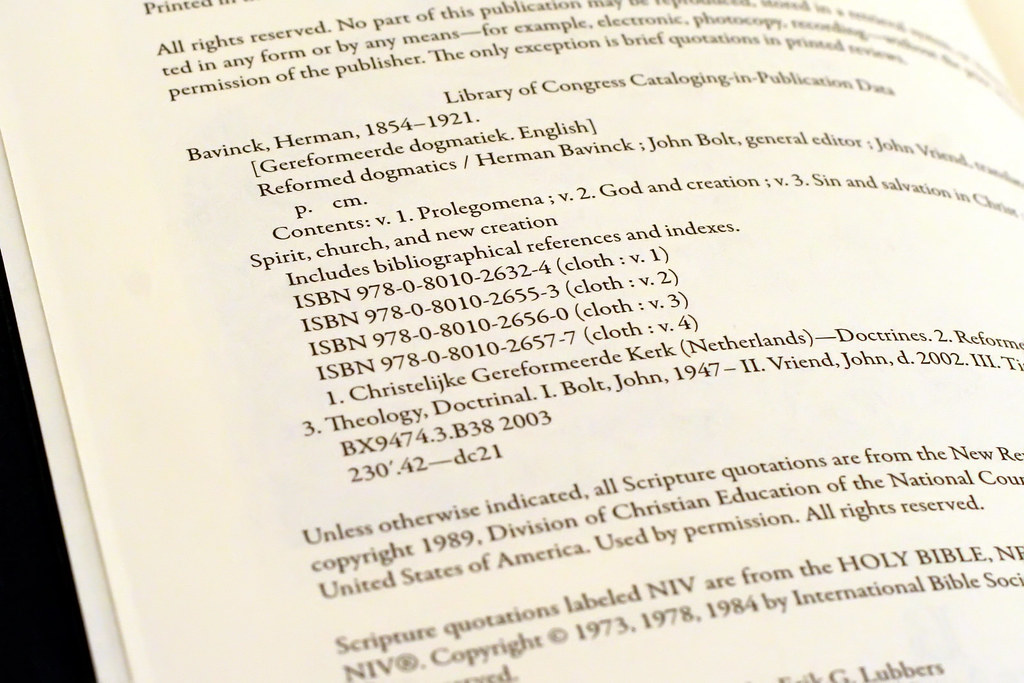
Volume 4 – 2008 printing – paper
As you can see from the table of contents page in volume 4, Baker claims all four volumes were printed in cloth.

I’ve contacted Baker Academic and will pass along updates as I receive them, especially if I can find a way to replace the paper editions with cloth editions.
Some questions for TSS readers:
(1) Do you own copies of Baker’s printings of Reformed Dogmatics? Which volumes? What are the print dates?
(2) Does the copyright page claim the volume is cloth?
(3) If so—and if you dare—pinch the top of the cover over the spine and try ripping it (ever so slightly) to see if you, too, have a “paperback”. And let me know in the comments. [No need for any more examples.]
Perhaps—and let’s hope—my two copies are aberrations.

 Over on his excellent blog, Worship Matters, Bob Kauflin has been posting recordings of worship songs from the 2008 Na conference in Louisville. The musical worship was led by his son Devon. Listen
  “Rick Phillips has an unbounded love for the doctrines of grace and writes about them with an enviable simplicity and clarity. Here is persuasive exposition of biblical teaching that captures the thrill of knowing a sovereign God. What’s So Great about the Doctrines of Grace? never loses sight of the grace to which these doctrines point. This is a wonderful book to read, study, lend, and give away.”

 Tony Reinke