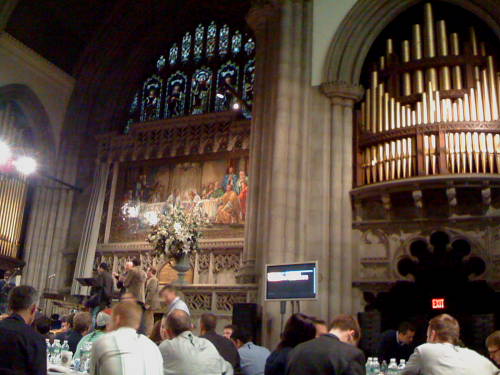
DWELL conference in Manhattan

This week I was honored to attended the Acts 29 DWELL conference in Manhattan. There was a rainy, cold, and foggy theme to my first time in the Big Apple, but that didn’t dampen the experience.

Around 400 church diverse church planters–some wearing suits, others wearing faux-hawks and tattoos–gathered on the edge of Central Park in an 170-year-old, baroque church building owned by the Fourth Universalist Society in upper Manhattan. You get a sense of the impressive architecture, stained glass, paintings, and pipe organ from this photo I took with my phone.

The attendees were seated (by the dozen) around tables where application discussions took place between addresses. It was great to see a few old friends and meet some new one’s, too. It was an impressive lineup and location for a church planting conference.

C.J. Mahaney opened with a message titled, Pastoral Priorities, Watching Your Life and Ministry, centered on 1 Timothy 4:16: “Keep a close watch on yourself and on the teaching. Persist in this, for by so doing you will save both yourself and your hearers.”

C.J. closed his message with these words on the second half of the passage.

Paul is not teaching self-atonement. Instead he is accenting human agency in the experience of salvation. … Calvin comments on this passage, “Although salvation is God’s gift alone, yet human ministry is needed as is here implied.” In this passage we are reminded of the vital importance of human ministry and godly leadership as a means of grace. And in this passage we are assured that if we watch our life and doctrine closely and persist and persevere in these practices, we can expect God to preserve us, and those we serve, for that final day. Here in this passage we find a promise of effective ministry in a most unexpected place.

And, most importantly, what stands behind this profound promise? The reason Paul can make this promise is the one mediator between God and man, the man Christ Jesus (2:5). The mediator stands behind this promise. What stands behind any effective pastoral ministry is the mediator Christ Jesus. What stands behind our watching our life and doctrine, what empowers our watching our life and doctrine, what guarantees the effectiveness of watching our life and doctrine, is the Savior.

Listen, if it were not for the work of the Savior, the burden of this verse would be simply too much to bear! But because of the Savior we have hope this morning for our pastoral ministry and in our pastoral ministry. We have hope that our lives, by the grace of God, will, in ever-increasing ways, faithfully reflect the transforming effect of the gospel. We have hope! We have hope that our preaching will faithfully proclaim our Savior. We have hope that our ministries will contribute to the preservation of ourselves and the congregation we serve. So, brothers, as we watch our lives, as we watch our doctrine, we are confident we will also watch the Savior work.

For me, sitting off to one side, there was dramatic irony in these closing paragraphs. C.J.’s voice rose a few decibels reminding us of the ministry-sustaining power of the gospel. The amplified emphasis of his voice, proclaiming the importance of the gospel, echoed through the old unitarian church built intentionally hollowed of the gospel and doctrine.

As I listened to the echo it was not only a great reminder to persist in watching my life and teaching, but in looking around at the church’s ornamentation it was also a reminder that failing to watch our life and teaching may not mean our churches will empty out for us to see our failures in this lifetime. A very sobering reminder we can take into all areas of life as we walk by faith, seeking to please God.

———

A longer version of this message was delivered in the 2006 Together for the Gospel conference message, “Watch Your Life.” Download here.

Books for Aspiring Patrologists (pt. 2)

In the first post, I passed along a recommendation for a book that serves as an overview of the intellectual and spiritual composition of the patristic authors. Personally, I want to learn enough about patrology to roll up my sleeves and begin excavating for myself gems from the original writings.

So today we turn to a recommendation on original source reading.

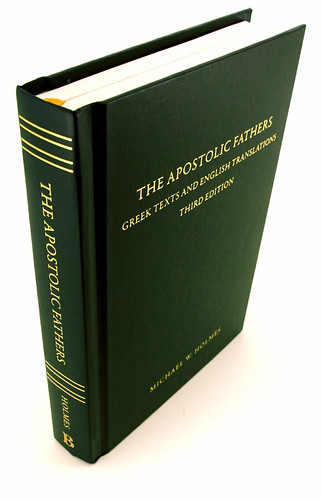
There is widespread agreement on one valuable collection of writings from the apostolic period (ca. AD 70-150), a volume edited by J. B. Lightfoot (1828-1889), compiled by his student J. R. Harmer, and now skillfully updated and edited by Michael W. Holmes titled The Apostolic Fathers: Greek Texts and English Translations, Third Edition (Baker Academic, 2007).

Holmes has done a nice job of keeping the scholarship up to date, adding very helpful book introductions. The 800+ page book includes several short letters preserved from the infancy of the Church. Though academic, the book is well-written and assembled for general readership. In the introduction to the Letters of Ignatius, for example, Holmes writes, “Just as we become aware of a meteor only when, after traveling silently through space for untold millions of miles, it blazes briefly through the atmosphere before dying in a shower of fire, so it is with Ignatius, bishop of Antioch in Syria. We meet him for the first and only time for just a few weeks not long before his death as a martyr in Rome early in the second century” (p. 166).

And Baker should be commended for their work, retypesetting and printing it on nice thin Bible paper. To think of it, The Apostolic Fathers has a similar look and feel to the beautiful NA27 Greek New Testament. Overall, I love the size, feel, and features of this volume. It comes with one of those built-in bookmark ribbons, and the dark green cover with the gold embossing is sharp.

On to a few excerpts.

In my evening reading I’ve been especially impressed with two excerpts from Ignatius’s letter to the Ephesians, written on or before 117 AD (pp. 182-201). Two themes emerge; the centrality of the cross and cautions to cultural adaptation.

1. Centrality of the Cross. This first excerpt has a lot to exegete. Listen to the known dangers of false teaching in this passage, where we see the Pauline warnings of the dangers of false teaching here echoed by a later generation of Christians.

But more specifically, notice the centrality of the cross in building the Church.

9:1 But I have learned that certain people from elsewhere have passed your way with evil doctrine, but you did not allow them to sow it among you. You covered up your ears in order to avoid receiving the things being sown by them, because you are stones of a temple, prepared beforehand for the building of God the Father, hoisted up to the heights by the crane of Jesus Christ, which is the cross, using as a rope the Holy Spirit; your faith is what lifts you up, and love is the way that leads up to God. 2 So you are all participants together in a shared worship, God-bearers and temple-bearers, Christ-bearers, bearers of holy things, adorned in every respect with the commandments of Jesus Christ. I too celebrate with you, since I have been judged worthy to speak with you through this letter, and to rejoice with you because you love nothing in human life, only God.

Ignatius beautifully captures the centrality of the cross in building the church.

2. Darkening lines in cultural engagement. And I find the patristic authors to be stimulating on the issue of cultural engagement. Try and isolate Ignatius’s warning amidst all the commands to relate to those in the world.

10:1 Pray continually for the rest of humankind as well, that they may find God, for there is in them hope for repentance. Therefore allow them to be instructed by you, at least by your deeds. 2 In response to their anger, be gentle; in response to their boasts, be humble; in response to their slander, offer prayers; in response to their errors, be steadfast in the faith; in response to their cruelty, be civilized; do not be eager to imitate them. 3 Let us show by our forbearance that we are their brothers and sisters, and let us be eager to be imitators of the Lord, to see who can be the more wronged, who the more cheated, who the more rejected, in order that no weed of the devil may be found among you, but that with complete purity and self-control you may abide in Christ Jesus physically and spiritually.

In light of the harsh pagan culture, Ignatius reminds the Christian Ephesians, “do not be eager to imitate them.” This is a helpful reminder for us today. Love those in the world? Yes. Love in word and deed? Yes. Respond to sin with kindness? Yes. See them as your equals, as brothers and sisters? Yes. Imitate the rough and crass edges of culture? No.

Be “OK” with not following and imitating their roughness. This excerpt is an interesting warning for early Christians struggling with loving those in the world without inadvertently absorbing the roughness of culture. This balance of engagement without conformity is still a tough question to answer nearly 2,000 years later. It’s helpful to see how these early Christians tried to understand the issues and set their parameters.

I could go on, there are other excellent passages. But my intent here is to recommend these books, stir a desire to read them, and let you spend less time on this blog and more time discerningly reading the patristic authors for yourself.

Please take with you one caution. Although this book looks, smells, and feels like a New Testament—even has verse numbers like a Bible!—it’s not Scripture. I receive emails and comments frequently from folks who say patrology transformed their understanding of Christianity. Statements like these read as though patrology and canonical scripture are equally shaping for these folks. They are not. So if your reading schedule is tight, you should never substitute time in Scripture with reading the early church fathers.

——————

Title: The Apostolic Fathers: Greek Texts and English Translations, Third Edition
Editors: J. B. Lightfoot, J. R. Harmer, and Michael W. Holmes
Boards: hardcover (not cloth)
Pages: 808
Volumes: 1
Dust jacket: no
Binding: sewn
Paper: thin, slightly yellowed, Bible paper
Topical index: yes, a thematic analysis
Scriptural index: no
Text: retypeset
Publisher: Baker Academic
Year: 2007
Price USD: $29.00
ISBNs: 080103468X, 9780801034688

WordPress.com

This morning I received a comment from a reader saying, “In your ‘Possibly related posts’ section at the end of the LotR post includes a vulgar link. You should take it off.”

A vulgar link? What?

Then I followed the permalink to this morning’s LotR post on my blog and noticed WordPress was generating “Possibly related posts” and attaching external links to the end of my post. Then, after a little research, I found that WordPress was automatically adding this little “feature” and turning it “on” without notification.

After some digging, this is the option I discovered on my dashboard: “Hide related links on this blog, which means this blog won’t show up on other’s blogs or get traffic that way.” Notice the presumption–it’s on until you turn it off.

Not only is this unethical from a blog engine, it has the potential to undermine the integrity of a blogger. So if you are considering starting a blog, surprises like this should factor into your consideration.

LotR/Hobbit movie update

Work is progressing on the two “Hobbit” movies. New Line Cinema and Metro-Goldwyn-Mayer Studios have announced that filming on the two films will begin in 2009 with the first movie released in 2010 and the second in 2011. Interestingly, this Reuters article, is saying the 2 films will fill in the 60-year storyline gap leading up to the LotR troilogy, making some predict that parts of the The Silmarilion will be found in the Hobbit movies, too.

Courageous Protestants

Remaining faithfully protestant is no hobby for the spineless, David Wells argues in his new book, The Courage to Be Protestant: Truth-lovers, Marketers, and Emergents in the Postmodern World (Eerdmans, 2008). Remaining faithfully protestant—simultaneously faithful to scripture and and firmly rooted historically—requires vigilant steadfastness.
“The key to the future,” Wells writes, “is not the capitulation that we see in both the marketers and the emergents. It is courage. The courage to be faithful to what Christianity in its biblical forms has always stood for across the ages” (p. 21).

The book title alone inspires me to tattoo Luther on my forearm (restrained by the bruising vanity of such an image when I’m old.)

Here’s why I like the title.

In these few words Wells is calling us to:

(1) Defend protestant Christianity, not just our little denominational sub-branch. What’s at stake is really protestant-wide reaching the broad limits of catholicity. The implications of these new movements are as big as is “protestant” is wide.

(2) Be courageous, not spineless. Don’t fall for the soft-sell marketing and neo-orthodox liberalism offered to our culture’s “perpetual squishitude” (DeYoung + Kluck). Enduring the relentless shifts in theology is not for the fainthearted.

(3) Love the truth of God’s word, don’t sacrifice it. The church’s hope rests in what is unseen, rooted in preaching of ‘the age to come.’ No matter the cultural drifts and currents, keep faithful to the preaching of the gospel. And love it! Don’t just be a truth-defender, be a truth-lover.

Wells–himself a monument of courage–reminds us that the hope the church offers the world flows from the freshwater spring of gospel proclamation.

Wells writes,

———–

“Christian hope is not about wishing things will get better. It is not about hoping that emptiness will go away, meaning return, and life will be stripped of its uncertainties, aches, and anxieties. Nor does it have anything to do with techniques for improving fallen human life, be those therapeutic, spiritual, or even religious. Hope has to do with the knowledge of ‘the age to come.’ This redemption is already penetrating ‘this age.’ The sin, death, and meaninglessness of the one age are being transformed by the righteousness, life, and meaning of the other. What has emptied out life, what has scarred and blackened it, is being displaced by what is rejuvenating and transforming it. More than that, hope is hope because it knows it has become part of a realm, a kingdom, that endures. It knows that evil is doomed, that it will be banished. This kind of hope has left behind it the ship of ‘this age,’ which is sinking. And if this other realm, this place where Christ is even now ruling, did not exist, Christians would be ‘of all people most to be pitied’ (1 Cor. 15:19). Their hope would be groundless and they would have lived out an illusion (cf. Ps. 73:4-14).

Vast, mysterious, and mostly unknown as the universe is, we are neither aliens nor strangers in it. It is our alienation from God that makes us see the world as if we were aliens. It is our estrangement from him that leaves us with this haunting sense that we are alone, strangers in a cold and indifferent universe. So it is that life comes to seem like only a ‘chance collocation of atoms’ destined to disappear beneath the rubble of a universe in ruins, as Bertrand Russell put it. It can all seem so meaningless, so ephemeral, so pointless. And it is meaningless, a vanity of vanities, until we see that fallen life yields up no meaning higher or deeper than its own fallenness. And that is only as high as the spirituality from below can ever ascend.

The only future there actually is, is the one established by God in Christ, the one wrought in time at the cross that alone reached into eternity. But we must receive entry into this future. We cannot seize it. It is not there to be had on our own terms. This is not our self-constructed future. It is God’s. It comes from above, not from below.

This is why those churches that have banished pulpits or are ‘getting beyond’ the truth question are going beyond Christianity itself. The proclamation of the New Testament is about truth, about the truth that Christ who was with the Father from all eternity entered our own time. As such he lived within it, his life, like ours, marked by days and weeks and years. He lived in virtue of his unity with the Father, living for him, living as the representative of his own people before the Father, his very words becoming the means of divine judgment and of divine grace. But in the cross and resurrection the entire spiritual order was upended, his victory reached into and across the universe, and saving grace is now personalized in him. The world with all its pleasures, power, and comforts is fading away. The pall of divine judgment hangs over it. A new order has arisen in Christ. Only in this new order can be found meaning, hope, and acceptance with God. It was truth, not private spirituality, that apostolic Christianity was about. It was Christ, not the self, who offered access into the sacred. It was Christ, with all his painful demands of obedience, not comfortable country clubs, that early Christianity was about. What God had done in space and time when the world was stood on its head was Christianity’s preoccupation, not the multiplication of programs, strobe lights, and slick drama. Images we may want, entertainment we may desire, but it is the proclamation of Christ crucified and risen that is the church’s truth to tell.”

–David F. Wells, The Courage to Be Protestant: Truth-lovers, Marketers, and Emergents in the Postmodern World (Eerdmans, 2008), pp. 203-204.

—————

Wells’s new book is excellent and may tempt you to get inked. Buy it, read it, and—as best as feeble sinners can—seek to walk humbly, faithfully cross-centered, and courageously protestant.

Together for the Gospel 2008

Clunk. Clunk. Wheeeeeeeeeeeee… Dun. Dun. Clunk. Click.

For more than a week now, I’ve been working next to an awkward-looking, loudly-clicking, nonstop-running printer. My desk is conveniently located about 6 inches from R2-D2 (as it’s been affectionately named). It’s a bulky printer, but also hard working, and very, very noisy. It reminds me of the old dot matrix printers that violently slapped back and forth, making that indescribable whining sound, across an endless line of perforated paper. It sounds a lot like that, with a shot of abrupt clanking mixed in.

Clunk. Clunk. Wheeeeeeeeeeeee… Dun. Dun. Clunk. Click.

I’m told the unceasing whine from the printer will be done soon. But for the last week, “R2” has been humming away 24/7, printing out colorful plastic nametags for each of the 5,000+ attendees scheduled to attend Together for the Gospel next week in Louisville.

Click.

As the loud printer slowly births each nametag—delivering one card every few minutes—the newborn falls on top of the other cards in the catch bin. I hear the click of the new card as it drops on the pile. Several times over this past week, at the sound of that click, I’ve paused momentarily to thank God for the person it represents. I don’t see the name, but I know that card represents someone for whom the gospel is precious, someone who prioritizes the gospel. And that is a work of God in their soul. So many works of grace. So many new births.

Click.

In the first couple days of the noise, my first thought at the click of the card was to wonder: is that the card that reads “John Piper, MN”? But separated from a thin screen, I cannot see the names. It’s just as likely the card represents a rural pastor from a farming community in Nebraska.

Listening to this printer has been wonderfully equalizing. When I get up from my desk I can see the long stacks of nametags, all arranged in alphabetical rows. Whether a main speaker, an old pastor, a young pastor, a ruling elder, a deacon, a seminary student, an aspiring seminary student, or a soul who is simply attending out of love for the gospel—each nametag is the same color, the same size, and the same arrangement. Equalized.

God knows our frame, that each of us are dust (Psalm 103:14). Saved. Precious to Him. Blood-bought. But we are all dust, equally dust, from A-Z.

Next week we gather at Together for the Gospel. But we are not coming together to huddle around prominent evangelical figures or to merely collect a stack of free books. We gather to proclaim our allegiance and faithfulness to the unchanging and eternal gospel. We gather to form a picture of God’s compassion, who, rather than destroying us, has compassionately atoned for our sin and redeemed us (Psalm 78:38-39).

Well, back to work.

Clunk. Clunk. Wheeeeeeeeeeeee… Dun. Dun. Clunk. Click.

See you in Louisville.

Tony