
Puritan John Owen (1616-1683) is an esteemed and prolific Christian author. His complete works of 24 volumes rightly remain in print today. On topics like the identification and mortification of remaining sin in the believer’s heart, or the glory of Christ, or communion with God in His Triunity, Owen is a giant in Church history. Likewise, Owen’s defense of justification by faith alone and particular atonement are classics that remain in print in various forms.
Over the past several years, John Owen has become a small publishing industry unto himself. Just in 2007 we’ve seen Kelly Kapic’s Communion with God: The Divine and the Human in the Theology of John Owen (Baker Academic) and Carl Trueman’s John Owen: Reformed Catholic, Renaissance Man (Ashgate). Reformation Heritage Books reprinted The Doctrine of Justification by Faith by John Owen with an intro essay by Trueman (this edition is not retypeset). And this Fall, two publishers released retypeset and edited (though unabridged) versions of Owen’s classic, Communion with God including Communion with God (Christian Focus) and Communion with the Triune God (Crossway).
That’s quite a lot of volumes published in one year about, or by, a Puritan born nearly 400 years ago!
Comparing Communion
This year I’ve received a lot of emails from readers asking me to compare and contrast the two editions of Communion with God and that’s my intention today.
But first, let me say I am grateful to publishers like the Banner of Truth, Christian Focus, and Crossway for continuing to publish Owen’s older works and abridgments (Banner and CF) and for those retypsetting and editing Owen’s works for a new generation (CF and Crossway). These are hardly endeavors that will land big publishing profits, and the editors can tell you how tough and time-consuming a project Owen proves to be. So from TSS we thank each of you for your diligent work!
Now, let’s compare the two volumes strictly by the numbers (notice the volumes are ordered different than the above photo):
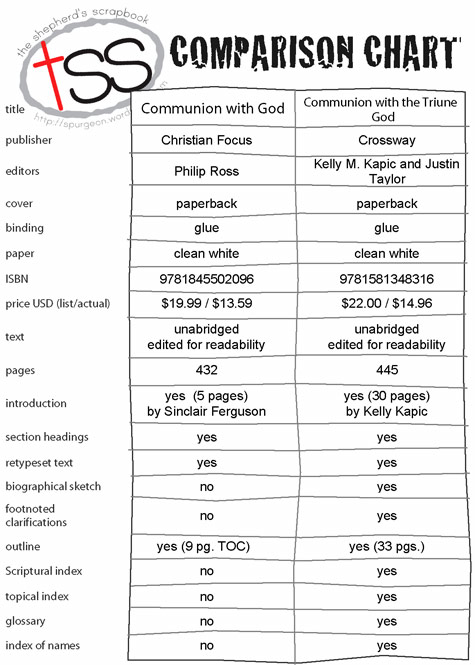
Both volumes are relatively close in size, price and construction quality. In both volumes the text has been edited and updated very well, and they read very similarly. Both works are the product of laborious editing.
Christian Focus edition
In the Christian focus edition, there are a few omissions (listed above) and one obvious weakness — Owen should never be dressed in pink and purple! Apart from that, there are some rather strong features to the Christian Focus edition. Especially noteworthy are the frequent headings and subheadings that break up the long text and help the reader along, making the text more visually appealing. And the Christian Focus edition has chosen to keep the Greek and Hebrew fonts whereas the Crossway edition has transliterated all the Greek and Hebrew (depending upon your view, this may be a strength or weakness). Albeit stripped of some features we see in the other volume, Christian Focus has produced a nice, high quality and very readable edition of Communion.
Crossway edition
But in a straight comparison, the Crossway volume impresses on many levels. The long introduction by Kelly Kapic is exceptional. The extensive (33 page!) outline is very helpful to browse Owen’s arguments and digressions. The footnotes provide helpful clarifications throughout, as does the glossary of terms in the back. But what really separates the two volumes are the indexes at the end. Crossway has made certain to include a detailed Scriptural index and lengthy topical index, making Owen’s classic more accessible than ever before. As a bonus, if you buy through Crossway they include a free electronic PDF version of the book that can be searched on your computer. Never has John Owen been more accessible and searchable.
Conclusion
Following in the footsteps of last year’s Overcoming Sin and Temptation (2006) Crossway is setting new standards for excellence in the publishing of John Owen works — making their books easier to navigate, useful for busy pastors, and exceptionally well outlined to help readers trace Owen’s arguments. Other publishers of Puritan works should make special note their priority on Scriptural and topical indexes. But where Crossway has not ventured, the Christian Focus works remain the best unabridged, retypeset editions of Owen available (these volumes include The Glory of Christ and The Holy Spirit). Both publishers are to be commended for their work, but we hope in the future their efforts will not be so unfortunately duplicated.
——————
Related: Read our full review of Communion with the Triune God (Crossway: 2007).
Related: Read our interview with Derek Thomas on the topic of John Owen and Communion with God.
Related: It’s not just Justin Taylor and Kelly Kapic! Another excellent Puritan reprint will be found in James Durham’s classic, Christ Crucified, recently reprinted by Naphtali. More info here.

 After reading the following quote from Jerry Bridges and Bob Bevington in
  Tony Reinke