The Thanksgiving Condition of Enjoyment

When I think of Thanksgiving I think about food — and so does Paul. Note the correlations between giving thanks to the Creator and enjoying a delicious feast:

1 Timothy 4:1–5:

Now the Spirit expressly says that in later times some will depart from the faith by devoting themselves to deceitful spirits and teachings of demons, through the insincerity of liars whose consciences are seared, who forbid marriage and require abstinence from foods that God created to be received with thanksgiving by those who believe and know the truth. For everything created by God is good, and nothing is to be rejected if it is received with thanksgiving, for it is made holy by the word of God and prayer.

Writes Hans Conzelmann (TDNT):

1 Tm. 4:3f attacks the Gnostically based demand for asceticism in meats by pointing to the custom of grace at meals, which is here connected with faith in God as the Creator. No laws can be set up in terms of foods. The norm is the attitude towards God. In this sense thanksgiving is the condition of enjoyment.

The Temple of Eden

In his book The Temple and the Church’s Mission: A Biblical Theology of the Dwelling Place of God, Greg Beale argues that the Garden of Eden was the first archetypal temple. He provides 14 conceptual and linguistic parallels between Eden and future tabernacle/temple structures.

Here are my brief summaries of his major points.

1. The Garden as the unique place of God’s presence. Eden was the place where God walked back and forth with man, paralleled this with later references to the Tabernacle (Gen. 3:8 with Lev. 26:12, Deut. 23:14; 2 Sam. 7:6–7).

2. The Garden as the place of the first priest. Adam was placed in the garden to “cultivate and keep it” (Gen. 2:15). Taken alone, “cultivation” has obvious agricultural meaning. But this pair of terms (“cultivate/keep” also translated “serve/guard”) is used elsewhere in the OT to describe the work of the priest (Num. 3:7–8; 8:25–26; 18:5–6; 1 Chr. 23:32; Ezek. 44:14). Thus “the task of Adam in Genesis 2:15 included more than mere spadework in the dirt of a garden. It is apparently that priestly obligations in Israel’s later temple included the duty of ‘guarding’ unclean things from entering (cf. Num. 3:6–7, 32, 38; 18:1–7), and this appears to be relevant for Adam, especially in view of the unclean creature lurking on the perimeter of the Garden and who then enters” (69).

3. The Garden as the place of the first guarding cherubim. After sin was introduced into the garden, Adam and Eve are barred from the tree of life by cherubim. This reveals that Adam’s work included more than gardening — he was to protect the garden from evil and uncleanness (Gen. 3:24 with Ex. 25:18–22; 1 Kgs. 6:29-35, 8:6–7; Ezek. 28:14–16, 41:18).

4. The Garden as the place of the first arboreal lampstand. Likely, the Tree of Life provides the model for the lampstand placed directly outside the holy of holies (Ex. 25:31–36).

5. The Garden as formative for garden imagery in Israel’s temple. Temple references in the OT possess botanical, garden-like features (1 Kgs. 6:18, 29, 32; 7:20–26, 42, 47; Zech. 1:8–11; Ps. 74:3–7; 52:8; 92:13–15; Lam. 2:6; Isa. 60:13, 21).

6. The Garden as the first source of water. Like Eden, the eschatological temples feature a source of water (Gen. 2:10 with Ezek. 47:1–12; Rev. 21:1–2).

7. The Garden as the place of precious stones. Note the correlation between precious stones in Eden and the building materials of the later tabernacle and temple (Gen. 2:12 with 1 Kgs. 6:20–22, Ex. 25:7, 11–39; 28:6–27; 1 Chr. 29:2).

8. The Garden as the place of the first mountain. Eden was situated upon a mountain (Ezek. 28:14, 16) just like Mount Zion (Ex. 15:17) and the eschatological temple (Ezek. 40:2; 43:12; Rev. 21:10).

9. The Garden as the first place of wisdom. “The ark in the holy of holies, which contained the Law (that led to wisdom) echoes the tree of the knowledge of good and evil (that also led to wisdom). Both the touching of the ark and the partaking of the tree’s fruit resulted in death” (73–74).

10. The Garden as the first place with an eastern facing entrance. Like the future tabernacle and temples, Eden was entered from the east (Gen. 3:24 with Ezek. 40:6).

11. The Garden as part of a tripartite sacred structure. Genesis 2:10 reveals that “a river flowed out of Eden to water the garden.” This reference formally distinguishes Eden from the garden. From this Beale builds the case that Eden and its adjoining garden “formed two distinct regions” (74). He sees here tripartite degrees of holiness, similar to the temple complex, comprised of (a) the region outside the garden (the outer court); (b) the garden representing a sacred place (the holy place); and (c) Eden, where God dwells (the holy of holies).

12. Ezekiel’s view of the Garden of Eden as the first sanctuary. In Ezekiel 28:13–18 the prophet draws a number of parallels between Eden and Israel’s tabernacle/temple. Specifically, the prophet references Eden as a sanctuary and pictures Adam dressed as a priest (v. 13). And “Ezekiel 28:18 is probably, therefore, the most explicit place anywhere in canonical literature where the Garden of Eden is called a temple” (75–76).

13. The Ancient Near Eastern concept of temples in association with garden-like features. “Gardens not untypically were part of temple complexes in the Ancient Near East” (76).

14. Early Judaism’s view of the garden as the first sanctuary. Beale provides evidence from the non-canonical Jewish literature to further prove that “Judaism in various ways also understood the Garden to be the first sanctuary in line with the above Old Testament evidence” (27).

Conclusion: “The cumulative effect of the preceding parallels between the Garden of Genesis 2 and Israel’s tabernacle and temple indicates that Eden was the first archetypal temple, upon which all of Israel’s temples were based” (79–80).

Read more on these conceptual and linguistic parallels on pages 66–80 of Beale’s The Temple and the Church’s Mission: A Biblical Theology of the Dwelling Place of God.
First

“First,” by Lauren Daigle:

Before I bring my need
I will bring my heart
Before I lift my cares
I will lift my arms
I wanna know You
I wanna find You
In every season
In every moment
Before I bring my need
I will bring my heart
And seek You

First
I wanna seek You
I wanna seek You
First
I wanna keep You
I wanna keep You
First
More than anything I want, I want You
First

Before I speak a word
Let me hear Your voice
And in the midst of pain
Let me feel Your joy
Ooh, I wanna know You
I wanna find You
In every season
In every moment
Before I speak a word
I will bring my heart
And seek You

First
I wanna seek You
I wanna seek You
First
I wanna keep You
I wanna keep You
First
More than anything I want, I want You
First

You are my treasure and my reward
Let nothing ever come before
You are my treasure and my reward
Let nothing ever come before
I seek You

First

First
I wanna seek You
I wanna seek You
First
I wanna keep You
I wanna keep You
First
More than anything I want, I want You
First
First

Get the First Draft Down (Advice for Writers)

This week my fingertips are tapping feverishly on book #4, the book on technology. My aim is to produce a tightly written book of 35k-words, and this week I need to add 15k on to the 10k already done in order to send out the book as two-thirds of a completed first draft for macro conceptual critique and editing. This week is on pace so far (by grace).

Chasing around a bookload of thoughts and capturing them and putting them on paper in a somewhat orderly manner is the hardest and least fun and most mind-intensive step in the book writing process for me, but it’s also a process I must endure and push through in order to free up the mental reserves I need to revise and tighten and clarify later on (the fun part!).

Here’s how Steven Pinker explained the process in The Sense of Style: The Thinking Person’s Guide to Writing in the 21st Century (2014):

I am told there are writers who can tap out a coherent essay in a single pass, at most checking for typos and touching up the punctuation before sending it off for publication. You are probably not one of them. Most writers polish draft after draft. I rework every sentence a few times before going on to the next, and revise the whole chapter two or three times before I show it to anyone. Then, with feedback in hand, I revise each chapter twice more before circling back and giving the entire book at least two complete passes of polishing. Only then does it go to the copy editor who starts another couple of rounds of tweaking.

Too many things have to go right in a passage of writing for most mortals to get them all the first time. It’s hard enough to formulate a thought that is interesting and true. Only after laying a semblance of it on the page can a writer free up the cognitive resources needed to make the sentence grammatical, graceful, and, most important, transparent to the reader. The form in which thoughts occur to a writer is rarely the same as the form in which they can be absorbed by a reader. The advice in this and other stylebooks is not so much on how to write as on how to revise.

In other words, get the first draft down on paper asap.

The Joy Project (Free Book)

TJP-cover-2.0-2
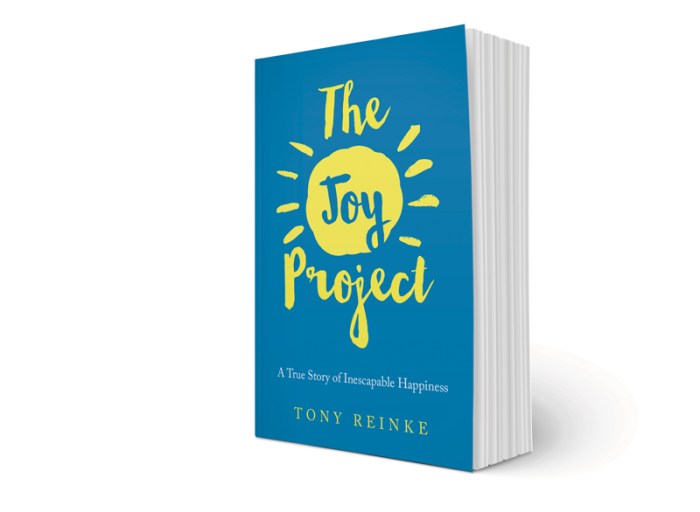
This week I launched my third solo book, titled, The Joy Project: A True Story of Inescapable Happiness.

The new book is short — 120 pages — but in those few pages I attempt to dive into the most profound story ever told in the universe, the story of God’s Sovereign Joy.

The Joy Project also fulfills of a dream of mine to write and publish a full book free of charge to the world. The dream has become a reality thanks to the financial donors behind desiringGod.org, and so it seemed appropriate to dedicate the book to these many men and women around the world who support our daily labors.

You can download the book right now, free of charge, in three digital formats, at desiringGod.org/thejoyproject.

The Church and the Problem of A-Literacy

Pastor Timothy R. Nichols, from his article “Holding Center: The Theocentric Unity of Truth in the Postmodern World,” CTSJ, 11.1 (2005): 52–54:

In general terms, an aliterate person is able to read, but chooses not to. Most people today can read in the gross sense, i.e., they can understand the labels on packages at the store, learn from the marquee what time a movie is showing, or read the road sign that tells them how many miles to Richmond. However, aliterate people do not exert the sustained attention necessary to draw meaning out of a longer written text like a poem, novel, or biography. And because they choose not to, they lose whatever skill they might have developed in school. An aliterate person who has been out of school for ten years will be very rusty indeed at understanding a printed text of any length. …

Although it is true that an illiterate (or aliterate) believer can live a successful Christian life, it would be a mistake to conclude on that basis that reading is not crucial to Christianity. As long as there are some readers who accurately convey the text to the rest, the church can tolerate a shortage of readers. However, the fewer the people who access the Scriptures directly, the more power those who do will have. This is dangerous — witness the many doctrinal and other abuses perpetrated by the medieval Catholic church. Popular facility [proficiency] with the text prevents a “priesthood of skilled readers.”