The Cross and Civil Justice

tssflag.jpgThe Cross and Civil Justice
by Francis A. Schaeffer

“… The problem always was, and is, What is an adequate base for law? What is adequate so that the human aspiration for freedom can exist without anarchy, and yet provides a form that will not become arbitrary tyranny?

In contrast to the materialistic concept, Man in reality is made in the image of God and has real humanness. The humanness has produced varying degrees of success in government, bringing forth governments that were more than only the dominance of brute force.

And those in the stream of the Judeo-Christian worldview have had something more. The influence of the Judeo-Christian worldview can be perhaps most readily observed in Henry De Bracton’s influence on British Law. An English judge living in the thirteenth century, he wrote De Legibus et Consuetudinibus (c. 1250).

Bracton, in the stream of the Judeo-Christian world view, said:

And that he [the King] ought to be under the law appears clearly in the analogy of Jesus Christ, whose vice-regent on earth he is, for though many ways we are open to Him for His ineffable redemption of the human race, the true mercy of God chose this most powerful way to destroy the devil’s work, he would not use the power of force but the reason of justice.

In other words, God in His sheer power could have crushed Satan in his revolt by the use of that sufficient power. But because of God’s character, justice came before the use of power alone. Therefore Christ died that justice, rooted in what God is, would be the solution. Bracton codified this: Christ’s example, because of who He is, our standard, our rule, our measure. Therefore power is not first, but justice is first in society and law. The prince may have the power to control and to rule, but he does not have the right to do so without justice…

What the Reformation did was to return most clearly and consistently to the origins, to the final reality, God; but equally to the reality of Man – not only Man’s personal needs (such as salvation), but also Man’s social needs.

What we have had for four hundred years, produced from this clarity, is unique in contrast to the situation that has existed in the world in forms of government. Some of you have been taught that the Greek city states had our concepts in government. It simply is not true. All one has to do is read Plato’s Republic to have this come across with tremendous force.

When the men of our State Department, especially after World War II, went all over the world trying to implant our form-freedom balance in government downward on cultures whose philosophy and religion would never have produced it, it has, in almost every case, ended in some form of totalitarianism or authoritarianism.”

– Francis Schaeffer, A Christian Manifesto (Crossway: 1982/2005) pages 27-29.

[Summary: God does not act out of power alone, but rather His power is displayed in acting righteously according to His Law. Thus, we see the significance of the Cross and the character of God in a democracy where the law curbs the power of its rulers. Countries that do not grasp the justice of God revealed in Christ’s work on the Cross (justification) are prone to being ruled unjustly by those with the most power. We can thank God today for His Law and for His Son and for His declaration that those in His Son’s blood are free from guilt! He is both just and the justifier (Rom. 3:26). … Have a great 4th of July! … “For freedom Christ has set us free” (Gal. 5:1).]

Comparing the Letters of Newton, Chalmers and Rutherford

A comparison:
The Letters of Newton, Chalmers and Rutherford

Few books minister more effectively to my soul than compilations of letters written by spiritual giants. These private letters reveal a private concern for particular souls. They are intended to comfort the downcast and encourage frail sinners on the brink of eternity to set their minds on things above.

Over the past year we have seen a sharp rise in the printing of these treasured letters. The most substantial projects from the Banner of Truth in 2007 thus far have been the publishing of the Letters of John Newton and Letters of Thomas Chalmers. These join the Banner’s monumental production from last year, Letters of Samuel Rutherford. So at the Shepherd’s Scrapbook we pulled out the scales to compare the three Banner volumes. Here are the raw statistics.

The covers and statistics make the three appear very similar but there are noted distinctions between them.

Index-ability

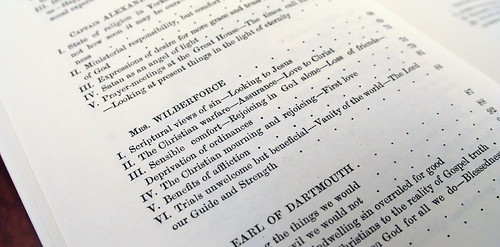
Because topics change from page to page, the most important factor in using the volumes of published letters is a good topical index. If you are preaching on assurance, you want to access the topically relevant letters quickly. The Letters of Samuel Rutherford published last year included a short but very useful topical index to all the letters (pp. 715-717). Unfortunately, neither of the two newer volumes were published with a similar straight topical index. But like Rutherford, the Newton volume does have a short topical summary in the table of contents. So for example, we know from the table of contents that the first published letter from Newton to Mrs. Wilberforce covers two topics: “Scriptural views of sin” and “Looking to Jesus.” These short topical summaries of each letter are very useful to navigate the mass of letters quickly. The Chalmers volume has none of these topical guides.

Content

As we have come to expect from Newton (1725-1807), his letters are filled with rich spiritual content that has proven timeless. Each letter is tenderhearted, sincere and conveys principles of relevance for the Christian today. These 128 letters are only a tiny selection from his writings, but they are a well-chosen selection. Rutherford (1600-1661) is rightly considered the most famous letter writer in all of church history. Charles Spurgeon considered Rutherford’s letters to be “the nearest thing to inspiration which can be found in all the writings of mere men.” It takes little imagination to see why. The letters of Chalmers (1780-1847) are noticeably short. While there are letters that rise to the spirituality of Rutherford and Newton (see excerpt below), many seem to have their greatest value as records of history. It appears this volume of letters may have been intended to be read alongside Chalmers’ Memoirs by those familiar with his life. A number of letters include details about financial accounts and other historical details. It’s worth noting that the original editors of Chalmers’ letters strove to publish them in chronological order whereas Newton’s letters are printed without concern to chronology. This reveals a subtle but important distinction between the purposes of the two works.

Readability

Both Newton and Chalmers are very easy to read. Readers unfamiliar with Puritan literature should know that Rutherford is much older and a bit tougher to read. A helpful glossary of difficult terms is found on pages 718-733 (apparently even for a reader in 1891, help was needed to refresh the language of 1661). All three volumes are high quality facsimile reproductions.

Biographies

The Newton volume includes only a very brief biography. Both the Rutherford and Chalmers volumes come with length biographical introductions. Rutherford’s was written by Andrew Bonar in 1891 and Chalmers’ by Iain Murray in 2007. Chalmers was used greatly in the revival of the Gospel in Scotland, and the biography by Murray is outstanding.

Conclusion

When it comes to spiritual letter writers, John Newton and Samuel Rutherford are in the Reformed Hall of Fame. It’s great that these two works are indexed topically in a way that will make them very easy to use in sermon preparation and for topic-specific devotional times. That within one year, the Banner of Truth has managed to publish these works in Smyth-sewn binding and beautiful cloth covers is itself a grand accomplishment that will serve the church for many decades.

My concluding recommendations for readers looking to pick up and read some spiritual letters this Summer: Chalmers’ letters are often spiritual but will be tougher to navigate due to lack of thematic summaries and index we see in the other two. Start with Newton and then move on to Rutherford. For those more interested in historical letters, return to Chalmers. In all three cases, your heart will be truly blessed as you read letters from three able physicians of the soul.

———

All three volumes can be purchased directly from The Banner of Truth.

———

EXCERPT: taken from the Letters of Thomas Chalmers (Banner of Truth; 2007). Chalmers apparently received a letter from a woman who feared that she did not see enough of her own personal sin to draw near the Savior. He writes,

“I would first, then, say to you, that you are not to wait till you have mourned enough for sin ere you accept the Savior. You complain that you have not such deep views of sin as experienced Christians speak of; but how did they acquire them? They are the fruits of their experience in Christ, and not of their experience out of Christ. They had them not before their union with the Savior. It was on more slender conceptions of the evil of sin than they now have that they went to Christ, that they closed with Him, and that they received from His sanctifying hand a more contrite spirit than before — a more tender conscience than before. Do as they did; wait not till you have gotten their deep sensibilities till you go to the Savior. Go to Him now; go to Him with your present insensibility; bring it before Him as part of your disease, and He, the Physician of souls, will minister to this and all other diseases. But, generally, you complain that you are ignorant of how to go — how to believe. Now, this has long been a stumbling-block to many; their thoughts are how they are to believe, when their thoughts should be what they should believe. They look inwardly for the work of faith, when they should look outwardly for the object of faith. ‘For every one thought,’ says Richard Baxter, ‘that he casts downwardly upon himself, he should cast ten upwardly and outwardly upon Jesus, and upon the glorious truths of the Gospel'” (letter 240, page 301).

Laboring after Assurance > 3

tsslaboring.jpg

Part 3: The means of assurance

Scripture calls all believers to draw near to God “with a true heart in full assurance of faith” (Heb. 10:22). We draw near to God, not only in the confidence the Cross has purchased, but in God-given assurance that we are indeed God’s children. So today we answer the important question: What means has God given to pursue the full assurance of faith?

A great summary answer is found in the Canons of Dort, a Reformed doctrinal statement written in 1619 to confront the rising influences of the teachings of a man named Jacob Arminius. Most importantly for our interests, they addressed the means to, and importance of, the assurance of salvation in the heart of the Christian. The authors write,

“This assurance, however, is not produced by any peculiar revelation contrary to, or independent of the Word of God; but springs from faith in God’s promises, which he has most abundantly revealed in his Word for our comfort; from the testimony of the Holy Spirit, witnessing with our spirit, that we are children and heirs of God; and lastly, from a serious and holy desire to preserve a good conscience, and to perform good works. And if the elect of God were deprived of this solid comfort, that they shall finally obtain the victory, and of this infallible pledge or earnest of eternal glory, they would be of all men the most miserable” (5.10).

According to the long and rich Reformed tradition we enjoy, the full assurance of the Christian flows through three means: (1) God’s promises in the Gospel; (2) The testimony of the Holy Spirit to our spirits; (3) In fruitfulness displayed in the Christian life. Having a full assurance of the faith is important, and if there was no way to gain this assurance, the elect would live the Christian life in a miserable condition of insecurity. Rather, these means of assurance are intended for our comfort and further fruitfulness in the advancement of the Gospel (as we will see later from John Owen).

This threefold distinction in our personal assurance of faith is solidly Biblical. Compare the Council of Dort with Hebrews 10:19-25 and Romans 8:15-17. We will look at Hebrews next time and Romans a little later today.

With this introduction, lets look a bit closer at each of the three means given in Scripture for our pursuit of assurance.

1. God’s promises in the Gospel

The authors of the Canon of Dort were careful to begin their statement on assurance firmly grounded in the revealed Word of God and the promises of God. And this is always where personal assurance must begin.

A misunderstanding of the Gospel promises will choke out any solid assurance from the soul. Full assurance of faith requires a full assurance of our Savior (Heb. 10:19-22). We must know that salvation comes by faith alone and grace alone through the righteous Blood of Jesus Christ alone. No level of self-righteousness will appease God’s wrath for my sin. I cannot please God by being better than others, going to church, or saying prayers and following religious ceremonies. The first (and most critical) key to solid assurance is holding an accurate understanding of the Gospel that pushes out all good works as a meriting the favor of God.

Legalism is thinking that God is less or more pleased with me based upon my obedience, rather than understanding God’s pleasure in me comes from the purchased righteousness of His Son alone (see our post on legalism). If we think legalistically about our relationship with God, our failures to live perfectly to His standard will be a swinging sledgehammer to any foundation of assurance.

But having a degree in systematic theology is not enough. These biblical promises in the Gospel must be personally applied to the soul. And this personal application of the Gospel is not without struggle. We are tempted towards self-righteousness, instead of hoping in the biblical promises of salvation in the Gospel.

“Our primary ground of assurance is the promises of God. These promises must be applied to our hearts and worked out in our lives, however. This often involves profound spiritual struggle. Bunyan spoke of pulling at one end of God’s promises while the devil was pulling at the other end. He could not apply God’s promises to himself, but the Holy Spirit confirmed them in him. When this happens, promises reap fruit in our lives and cause us to relish the Spirit’s witness with our spirit that we are sons of God” (Beeke, Quest, 283).

2. The manifest witness of the Holy Spirit

One of the most obvious means God has ordained for the assurance of His children is the direct testimony of the Holy Spirit in our hearts. Paul details this in Romans,

Romans 8:15-17 … “15 For you did not receive the spirit of slavery to fall back into fear, but you have received the Spirit of adoption as sons, by whom we cry, “Abba! Father!” 16 The Spirit himself bears witness with our spirit that we are children of God, 17 and if children, then heirs — heirs of God and fellow heirs with Christ, provided we suffer with him in order that we may also be glorified with him.”

One of my favorite Patristic preachers, John Chrysostom (349-407), once said on this point, “What doubt is left here? If a man, or an angel should make a promise, perhaps some might doubt, but if the supreme Essence, the Spirit of God, who causes us to pray, makes a promise to those praying, bestows the promise, giving the testimony to us within, what room is there for doubt?” (On Romans, homily 14). Amen! There is a powerful confirmation in the Soul of the Child of God that is infallible. In fact the Reformers called this “infallible” assurance.

So what does this infallible assurance look like?

First, this is intensely personal and private. This is not an assurance that can be given from anyone but the Holy Spirit Himself in the soul of the believer. Clearly from the history of Christians over the centuries we can see that this inner testimony of the Spirit does not automatically come at the moment of salvation. Martyn Lloyd-Jones says for some it can be an overwhelming sensation that may cause one to physically tremble, a one-time experience that will never be forgotten. For others this assurance comes in waves as the Spirit testifies to their spirits over the years. There is little way to say exactly how this assurance flows to God’s children, but it’s clear that it does and it’s a powerful experience that leaves our spirits with rock-solid assurance.

This is an experience where “Christ manifests Himself to us and we know Him with a kind of inner intuition, over and above all that we believe about Him by faith. He is made real to us” (Lloyd-Jones, Doctrines, 2:162).

As one who is a continuist (like Lloyd-Jones), my faith dovetails nicely with this testimony of the Spirit as I seek the continued filling of the Holy Spirit (Eph. 5:18). I pray for a greater capacity to experience more of the Spirit and an opportunity to pursue more of the Spirit as He manifests Himself to me and confirms my assurance in Christ. For me, the filling of the Spirit is not only for the building of the church but also for personal assurance as I pursue Him. Surely Jesus also had assurance in mind when called us to pray for more and more of the Spirit. “If you then, who are evil, know how to give good gifts to your children, how much more will the heavenly Father give the Holy Spirit to those who ask him!” (Luke 11:13).

The Spirit that gives unshakable assurance is a “good gift” that we should pursue and pray for and experience in our own souls.

3. Personal godliness

An assurance that rests in the objective claims of the Gospel and the testimony of the Spirit in the soul is an incomplete assurance. We must also find assurance in our lives. Is God at work in me? Am I changing? Am I becoming more like Christ? Am I growing more obedient? Do I hate sin? Am I gaining victory over sin?

If we don’t ask these hard questions, we will pursue a lopsided assurance and downplay the hard passages of Scripture. References like 1 John 2:3 — “And by this we know that we have come to know him, if we keep his commandments” – are intended for our comfort and assurance, not our condemnation. But until we view personal godliness within our pursuit of assurance, passages like this one and many, many others will haunt us. This was not their intent. 1 John was written so we would have confidence in our position as God’s children (see 5:13).

Laboring after full assurance

I am fully aware that some will pursue assurance with 1 and 2, at the neglect of 3; or will pursue assurance in 3, and neglect 1 and 2. A full assurance of the faith rests in a balance of all three means. In his lectures on systematic theology, Lloyd-Jones says,

“How, then, is one to obtain this assurance? Here are the rules taught in Scripture: first make certain of your belief. If you have not got assurance, make certain that you are really not relying upon yourself in any respect for salvation. Be sure that you see all your righteousness as filthy rags and know that if you lived a thousand years you would never fit yourself to stand before God. Make certain that you are relying only upon the finished work of Christ upon the Cross, that you are solely dependent upon His righteousness. Apply the word of Scripture to yourself, get to know it, read it. Take these scriptures that I have been quoting; stand on them; apply them to yourself. Say, ‘I have been crucified with Christ, I have died with Christ. The Scripture says it; I believe it and I stand on it.’ Live the life. Yield yourself to be led of the Spirit. Seek His face. If you ask Him to fulfill His promise and to manifest Himself to you, He has pledged to do it” (Doctrines, 2:162-163).

Conclusion

Personal assurance of the faith is not some vague hope in the back of the Christian mind. A full assurance is the pursuit of the Christian, and should be experienced in the soul! We are called to “feel” our personal assurance.

The bottom line is that God calls His children to pursue a full assurance of our faith. We are called to diligently and carefully and humbly pursue this assurance. Remember what John Owen said? “It is the duty of every believer to labor after an assurance of a personal interest in forgiveness, and to be diligent in the cherishing and preservation of it when it is attained.”

Owen knew this full assurance was not easily attained but a laborious pursuit of Gospel promises, diligent honesty and self-examination and patience upon the testifying work of God. The Westminster Confession of Faith (1647) reminds us,

“This infallible assurance doth not so belong to the essence of faith, but that a true believer may wait long, and conflict with many difficulties, before he be partaker of it: yet, being enabled by the Spirit to know the things which are freely given him of God, he may, without extraordinary revelation in the right use of ordinary means, attain thereunto. And therefore it is the duty of every one to give all diligence to make his calling and election sure, that thereby his heart may be enlarged in peace and joy in the Holy Ghost, in love and thankfulness to God, and in strength and cheerfulness in the duties of obedience, the proper fruits of this assurance; so far is it from inclining men to looseness” (18.3).

In this laboring after full assurance, we are coming closer to the heart of the Puritan life and the life of the Psalmists.

TSS Bday and Tips for Christian Bloggers

TSS celebrates first birthdaytssbday.jpg

On June 17, 2006 I decided to start a little blog. I needed something useful to stay in touch with about 10 pastors I had met at Together for the Gospel and to share with them some quotes I had come across in my reading. The blog would function as a notebook of quotations for pastors. I called it The Shepherd’s Scrapbook.

As any blogger can tell you, a blog changes in its first year and TSS is no different. Far from a notebook of quotes, it morphed into a blog of do-it-yourself projects (like the Blank Bible Series) and later moved into areas of exegetical research and using the Puritan literature effectively. The initial idea of featuring straight quotes from important books was replaced with book reviews, book announcements, book photographs, book-of-the-year awards, and then on to essays on various subjects relating to the faith — like understanding legalism, the wrath of God and especially the Cross of Christ and how His Cross impacts our daily Christian lives. Then we looked at a large section of John Calvin’s Institutes of the Christian Religion in a series on Humble Calvinism and blogged two conferences this Spring.

So what exactly is The Shepherd’s Scrapbook? I cannot say for certain. It’s for pastors but it’s also for laypersons. It’s for book collectors, book binders, book readers and book photographers. It’s a blog for those who read the Puritans and follow the Reformed theological tradition. But most importantly it’s a blog devoted to living a Cross-centered life. Amidst all the essays, quotes and book reviews, the single thread running through the 340 posts of our first year is an emphasis on boasting in the Cross of Jesus Christ! Galatians 6:14 is our touchstone.

Tips for bloggers

I dread reading tips from other bloggers so I hesitate writing tips for bloggers. But on this first anniversary of The Shepherd’s Scrapbook I’ll share some thoughts on some things that have helped set TSS apart in the blogosphere. So here are some miscellaneous points you may consider when starting or maintaining a Christian blog:

1. Don’t follow rules. Obviously we should limit ourselves under Scriptural standards of character. But take lightly the popular blogging structures and even the advice that follows. Know first that blogging is a free forum and, as long as you are God-honoring, you can post your wittings however you like.

2. Make Jesus famous. The trend in Christian blogging is to cover the current events and political rumblings. But there is a growing need for bloggers to use this medium to exalt in the ancient work of Jesus Christ. Even the most popular Christian blogs can go weeks without any serious mention of Jesus Christ and Him crucified. Center your blog around Galatians 6:14. Cover contemporary events if you like, but discern which ones are important to the Cross and which ones are not.

3. Identify and use your particular skills. One of my most useful blogging skills is a daringness, fearlessness — and a wee bit of senselessness — to rip an ESV Bible through a humming table saw. You may not have this skill, but likely you have other unique skills that distinguish you from other bloggers that you have never considered. Think carefully how your talents can be used in the Christian blogosphere.

4. Write short posts. If a bumper sticker with 4 words gets readers to think, 250 words are sufficient to get your readers to think. Keep posts short and keep them important. “Avoid needless words.”

5. Use common words. The web is indexed by strands of words and phrases (not by pictures or songs or cool graphics). Effectively reaching your potential audience means using these common words. When you write theologically, make sure you are using the terms most frequently used for your subject. Use creative words but never forget the most common ones, too. Get familiar with the common vernacular.

6. Use creative photos and graphics. I work in retail/secular blogging so I can say with some level of confidence that Christian blogs are often the most bland when it comes to visual creativity! Don’t be the pale white Calvinist on the beach. Get some color.

7. Pray. Writing is hard enough, but when you need to write daily it takes a lot more of God’s grace. Rest in Him and pray that He would lead your thoughts. (1) Pray hard. (2) Think hard. (3) Write hard. Blogging well is tough.

8. Marry a supportive editor. My wife is a precious gift and an excellent editor. I have carefully watched her responses over the months to TSS. Never has she complained about the time I spend developing TSS and many times she has voiced her appreciation for the content and support for the work. Bloggers (and really any married person who spends a lot of time online) MUST watch carefully what effects the Internet is having on their family. When I meet bloggers or people who spend a lot of time online I try to gauge responses from their spouses whether they are supportive or not. Pastors of bloggers should ask the spouses of bloggers these same questions. If your wife/husband is not encouraging you in your blogging, don’t continue! If you are single, be on the lookout for a spouse with editing skills.

9. Be prepared for humility. The idea that people blog out of arrogance is quite unlikely. A blogger takes what is floating in his brain, expresses it to the world, and opens himself up for critical comments from about anyone online, leaving these critical comments for world to read. Honest blogging is a hard path towards humility.

10. Make your site easy to navigate.
Use helpful indexes if you run a multi-part series and otherwise think of what a newcomer to your blog is going to see. Who are you? How would a visitor find out who you are? What type of a blog do you run? What’s your philosophy of blogging? Make these things obvious. (I’ve sacrificed far better-looking WordPress templates for the double-column version so all this info can be displayed on the front page of TSS).

11. Build relationships. The hits to this blog are relative to the number of close friends I have met through this blog over the past year. Building and maintaining these connections and friendships is one of the primary uses of this blog. So blog on what interests you and treasure the readers who share these same interests. Don’t blog for the numbers, blog for the friendships. Review #5 for how to find these friends online.

12. Don’t marry a blogger. I said marry an editor, but never a fellow blogger, or something humiliating like this may happen on your birthday.

Blessings and thanks for reading The Shepherd’s Scrapbook!