On Prose Flow (Writing)

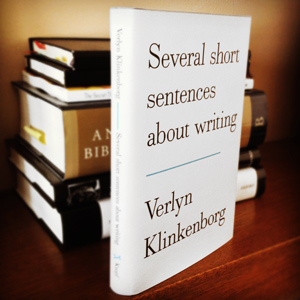
Writes non-fiction author and editor Verlyn Klinkenborg in his insightful new book Several Short Sentences About Writing (Knopf, 2012), page 67:

Your job as a writer is making sentences.
Your other jobs include fixing sentences, killing sentences, and arranging sentences.
If this is the case — making, fixing, killing, arranging — how can your writing possibly flow?
It can’t.

Flow is something the reader experiences, not the writer.

A writer may write painstakingly,
Assembling the work slowly, like a mosaic,
Fitting and refitting sentences and paragraphs over the years.
And yet to the reader the writing may seem to flow.

The reader’s experience of your prose has nothing to do with how hard or easy it was for you to make.
You’re not writing for a reader in the mirror whose psychological state reflects your own.
You have only your own working world to consider.
The reader reads in another world entirely.

My Favorite Books of 2012 on Writing

Each year I set aside the month of January to read (and re-read) great books on writing. And each year I discover one or two worthy new titles to add to my bowed shelf of books on the topic.

I suppose the thrill of discovering a new great book on writing is a feeling shared only by fellow wordsmiths. But it is sweet, no? I distinctly remember the bookstore where in 2006 I discovered Virginia Tufte’s magnificent book Artful Sentences: Syntax as Style. I return to her book every year to be inspired in the delicate art of sentence crafting. And I still remember the smell of the bookstore where I discovered Stanley Fish’s, How to Write a Sentence: And How to Read One, in 2011. Like I said, finding great books on writing is memorable.

This past year I added four new impressive titles to my shelf, so I guess I’ll call them my favorite books of 2012 on writing:

  1. Jack Hart, Storycraft: The Complete Guide to Writing Narrative Nonfiction (University of Chicago)
  2. Douglas Wilson, Wordsmithy: Hot Tips for the Writing Life (Canon)
  3. Constance Hale, Vex, Hex, Smash, Smooch: Let Verbs Power Your Writing (W. W. Norton)
  4. Verlyn Klinkenborg, Several Short Sentences About Writing (Knopf)

In Celebration of Long Sentences

C. S. Lewis said he had no use for reviews of his own works. The positive reviews puffed him up, the critical reviews riled him up, and neither the puffing nor the riling were good for the soul. So I should stop reading blog reviews, I really should, especially after the most recent one said my book was too “wordy.” That’s never been said of me before. What most people would never guess is that I am a fan of the long sentence, and here are some nice quotes on their value.

Writes essayist and novelist Pico Iyer in his recent article:

No writer can compete, for speed and urgency, with texts or CNN news flashes or RSS feeds, but any writer can try to give us the depth, the nuances — the “gaps,” as Annie Dillard calls them — that don’t show up on many screens. Not everyone wants to be reduced to a sound bite or a bumper sticker.

Enter (I hope) the long sentence: the collection of clauses that is so many-chambered and lavish and abundant in tones and suggestions, that has so much room for near-contradiction and ambiguity and those places in memory or imagination that can’t be simplified, or put into easy words, that it allows the reader to keep many things in her head and heart at the same time, and to descend, as by a spiral staircase, deeper into herself and those things that won’t be squeezed into an either/or. With each clause, we’re taken further and further from trite conclusions — or that at least is the hope — and away from reductionism, as if the writer were a dentist, saying “Open wider” so that he can probe the tender, neglected spaces in the reader (though in this case it’s not the mouth that he’s attending to but the mind).

The long sentence does make probing ambiguity possible, but it can also communicate stout specificity that short sentences sometimes lack. Says Brooks Landon in his course Building Great Sentences:

Cumulative sentences [ie long, right-branching sentences] can take any number of forms, detailing both frozen or static scenes and moving processes, their insistent rhythm always asking for another modifying phrase, allowing us to achieve ever-greater degrees of specificity and precision, a process of focusing the sentence in much the same way a movie camera can focus and refocus on a scene, zooming in for a close-up to reveal almost microscopic detail, panning back to offer a wide-angle panorama, offering new angles or perspectives from which to examine a scene or consider an idea. …

Cumulative sentences that start with a brief base and then start picking up new information much as a snowball gets larger as it rolls downhill, fascinate me with their ability to add information that actually makes the sentence easier to read and more satisfying because it starts answering questions as quickly as an inquisitive reader might think of them, using each modifying phrase to clarify what has gone before, and to reduce the need for subsequent explanatory sentences, flying in the face of the received idea that cutting words rather than adding them is the most effective way to improve writing, reminding us that while in some cases, less in indeed more, in many cases more is more, and more is what our writing needs.
Writer . . . with Children

Wise words from Douglas Wilson for writers who have a family to care for, taken from his new book Wordsmithy: Hot Tips for the Writing Life (Canon Press, 2011), page 40:

I have read enough books to know that the “Acknowledgements” section frequently includes a tribute to the wife and kids, who always let Dad go off to the study for the interminable time it took to produce the book. This is a reasonable thing to acknowledge, of course, but I would encourage writers not to overdo it — the disappearing that is, not the acknowledging. When an extra load develops, try to have it land on you and not on the family. If it has to get done now, then get up at five, and nobody else pays. So if you need to, get up at five, but always try to go home at five.

Think of it this way. A 60-hour work week is an honest job and a significant load, but a lot of the problems that come to people who work this much happen because of where those 60 hours are placed. Apportion 40 hours to your regular job, the calling which pays the bills, and then 20 hours for your half-time job of getting a writing career started. It is possible to work those 60 hours and still have lots of time left over for family. A week has a total of 168 hours in it. Sixty hours of work leaves 108, and 8 hours of sleep a night take away another 56 hours, leaving you with 52 hours a week to play tag in the backyard with the kids.

Read like someone who can afford to forget most of what you read

A tip for writers from Douglas Wilson, Wordsmithy: Hot Tips for the Writing Life (Canon Press, 2011), pages 36–37:

We test students right after they read something mostly to ensure that they have in fact read it. From this, many have drawn the erroneous conclusion that the only good that can be extracted from the reading is that which can be displayed on or measured by such a test.

This is wildly inaccurate. Most of the good your reading and education has done for you is not something you can recall at all. . . .

Mark every striking thing that you read. You won’t remember everything you read, and you won’t even remember everything you mark. Nevertheless, it is not a sin to remember some things or to mark them in such a way as to be able to find them again. I use blue highlighters on everything, to such an extent that one of my granddaughters assumed, reasonably enough, that this is what I use whenever I am “coloring.”

But you are not cramming for a test. You are simply marking things because this is a good way to read with your eyes open. You read widely to be shaped, not so that you might be prepared to regurgitate. Read like someone who can afford to forget most of what you read. It does not matter because you are still going to be shaped by it.

On Dispensing Religious Jargon

Here’s a wise caution for all preachers, teachers, and writers who frequently draw from the vocabulary of the faith — words like sin, grace, Christ, and a host of other sanctified terms that emerge over time within our particular circles — but who are tempted to use the terms without ever stopping to explain their meaning. Helmut Thielicke explains the danger, and then proposes one helpful practice, in his book The Trouble with the Church: A Call for Renewal (Harper & Row, 1965), pages 36–38:

Where is the average person today who, when he hears the word “sin,” really hears what the New Testament meant by that word? For whom today does this word still say that here man is being addressed at the point of his resistance and opposition to God, that this means man in his will to assert his autonomy, his insistence that everything centers in man, his incredible passion for security, his lostness in preoccupation with the moment and that which is tangible and immediately at hand? And yet all this must be heard when we hear the word “sin,” if for no other reason than to understand that it is possible for a sinner to be at the same time an example of moral perfection and that he need by no means be a criminal, an antisocial, or even a person who lacks seriousness. Were not the Pharisees ethically very respectable people? And yet for Jesus they were more drastic examples of sin than publicans and prostitutes.

And the word “Christ” itself? What would really be the result if we were to investigate the exchange value of that term in the psychological substructure of the average man today? What we would come out with would probably be some idea of a fabulously wise man or a perfect human being.

The point is that we need to say what we mean by these terms; we dare not throw them at people as supposedly valid coins whose value is immediately recognized. Otherwise we shall all too thoughtlessly reach out for them with the notion that they are perfectly familiar, whereas the truth is that the metal begins to glow and burn only when we have some idea of what these coins really signify. …

I once experimented with students, having them prepare sermons in which the conventional terms like “God,” “sin,” “grace,” etc. did not appear. The words had to be paraphrased. I think this is a good exercise, even though it has importance only as an interim practice. For we should not discontinue the use of these words in the pulpit; all we need is a withdrawal-cure because of the thoughtless use we make of them. We need to learn to overcome the temptation to string together the old words in different variations, because then souls remain underfed and are lost.