Image vs Word

Neil Postman in Amusing Ourselves to Death: Public Discourse in the Age of Show Business (Penguin, 2005) p. 9:

“‘Thou shalt not make unto thee any graven image, any likeness of any thing that is in heaven above, or that is in the earth beneath, or that is in the water beneath the earth’ [Exodus 20:4]. I wondered then, as so many others have, as to why the God of these people would have included instructions on how they were to symbolize, or not symbolize, their experience. It is a strange injunction to include as a part of an ethical system unless its author assumed a connection between forms of human communication and the quality of a culture. We may hazard a guess that a people who are being asked to embrace an abstract, universal deity would be rendered unfit to do so by the habit of drawing pictures or making statues or depicting their ideas in any concrete, iconographic forms. The God of the Jews was to exist in the Word and through the Word, an unprecedented conception requiring the highest order of abstract thinking.”
Blessings!

… is my typical email sign off.

Email closings have fallen on hard times. And well they should. Most closing salutations are bland or unfit.

“Sincerely” will do little convince the reader if your letter has been insincere. “Take care” is a subtle way of saying “Please don’t reply to this email because I’m busy.” “Peace out” and “Keep it real.” Not sure what exactly these are intended to communicate. “See you later” is a bland cliché. “Cheers” is more robust and gladdening to the heart. “Warmly” is cozy, especially in the winter.

But I use the term “Blessings!”, and yes, with an !.

Why?

Primarily because “Blessings” has a bloody heritage. The term bless traces its family history back to the ancient term blōdisōian, a pagan word meaning to consecrate one by covering them in sacrificial blood.

At some point in history the word became a threat and was used in fights when someone promised to break the other’s nose so as to cause them to bleed all over themselves. Thankfully the threatening overtone was purged from the English over the years. (The fightin’ French still use “blesser” for “one who wounds.”)

But in the Christian sense—at least in the way I use it—“Blessings!” is my preferred way of wishing others experience the divine riches that flow from being covered and consecrated and cleansed by the blood of Christ.

So there you have it.

Blessings!

Tony

You Digg?

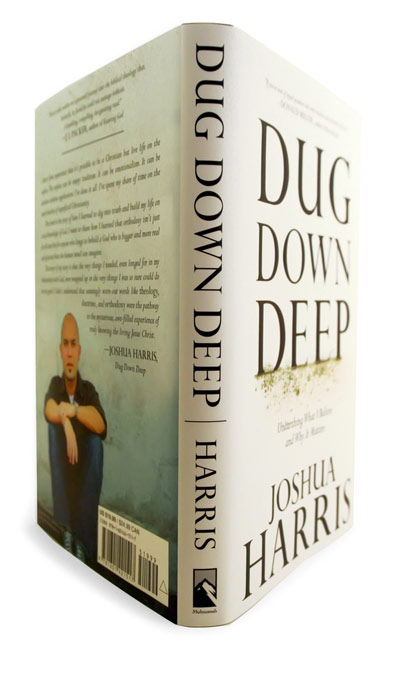
My pastor Joshua Harris has a new book—Dug Down Deep: Unearthing What I Believe and Why It Matters (Multnomah, 2010). I’m only a couple chapters in but it’s very good thus far.

Here are three that have finished it:

J. I. Packer: “Via vivid autobiography, Pastor Harris takes readers on a personal journey into the biblical theology that, belatedly, he found he could not manage without. A humbling, compelling, invigorating read.”

John Piper: “When the apostle Peter says, ‘Humble yourselves under the mighty hand of God…casting all your anxiety on Him,’ he implies that humble people are fearless. They have the courage to stand up for truth humbly. I love the term ‘humble orthodoxy.’ And I love Josh Harris. When they come together (Josh and humble orthodoxy), as they do in this book, you get a humble, helpful, courageous testimony to biblical truth.”

Joni Eareckson Tada: “More than forty years of quadriplegia has underscored to me the matchless value of knowing—really knowing—the doctrines of the Christian faith. Dug Down Deep reveals how biblical doctrine provides a pathway to understanding the heart and mind of God. If you’re looking for ‘that one book’ that will push you farther down the road to faith than you’ve ever journeyed before, Dug Down Deep is it. I highly recommend it!”

The Epic of the Universe

From Marilynne Robinson’s novel, Gilead (Farrar, Straus and Giroux, 2004) pages 56–57:

“I have been thinking about existence lately. In fact, I have been so full of admiration for existence that I have hardly been able to enjoy it properly. As I was walking up to the church this morning, I passed that row of big oaks by the war memorial—if you remember them—and I thought of another morning, fall a year or two ago, when they were dropping their acorns thick as hail almost. There was all sorts of thrashing in the leaves and there were acorns hitting the pavement so hard they’d fly past my head. All this in the dark, of course. I remember a slice of moon, no more than that. It was a very clear night, or morning, very still, and then there was such energy in the things transpiring among those trees, like a storm, like travail. I stood there a little out of range, and I thought, It is all still new to me. I have lived my life on the prairie and a line of oak trees can still astonish me.

I feel sometimes as if I were a child who opens its eyes on the world once and sees amazing things it will never know any names for and then has to close its eyes again. I know this is all mere apparition compared to what awaits us, but it is only lovelier for that. There is a human beauty in it. And I can’t believe that, when we have all been changed and put on incorruptibility, we will forget our fantastic condition of mortality and impermanence, the great bright dream of procreating and perishing that meant the whole world to us. In eternity this world will be Troy, I believe, and all that has passed here will be the epic of the universe, the ballad they sing in the streets. Because I don’t imagine any reality putting this one in the shade entirely, and I think piety forbids me to try.”

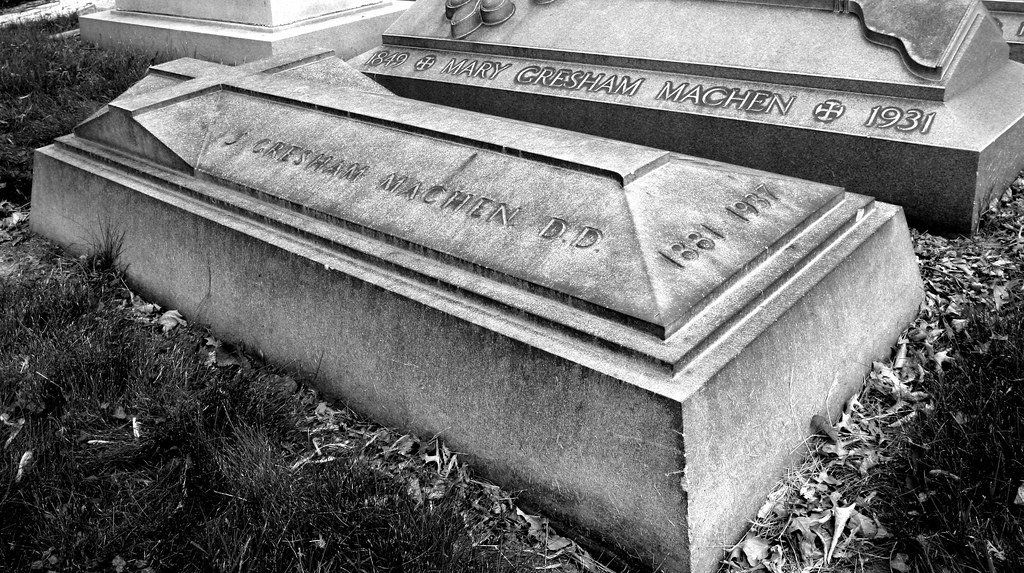
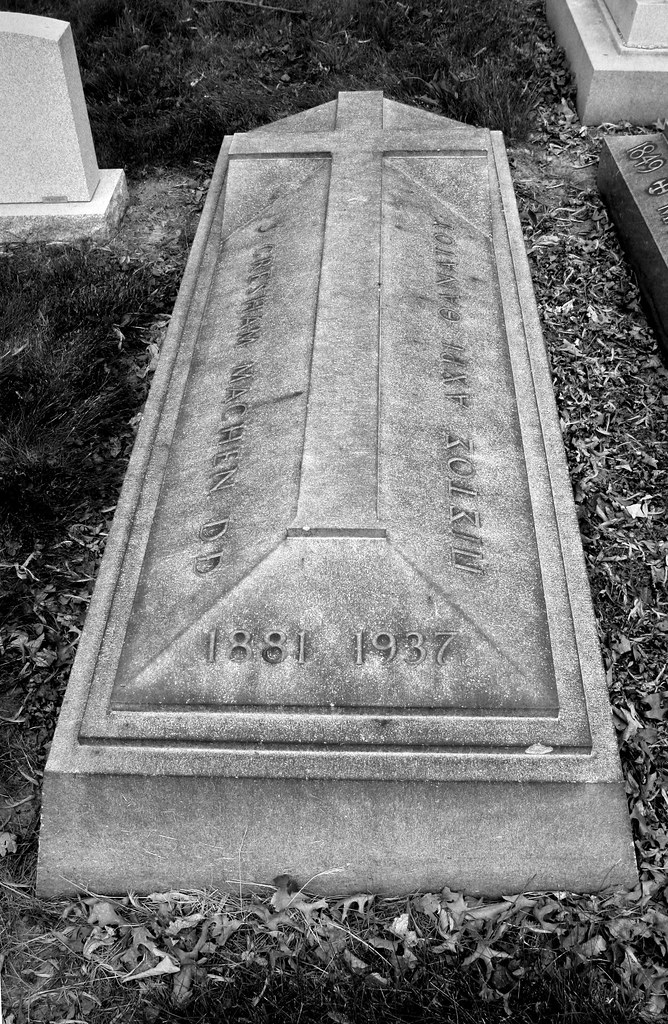
John Gresham Machen

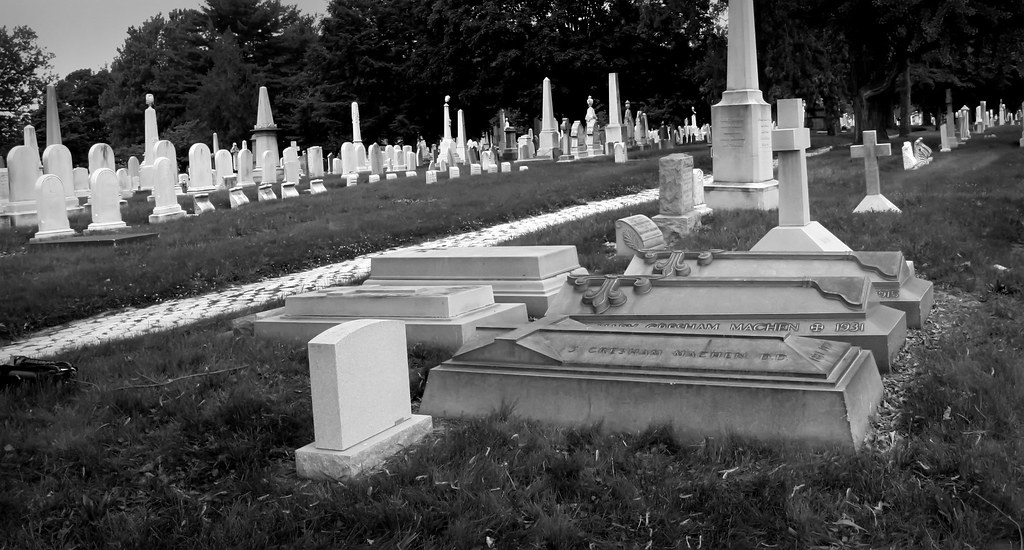
Among my many quirks and oddities is my taphophilia — a love of cemeteries. I find few places more life-focusing and life-giving than to walk among the land of the dead. And I’ve killed a good many healthy dinner party conversations with the assumption that others find as much enjoyment among the remains of the dead as I do.

In downtown Baltimore, just a couple miles north of Camden Yards, sits my favorite local necropolis, Green Mount Cemetery. Green Mount is the final resting place of John Gresham Machen (1887–1937). Machen is the author of some excellent books including What is Faith?, Christianity and Liberalism and The Christian View of Man. He served as the Professor of New Testament at Princeton Seminary between 1915 and 1929, and left Princeton to form Westminster Theological Seminary in Philadelphia.

Machen died on January 1, 1937.

Some pics from my last trip to Green Mount (click for larger):


——-

——-

——-

——-

——-

——-

——-