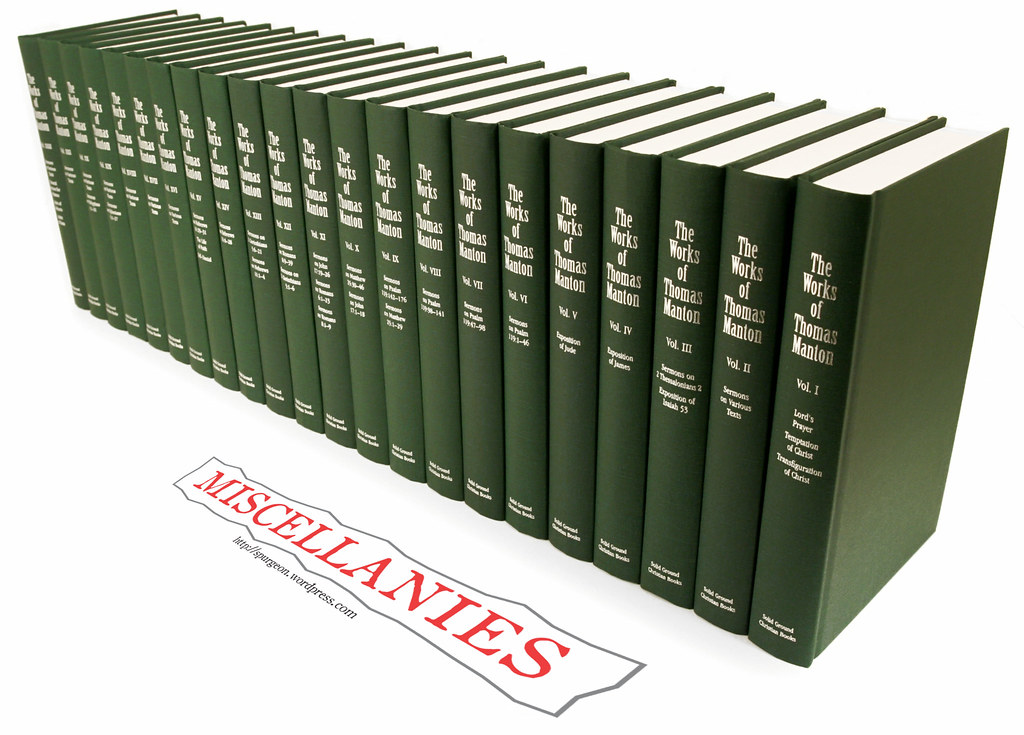
Review: Complete Works of Thomas Manton

For each of the past several years, we’ve been blessed with at least one monumental publishing achievement that further exposes contemporary readers to the exegetical and theological gems of the Puritan literary legacy. In 2006, Reformation Heritage Books reprinted the 12-volume Works of Thomas Goodwin. And over the last two years Justin Taylor and Kelly Kapic have blessed us with carefully edited and re-typeset versions of John Owen classics—Overcoming Sin and Temptation (Crossway, 2006) and Communion with the Triune God (Crossway, 2007).

But 2008 will be known for its own monumental achievement, in the reprinting of what I consider to be one of the leading collections of Puritan sermons. Solid Ground Christian Books has printed and is now shipping a new photolithographed, cloth-covered, sewn-bound, edition of the 22-volume, 10,500 page, Complete Works of Thomas Manton. And today I want to tell you about it.

Thomas Who?

Two years ago I compiled a list of most helpful Puritan resources for expositional, theological, and pastoral research. That list placed at #5 a man named Thomas Manton. Some of you were perplexed that I ranked this more obscure Puritan above those of more repute—John Owen, John Flavel, Richard Sibbes, Jeremiah Burroughs, Thomas Brooks, Thomas Goodwin, and Edward Reynolds. Each of these men represent exceptional gifting in the Puritan period; and if you disagree that Manton deserves to be above them, I think we can agree Rev. Manton belongs among them.

Compared to other favorite Puritans, Manton’s bibliography lacks pizzazz. Apart from two commentaries on James and Jude (both of which are excellent), he chose not to write books. Which explains why 20 of 22 volumes are stuffed full of expositions of Scripture. To the core of his life and ministry, Manton was a preacher of God’s Word, an able expositor who walked slowly through large sections of scripture in a very thorough and deliberate fashion. Dr. Joel Beeke writes, “Manton presents us with the best that English Puritans had to offer in careful, solid, warmhearted exposition of the Scriptures.”

The value of Manton’s works is discovered in the value of Manton the expositor.

So what type of preacher is Manton? Where does he rank among the other Puritan preachers? In assessing the value of Manton’s sermons, I find the careful thoughts of 19th century preacher Charles Haddon Spurgeon especially insightful. Spurgeon, in his commentary on Psalm 119, speaks fondly about a season of focused reading in Manton’s Works. Here is Spurgeon’s experience:

While commenting upon the one hundred and nineteenth Psalm, I was brought into most intimate communion with Thomas Manton, who has discoursed upon that marvelous portion of Scripture with great fullness and power. I have come to know him so well that I could pick him out from among a thousand divines if he were again to put on his portly form, and display among modern men that countenance wherein was ‘a great mixture of majesty and meekness.’ His works occupy twenty-two volumes in the modern reprint—a mighty mountain of sound theology. They mostly consist of sermons; but what sermons! They are not so sparkling as those of Henry Smith, nor so profound as those of Owen, nor so rhetorical, is those of Howe, nor so pithy as those of Watson, nor so fascinating as those of Brooks; and yet they are second to none of these. For solid, sensible instruction, forcibly delivered, they cannot be surpassed. Manton is not brilliant, but he is always clear; he is not oratorical, but he is powerful; he is not striking, but he is deep. There is not a poor discourse in the whole collection—they are evenly good, constantly excellent. Ministers who do not know Manton need not wonder if they are themselves unknown.

Don’t you love the way Spurgeon slaps ministers around who are unfamiliar with the Puritans? Spurgeon has a great respect for the Puritan preachers, and an appreciation for their consistent value for the Church. Manton is not the most brilliant of the Puritans, but he certainly is one of the most readable—and thereby one of the most valuable—of all the Puritan authors. Manton’s sermons are marked by clarity, doctrinal precision, and simplicity. And that places Manton right along with the very best of them.

Spurgeon understood that Manton was a preacher concerned to connect the deep truths of scripture to common audiences. His preaching was not glamorous in the day, and thereby unstained with the contemporary oratorical decorations and superfluous adornments that would have surely dated his language. Spurgeon loved to recount one story that showcases Manton’s care to preach in a manner suitable to the common Christian.

While Dr. Manton was minister at Covent Garden he was invited to preach before the Lord Mayor and Court of Aldermen, and the Companies of the City, upon a public occasion, at St. Paul’s. The doctor chose a very difficult subject, in which he had an opportunity of displaying his judgment and learning, and appearing to the best advantage. He was heard with the admiration and applause of the more intelligent part of the audience; and was invited to dine with my Lord Mayor, and received public thanks for his performance.

But upon his return in the evening to Covent Garden, a poor man following him, gently plucked him by the sleeve of his gown, and asked him if he were the gentleman who had preached that day before the Lord Mayor. He replied, he was.

“Sir,” says he, “I came with an earnest desire after the word of God, and in hope of getting some good to my soul, but I was greatly disappointed, for I could not understand a great deal of what you said: you were quite above me.”

The doctor replied, with tears in his eyes, “Friend, if I did not give you a sermon, you have given me one; and, by the grace of God, I will never play the fool by preaching before my Lord Mayor in such a manner again.”

Well Manton did not play the fool and his volumes of sermons testify to Manton’s desire to communicate to and edify the common Christian audience of his day. There is sweet consistency throughout his many sermons, or as Spurgeon puts it, “There is not a poor discourse in the whole collection they are evenly good, constantly excellent.”

But these sermons are slightly different than other collections of sermons I have purchased and read over the years. Unlike Spurgeon’s sermons, Manton is much less wordy, making me think these printed sermons are more likely his sermon manuscripts than edited transcripts (as in the case of Spurgeon). This means Manton’s sermons, by comparison, have a sweet concentration about them. And each sermon is very carefully outlined with use of clear points and subpoints, which make his sermons very easy to follow. Take Manton’s concentrated sermon form and well-outlined structure, multiply this by several sermons per volume, multiply that by 20 volumes, and you get a lifetime of sermon gems to feast the soul.

22-Volume Works

Recently Solid Ground Christian Books has served the Church by reprinting and shipping the entire 22-volume Complete Works of Thomas Manton. Currently the set is available through Reformation Heritage Books for $320.00 (plus a free copy of Meet the Puritans on each set). After some time reading and getting familiar with this new set, I offer my thoughts.

The new Manton set bears an obvious resemblance to the Banner’s edition of John Owen’s Works. Each volume is identical in height and depth, and has the same paper thickness, sewn binding, and photolithographed 19th century typeset. They are also nearly twins in beautiful genuine green cloth covers (Manton being slightly darker). There are two differences. The Manton volumes are not clothed in dust jackets. But on the other hand, the pages in Manton are bleach white, making them clearer and easier to read than the yellow paper of the Owen set.

Here are two detail photos of the set, one a close-up picture of the binding, cover, and paper color and another of the photolithographic text and paper color (click pictures for larger).

And this leads me to my favorite feature of the Manton set.

What determines the usefulness of a prolific Puritan writer? For busy pastors under the time crunch of sermon preparation, or for the common Christian reader looking to be fed devotionally on a specific topic or passage, the answer often boils down to one feature—indexing. Has the Puritan set been carefully indexed for ease-of-use? And there are, in my opinion and experience, no Puritans that have been more exhaustively or carefully indexed than this set of Manton works! The whopping 306 pages(!) of topical and scriptural indices take up most of the final volume in the Manton set, putting at your fingertips all 10,500+ pages of theological, expositional, and pastoral wealth.

There may be no better way to catch a glimpse into the priorities and usefulness of Manton than to peruse this massive index for yourself. So for your convenience I have converted these 306 pages into a single PDF, which you can download by clicking here (30.8MB file). I think by perusing the index you will gain a vision for the topics covered and the usefulness of Manton.

Conclusion

In late October of 1870, J.C. Ryle wrote a foreword to commemorate the first modern printing of Manton’s Works. In it Ryle wrote:

In days like these, I am thankful that the publishers of Manton’s Works have boldly come forward to offer some real literary gold to the reading public. I earnestly trust that they will meet with the success which they deserve. If any recommendation of mine can help them in bringing out the writings of this admirable Puritan in a new form, I give it cheerfully and with all my heart.

Today, I simply echo the recommendations of Spurgeon, Ryle, and Beeke. There are few, if any, Puritan sets that will provide you a more consistent and bountiful source of spiritual food for your soul than The Complete Works of Thomas Manton. And that is why I am so grateful for the Puritan preacher and so indebted to Solid Ground Christian Books for investing the time and money to offer this literary gold once again to the reading public.

——————

Title: The Complete Works of Thomas Manton
Author: Thomas Manton
Boards: hardcover; green cloth and silver gilding
Pages: 10,500
Volumes: 22
Dust jackets: no
Binding: sewn
Topical index: yes (extensive!; 224 pages)
Scriptural index: yes (extensive!; 80 pages)
Text: Photolithograph of 1870 James Nisbet & Co. edition
Publisher: Solid Ground Christian Books
Year: 2008
Price USD: $1,000.00 / $320.00 at RHB
ISBN: 978-1-59925-159-2

Preaching OT Narratives

The Simeon Trust is offering a 6-session workshop by John Woodhouse (Principal of Moore Theological College in Sydney, Australia) on preaching Old Testament narratives. Woodhouse says in the first session: “I’ll be arguing that we should take the time and trouble to study and appreciate the brilliance of these stories [OT narratives]. They should be part of our sermons. And I’ll be trying to develop some insights into how we should do this. That’s the journey we’ve embarked upon.”

Looks excellent. Click here for more information and full access to the MP3 audio downloads.

HT:JT

Works of Jonathan Edwards online

October 5, 2008 is the birthday of Jonathan Edwards (happy 305th!). And on this date the Jonathan Edwards Center at Yale will launch WJE Online 2.0, a new 73-volume(!) digital works of Edwards, which will include the full electronic versions of the printed Yale Works (25 volumes) and another 47 volumes of unpublished, digitized sermons and other material.

Wow!

Currently you can search and browse the electronic version of the 25-volume Yale works for free (though I’m not sure it will be that way forever).

Here is the complete index of 2.0 works …

Volume 1: Freedom of the Will
Volume 2: Religious Affections
Volume 3: Original Sin
Volume 4: The Great Awakening
Volume 5: Apocalyptic Writings
Volume 6: Scientific and Philosophical Writings
Volume 7: The Life of David Brainerd
Volume 8: Ethical Writings
Volume 9: A History of the Work of Redemption … Continue reading

D.A. Carson conference on suffering

Those in the Omaha area should take note of Dr. D.A. Carson’s conference titled, “Making Sense of Suffering.” The conference will be held Saturday, October 4th at Omaha Bible Church. As usual the OBC conference cost is low—$15 per person and a max of $25 per family (comes with a catered lunch). The conference is structured around Carson’s excellent book on the topic, How Long, O Lord? Reflections on Suffering and Evil. We all need a clear and developed vision of God’s purposes behind our suffering, and this holds true for those not currently experiencing suffering. Register online here.

“Don’t Waste Your Suffering” message

On the topic of suffering, I recommend Pastor Jon Smith’s sermon from Covenant Life Church, “Don’t Waste Your Suffering” (8/24/08). Jon shares his compelling testimony as one who glorified God in the midst of overwhelming personal loss. This message will tug hard at your heart (and especially if you are a parent of young kids) so grab Kleenex while it downloads. Listen/download here.

God is kind to provide the Church with men like Carson, Smith, John Piper and David Powlison who can equip and prepare Her for future personal loss and suffering.

Cross-Centered News Consumption

Yesterday in church we prayed for the growing—and growing increasingly persecuted—Church in Iran. It was humbling to learn about the spread of the gospel in that country and especially because I had spent 20 minutes that morning learning from the Washington Post all about the policy shifts and political activities of Sarah Palin in Alaska. Arriving at church I think I was more informed about the library restructuring in Alaska by a “bulldog in lipstick” than I was the status of the gospel in ancient Iran.

So it’s got me thinking today–what constitutes true news?

We are inundated with blogs, websites, podcasts, XM radio, newspapers, books, magazines, talk shows, Oprah, CNN, coffee-shop conversations, and the list goes on! And we all want to be well-informed (that’s why we read blogs). But it often feels like we are waist-deep in a powerful stream of information passing all around. What should we scoop up in our little mug for closer examination? What should we let pass untouched?

Defining “News”

What constitutes true news is, for the Christian, no easy question to answer. But neither is this a new question. Long before the “information age,” an obscure Puritan preacher named Henry Hurst (1629-1690) delivered a sermon to answer the question: “How may we inquire after news, not as Athenians, but as Christians, for the better management of our prayers and praises for the Church of God?” His text was Acts 17:21—“Now all the Athenians and the foreigners who lived there would spend their time in nothing except telling or hearing something new.”

Hurst understood the attraction we all have to the latest news, not because of its intrinsic importance, but due to our Athenian-like insatiable inquiry to feed on a stream of fresh tidbits. And I don’t claim innocence here. Often my news consumption habits are as defendable as the Athenians.

In Hurst’s sermon he begins by separating “news” into three categories:

A. Trifling reports. These reports are, “below the gravity and prudence of a man to receive from a reporter, or to communicate to any hearer.” Think petty rumors spread in gossip columns, blogs, or in conversations at Starbucks, the fascination into who Michael Jackson is dating, the National Inquirer, much daytime television, etc.

B. Personal and private matters. These reports are “of no more concern to a judge or magistrate or the public than a scuffle of boys in their sports to a general and his army.” These are stories with very little consequence, that should have remained a private issue, but have become public only because of the Athenian attraction within us.

C. Public news that concerning the state and Church
. The final category includes news reports that communicate “threatening danger, or some smiling providence” as it relates to the Church or state. There is every reason to be aware of what threatens the health and safety of our country. Genuine worldwide threats should concern us, and especially those in position to provide leadership in light of the dangers.

But the infatuation so much inconsequential “news” (#1+2), Hurst argues, led the Athenians to wasting time, neglecting duties, a loss of trade and employment, and bred further false stories of others and provoking contention among those we should be offering peace. Hurst writs, “I could wish there were a redress of all the inconveniences and vices that spring up in coffee houses [the blogosphere of the 17th century]; but I believe that every man who frequents them must mend his own faults herein.” I’m writing this at Starbucks, and as I look around to the tables of conversation I see that this temptation to Athenian rumor milling is just as relevant here as a 17th century coffee house.

Inquiring about the Church

Although much of Hurst’s sermon is convicting, he does provide very helpful and constructive thoughts on how to pursue news for the glory of God. And it’s all based upon a very simple premise.

True news is defined by a genuine love and concern for the Church. Hurst says it this way: “You may, as Christians ought, inquire what news of the Church’s affairs that you may the better manage your prayers for the Church in trouble, or praise God for good wrought for it.…A Christian ought to make inquiry into news that concerns the Church, according to the advantage and capacity he hath, to more fully to know both the good and welfare of the people of God, or to know the sorrows and dangers that lie upon the Church.”

After encouraging kings and Christian leaders especially to concern themselves as to the state of the Church, Hurst turns to the lay folks.

“Merchants and travelers who learn from the far remote parts for their trade, and gentlemen who travel for their pleasure and to satisfy themselves by an ocular survey of countries and cities, have some greater advantages to see and hear the low and sinking state, or the rising and flourishing condition, of those Churches which are planted in such countries. As Christians, they are bound to observe, inform themselves, and tell others, how it is with the Churches, so that prayers and praises may be offered unto God for them. But this is very little minded by merchants, when abroad; and less minded by them, when returned home with wealth, greater than ever they hoped. Though religion decay, and Churches lessen in number, knowledge, faith, and holiness; yet who of them, out of their abundance, settle a tribute of thankfulness to God, making provision for the sending and maintaining preachers and schoolmasters among them.”

Hurst’s mode of information is certainly dated, but his standards for genuine news are not. He encourages those out in the field to carefully communicate to the rest of the Church on the condition of the global spread, successes, and hindrances to the gospel. This is truly eternally-relevant news to spread among the Churches.

Sounds great if you are a missionary, but how should those of us domestically-bound folks find and use these updates on the condition of the global spread of the gospel? Hurst provides the following directives:

1. Find levelheaded sources. “He who inquires as a Christian, in order to manage prayer and praise, should, I think, inquire of those who can and will inform him the best, most truly and sincerely, of any news he knows. There has been, and now are, persons who abuse the world with false reports to amuse the more simple-hearted. They dare coin lies, and cry out, ‘Woe, woe!’ or, ‘Peace, peace!’ very wrongly to the nature and aspect of affairs.”

2. Respond to this news from the heart
. News of the Church’s condition around the world should affect our hearts. “If you would inquire as Christians ought, to affect your hearts, in order to pray or praise God for the Church, let your thoughts be much upon the importance of what is reported to you. Weigh what influence the new things are likely to have on the good or evil, to the comfort or the discomfort, of the Church-catholic, or any particular churches near to or far from you.” Our hearts will be numb towards the condition of the global Church until we have properly weighed the eternal significance of the so-called news we fill our minds with.

3. Inquire with compassion
. “He who inquires as a Christian, must inquire with a compassionate affection to the suffering Churches of Christ, feeling their wounds as living members feel the grief and wounds of the body in whatever part is hurt…When Christ foresaw and foretold the doleful state that Jerusalem should fall into, he wept over her; and so must every Christian weep over desolate and disconsolate Jerusalem, when he hears her sorrows, and prays for her relief. Among natural relations, few there are who are not affected with grief for the sorrows and troubles of a brother: there should not be one among spiritual relations, but should with hearty grief entertain the news of sorrows and distress upon the Church, and give God no rest till he make her a quiet habitation, till he turn her mourning into joy, till he take away the garments of her widowhood, and clothe her with the garments of his salvation.”

4. Inquire humbly. “When you inquire into the present news that concerns the Church, that you may the better pray for the Church, or praise God on behalf of the Church, inquire into the condition of the Church with an humble, mourning, and repenting heart. So did Josiah, in reading the law, and comparing Judah’s former behavior—how that people had sinned against the law of God; and by this he discovered what sins.” Reports of success or failures should be received by a humble, broken, and prayerful heart. When we see the Church faltering somewhere in this country or globally, we (bloggers) can be tempted to strike out publicly, often through some form of “watchtower” blog. Often these blogs become nothing more than a fire hose of self-righteousness spewing trifling reports on private matters. Especially for those of us not in persuasive positions of authority, problems within the Church should drive us to our knees in humble, private prayer to God. Do we respond humbly to Church news?

5. Pray, anticipating the full deliverance of the Church. Negative news, like updates on the persecution in Iran, should lead us to pray for the full deliverance of the Church. How long, O Lord? “It needs not a particular proof, that there are many express promises that the Church shall be delivered; that there is a fixed time for the beginning, progress, and full accomplishment of these promises; that their accomplishment shall be gradual, and such as will clear itself; and though we cannot say when the full accomplishment will take place to a day or month.”

Conclusion

I could go on. Hurst’s sermon is helpful in so many areas. Like the Athenians we are prone to the “new” not what is true “news”. We need to be careful we don’t heedlessly soak our heads in the inconsequential facts, rumors, and what should remain private. And Hurst motivates me to see that when we open the newspaper we need to especially guard our hearts for what we consider important news. Is the gospel advancing? Is the gospel seemingly receding? These events should especially capture our attention, our hearts, and our prayers.

As much as I love reading about the upcoming Presidential elections, I find myself intrigued in reading about the “bulldog in lipstick,” whether John McCain knows how to Google search or send an email, and the enduring effect of Obama’s pillar-decorated DNC speech. That’s why I’m thankful today for an obscure 17th century Puritan preacher (“obscure”=he has no Wikipedia page dedicated to his life and accomplishments). He reminds me to focus on the truly important events happening around the world.

May God help us as we pursue true news, reports that update us to the Church’s highest mission—“Go therefore and make disciples of all nations, baptizing them in the name of the Father and of the Son and of the Holy Spirit, teaching them to observe all that I have commanded you. And behold, I am with you always, to the end of the age” (Matthew 28:19-20).

————–

Hurst’s sermon was published in volume 4 of MORNING EXERCISES AT CRIPPLEGATE, ST. GILES IN THE FIELDS, AND IN SOUTHWARK, a collection of Puritan sermons published in 1844 by James Nichols.

Friday Miscellanies

Presently my brain feels like it’s been scooped out of my skull, coated in batter, fried, sprinkled with powdered sugar, and served on a paper plate at the county fair. So today I’m trying something new—a series of miscellanies from my week. This week included helpful reading on the topics of humility, books, politics, manliness, freebies, weight loss, social networking, and the end of the world. And I have conclusive proof that faux hip-hop routines should be forever banned from churches. Presenting the first ever Friday miscellanies…

[Humility] The following quote by Jonathan Edwards (Religious Affections) has been like a meat tenderizer to my heart all week: “All gracious affections that are a sweet odor to Christ, and that fill the soul of a Christian with a heavenly sweetness and fragrancy, are brokenhearted affections. A truly Christian love, either to God or men, is a humble brokenhearted love. The desires of the saints, however earnest, are humble desires: their hope is a humble hope; and their joy, even when it is unspeakable, and full of glory, is a humble brokenhearted joy, and leaves the Christian more poor in spirit, and more like a little child, and more disposed to a universal lowliness of behavior.”

[Books] T-minus 32 days, 15 hours, 25 minutes, and 13 seconds until the ESV Study Bible ships (Oct. 15). Who’s counting? Post the widget on your own blog (here).

[Books] Douglas Moo’s new Pillar commentary on Colossians and Philemon is out. Delicious!

[Books] Getting the Blues: What Blues Music Teaches Us about Suffering and Salvation by Steve Nichols is now out.

[Apocalypse] Contrary to some predictions, the Swiss and their Large Hadron Collider didn’t slip the world into a black hole noose this week. Gene Veith: “Today, a super-particle accelerator will get turned on just outside of Geneva, Switzerland. Some people, though, are afraid it will generate black holes that will suck in all the matter of the earth.”

[Clothing] Don’t Waste Your Threads. DWYLife shirts now available online.

[Church] “The City” is for Mars Hill church [think Mark Driscoll] an innovative way to connect their church that uses the best of online social networking to facilitate care within the church body. I’ve been watching this develop over the past year and I can see great benefit in its ability to facilitate care groups Continue reading