Cloth or Paper? Bavinck RD Cover Concerns

[The definition of a bibliophile is “one who loves books, but especially for qualities of format.” I admit to being one. This post is intended for my fellow bibliophiles.]

Cloth-covered books are durable, resilient, and protect valuable books for decades of use, so I appreciate publishers who print books in cloth and find it easy to pay extra few bucks for these volumes.

However, not everything that looks like “cloth” is genuine cloth. Publishers have become advanced with using faux cloth covers, which amount to pressed and texturized paper used as an inexpensive way to add grain to a hardcover book without the added cost of real cloth. But those volumes are typically not sold as “cloth.”

Which brings me to yesterday when I received my long-awaited copy of Herman Bavinck’s Reformed Dogmatics, Volume Four (Baker Academic, 2008). J.I. Packer says this work “remains after a century the supreme achievement of its kind.” Now completely translated from Dutch, it stands as one of the great reformed systematic theologies in the English language, and sports a hefty list price ($180.00)—a small price for a set I intend to use the rest of my life and one day pass to my children.

The first three of my volumes—all recently purchased—were genuine cloth covered (as advertised). Or so I assumed. But my curiosity was raised yesterday when my fourth and final volume arrived. I removed the dust jacket and noticed the cover on the final volume lacked the same depth of texture as the first three volumes. And it didn’t have the same laminated matte finish over the cloth but the feel of, well, paper. That’s when I decided to tug on the spine. [For those of you longtime TSS readers you will not be surprised at my biblio-destructive tendencies]. I pinched the cover over the spine, and with little effort, the cover tore like a piece of newspaper. Cloth doesn’t rip (at least not diagonally).

As you can see from the pics, the cover on my volume is nothing more than pressed paper—a cloth-like feel, a cloth-like appearance, but without any cloth.


My tinge of guilt for tearing Bavinck (gasp!) was overcome by the feeling of adrenaline a muscle man must experience tearing phone books. So I decided to test my three other Bavinck volumes. I discovered two volumes were genuinely cloth (absolutely would not rip even under intense pressure), and a second volume that was paper. Here’s what I found:

Volume 1 – May 2007 printing – cloth
Volume 2 – August 2006 printing – paper
Volume 3 – July 2007 printing – cloth
Volume 4 – 2008 printing – paper

As you can see from the table of contents page in volume 4, Baker claims all four volumes were printed in cloth.
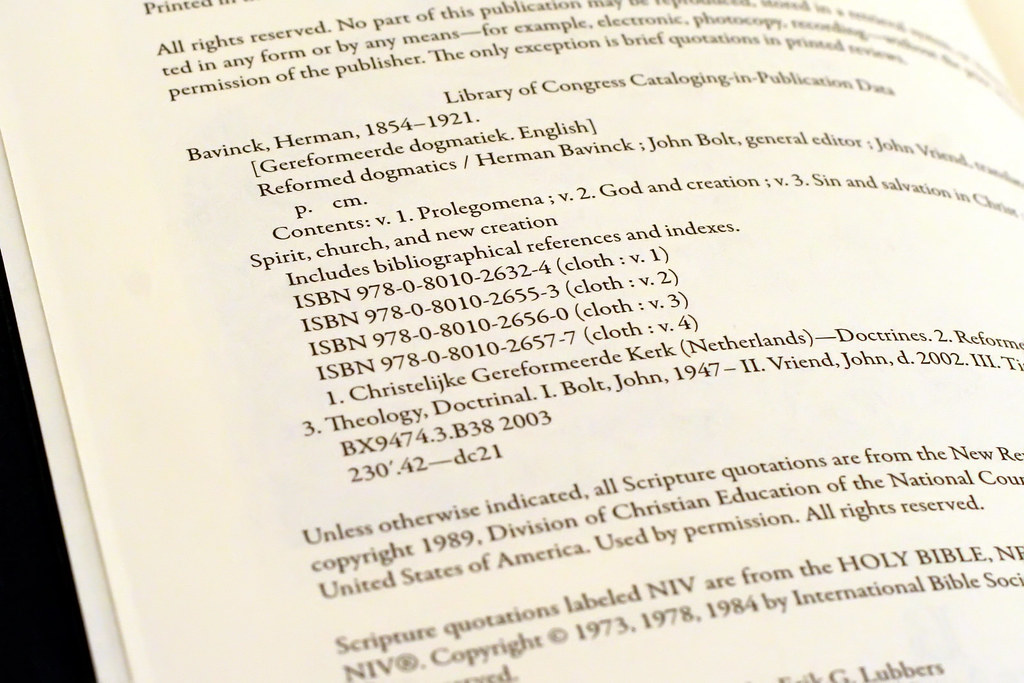
I’ve contacted Baker Academic and will pass along updates as I receive them, especially if I can find a way to replace the paper editions with cloth editions.

Some questions for TSS readers:

(1) Do you own copies of Baker’s printings of Reformed Dogmatics? Which volumes? What are the print dates?

(2) Does the copyright page claim the volume is cloth?

(3) If so—and if you dare—pinch the top of the cover over the spine and try ripping it (ever so slightly) to see if you, too, have a “paperback”. And let me know in the comments. [No need for any more examples.]

Perhaps—and let’s hope—my two copies are aberrations.

Slowing the Stream of Sainthood

It may be Pope John Paul’s cannon-happy legacy that’s now holding up his own path to “sainthood.” This from the Washington Post article, “Charting a Path to Sainthood“:

John Paul, who canonized more people than any pope in history — 482 — has entered the system just as it is slowing. In February, the Vatican issued a document calling for the consideration process to be followed more stringently, apparently responding to worries that perhaps John Paul’s numbers were too high. … In his three years as pope, Benedict has canonized just 14. Although he has said he favors John Paul being named a saint, he has not exercised his right to make it happen immediately.

PS – A simple scan of the term “saint” in Scripture makes clear that each genuine Christian is a true saint. And death is no prerequisite for “sainthood” (2 Thessalonians 1:10).

J. Gresham Machen (1881-1937)

Baltimore, MD—Last week our neighbors graciously surprised my son and I with a pair of tickets to Friday’s Red Sox v. Orioles game at Camden. We took full opportunity of our first trip to Baltimore’s inner harbor—we played games and ate lunch at the ESPN Zone, walked through a civil war ship, explored the shoreline of the inner harbor, and shopped at a Barnes & Noble bookstore housed in an old converted power plant.

The inner harbor area was crawling with Red Sox fans, and the game later that evening confirmed there were more Sox fans than Baltimore fans. The chants, “Let’s Go, Orioles” were all drowned out by “Let’s Go, Red Sox.”

It was Manny Ramirez’s birthday and his career home run total stood at 499. Camera bulbs popped like little flashes of lightning from the crowd upon each pitch, hoping to capture the swing of number 500. Manny didn’t come close to hitting home runs that night, ending the evening with a pop-up about 200 feet in the air which the O’s catcher caught standing on home plate. The next night (Saturday) Manny connected on 500. One day too late. The Sox won the Friday game 5-2 in 13 innings.

On the late, hour-long ride home my son and I concluded one of the highlights of the day was our stop before the inner harbor and Camden.

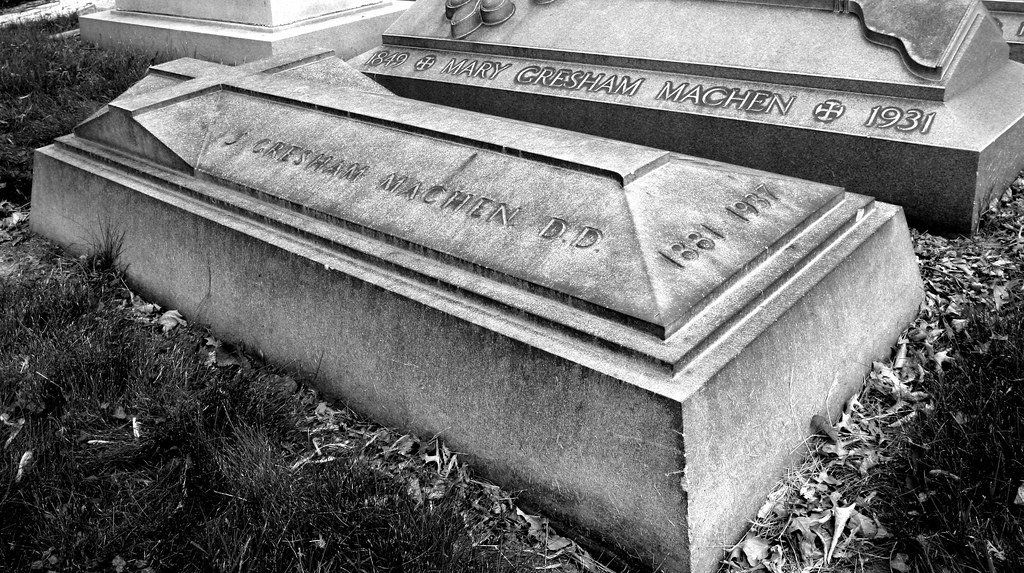
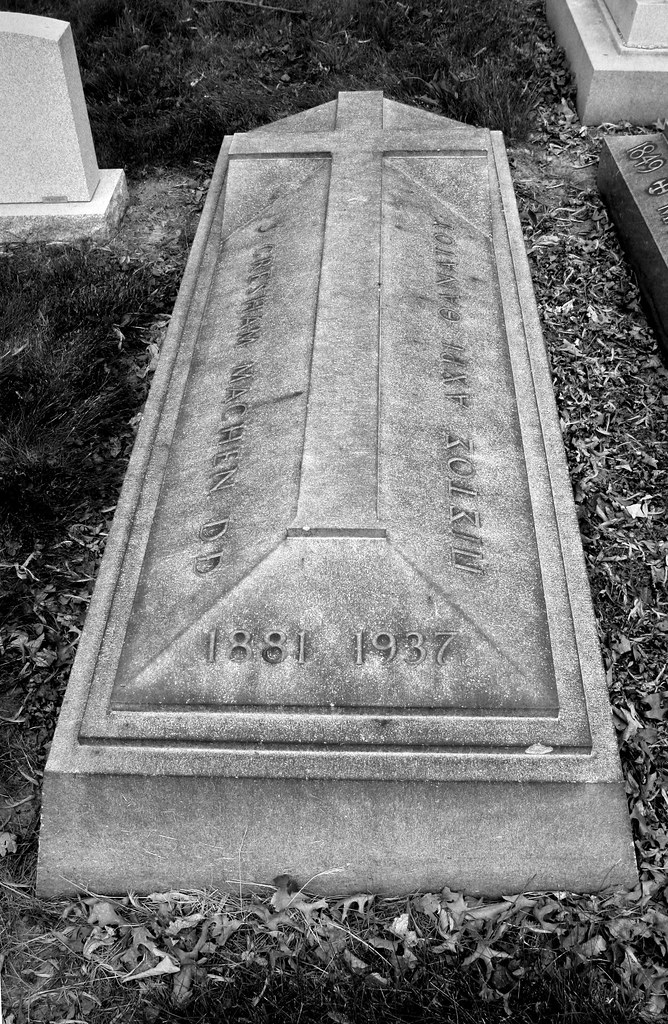
About a half mile North of Camden Yards sits The Green Mount Cemetery, an old, 60-acre plot of land, established in 1839, separated from the rest of the world by a stone wall perimeter. The cemetery is the final resting place of the famous (Johns Hopkins) and the infamous (John Wilkes Booth). It’s also the final resting place of Baltimore native, J. Gresham Machen (1881-1937).

Machen, who never married, was laid to rest here on January 5, 1937 next to his father (Arthur Webster) and mother (Mary Gresham). (See map).

Machen’s life and ministry were prolific. He contended for the faith at Princeton Seminary, eventually established Westminster Theological Seminary in 1929, supported and trained global missions, and wrote books like What is Faith? (Banner of Truth 1925) and Christianity and Liberalism (Eerdmans, 1923) that remain readable and relevant today. It’s no surprise to read Machen’s books quoted throughout Why We’re Not Emergent (Moody, 2008). Machen’s books speak to contemporary issues nearly a century later.

So last Friday, in the same manner as our trip to Princeton Cemetery in 2006, my son and I spent a few moments photographing Machen’s grave and reflecting on God’s graciousness to the church. Here are some pictures (mostly b/w) of our time at Green Mount.


——-

——-

——-

——-

——-

——-

——-

Augustine: Expositions of the Psalms

“Augustine’s sermons on the Psalms are difficult for the modern reader, for in them the preacher’s love of allegory often leads him far from the literal sense. His understanding of the psalm titles had a tendency to encourage him to the wildest excesses of allegorical interpretation. The Latin translation he used was often so misleading that even the ingenuity of an Augustine was taxed to make some sort of spiritually edifying sense out of the text. Yet, nevertheless, this collection of sermons is a fascinating mural of theological and devotional insight. More even than a mural, perhaps it should be compared with a complete city, with its marketplaces, its fortresses, its courtyards, its tenements and sacred sanctuaries.

“Augustine’s cycle of sermons on the Psalms is a veritable theological Jerusalem of heavenly meditation and celestial praise. It has fortresses of moral instruction, luxurious palaces of rich doctrinal theology, brilliant vistas of typological insight, pious parks and playgrounds of allegory. For the theologian, yes, even for the modern theologian, reading these sermons is like a vacation in Venice. It is a marvelous fantasy, a very classical fantasy, which somehow points to a reality beyond the fantasy and which is so much more true than the more mundane type of reality; it is a reality everyday shopping-center reductionists will never understand.”

-Hughes Oliphant Old, The Reading and Preaching of the Scriptures in the Worship of the Christian Church, Volume 2: The Patristic Age (Eerdmans, 1998 ) pp. 357-358.

Exegeting A Crowd

I’ve been meaning to transcribe an excerpt from a recent message at my home church, Covenant Life (Gaithersburg, MD). Being in Louisville, perhaps, is why the excerpt from Dr Albert Mohler’s message came back to mind.

On May 4th Dr Mohler preached on The Parable of the Sower (Matthew 13:1-23). He made these remarks at the beginning of the message:

“The crowd is so large that has been gathering over the course of this day that Jesus is required to do what a teacher must do and that is find some way to get distance from the crowd that is necessary to be seen and heard. In this case Jesus gets into a boat and goes slightly off shore in order that he might teach. The crowd is a very important factor to this passage.

The crowd is a matter of some question–some challenge, some perplexity–to us as well. Is has become clear that evangelical Christians in particular have a hard time understanding the nature of a crowd. We are tempted to think of a crowd as a great gathering of receptivity.

We understand that the crowd is gathering because something has been happening. We as evangelicals sometimes mistake a crowd for a church. It’s hard for us sometimes to understand what’s going on. Jesus helps to clarify this for his own disciples.”

–Albert Mohler, The Parable of the Sower, sermon at Covenant Life Church (Gaithersburg, MD) on May 4, 2008.