We Are All Apologists Now

fools-talkOs Guinness, in his new book Fool’s Talk: Recovering the Art of Christian Persuasion (IVP), pages 15–16:

We are all apologists now, and we stand at the dawn of the grand age of human apologetics, or so some are saying because our wired world and our global era are a time when expressing, presenting, sharing, defending and selling ourselves have become a staple of everyday life for countless millions of people around the world, both Christians and others. The age of the Internet, it is said, is the age of the self and the selfie. The world is full of people full of themselves. In such an age, “I post, therefore I am.”

To put the point more plainly, human interconnectedness in the global era has been raised to a truly global level, with unprecedented speed and on an unprecedented scale. Everyone is now everywhere, and everyone can communicate with everyone else from anywhere and at any time, instantly and cheaply. Communication through the social media in the age of email, text messages, cell phones, tweets and Skype is no longer from “the few to the many,” as in the age of the book, the newspaper and television, but from “the many to the many,” and all the time. . . .

That is why it can be said that we are in the grand secular age of apologetics. The whole world has taken up apologetics without ever using or knowing the idea as Christians understand it. We are all apologists now, if only on behalf of “the Daily Me” or “the Tweeted Update” that we post for our virtual friends and our cyber community. The great goals of life, we are told, are to gain the widest possible public attention and to reach as many people in the world with our products — and always, our leading product is Us.

Are Christians ready for this new age? We who are followers of Jesus stand as witnesses to the truth and meaning of the life, death and resurrection of Jesus as a central matter of our calling. We are spokespersons for our Lord, and advocacy is in our genes. Ours is the apologetic faith par excellence. But regardless of the new media, many of us have yet to rise to the challenge of a way of apologetics that is as profound as the good news we announce, as deep as the human heart, as subtle as the human mind, as powerful and flexible as the range of people and issues that we meet every day in our extraordinary world in which “everyone is now everywhere.”

Later Guinness writes (pages 166–167):

On the one hand, modern words suffer from inattention. Everyone is speaking and no one is listening. On the other hand, modern words suffer from inflation. Under the impact of the omnipresence of advertising and “adspeak,”words are nothing more than tools to sell products and agendas, and the highest and most sacred words can be used to give a leg up to the most trivial of goods and the worst of causes. Words today are all so much “verbiage,” “propaganda” and a matter of “words, words, words.”

In direct and forceful contrast, we Christians must show again that we are both people of the Word and people who believe in words. Words are never mere words for us, for they are linked indissolubly to truth, freedom, worship and human dignity. Words matter because we worship the Word himself, and our words used on his behalf should be spring-loaded with the truth and power of his Word — especially to those who are closed.

The problems of inattention and inflation are only two of the oddities of communication in the great age of communication. But they show how great communicators as Christians are called to be and have often been, communication today is often harder and not easier. More importantly, they show that the best answer to the challenge is not through improved technology but through deeper theology.

Book(s) Updates

books

Here’s a real quick update on my book projects (past, present, and future).

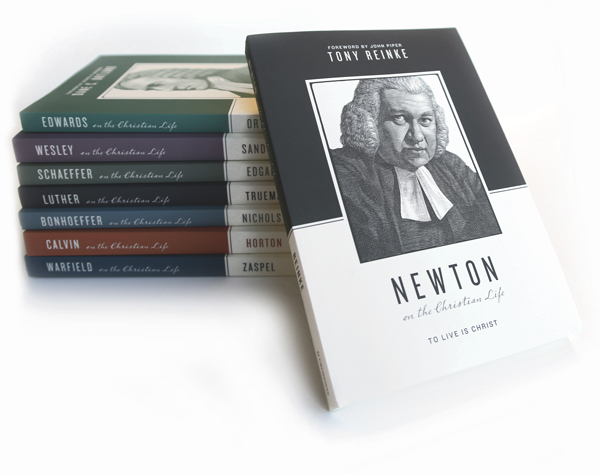
First, a special thank you to everyone who lent a hand to launch my new book, Newton on the Christian Life: To Live Is Christ (Crossway). Apart from a glitch in Amazon’s automation process that prevented the book from being restocked in a timely manner (and which dragged the launch out longer than expected), everything went very well. I’m grateful to God for many friends who wrote encouraging endorsements and who helped spread the word online. A special thanks to Westminster Books who ran a special offer on the book for a couple of weeks and brought some level of consistency to the launch (and sanity to me).

Newton is book #2 for me. Book #3 is nearly complete. Last week I was graciously given some time to finish up the book in a remote cabin in the woods of Minnesota. The time was focused and productive and I’m now done with it. From here it will go through two final rounds of edits in the coming weeks. The endorsements are in and the cover is finished (and it’s beautiful!). I speak in veiled terms because it is a secret. All I can say it will be 130 pages long, it will launch in October, and it will be given away free of charge to the world (which is the fulfillment of a dream for me).

Today I signed a contract for book #4, and I launch into the big ocean of writing and research in early July. The book will be my third with Crossway (book #1, you may remember, is titled Lit! A Christian Guide to Reading Books, and was published back in 2011). Book #4 will also be my third book in which I will be working closely with Justin Taylor, which is a privilege only an author in such a position can fully appreciate. I’ll share more about book #4 later this fall (after #3 launches).

Over the last several months the Lord has been kind to me, sparking many potential book ideas and delivering a lot of creative energy. My new urgency in writing books is the culmination of a two-year process of evaluating two questions: (1) Has God called me to write or edit? And, (2) If I’m called to write, what should I be writing (both in format and theme)? Authoring books is a calling others have affirmed, and there are few things I love more than writing thickly researched, highly edited, and refined projects on targeted subjects, all to serve the local church. I do not write to write; I write to serve. And I firmly believe writing books is a primary calling on my life, at least for the near future.

Speaking of writing, a number of friends online have asked if I would share my writing process for the Newton book — the ins and outs of what a typical week looked like for me (as a weekend writer with a family). I have also been asked to explain my formal process for how I envisioned writing what I have called “pastoral synthesis,” the art of taking Newton’s 1,000 letters and drawing them together under an umbrella of selected universals of the Christian life. I’m under deadline to finish three article projects in the next week, but when I get those done I hope to return to those journal pages, transcribe my notes, and share my process here at tonyreinke.com.

So those are my book updates.

What a joy to serve you as a writer. As I have come to appreciate, authors labor for long hours in isolation, for an audience they cannot see, to address a future they cannot predict. So to now have the Newton book out and to see it bless particular readers is a thrill for me (and especially to hear from a number of pastors and from Christians who are struggling with depression). I thank you for your online encouragements and for the incredibly kind reviews that have begun appearing on the Newton page in Amazon.

Of course you can always find an updated list of books I have written or edited at the bottom of the About page, here.

As old Bunyan once said, I am honored to serve you with what little I have to offer.

Blessings in Christ!

Tony Reinke

We Are What We Love

tk

Tim Keller, Preaching: Communicating Faith in an Age of Skepticism (releases June 9), pages 159–160:

What the heart most wants the mind finds reasonable, the emotions find valuable, and the will finds doable. It is all-important, then, that preaching move the heart to stop trusting and loving other things more than God. What makes people into what they are is the order of their loves — what they love most, more, less, and least. That is more fundamental to who you are than even the beliefs to which you mentally subscribe. Your loves show what you actually believe in, not what you say you do. People, therefore, change not by merely changing their thinking but by changing what they love most. …

So the goal of the sermon cannot be merely to make the truth clear and understandable to the mind, but must also be to make it gripping and real to the heart. Change happens not just by giving the mind new arguments but also by feeding the imagination new beauties.


On a related note, find Keller’s lectures on preaching here.

The Films David Powlison Assigned

d-pow

Bible counselor extraordinaire David Powlison used literature to teach his course, The Elements of Biblical Change.

His students were asked to chose from novels (Joseph Conrad, Heart of Darkness; Albert Camus, The Plague), drama (Eugene O’Neill, The Iceman Cometh; Arthur Miller, Death of a Salesman), and short stories (Anton Chekhov and Raymond Carver).

Students were also required to read Marilynne Robinson’s Gilead and Alan Paton’s Cry, the Beloved Country. I recently posted a short clip of Powlison from a dinner with him in 2009, explaining why he loves Cry, the Beloved Country.

Near the end, Powlison mentions assigning films in the class, too, and that led a number of you to email me for his list. So I asked David and he sent it:

  1. The Great Santini” (1979). With this film, students were asked to do a personal application study on anger (grumbling, resentment, conflict, judgmentalism, etc.)
  2. Wit” (2001). With this film, students were asked to do a personal application study on anxiety (preoccupation, obsession, fear, control, etc.)
  3. Ordinary People” (1980)
  4. Il Postino (The Postman)” (1994). With this film, students were asked to do a personal application study on escapism (addictions, avoidance, love of pleasure, etc.)

Here’s a clip from Wit:

There you have it.

My new book launches tomorrow

jnxl-11After nearly three years of planning, researching, writing and re-writing, tomorrow I launch my new book into the world: Newton on the Christian Life: To Live Is Christ. It is the latest addition to the outstanding series from Crossway Books: Theologians on the Christian Life, edited by Justin Taylor and Steve Nichols. And I could not be happier with the final product.

As the book launches, there will be more details to share all week. Already, the first major review of the book was published today (reformation21). Tomorrow, Tim Challies will interview me, and Westminster Books will launch a special promo sale (details forthcoming). I will keep you posted as launch week unfolds.

At the beginning of my book I chose these words from one of John Newton’s personal letters as an epigraph over the entire project: “I thank the Lord if he makes my writings useful. I hope they contain some of his truths; and truth, like a torch, may be seen by its own light, without reference to the hand that holds it.” I love those sentences — and they are my eager prayer and hope.

Some readers have emailed to ask how they can pitch in to help spread news about the new book, and here is one valuable way you can help. Over the coming weeks please use the hashtag #JNXL when you post quotes on Twitter, or when you talk about the book on Facebook, or when you Instagram pictures of the book or quotes from it. Using #JNXL will help draw together the collective interest online and help your friends listen in to a bigger conversation.

(And if you need some good Newton tweetables to get you started, see my stash here.)

Finally, this is a moment for me to thank all of you who follow me on this blog and on social media and who are eager to encourage me over the years. Thank you for reading my books and cheering me on. I am honored to serve you, and I am grateful to God to be the recipient of years of kindness from you.

Very gratefully,

Tony

Information, Meaning, and the Curse of Omniscience

James Gleick, The Information: A History, A Theory, A Flood (Vintage, 2011), pages 416, 425–426:

The birth of information theory came with its ruthless sacrifice of meaning — the very quality that gives information its value and its purpose. . . .

No deus ex machine waits in the wings; no man behind the curtain. We have no Maxwell’s demon to help us filter and search.

“We want the Demon, you see,” wrote Stanislaw Lem, “to extract from the dance of atoms only information that is genuine, like mathematical theorems, fashion magazines, blueprints, historical chronicles, or a recipe for ion crumpets, or how to clean and iron a suit of asbestos, and poetry too, and scientific advice, and almanacs, and calendars, and secret documents, and everything that ever appeared in any newspaper in the Universe, and telephone books of the future.”

As ever, it is the choice that informs us (in the original sense of that word). Selecting the genuine takes work; then forgetting [the rest] takes even more work.

This is the curse of omniscience: the answer to any question may arrive at the fingertips — via Google or Wikipedia or IMDb or YouTube or Epicurious or the National DNA Database or any of their natural heirs and successors — and still we wonder what we know.

Ecclesiastes 12:12–14:

Of making many books there is no end, and much study is a weariness of the flesh. The end of the matter; all has been heard. Fear God and keep his commandments, for this is the whole duty of man. For God will bring every deed into judgment, with every secret thing, whether good or evil.