How Joy Dies

pss-1Psalm 16:4 —

The sorrows of those who run after another god shall multiply;
their drink offerings of blood I will not pour out
or take their names on my lips.

James A. Johnston, The Psalms, Volume 1 (Crossway; 2015), page 178 —

Being happy in God starts with saying no. You cannot be happy and satisfied in God if you are riding the fence. Some people wonder why they cannot find joy in Christ, but they have a foot in each world. They want God to bless them, but they are living for themselves too. They hedge their bets.

David knows better. He will have nothing to do with pagan sacrifices. He will not worship by pouring out the blood of their sacrifices, and he will not pray to their gods. Finding joy and satisfaction in God starts by saying no.

David Brooks, Augustine, and Expulsive Pleasures

I certainly expected to find flashes of insight from New York Times columnist David Brooks in his new book The Road to Character (Random House). I didn’t expect to find Christian Hedonism.

Late in the book Brooks recounts Augustine’s conversion, a conversion postponed by a desire to cling tightly to worldly pleasures.

Brooks tells the story:

In the Confessions, Augustine paints the scene when the delay finally ended. He was sitting in a garden talking with a friend, Alypius, who told him some stories about monks in Egypt who gave up everything to serve God. Augustine was amazed. The people who were not part of the elite educational system were out doing amazing things while the graduates of that system lived for themselves. “What ails us?” Augustine cried. “The unlearned start up and take heaven by force and we, with this our learning, but without heart, wallow in flesh and blood.”

In this fever of doubt and self-reproach, Augustine stood up and strode away while Alypius gazed on in stunned silence. Augustine began pacing around the garden, and Alypius got up and followed him. Augustine felt his bones crying out to end this self-divided life, to stop turning and tossing this way and that. He tore at his hair, beat his forehead, locked his fingers and hunched over, clasping his knee. It seemed as if God was beating on his insides, inflicting a “severe mercy,” redoubling the lashes of fear and shame that afflicted him. “Be it done now, be it done now,” he cried to himself.

But his worldly desires would not give up so easily. Thoughts jumped into his head. It was as if they were plucking at his garments. “Are you going to cast us off? You’ll never experience our pleasures ever again?” Augustine hesitated, wondering, “Do I really think I can live without these pleasures?”

Then there appeared in his mind a thought, the ideal of dignified chastity and self-control. In the Confessions, he dresses up this thought in metaphorical terms, as a vision of a woman, Lady Continence. He does not describe her as an ascetic, puritanical goddess. On the contrary, she is an earthy, fecund woman. She’s not renouncing joy and sensuality; she’s offering better versions. . . .

Augustine cast himself down under a fig tree, giving way to his tears. Then he heard a voice, which sounded like the voice of a boy or a girl from another house neighboring the garden. It said, “Take up and read. Take up and read.” Augustine felt a sense of immediate resolve. He opened up a nearby Bible and read the first passage on which his eyes fell: “Not in rioting and drunkenness, not in chambering and wantonness, not in strife and envying; but put ye in the Lord Jesus Christ, and make not provision for the flesh, in concupiscence.”

Augustine had no need to read any further. He felt a light flooding his heart and erasing every shadow. He felt a sudden turning of his will, a sudden desire to renounce worldly, finite pleasures and to live for Christ.

In beautiful summary, Brooks writes:

Augustine says no to one set of desires and pleasures and rises to a higher set of joys and pleasures. (202–203)

This is the expulsive power of a new affection. This is Christian Hedonism. This is the beauty of Christ overpowering our sinful addictions to the fleeting pleasures of the world. This, as Brooks seems to know, is where character is born.

My Pens

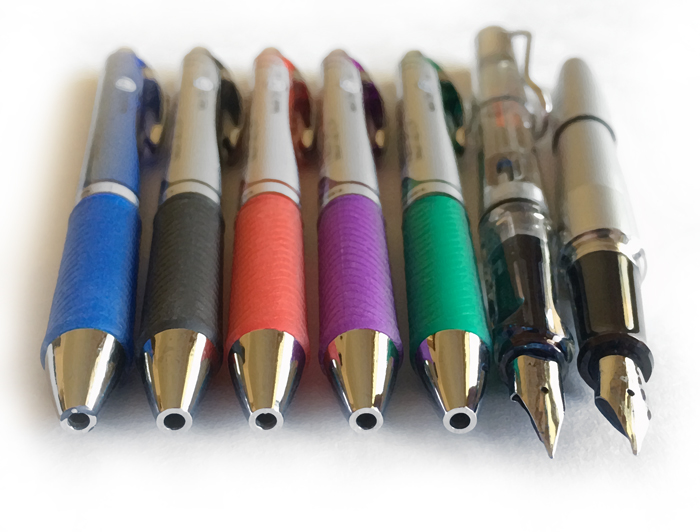
pen-heroI get a lot of questions from readers who want to know what pens I use (probably because I’ve done things like this in the past). So this is a short blog, by request, to explain.

I pulled them out of my bag and took this iPhone pic. As you can see I carry two different types of pens with me — reliable general use retractable pens, and two fountain pens for more serious writing and editing projects.

For general use, and for marking in books, nothing beats Pentel’s EnerGel Deluxe .7mm. I’ve used them for about six years. I started off with the .5mm version, and they were nice, but the bigger point offers a broader ink selection and I grew to like them more and more over time in every way. Mostly I use blue, black, and red, but sometimes the purple and green depending on how many colors I need on a page. You can get an assorted 6-pack of these pens for $12.

For more serious projects, for writing first drafts of some blog posts, for writing notes to others, for personal journal entries, and for making hand edits on my articles and book projects (which are, in the final stages all done by hand on paper), I use fountain pens. My favorite being the Lamy Safari Vista clear, extra-fine point ($24) with ink converter ($7). It’s very wet for an extra-fine nib and writes at what is more accurately classified as a medium point. The pen writes better and better with age (mine is four years old).

On standby is a simple Pilot Metropolitan, medium point ($13) with ink converter ($8).

For ink, I have been very happy with Iroshizuku’s blue-black ($23).

So there you have it. My pens.

And as I explained in my piece “Jack’s Typewriter,” C.S. Lewis makes a good argument for why writers should experiment a few times getting away from the keyboard to write more slowly, on paper, with a good pen.


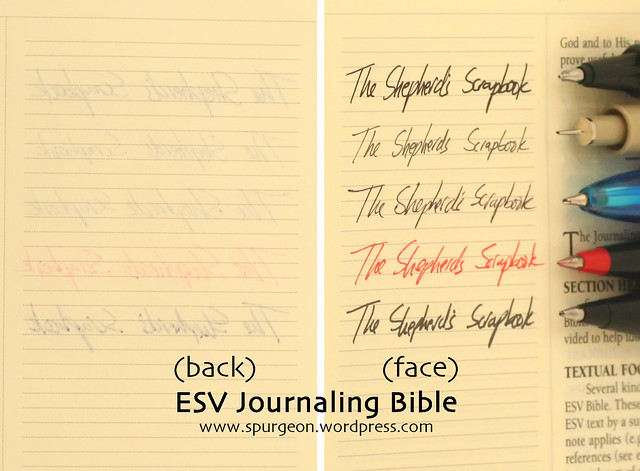
Related: Here are some good pens for writing in Bibles.

Cry, the Beloved Country

Cry-the-Beloved-CountryMost of my favorite conversations about literature have been with David Powlison, and most of those conversations have been spontaneous, leaving me to scribble down notes on whatever paper was close. But six years ago, in the spring of 2009, over dinner in a restaurant, I wised up, brought a handheld recorder, got his permission to record, and then asked him about the novels that have most shaped his ministry.

As you might expect, he commended Gilead by Marilynne Robinson. But first he commended Cry, the Beloved Country by Alan Paton. Here’s what he said (6-minute audio):

iPhone Flattery

I’m finishing up a survey of 8,000 of our readers at desiringGod.org, to get a sense of the scope and influence of social media on the Christian life. The results are eye-opening. Probably most surprising is the generational divide that splits over whether we should be optimistic or pessimistic about what our devices are doing to us.

I hope to share the full findings at DG in the coming month, but what I see is a trend among the 18–39 group (especially men) who are pessimistic and more likely to admit their phone habits are self-destructive. The +40 group (especially among women) is trending optimistic, a demographic that seems more likely to use social media as an extension of face-to-face relationships.

Nevertheless, take it from Andy Crouch, who disconnected for the 40 days of Lent, to explain what life was like freed from illuminated pixels:

There is a lot of talk about the ways our devices are distracting us, and that is certainly true. Having spent several weeks away from it all, I’m a bit aghast at how much buzzing and blinking, how many notifications and messages, how much unasked-for stimulation, I’ve let creep into my life over the past few years. But there’s something deeper than just the sheer variety and urgency of data that presents itself to us. The issue is not just cognitive. The deeper danger of our screens, I am coming to think, is flattery.

Our screens, increasingly, pay a great deal of attention to us. They assure us that someone, or at least something, cares. The mediated world constantly falls over itself to tell us, often in entirely automated ways, that we matter every bit as much as we secretly hope we do. They tell us we are liked, retweeted, favorited—that we are significant, useful, and urgently needed. Every generation of devices gets better at this, becomes less a persnickety, recalcitrant technician (does anyone remember the exacting syntax of command-line interfaces?) and more and more an utterly dedicated, ingratiating concierge for our preferred future.

The unmediated world does not flatter us in this way. Stand on a deserted seashore and the creation pays you no evident attention, except perhaps for a few creatures that alter their paths to keep a safe distance. Even our fellow human beings rarely flatter us with the attention we think we deserve. Walk down a street in Hong Kong or Phnom Penh or London or Rome, and unless you are young and beautiful, or possibly rich, no one will pay you the slightest heed. And youth and beauty, even wealth, are fleeting things. I never was beautiful, but I have had some success, enough to know that even at the heights of attention, when the whole room is looking at you, smiling at you, standing and applauding you, the overwhelming experience of life as a human being is smallness and disregard. There is a hunger for attention that all the selfies in the world will never fill, a hunger that only grows as our mediated world breathlessly offers more and more ways to call attention to ourselves.

Read the whole article here.