Thomas Shepard: “too great love for books”

Thomas Shepard

On occasion I read a book that’s so humbling I just stop reading and pray for my own soul. And that’s exactly what happened Friday when I began reading Alexander Whyte’s 1909 book Thomas Shepard: Pilgrim Father and Founder of Harvard (reprinted in 2007 by Reformation Heritage Books).

Thomas Shepard (1605-1649) was a Puritan known for his experiential preaching and writing. Whyte (1836-1921) meditated on selections from Shepard’s life and writings. The meditations are very rich.

Shepard was a very influential Puritan, a very gifted evangelist and preacher. Yet he constantly saw his weaknesses and shows his dependence upon the power of God. Amidst his success, Shepard’s private writings capture a deep lament that his own influence impaired the spiritual growth of those around him. In one overstatement Shepard writes, “under the blighting shadow of my presence neither old nor young ever really prospered.” Shepard lamented that his children were born — at least to him. His sense of inherent failure and incapacitating sinfulness apart from God’s graciousness makes his thoughts and meditations very humbling.

In the following example Whyte uses the journal of Shepard to reveal the dangers of loving our books to the neglect of our families. This is an excellent lesson for all bibliophile/husband/fathers like myself.

“As I go over and over Thomas Shepard’s Meditations and Spiritual Experiences I find these four faults of his filling Shepard’s heart and conscience with a great remorse. First, his too great love for books and his too much time spent in his study. Had Shepard been a celibate priest instead of a Protestant and Puritan pastor, his love for his books and his long hours in his study would all have been to be commended. But with his family neglected, his pulpit and his class studies became his besting sin. He laments in one place his ‘ragged style’ in writing, as well he may. But far better write a ragged style than bring up and send out ragged children into the world. Shepard lived among his books before he was married, and he continued to live too much among them after he was a married man and father of a family. And that bad habit of his was very near being the ruin of his household life. Ministers, says Samuel Rutherford, of all men are made up of extremes. Some ministers ruin themselves and their families and their people, and all beyond redemption, by their sinful neglect of their sacred studies. And then there is one minister here and another there like Thomas Shepard, who imperil their own and their children’s souls by their intemperate and untimeous devotion to their books and to their desks. But the beauty of Thomas Shepard was that he discovered his mistake and set himself to rectify his mistake before it was too late. He continued to love his books and to labor at his sermons, but he gave more and more time and thought to make his children living epistles to be known and read of all men.”

Alexander Whyte, Thomas Shepard: Pilgrim Father and Founder of Harvard (Reformation Heritage; Grand Rapids, MI) 1909/2007. Pp. 36-37.
Resurrection meditation

‘I have seen the Lord’
A Short Resurrection Sunday meditation

I’m intrigued by the various responses to the empty tomb. For me the distinction is seen most clearly in the contrasted reaction of the disciples and Mary Magdalene (see John 20:1-18).

You probably know the story well. On the first day of the week Mary Magdalene sets out before dawn to the tomb where Jesus’ body was laid. To her surprise, the stone had been rolled away and Jesus was gone. Mary runs to Simon Peter and the other disciples to tell them of the news. Peter and another disciple run to the tomb to see for themselves. Sure enough, the burial clothes were there, but Jesus was gone. Perplexed, the disciples walk back home.

But Mary Magdalene returns to the tomb for another look. Maybe this time Jesus’ body will be there (like when we look in a drawer for something that’s lost and a few minutes later return to the same drawer thinking our object of concern must be there and we missed it). Mary did not miss the body of Jesus. He was gone. Mary breaks down. As has often been the case in these horrible few days, tears fill her eyes and her head rests in her hands. She is in no hurry to return home.

Now two angels sit in the tomb and ask Marry a question, “Woman, why are you weeping?” For the second time this morning Mary reveals her heart in these words: “They have taken away my Lord, and I do not know where they have laid him.” Now a man chimes into the conversation, saying, “Woman, why are you weeping? Whom are you seeking?” Thinking this man was the gardener, she said to him, “Sir, if you have carried him away, tell me where you have laid him, and I will take him away.” This is Mary’s third plea to see Jesus.

The story takes a dramatic turn when Mary realizes the gardener is really the One she is seeking after. “Mary,” is the only word Jesus needs speak. Mary recognizes Jesus, her heart is flooded with joy and her legs run with new strength to tell the disciples, “I have seen the Lord!”

It’s an amazing story with renewed power each time I read it.

But my question is this: Why did the Resurrected Jesus first reveal Himself to Mary Magdalene before the other disciples? The answer seems to be obvious. Mary was not asking, “Is Jesus here or not?” Her persistent question — asked to anyone in the vicinity of the tomb — was simply, “Where is He?” For Mary, the answer to her question was not found in the tomb, but in a Man. Where have they laid Him? Take me to where you put Him. These were her questions.

In this Resurrection season it’s a question I ask of myself: Am I content this Resurrection Sunday to see an empty tomb and go home, or will I seek the presence of Jesus? Will I be content with a sermon and a service, or will I wait in anticipation for Jesus to manifest Himself to me?

Jesus promises “he who loves me will be loved by my Father, and I will love him and manifest myself to him” (John 14:21). It’s this promise we see fulfilled in the pleas of Mary Magdalene.

So praise God that He has spared you from the wrath you and I deserve. Praise Him for His Son, in Whom our unrighteousness is traded for His righteousness and our death for the life we have in His Resurrection. But also, as Spurgeon reminds us, use this opportunity to seek the manifestations of Christ. “Seek such spiritual manifestations if you have never experienced them; and if you have been privileged to enjoy them, seek more of them … God bless you, and lead you to seek these manifestations constantly” (sermon 29).

Pursue Jesus and especially that you would “see Him” during this Resurrection weekend. Don’t be too quick to walk home.

Good Friday

Holding the cup
by C.H. Spurgeon

“The darkest hour of Christ’s life was when his Father forsook him — that gloomy hour when his Father’s remorseless hand held the cup to his Son’s own lips, and bitter though it was said to him, ‘Drink my Son — ay, drink;’ and when the quivering Savior, for a moment, having man within him — strong in its agonies for the moment, said, ‘My Father, if it be possible, let this cup pass from me.’ Oh! it was a dark moment when the Father’s ears were deaf to his Son’s petitions, when the Father’s eyes were closed upon his Son’s agonies. ‘My Father,’ said the Son, ‘Canst thou not remove the cup? Is there no way else for thy severe justice? Is there no other medium for man’s salvation?’ There is none! Ah! it was a terrible moment when he tasted the wormwood and the gall” (sermon 61).

ESV Journaling Bible

ESV Journaling Bible

The last time we announced a new ESV Bible it was a joke meant to be a late April fools trick (and it worked). But today’s post is no joke.

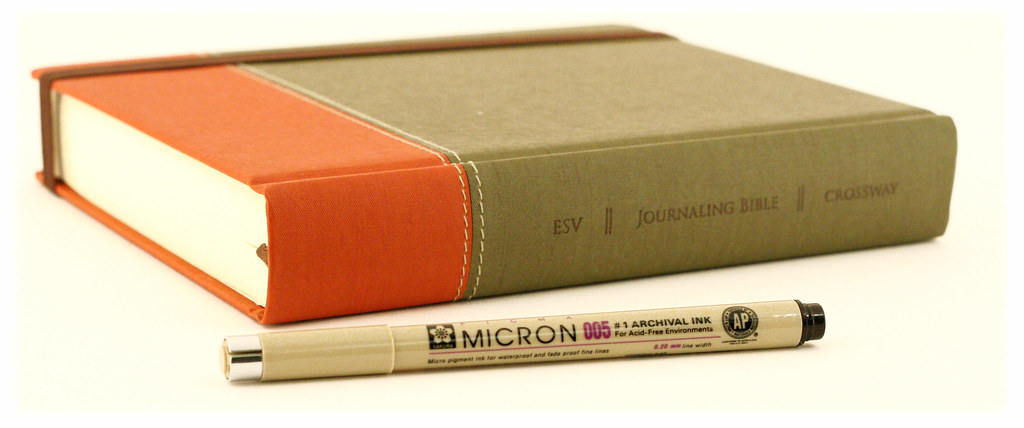
Because so many readers of the Blank Bible series simply don’t have the equipment or time to make their own, I’ve received a lot of emails about my thoughts on the ESV Journaling Bible. So I finally decided to get a copy and try it out myself (this one came safely to my home in cardboard through FedEx).

After opening the box I had three immediate thoughts: “It’s a lot smaller than I expected” … “It’s more portable than I expected” … and finally, “It’s much more durable than I expected.”

Here are more notes after further reflection (and some field-testing).

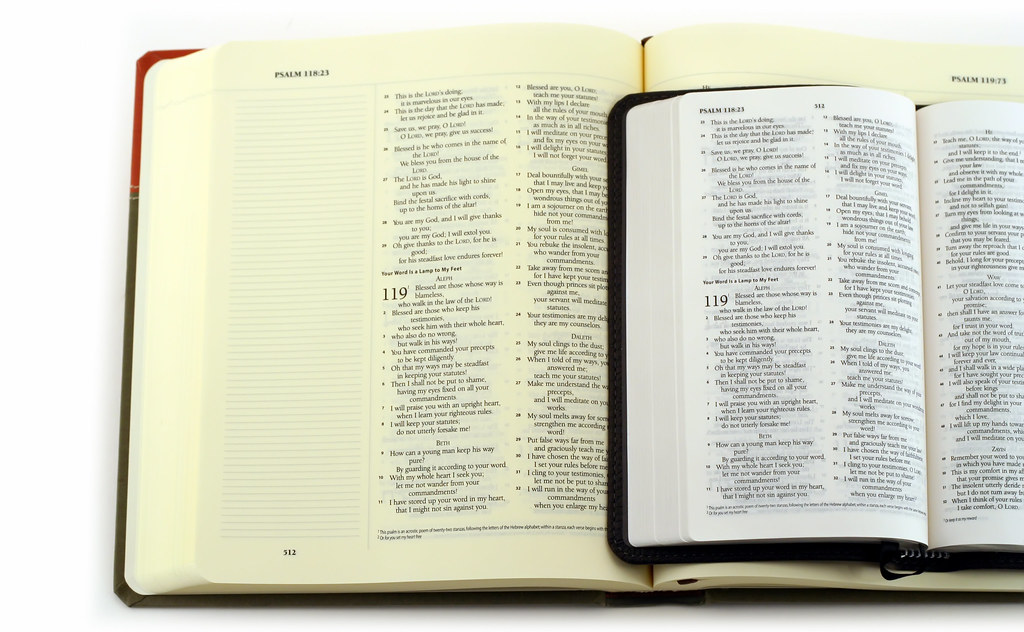
1. Size. The font size is small but (as you can see in the picture) slightly larger than the ESV Compact TruTone edition. The marginal note areas are lined for a note taker with small handwriting. The top margin can also be used for notes.

2. Paper color. Also in this comparison you can see that the Journaling Bible features an off-white paper color compared to other ESV Bibles. This may not be a big deal but it does seem to make the already small font a bit tougher to read (by decreasing the contrast of the paper/text).

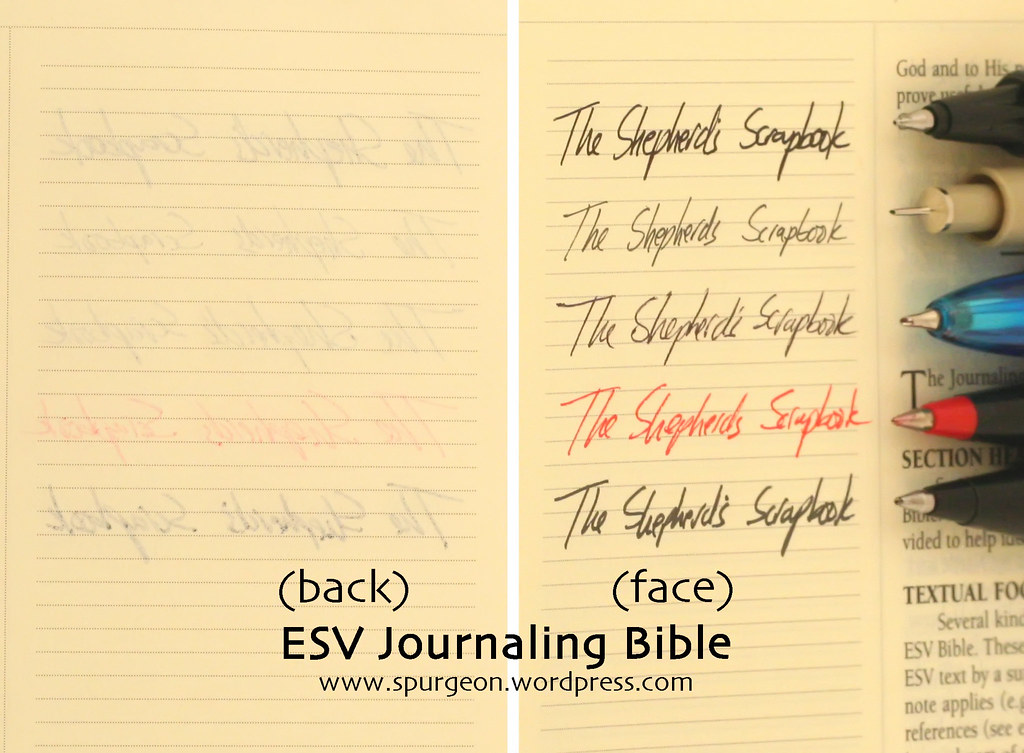
3. Pen bleed. The biggest factor in determining which Bibles can or cannot be written in comes down to how likely the pages are to bleed (pencils are not my thing). We put our safety goggles on, unlocked the door to our underground TSS testing laboratory and — with my poor handwriting skills and five different pens — we put this new ESV Bible to the test.

From top-to-bottom we used the following pens: a black Pilot Vball extra fine roller, a black Pigma Micron 005, an everyday black ballpoint, a red uni-ball micro roller and one big black uni-ball Deluxe roller (an ink pouring pen I wouldn’t consider for a Bible).

The results were fairly surprising because none (not even the uni-ball Delux roller) bled through the paper. No surprise, the best pen for this Bible was the Pigma Micron 005 available at scrapbook and craft stores. The regular ballpoint pen comes in second. But the bigger point is that these pages successfully absorbed all five inks without bleeding.

Join us tomorrow when we run the Journaling Bible through several more tests: The “Flame Retardant?” test, the “Ran Over By Car” test and (my personal favorite) the “Will It Float?” test. Actually, if I were serious this sturdy Bible would probably fare better than expected.

Unlike the blank Bibles I’ve created in the past, the Journaling Bible is compact and portable. It’s a good substitute if making a Blank Bible is out of the question. If you don’t mind the small font and the paper color, it is a very durable ESV with excellent margins and paper for note taking. You can get the black Journaling Bible for about $18 and the fancy calfskin version for about $41. A small price considering it enables you to carry your Bible and your reflections in one compact volume.

—————————-

[NOTE: For our review we used the Terra Cotta/Sage edition of the Journaling Bible – ISBN: 1581348959]

Evangelicals and Mormons Together?

Evangelicals and Mormons Together?

After your heart rate returns to normal, know that this is not real. At least not yet. Gary L.W. Johnson warns in a new book, By Faith Alone: Answering the Challenges to the Doctrine of Justification (Crossway; 2007) that EMT may be just around the corner. In his chapter, Johnson responds to a 1994 book by Keith Fournier entitled A House United: Evangelicals and Catholics Together: A Winning Alliance for the 21st Century (NavPress; 1994). Fournier claims to be a both Evangelical and Roman Catholic. Johnson responded by writing,

“According to him [Fournier], an evangelical is one who knows Christ as Savior and Lord and tells others about him. If this is all it takes to be considered one of today’s evangelicals, we should prepare ourselves to be accosted by evangelical Mormons or Moonies, each clamoring to be recognized at such. And why not? They can easily subscribe to Fournier’s definition…” (By Faith Alone, p. 194).

And that’s exactly what’s beginning to happen. Johnson uses the Fournier book as a backdrop to introduce a newer book by Robert Millet a Mormon professor at BYU. His book is titled, A Different Jesus? The Christ of the Latter-Day Saints (Eerdmans, 2005) and is endorsed by Richard Mouw, the president of Fuller Seminary. Mouw, a professed Calvinist, wrote the foreword and afterward. He writes, “a genuine personal relationship with Jesus Christ does not require that we have all our theology straight” (195). Of course he is right that our relationship with God (thankfully) does not wait until “all our theology” is straight. But Paul is also clear that getting the essential doctrines of the gospel wrong is to be a “foolishly-bewitched-fool” (Galatians 3:1-4).

If the mainline evangelical community backs away from a clear public defense of the gospel and fails to uphold the doctrine of a sinner being made right with God through justification (the legally imputed righteousness of Christ) alone, it’s not a stretch to think Evangelicals and Mormons will eventually come together, too. Al Mohler closes the book with these words: “We can only hope and pray that contributions like this important volume can help to awaken evangelicalism to its doctrinal peril. Otherwise, nothing genuinely evangelical will remain of evangelicalism” (208).

Beneath the Greek references and complex debates this book is a great reminder of the gospel’s simplicity and that makes it a great reminder how, apart from God’s sovereign grace, we walk around in the rut of this world, blindfolded to gospel of life. Oh, how we all need God’s illuminating grace to break into our spiritual blindness and raise our dead hearts! Thank you Jesus!

Check it out for yourself. By Faith Alone: Answering the Challenges to the Doctrine of Justification is a collection of articles by writers like David Wells and Al Mohler on the topic of justification. They discuss current controversies over the gospel and deal with E.P. Sanders, James D.G. Dunn and N.T. Wright (just like the Crossway release earlier this year, Jesus’ Blood and Righteousness by Brian Vickers).

Title: By Faith Alone: Answering the Challenges to the Doctrine of Jusitification
Authors: Gary L.W. Johnson and Guy P. Waters, editors
Reading level: 3.5/5.0 > moderately difficult
Boards: paper
Pages: 214
Volumes: 1
Dust jacket: no
Binding: glue
Paper: normal
Topical index: yes
Scriptural index: yes
Text: perfect type
Publisher: Crossway
Year: 2007
Price USD: $17.99/$12.99 from Monergism
ISBNs: 9781581348408, 1581348401

New John Owen title?

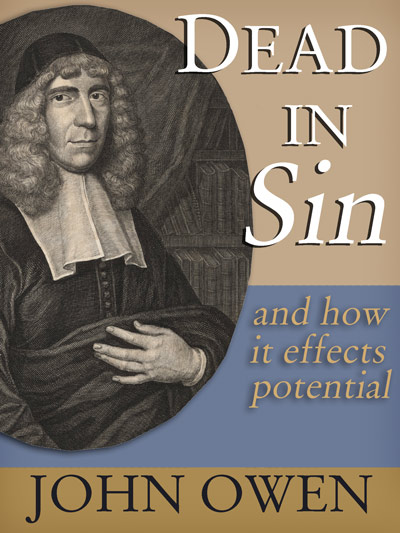
As Tominthebox has documented, John Owen’s works are on the verge of a popular swing. I’m certain Owen will be gaining millions of new readers with the new “Message” edition. In light of this amazing shift in contemporary publishing, I’m proposing a new Owen title that (no doubt) would be another blockbuster! A collection of quotes by Owen (modified into much shorter sentences) on the topic of sin within the pop-language of the day. Any takers?

johnowen.jpg