College Football, Play, and Eschatological Joy

In his new book, The Rest of Life, Ben Witherington includes a chapter on sports and recreation (chapter 2: “Play On”). Play is a category that fits somewhere in the Christian life between work and rest, and it’s a category worthy of our theological attention. Witherington largely builds off Moltmann’s theology of play published in the early 1970s, a book that argues that honest play carries with it an inner proleptic hope of something to come.

In his book, Witherington picks up Moltmann’s connection between play and eschatological expectation, and builds on it, and applies this worldview to his golf game, his running, and the ups and downs of cheering on the Boston Red Sox as a fan. He focuses mostly on amateur team sports and backyard sports done “just for fun” (Witherington argues that pro athletes are not playing per se, but really working).

So how are sports tied to the eschaton? This is how Witherington words it (pages 42–43, 57):

… in playing we anticipate our liberation, a time when we study war no more, a time when we shed all those things that inhibited us and alienated us from real life. Play foreshadows the joy of the eschaton where all matter of drudgery and disease and decay and death will be left behind. Play is quite rightly seen as a celebration of life lived to its fullest, its fastest, its highest, its limits. … Games, played well and fairly, fuel a theology of hope for the future. Playing is not a useless activity. It anticipates the joy of the eschaton. …

Play foreshadows an eschatological better day when things go right, and this is worth celebrating now. The foreshadowing of better times is itself a foretaste of better times, and this is in part the theological function of play. It is not enough to say that play provides relaxation, elevation of the spirits, escape from reality, or pleasure, but serves no utilitarian purpose.

While play does do those things, play is also teleological. It performs no immediate service or utilitarian purpose, but it points to a future goal, a future state, a future time when the harmony and joy of play become the harmony and joy and play of all life, free from disease, decay, and death, free from suffering, sin, and sorrow. Free to be all that we were intended to be. …

Play was meant to point us forward toward a better day, a better time, a more harmonious world where all manner of things are well. Play suggests to us the full possibilities of what we can be, the hint of what it means to really live, to be fully human, to have real brothers and sisters in arms, all on the same team playing together toward the same end. This goes beyond camaraderie to koinonia.
Long iPhone Lines and Individualism

From Don Carson’s 2010 editorial, “Contrarian Reflections on Individualism”:

I wonder whether individualism is in reality as highly prized as some think. One could make a case that many people want to belong to something—to the first group that manages to purchase an iPhone, to the “emerging” crowd or to those who want little to do with them, to the great company that can discuss baseball or cricket or ice hockey, to those who are up-to-date in fashion sense, to those who are suitably green or those who are suspicious of the green movement, to various groups of “friends” on Facebook, to those who tweet, and so on. If you say that most of these groups do not foster deep relationships, I shall agree with you—but then the problem lies in the domain of shallow relationships of many kinds, rather than in individualism per se.

Delighting in God’s Creation

From Charles Spurgeon’s sermon on the beautiful text of Isaiah 65:17–19 (#2211):

I must confess that I think it a most right and excellent thing that you and I should rejoice in the natural creation of God.

I do not think that any man is altogether beyond hope who can take delight in the nightly heavens as he watches the stars, and feel joy as he treads the meadows all bedecked with kingcups and daisies. He is not lost to better things who, on the waves, rejoices in the creeping things innumerable drawn up from the vast deep, or who, in the woods, is charmed with the sweet carols of the feathered minstrels.

The man who is altogether bad seldom delights in nature, but gets away into the artificial and the sensual. He cares little enough for the fields except he can hunt over them, little enough for lands unless he can raise rent from them, little enough for living things except for slaughter or for sale. He welcomes night only for the indulgence of his sins, but the stars are not one half so bright to him as the lights that men have kindled: for him indeed the constellations shine in vain.

One of the purest and most innocent of joys, apart from spiritual things, in which a man can indulge, is a joy in the works of God. . . . I like to see my Savior on the hills, and by the shores of the sea. I hear my Father’s voice in the thunder, and listen to the whispers of his love in the cadence of the sunlit waves. These are my Father’s works, and therefore I admire them, and I seem all the nearer to him when I am among them.

If I were a great artist, I should think it a very small compliment if my son came into my house, and said he would not notice the pictures I had painted, because he only wanted to think of me. He therein would condemn my paintings, for if they were good for anything, he would be rejoiced to see my hand in them. Oh, but surely, everything that comes from the hand of such a Master-artist as God has something in it of himself!

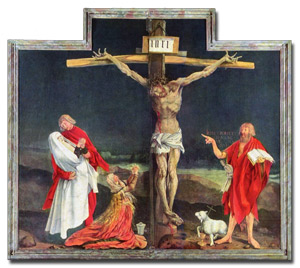
Matthias Grünewald’s Isenheim Altarpiece

From Tullian Tchividjian’s forthcoming book Glorious Ruin: How Suffering Sets You Free (October 2012), page 189:

If you’ve taken an art history class, you’ve probably come across Matthias Grünewald’s Isenheim Altarpiece. Or at least the panel depicting the crucifixion.

Completed in 1515, just before the Protestant Reformation blasted off, the altarpiece was commissioned for the church hospital of St. Anthony in Colmar, France, which specialized in comforting those dying with skin diseases. Grünewald took a radical approach to his subject. While most of his contemporaries were still depicting Calvary with post-Renaissance delicacy, Grünewald’s version was dark and borderline horrific: especially Christ’s smashed feet, His contorted arms, and His twisted hands. The cross is bowed to demonstrate Jesus bearing the sins of the world.

The most shocking part of the piece, however, is that Jesus Himself has a skin disease; His loincloth is the same as the wrappings worn by the hospital’s patients. The altarpiece is a creation of such shocking intensity that many initially — and even today — found it repulsive. Yet the graphic nature served masterfully to define and illustrate the Antonite brothers’ powerful understanding of Christian ministry. Apparently patients were brought before the piece in order to meditate on it as they died. The brothers were a quiet order, so no explanations were provided. There was no awkward chatter, no halfhearted attempts to piously let God off the hook. There was just silence.

Isaiah 53:5:

But he was pierced for our transgressions; / he was crushed for our iniquities; / upon him was the chastisement that brought us peace, / and with his wounds we are healed.

How C. S. Lewis Processed Great Fiction

C. S. Lewis to an inquirer, as published in The Collected Letters of C. S. Lewis, 2:644:

I myself always index a good book when I read it for the first time noting (a) Linguistic phenomena. (b) Good & bad passages. (c) Customs: meal times, social classes, what they read etc. (d) Moral ideas. All this reading, though dedicated ad Dei gloriam [to the glory of God] in the long run must not be infected by any immediate theological, ethical, or philosophic reference. Your first job is simply the reception of all this work with your imagination & emotions. Each book is to be read for the purpose the author meant it to be read for: the story as a story, the joke as a joke.

This is a nice concise summary of principles more fully unpacked in Lewis’ book An Experiment in Criticism.

The 35W Bridge Collapse 5 Years Later

Before we moved to the D.C. area we spent a year in Minneapolis, and it happened to be the year of the 35W bridge collapse. Today marks the 5th anniversary of the tragedy and it brings back a lot of personal memories of life in the Twin Cities during that season. David Mathis looks back on the event on the DG blog here.

Every year the anniversary resurfaces haunting memories of the scene, and the silent disbelief of the hundreds of onlookers wandering around speechless trying to see the bridge from various vantage points. It was as if nobody believed that it really happened.

It was under clouded skies a few days later (August 4, 2007) that President Bush flew into the Twin Cities to survey the damage. I, being the journalist, grabbed my camera (a Digital Rebel XT) and “Big Sig,” my Sigma 400mm telephoto lens. From high atop the campus of the University of Minnesota I captured the following photos of the President’s visit. Three helicopters – two smaller and one large one – all landed near the river, downstream about 1/4 mile from the collapsed bridge. The perimeter boundary around the scene was enormous and provide only a few areas where the collapsed bridge was viewable. But I did have a good location high above the valley to photograph the departure of the three presidential helicopters (and the unit of sharpshooters).

On days like today, these memories and these images come flooding back.