A Personal Update

Big changes are in store for the Reinke clan in 2012.

We’ve begun packing up our home as we prepare to move back to Minnesota where I will soon begin working for Desiring God, providing a mix of writing, editing, and research. My wife and I are excited about the new opportunity, and we are delighted to rejoin many of our Sovereign Grace and DG friends that we met in the Twin Cities during our brief stay in 2007.

Of course this means I will be leaving the Sovereign Grace Ministries office in Maryland, and Friday is my final day on staff. It has been a delightful four years serving alongside C.J. Mahaney as his editorial and research assistant. I will miss working with him in the office, traveling with him to conference engagements, and of course I will miss the multitasking meetings that may have appeared to some as a simple game of catch in the parking lot. I will greatly miss working with my friends in the Sovereign Grace office, worshipping with our friends at Covenant Life Church, and serving the many incredible pastors in Sovereign Grace who are spread across the country and the world.

When I reflect over the last four years I am deeply grateful for the accelerated learning I received from every direction – in theology, in marriage, in parenting, and in my vocational maturity. C.J.’s generosity made it possible for me to use these years to challenge myself as a writer and a researcher, a trajectory that culminated in my book Lit!. Never have I advanced in so many areas of life than in the last four years, and that is largely a result of C.J.’s investment in my life. In this brief post it is hard to detail my respect for him, and thank him for his friendship and for his mentoring — personally, pastorally, and doctrinally.

C.J. was kind enough to help confirm my suitability for the DG role. He was sad that our time together was now drawing to a close, but he was also joyful and optimistic about my future. He said if I didn’t take the job I would be, quote, an idiot.

The move is marked by sadness for us, but I can hardly imagine another man beside C.J. that I would rather work with than John Piper. It is an honor of the highest degree to serve alongside two men who have been fruitfully used by God as agents of gospel transformation in the lives of countless thousands of Christians around the world over the years (and myself personally). My calling to steward the teachings of these men is a sobering weight of responsibility as much as it is a rich kindness from the Lord.

A beloved co-worker and friend of mine at SGM emailed this encouragement to me a few weeks back:

I am excited for you, Tony. Someone getting to use their gifts at full throttle is one of the best things we still have in the fallen world. You are going to have your tachometer pegged at DG, and that is going to be good for Christians around the world, the majority of whom you will not meet this side of glory. You aren’t leaving the body, just getting sewn on somewhere different. Like a skin graft, if that inspires you.

The skinning metaphor fits.

My family will greatly miss the east coast, our neighbors and friends, our church home, our proximity to D.C., and all the historical sites that are within driving distance. In the last four years I think our family has taken in as many sights as possible, though my untiring wife will probably disagree. Where we do agree is that when we move, a piece of our lives will stay behind. We love it here. And although I could check on the current weather conditions in Minneapolis, I’m afraid to look! Despite the frigid weather, our move to Minneapolis will place us much closer to our extended family, one of the big factors in our move.

We hope to be settled in Minneapolis by the first week of February. With the move we will transfer our church membership from CLC to Bethlehem Baptist Church (at the request of DG). We are happy to make BBC our new church home. I continue to believe that Sovereign Grace Church is one of the very best churches in the country. (You may remember that back in 2006 my wife and I closed our business, sold our house, and moved our family to Minneapolis from Omaha for the sole reason of joining the church. It was a great move.)

When I look back I see why the Lord brought us to Maryland from 2008–2011. This move has provided me with valuable training and experience that I maybe could not have received anywhere else. Likewise, I can see why the Lord brought us through Minneapolis in 2007. He was preparing us for a return. So much of life is a mystery, so when things come together like this, God’s plan for us becomes clear, and I can only stand in awe and gratefulness for the incredible opportunities the Lord has brought into our lives.

If you think of us, please pray for us during our transition.

Blessings!

Tony

The Grand Centre of Unity

J. C. Ryle, Old Paths (London, 1898), 259:

The cross is the grand centre of union among true Christians. Our outward differences are many, without doubt. One man is an Episcopalian, another is a Presbyterian,—one is an Independent, another a Baptist,—one is a Calvinist, another an Arminian,—one is a Lutheran, another a Plymouth Brother,—one is a friend to Establishments, another a friend to the voluntary system,—one is a friend to liturgies, another a friend to extempore prayer. But, after all, what shall we hear about most of these differences, in heaven? Nothing, most probably: nothing at all.

Does a man really and sincerely glory in the cross of Christ? That is the grand question. If he does, he is my brother: we are travelling on the same road; we are journeying towards a home where Christ is all, and everything outward in religion will be forgotten. But if he does not glory in the cross of Christ, I cannot feel comfort about him. Union on outward points only is union only for a time: union about the cross is union for eternity. Error on outward points is only a skin-deep disease: error about the cross is disease at the heart. Union about outward points is a mere man-made union: union about the cross of Christ can only be produced by the Holy Ghost.

In Celebration of Long Sentences

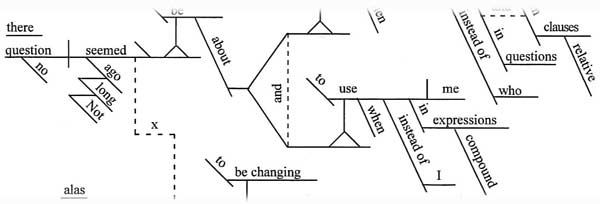
C. S. Lewis said he had no use for reviews of his own works. The positive reviews puffed him up, the critical reviews riled him up, and neither the puffing nor the riling were good for the soul. So I should stop reading blog reviews, I really should, especially after the most recent one said my book was too “wordy.” That’s never been said of me before. What most people would never guess is that I am a fan of the long sentence, and here are some nice quotes on their value.

Writes essayist and novelist Pico Iyer in his recent article:

No writer can compete, for speed and urgency, with texts or CNN news flashes or RSS feeds, but any writer can try to give us the depth, the nuances — the “gaps,” as Annie Dillard calls them — that don’t show up on many screens. Not everyone wants to be reduced to a sound bite or a bumper sticker.

Enter (I hope) the long sentence: the collection of clauses that is so many-chambered and lavish and abundant in tones and suggestions, that has so much room for near-contradiction and ambiguity and those places in memory or imagination that can’t be simplified, or put into easy words, that it allows the reader to keep many things in her head and heart at the same time, and to descend, as by a spiral staircase, deeper into herself and those things that won’t be squeezed into an either/or. With each clause, we’re taken further and further from trite conclusions — or that at least is the hope — and away from reductionism, as if the writer were a dentist, saying “Open wider” so that he can probe the tender, neglected spaces in the reader (though in this case it’s not the mouth that he’s attending to but the mind).

The long sentence does make probing ambiguity possible, but it can also communicate stout specificity that short sentences sometimes lack. Says Brooks Landon in his course Building Great Sentences:

Cumulative sentences [ie long, right-branching sentences] can take any number of forms, detailing both frozen or static scenes and moving processes, their insistent rhythm always asking for another modifying phrase, allowing us to achieve ever-greater degrees of specificity and precision, a process of focusing the sentence in much the same way a movie camera can focus and refocus on a scene, zooming in for a close-up to reveal almost microscopic detail, panning back to offer a wide-angle panorama, offering new angles or perspectives from which to examine a scene or consider an idea. …

Cumulative sentences that start with a brief base and then start picking up new information much as a snowball gets larger as it rolls downhill, fascinate me with their ability to add information that actually makes the sentence easier to read and more satisfying because it starts answering questions as quickly as an inquisitive reader might think of them, using each modifying phrase to clarify what has gone before, and to reduce the need for subsequent explanatory sentences, flying in the face of the received idea that cutting words rather than adding them is the most effective way to improve writing, reminding us that while in some cases, less in indeed more, in many cases more is more, and more is what our writing needs.

Where Do Good Works Spring?


Ephesians 2:8–10:

For by grace you have been saved through faith. And this is not your own doing; it is the gift of God, not a result of works, so that no one may boast. For we are his workmanship, created in Christ Jesus for good works, which God prepared beforehand, that we should walk in them.

Herman Bavinck, Our Reasonable Faith, 479–480:

Good works are not independently and newly brought into being by the believers themselves. They lie completely prepared for them all and for each one of them individually in the decision of God’s counsel; they were fulfilled and were earned for them by Christ who in their stead fulfilled all righteousness and the whole law; and they are worked out in them by the Holy Spirit who takes everything from Christ and distributes it to each and all according to Christ’s will.

So we can say of sanctification in its entirety and of all the good works of the church, that is, of all the believers together and of each one individually, that they do not come into existence first of all through the believers, but that they exist long before in the good pleasure of the Father, in the work of the Son, and in the application of the Holy Spirit. Hence all glorying on man’s part is also ruled out in this matter of sanctification. We must know that God in no way becomes indebted to us, and that He therefore never has to be grateful to us, when we do good works; on the contrary, we are beholden to God for them, and have to be grateful to Him for the good works that we do.

Give Yourself to the Church

Charles Spurgeon [sermon #2234 (1891)]:

Give yourself to the church. You that are members of the church have not found it perfect, and I hope that you feel almost glad that you have not. If I had never joined a church till I had found one that was perfect, I should never have joined one at all; and the moment I did join it, if I had found one, I should have spoiled it, for it would not have been a perfect church after I had become a member of it. Still, imperfect as it is, it is the dearest place on earth to us.

How Many?

Richard Gaffin, WTJ 38.3 (1975), 299:

How many believers today understand themselves with the apostle as those “upon whom the ends of the ages have come” (1 Cor 10:11)?

How many experience that they are members of God’s eschatological kingdom not only at hand but already present?

How many grasp with some perception of its vast implications that in the interim between the resurrection and return of Christ the existence of the church in the world is determined by the overlapping tension between this age and the age to come?

Richard Gaffin, JETS 41.4 (1998), 585:

How many believers today recognize that the present work of the Spirit within the Church and in their lives is of one piece with God’s great work of restoring the entire creation, begun in sending his Son “in the fullness of time” (Gal 4:4) and to be consummated at his return?

How many Christians grasp that in union with Christ, the life-giving Spirit, the Christian life in its entirety is essentially and necessarily resurrection life?

How many comprehend that in terms of Paul’s fundamental anthropological distinction between “the inner” and “outer man” (2 Cor 4:16), between “heart” and “body,” believers at the core of their being will never be any more resurrected than they already are?

Richard Gaffin, By Faith, Not by Sight (2006), 75:

How many Christians understand that the Holy Spirit presently at work in them is nothing less than resurrection power, that the Spirit, through whom God “will give life to your mortal bodies,” is “his Spirit who dwells in you” (Rom. 8:11)?

How many believers grasp that the Holy Spirit indwelling them is an eschatological power, that, in terms of the metaphors Paul uses, he in his activity in the church is an actual “down payment” on our eschatological inheritance (2 Cor. 1:22, 5:5; Eph. 1:14), the “firstfruits” of the full “harvest” of his eschatological working (Rom. 8:23)?

How many appreciate that Christ himself, as “life-giving Spirit” (1 Cor. 15:45), is present and at work in our lives in his resurrection power?