The Marks of A Healthy Missional Church

Michael Horton, The Christian Faith: A Systematic Theology for Pilgrims On the Way (Zondervan, 2011), pages 899–902 [his|mine]:

In Acts, the mission of the church and its actual growth are always attributed to the means of grace, which the so-called marks of the church (preaching, sacrament, and discipline) identify.

The preaching of the Word and the administration of the sacraments have (or at least should have) such preeminence in the church not because of the desire for clerical dominance over the laity; on the contrary, it is because of the unique and essential service that this ministry provides for the health of the whole body and its mission in the world. So instead of treating the formal ministry and marks of the church as one thing and the mission of the church as another, we should regard the former not only as the source but as in fact the same thing as the latter.

Throughout the book of Acts, the growth of the church—its mission—is identified by the phrase, “And the word of God spread.” The regular gathering of the saints for “the apostles’ teaching and the fellowship,” “the breaking of bread,” and “the prayers” (Ac 2:42) is not treated in Acts merely as an exercise in spiritual togetherness but as itself the sign that the kingdom had arrived in the Spirit. …

The mission of the church is to execute the marks of the church, which are the same as the keys of the kingdom. Where the gospel is being preached, the sacraments are being administered, and the officers are caring for the flock, we may be confident that the mission is being executed, the keys are being exercised, and the attributes of “one holy, catholic, and apostolic church” are being exhibited. Preaching, sacrament, and discipline are singled out in the Great Commission and, as we have seen, in Acts 2:42. If these are missing, marginalized, or obscured, there is no office, no charismatic ministry, and no innovative program that can build and expand Christ’s kingdom. God may use many means, but he has ordained these and has promised to work the greatest signs and wonders through them. …

There is a gathering—an ekklesia—because there is a work of God through preaching and sacrament called the gospel that does its work before we can get around to ours [personal evangelism and societal transformation]. We cannot create the church by our acts of service, missionary zeal, church orders and liturgies, pragmatic programs, authenticity, or romanticizing efforts at generating community. Rather, it is God who creates his own unique community in the world by speaking it into existence and sustaining it in its pilgrimage.

We must therefore resist the false choice between looking after the sheep already gathered through preaching, sacrament, and discipline (the marks) and reaching out to the lost sheep who have yet to hear and believe (the mission). The church is created and sustained by the Spirit through preaching and sacrament, and the church grows numerically—expanding in its mission—by these same means. …

The Word that is preached, taught, sung, and prayed, along with baptism and the Eucharist, not only prepare us for mission; it is itself the missionary event, as visitors are able to hear and see the gospel that it communicates and the communion that it generates. To the extent that the marks define the mission and the mission justifies the marks, the church fulfills its apostolic identity.

Phillis Wheatley on Whitefield

At age 7 Phillis Wheatley (1753-1784) was made a slave, taken from her home in west Africa, and sold to a family in Boston. At age 20 Wheatley became the first African American poet to be published. Her book was simply titled Poems on Various Subjects, Religious and Moral (1773). Her short life is a magnificent testimony to perseverance and determination. Her poems were well received, especially one she wrote in 1770 at the death of preacher George Whitefield. In the poem Wheatley does a fine job capturing a couple of important themes in Whitefield’s ministry, the centrality of the gospel, of course, but also Whitefield’s deep care and concern for African American slaves and their souls. This was not lost on Wheatley. Here’s a portion of her poem (entire ebook here):

… He pray’d that grace in ev’ry heart might dwell,
He long’d to see America excell;
He charg’d its youth that ev’ry grace divine
Should with full lustre in their conduct shine;
That Saviour, which his soul did first receive,
The greatest gift that ev’n a God can give,
He freely offer’d to the num’rous throng,
That on his lips with list’ning pleasure hung.

Take him, ye wretched, for your only good,
Take him ye starving sinners, for your food;
Ye thirsty, come to this life-giving stream,
Ye preachers, take him for your joyful theme;
Take him my dear Americans, he said,
Be your complaints on his kind bosom laid:
Take him, ye Africans, he longs for you,
Impartial Saviour is his title due:
Wash’d in the fountain of redeeming blood,
You shall be sons, and kings, and priests to God.

But, though arrested by the hand of death,
Whitefield no more exerts his lab’ring breath,
Yet let us view him in th’ eternal skies,
Let ev’ry heart to this bright vision rise;
While the tomb safe retains its sacred trust,
Till life divine re-animates his dust.

Indicatives, Imperatives, and Personal Holiness

C. F. D. Moule, “’The New Life’ in Colossians 3:1-17,” Review and Expositor 70:4 (1973), page 479 [ht]:

Christian existence is a strangely relaxed kind of strenuousness, precisely because the Christian gospel is what it is. Before ever any demand is made, the gift is offered: the announcement of good news precedes the challenge.

The indicative precedes the imperative as surely as the rope is made fast round a firm piece of rock for the climber’s security before he has to apply himself to the struggle. Moreover (if the parable may be extended one clause further), the climber must attach himself to the rope before starting his effort. So the gospel not only begins with the indicative statement of what God has done, before it goes on to the imperative: even the imperative is first a command to attach oneself (be baptized! become incorporate!), before it becomes a command to struggle.

The striving does come: strenuousness is indispensable for the Christian climber—but only in dependence on all that has first been given by God and then appropriated through the means of grace. And the attachment to Christ, which is what causes the tension and makes us “amphibian,” is also precisely what gives us our confidence and our grounds for hope, as it is also the source of forgiveness and renewed strength when we fail.

Related: Sinclair Ferguson on “Supporting the imperatives to holiness.”

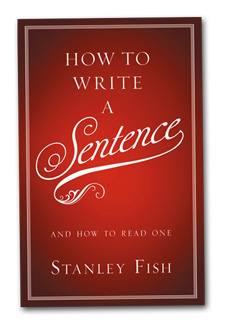
How To Write A Sentence

Forget grammar. Writing is about logic.

Stanley Fish makes this argument in his new book How To Write A Sentence: And How To Read One (Harper: 2011), and it defines for me something that has been morphing in my writing philosophy over the last couple of years. At some point I began shifting time away from grammatical studies and investing more time in the study of logic. I was pleased to read an author who articulated this intuitive shift. Fish writes,

Many people are put off writing because they fear committing one or more of the innumerable errors that seem to lie in wait for them at every step of composition. But if one understands that a sentence is a structure of logical relationships and that the number of relationships involved is finite, one understands too that there is only one error to worry about, the error of being illogical, and only one rule to follow: make sure that every component of your sentences is related to the other components in a way that is clear and unambiguous (unless ambiguity is what you are aiming at). (p. 20)

Brilliant.

In other words, don’t let the fear of breaking grammatical rules stop you from writing. Seek first to make logical connections in your writing, make those connections clear, and gauge your success on how well you make them. This point is liberating to me as a writer, but more than liberating, it inspires my writing in a way that grammar cannot, since, as Fish writes, writing with an eye on logic will force your mind to think of correlations and contradictions in ways that can add new dimensions to your thinking and writing (see pp. 30-33).

Another point that Fish makes well is the importance of determining a sentence’s purpose. He asks: What is the intended effect of the sentences that we write? The question is important because there is a wide range of sentence effects that are reflected in various forms, and each form communicates something different to the reader. Too often writing instruction discusses the how of writing, but not the why.

People write or speak sentences in order to produce an effect, and the success of a sentence is measured by the degree to which the desired effect has been achieved. That is why the prescriptive advice you often get in books like Strunk and White’s The Elements of Style—write short sentences, be direct, don’t get lost in a maze of piled-up clauses, avoid the passive voice, place yourself in the background, employ figures of speech sparingly—is useful only in relation to some purposes, and unfortunate in relation to others. The first thing to ask when writing a sentence is “What am I trying to do?” … In short, pick your effect, figure out what you want to do, and then figure out how to do it. (pp. 37, 44)

Fish’s point is brilliantly illustrated a few pages later when he explains how using a short and long sentence create different effects for the reader.

Shorter sentences feel planned because they have the proverbial air of being pre-packaged. The writer is saying, “I didn’t make this up on the fly; I’m just giving form to what everyone knows.” Longer sentences can achieve a similar effect by calling attention to their own construction. The writer is saying, “I’m not just putting down whatever comes into my head; I’m giving you the ordered fruits of my considered deliberations.” (p. 48)

Can you see the difference? Short sentences proverbially restate an idea that should be familiar to the reader. On the other hand, longer sentences are better suited for communicating the inner life and the extended deliberations in the author’s mind—thoughts that are anything but proverbial and assumed, but are unique, revealing the secret thought life of the author. Paragraph-length descriptions of the effects of certain sentence styles, like the one I quote above and the others spread throughout the book, illustrate how different sentence forms accomplish different tasks, and reinforce his motto: “You shall tie yourself to forms and the forms shall set you free” (p. 33). The form is part of the message.

The bulk of the book is comprised of five chapters on subordinate sentences, additive sentences, satirical sentences, first sentences, and last sentences.

  • The subordinating style: “which ranks, orders, and sequences things, events, and persons in a way that strongly suggests a world where control is the imperative and everything is in its proper place.”
  • The additive style: “which gives the impression of speech and writing just haphazardly tumbling out of the mouth or the thoughts of a writer who is not worrying about getting every particular just right.”
  • The satirical style: “employed as a weapon by writers who want to harpoon persons, parties, or society as a whole.”
  • First sentences: are “promissory notes. Whether they foreshadow plot, sketch in character, establish mood, or jump-start arguments, the road ahead of them stretches invitingly and all things are, at least for the moment, possible.”
  • Last sentences: “are more constrained in their possibilities. They can sum up, refuse to sum up, change the subject, leave you satisfied, leave you wanting more, put everything into perspective, or explode perspectives. They do have one advantage: they become the heirs of the interest that is generated by everything that precedes them; they don’t have to start the engine; all they have to do is shut it down.”

Conclusion

How To Write A Sentence is simple enough that you can learn the very basics of how to construct a sentence to achieve an intended effect. But Fish is also deeply perceptive of what makes a great sentence, and readers will delight in his careful exegesis of many great sentences in literary history. In this short book (162 pages) Fish serves two audiences quite well. It will inspire young writers to write clear, purposeful, sentences; and it will delight advanced writers as it breaks down great sentences. How To Write A Sentence will be added to the shelf with my favorite books on writing and frequently revisited for fresh inspiration.

He, She, It, They—Dealing With Generic Singular Personal Pronouns

The following excerpt is from a footnote on page 36 of the most nutty (and most helpful), logic textbook I own—Peter Kreeft, Socratic Logic: A Logic Text Using Socratic Methods, Platonic Questions, and Aristotelian Principles (South Bend, IN: St. Augustine’s, 2008). He writes:

The use of the traditional inclusive generic pronoun “he” is a decision of language, not of gender justice. There are only six alternatives.

(1) We could use the grammatically misleading and numerically incorrect “they.” But when we say “one baby was healthier than the others because they didn’t drink that milk,” we do not know whether the antecedent of “they” is “one” or “others,” so we don’t know whether to give or take away the milk. Such language codes could be dangerous to baby’s health.

(2) Another alternative is the politically-intrusive “in-your-face” generic “she,” which I would probably use if I were an angry, politically-intrusive, in-your-face woman, but I am not any of those things.

(3) Changing “he” to “he or she” refutes itself in such comically clumsy and ugly revisions as the following: “What does it profit a man or woman if he or she gains the whole world but loses his or her own soul? Or what shall a man or woman give in exchange for his or her soul?” The answer is: he or she will give up his or her linguistic sanity.

(4) We could also be both intrusive and clumsy by saying “she or he.”

(5) Or we could use the neuter “it,” which is both dehumanizing and inaccurate.

(6) Or we could combine all the linguistic garbage together and use “she or he or it,” which, abbreviated, would sound like “[word removed].”

I believe in the equal intelligence and value of women, but not in the intelligence or value of “political correctness,” linguistic ugliness, grammatical inaccuracy, conceptual confusion, or dehumanizing pronouns.

There you have it.

I know what you’re asking: Where does Grammar Girl stand in the debate? She starts out a bit shilly-shally (or is it dilly-dally?) but eventually seems to favor a bold and reckless solution—using “they.”

What do you think?

Wise counsel for anyone bummed by an apparent lack of spiritual growth

John Newton, Letters of John Newton (Banner of Truth: 1869/2007), page 380:

I have no doubt you think others better than yourself: thus far you are conformed to the Scripture rule (Philippians 2:3 [“in humility count others more significant than yourselves”]). You should not therefore be displeased with yourself on that account. I shall not contradict you. But some of those you deem so were planted in the Lord’s garden many years before you. Why then should you complain that you are not so tall, nor your branches so wide, nor your root so deep, in two years’ growth, as others who have been growing twenty or thirty years? Should a little sapling, just springing up from an acorn ask, “Why am not I as large as the stoutest oak in the wood?” You would know how to answer it. …

Do not let Satan impose a false humility upon you. Depend upon it, there is more of self and self-righteousness in these complaints than we are usually aware of. It is better to be thankful for what you have received than impatient because you have no more. If you can make yourself better, do it by all means; but if you cannot, wait simply the Lord’s time, at the Lord’s feet. If your heart is upright, you have only to attend to the means and precepts of grace [private prayer and Scripture study].

The Lord must do the rest, and He will, otherwise it can never be done. Try to be thankful; it is both a utile [useful] and a dulce [pleasant]. You cannot be too humble, or think too little of yourself; but these views need not break your peace. You are to be strong, and to rejoice, not in yourself, but in Jesus Christ the Lord, and in the power of his might. One view of the brazen serpent will do you more good than pouring over your own wounds for a month [Numbers 21:4–9, John 3:14–15].