Athanasius on “The Divine Songs”

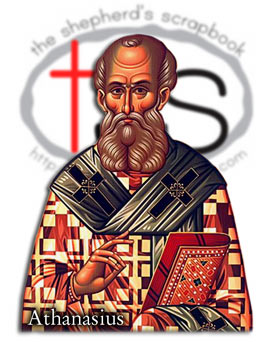
tss-athanasius.jpgAmong all the books [of Scripture], the Psalter has certainly a very special grace, a choiceness of quality well worthy to be pondered; for, besides the characteristics which it shares with others, it has this peculiar marvel of its own, that within it are represented and portrayed in all their great variety the movements of the human soul.

It is like a picture, in which you see yourself portrayed, and seeing, may understand and consequently form yourself upon the pattern given.

Elsewhere in the Bible you read only that the Law commands this or that to be done, you listen to the Prophets to learn about the Saviour’s coming, or you turn to the historical books to learn the doings of the kings and holy men; but in the Psalter, besides all these things, you learn about yourself. You find depicted in it all the movements of your soul, all its changes, its ups and downs, its failures and recoveries. Moreover, whatever your particular need or trouble, from this same book you can select a form of words to fit it, so that you do not merely hear and then pass on, but learn the way to remedy your ill. Prohibitions of evil-doing are plentiful in Scripture, but only the Psalter tells you how to obey these orders and abstain from sin.

Continue reading

Lauterbach’s Gospel Driven Life blog

tsscertified.jpgMark Lauterbach is a pastor and author of Gospel Driven Life, the best Cross centered blog on the Internet. In our search for the very best Cross-centered resources we consider this blog essential reading and proudly stamp it “TSS Certified Cross-Centered.”

Just recently Lauterbach wrote: “I have wondered for a couple of years where the Gospel intersects modern American life — and I think it is here. The Gospel calls us to stop trying to improve ourselves.” Read more.

A full list of “TSS Certified Cross-Centered” blogs, books, music, movies and other resources is in the works. Stay tuned …

Trueman: Where’d the Psalms go?

tsslogo.jpgIt is quite obvious in Scripture that Psalms are to be sung in the corporate life of the church (Col. 3:16; Eph. 5:19). Scripture assumes continuity between the life of the Psalmist before the Cross, and the life of the Christian after the Cross. Yet, this emphasis on relating to the Psalmist – not to mention the direct singing of the Psalms – seems to be largely missing from the contemporary church. I wonder why?

Let me make my own confession. As a non-denominational reformed Christian, I’ve never sung from a Psalter. In fact I’ve never held a Psalter in my hands. In my circles, I would have a hard time finding people who even know what a Psalter is! (One close friend suggested it must be something like a salt shaker!)

I am thankful that Scripture calls us to sing Psalms, and also opens the door to hymns and various other spiritual songs. I am deeply grateful for the corporate freedom to sing a variety of worship songs.

But a big question in my mind over the past year is, simply, why have the Psalms been disconnected from the corporate expression of the church? In the past I have suggested that perhaps part of the reason Puritan spirituality seems so foreign to us today is because the Puritans used the Psalms to interpret their life experiences. But this does not get us closer to a contemporary answer.

Recently I read Carl Trueman’s collections of essays, The Wages of Spin: Critical Writings on Historical and Contemporary Evangelicalism (Christian Focus: 2004). These essays provoked stimulating thoughts in a number of areas. Trueman is the Neil Postman (Amusing Ourselves to Death) of the contemporary church and if you want a great read, Wages of Spin is it. (Catchy title, isn’t it?)

In his chapter “What Can Miserable Christians Sing?” Trueman also takes note of the disappearance of the Psalms in corporate worship. While I am no closer to an answer, I have benefited from his insights:

Having experienced — and generally appreciated — worship across the whole evangelical spectrum, from Charismatic to Reformed — I am myself less concerned here with the form of worship than I am with its content. Thus, I would like to make just one observation: the psalms, the Bible’s own hymnbook, have almost entirely dropped from view in the contemporary Western evangelical scene. I am not certain about why this should be, but I have an instinctive feel that it has more than a little to do with the fact that a high proportion of the psalter is taken up with lamentation, with feeling sad, unhappy, tormented, and broken. In modern Western culture, these are simply not emotions which have much credibility: sure, people still feel these things, but to admit that they are a normal part of one’s everyday life is tantamount to admitting that one has failed in today’s health, wealth, and happiness society. And, of course, if one does admit to them, one must neither accept them nor take any personal responsibility for them: one must blame one’s parents, sue one’s employer, pop a pill, or check into a clinic in order to have such dysfunctional emotions soothed and one’s self-image restored.

Now, one would not expect the world to have much time for the weakness of the psalmists’ cries. It is very disturbing, however, when these cries of lamentation disappear from the language and worship of the church. Perhaps the Western church feels no need to lament — but then it is sadly deluded about how healthy it really is in terms of numbers, influence and spiritual maturity. Perhaps — and this is more likely — it has drunk so deeply at the well of modern Western materialism that it simply does not know what to do with such cries and regards them as little short of embarrassing. Yet the human condition is a poor one — and Christians who are aware of the deceitfulness of the human heart and are looking for a better country should know this. A diet of unremittingly jolly choruses and hymns inevitably I creates an unrealistic horizon of expectation which sees the normative Christian life as one long triumphalist street party — a theologically incorrect and a pastorally disastrous scenario in a world of broken individuals. Has an unconscious belief that Christianity is — or at least should be — all about health, wealth, and happiness silently corrupted the content of our worship? Few Christians in areas where the church has been strongest over recent decades — China, Africa, Eastern Europe – would regard uninterrupted emotional highs as normal Christian experience. Indeed, the biblical portraits of believers give no room to such a notion. Look at Abraham, Joseph, David, Jeremiah, and the detailed account of the psalmists’ experiences. Much agony, much lamentation, occasional despair — and joy, when it manifests itself — is very different from the frothy triumphalism that has infected so much of our modern Western Christianity. In the psalms, God has given the church a language which allows it to express even the deepest agonies of the human soul in the context of worship. Does our contemporary language of worship reflect the horizon of expectation regarding the believer’s experience which the psalter proposes as normative? If not, why not? Is it because the comfortable values of Western middle-class consumerism have silently infiltrated the church and made us consider such cries irrelevant, embarrassing, and signs of abject failure?

I did once suggest at a church meeting that the psalms should take a higher priority in evangelical worship than they generally do — and was told in no uncertain terms by one indignant person that such a view betrayed a heart that had no interest in evangelism. On the contrary, I believe it is the exclusion of the experiences and expectations of the psalmists from our worship — and thus from our horizons of expectation — which has in a large part crippled the evangelistic efforts of the church in the West and turned us all into spiritual pixies. By excluding the cries of loneliness, dispossession, and desolation from its worship, the church has effectively silenced and excluded the voices of those who are themselves lonely, dispossessed, and desolate, both inside and outside the church. By so doing, it has implicitly endorsed the banal aspirations of consumerism, generated an insipid, trivial and unrealistically triumphalist Christianity, and confirmed its impeccable credentials as a club for the complacent. In the last year, I have asked three very different evangelical audiences what miserable Christians can sing in church. On each occasion my question has elicited uproarious laughter, as if the idea of a broken-hearted, lonely, or despairing Christian was so absurd as to be comical — and yet I posed the question in all seriousness. Is it any wonder that British evangelicalism, from the Reformed to the Charismatic, is almost entirely a comfortable, middle-class phenomenon?

Carl R. Trueman, The Wages of Spin: Critical Writings on Historical and Contemporary Evangelicalism (Christian Focus: 2004) pp. 158-160.

IMG_5277.ed.jpg

For Us and for Our Salvation by Stephen Nichols

tsscertified.jpgBook announcement
For Us and for Our Salvation by Stephen Nichols

Conservative Evangelical publishers are placing a greater emphasis on patristics, the study of the early church fathers. It’s no surprise. Prominent figures have been jumping off the Evangelical bus and walking towards Rome and frequently (we are told) because Rome better stresses the church fathers. In particular, the Reformed community is reclaiming its rich patristic heritage. For Us and for Our Salvation: The Doctrine of Christ in the Early Church (Crossway: 2007) by Stephen J. Nichols is one great example.

At 37 years old, Nichols has written everything but a cookbook. He is known as a master storyteller and a prolific writer, the author of several biographies and a lively overview of the Reformation – The Reformation: How a Monk and a Mallet Changed the World – the most exciting book we’ve seen in 2007! On top of patristic theology and the Reformation history, Nichols recently published an excellent essay on J. Gresham Machen, B.B. Warfield and Fundamentalism and is now working on a book connecting theology and the blues.

Due out on August 13th, Nichols’ latest release is yet another of his excellent historical studies. Now Nichols travels back into the first five centuries to rediscover the debates and characters who fought and defended a true understanding of Christ in His glory.

“Perhaps in no area of theology is this more necessary or beneficial than in the doctrine of Christ in the early church. … The early church fathers wrestled with the same problems presented by The Da Vinci Code phenomenon and its fanciful speculations about Jesus. They wrestled with the same problems presented by Islam and its adamant denial of the deity of Christ. And they wrestled with the same problems presented by the scholars working in the Jesus Seminar or in Gnostic texts like the Gospel of Judas who quickly dismiss the four canonical Gospels as God’s true revelation to humanity. In the days of the early church, the names of the opponents were different from those faced by us today, but the underlying issues bear a striking resemblance. When the church fathers responded with the orthodox view of Christ, they did the church of all ages a great service” (p. 14).

Contents

The book development is split into three historical eras: the first three centuries, the fourth century, and the fifth century. Nichols is a master tour guide through the significant theological works of Church history and sufficient room is provided for the church fathers to speak in their own words. Nichols provides an concise breakdown of the content:

“This book explores these controversies over Christ faced by the early church. This book also looks to tell the story of the people involved – Arius and Eutyches, Ignatius and Irenaeus, Athanasius and Leo. These may or may not be known to contemporary evangelicals, but they should be. The following chapters unfold this struggle in the early church chronologically. Chapter 1 starts with one foot in the pages of the New Testament and stretches to the first decade of the 300s. Chapter 3 tells the story of Athanasius and his arch-nemesis Arius, the two figures behind the Nicene Council in 325 and the Council of Constantinople in 381. Chapter 5 unfolds the events of the 400s, focusing on Leo I and the Chalcedonian Council in 451. In an unprecedented event, no fewer than 520 bishops met and actually agreed on a very nuanced and sophisticated theological statement that we know as the Chalcedonian Creed. The intervening chapters, 2, 4, and 6, all break from the narrative to provide primary source documents, allowing the major figures in this struggle to tell the story in their own words. A brief epilogue explores the variations on these themes that have occurred in the life of the church since Chalcedon in 451” (pp. 15-16).

TSS Certified Cross-Centered

Nichols’ historical illumination of the church fathers is excellent but more excellent is the Cross-centered focus. Nichols is not content sharpening orthodox Christology until the Cross is brought into focus. At each point Nichols reminds us the greatest danger of misunderstanding Christ is a misunderstanding of the Cross. This repeated emphasis warrants the “TSS Certified Cross-Centered” stamp.

Conclusion

In The Glory of Christ, John Owen said a hearty gaze at the glory of Christ is exactly what we need to cure our spiritual declension and spur us to new levels of Christian maturity. Owen was right (see 2 Cor. 3:18). In For Us and for Our Salvation, Nichols leads us to a great view overlooking the valley of patristic Christology. But more importantly he has led us to a place where we can better behold the life-transforming glory of Christ.

———–

Title: For Us and for Our Salvation: The Doctrine of Christ in the Early Church
Author: Stephen J. Nichols
Reading level: 2.0/5.0 > very readable
Boards: paperback
Pages: 172
Volumes: 1
Dust jacket: no
Binding: ? (reviewed electronically)
Paper: ?
Topical index: ?
Scriptural index: ?
Text: perfect type
Publisher: Crossway
Year: 2007
Price USD: $14.99 (w/free PDF edition)
ISBNs: 9781581348675

QA: Family worship and unattentive children

tssqa.jpgThe TSS mailbag is filled with excellent questions from readers. One such question comes from Phil, a man striving for a consistent family worship schedule despite an unattentive little child. What to do? Dr. J. Ligon Duncan has written about family worship and so I passed the question along to him for his advice. He kindly responded with this excellent perspective:

My own answer is you start family worship as soon as possible, as soon as one is married, and continue it after children come along, no matter how young the children are (and the younger the better). The point is not for the youngest children to be able to comprehend (or even to sit still during it!). The point is impress upon them, by paternal example the priority of God and his word in all of life. They learn this, even if they comprehend nothing in the reading, praying and singing, simply by seeing a father pausing day after day to read the word with his family.

Here is what I said in Give Praise to God (P&R):

“Now there is a whole host of practical questions and problems that come to mind once we determine to begin family worship. How long should it last? It should be regularly brief, as little as 10 minutes when the children are very young. Gradually, it will run a little longer as they grow older and conversations strike up. Don’t kill it by trying to go too long. Pace yourself. Regularity and repetition is the key. When should we do family worship? When it works – morning/breakfast, suppertime or bedtime are the three most common times.

“… There are dozens of potential hindrances: a lack of discipline, a lack of sense of the importance of family worship, a lack of experience of family worship in one’s own upbringing and more.

“But above all, there is the enemy of idealism. You have this picture of a Puritan family sitting around the table attentively and reverently reading the whole book of 1 Chronicles at a sitting, singing half the Psalter from memory, and praying for ninety minutes, and then you look around your table and your wife is rolling her eyes, your two-year old is throwing left-over spaghetti around the kitchen, your eight-year old is making faces at her sister and your teenager would rather do calculus. Don’t let the gap between the ideal and the reality stop you! Those unattentive children will grow up and thank you for persevering, and the memories of a father who loved them enough to make that kind of an effort will etch a permanent affection in their hearts.”

J. Ligon Duncan
First Presbyterian Church

Excellent advice! Thank you Dr. Duncan. For more insight on family worship see Duncan’s chapter in Give Praise to God: A Vision for Reforming Worship (P&R: 2003). Duncan lays the foundation for family worship – Scripture reading, song and prayer – and then addresses several other common hurdles to success.

————

Have a question to throw in the TSS mailbag? Pass it along via email (tony AT takeupandread DOT com). Thanks for reading! Tony