Unable to attend the Ligonier conference (Contending for the Truth), I stayed at home and watched a fair  amount over the Internet. One personal surprise and highlight was seeing Joel Beeke. It’s great to see his book Meet the Puritans (our 2006 Book-of-the-Year) continue to grow in popularity. Our friends from Reformation Heritage Books and Puritan Reformed Theological Seminary in Grand Rapids, MI have made the notes from his short address available to TSS. -Tony
——————————-
Why You Should Read the Puritans
by Joel R. Beeke
The great eighteenth-century revivalist, George Whitefield, wrote:
The Puritans [were] burning and shining lights. When cast out by the black Bartholomew Act, and driven from their respective charges to preach in barns and fields, in the highways and hedges, they in a special manner wrote and preached as men having authority. Though dead, by their writings they yet speak: a peculiar unction attends them to this very hour (Works, 4:306-307).
Whitefield went on to predict that Puritan writings would continue to be resurrected until the end of time due to their scriptural spirituality. Today, we are living in such a time. Interest in Puritan books has seldom been more intense. In the last fifty years, 150 Puritan authors and nearly 700 Puritan  titles have been brought back into print.
Puritan literature has so multiplied that few book lovers can afford to purchase all that is being published. What books should you buy? Where can you find a brief summary of each Puritan work and a brief biography of each author so that you can have a glimpse of who is behind all these books?
These kinds of questions motivated Randall Pederson and me to write Meet the Puritans: With a Guide to Modern Reprints. In this book, we tell the life stories of the 150 Puritan writers who have been reprinted in the past fifty years. We have also included concise reviews of the 700 newly published Puritan titles plus bibliographical information on each book. And we have noted the books that we consider most critical to have in a personal library.
We had four goals for writing this book: first, that these godly Puritan writers will serve as mentors for our own lives. That is why we have told the stories of the Puritans on a layperson’s level and kept them short. You could read one life story each day during your devotional time. Second, we trust that when you read these reviews of Puritan writings, you will be motivated to read a number of these books, each of which should help you grow deeper in your walk with the Lord. Third, we hope this book will serve as a guide for you to purchase books for your families and friends, to help them grow in faith. Finally, for those of you who are already readers of Puritan literature, this guide is designed to direct you to further study and to introduce you to lesser-known Puritans that you may be unaware of.
Definition of Puritanism
Just who were the Puritan writers? They were not only the two thousand ministers who were ejected from the Church of England by the Act of Uniformity in 1662, but also those ministers in England and North America, from the sixteenth century through the early eighteenth century, who worked to reform and purify the church and to lead people toward godly living consistent with the Reformed doctrines of grace.
Puritanism grew out of three needs: (1) the need for biblical preaching and the teaching of sound Reformed doctrine; (2) the need for biblical, personal piety that stressed the work of the Holy Spirit in the faith and life of the believer; and (3) the need to restore biblical simplicity in liturgy, vestments, and church government, so that a well-ordered church life would promote the worship of the triune God as prescribed in His Word (The Genius of Puritanism, 11ff.).
Doctrinally, Puritanism was a kind of vigorous Calvinism; experientially, it was warm and contagious; evangelistically, it was aggressive, yet tender; ecclesiastically, it was theocentric and worshipful; politically, it aimed to be scriptural, balanced, and bound by conscience before God in the relationships of king, Parliament, and subjects; culturally, it had lasting impact throughout succeeding generations and centuries until today (Durston and Eales, eds., The Culture of English Puritanism, 1560-1700).
How to Profit from Reading the Puritans
Let me offer you nine reasons why it will help you spiritually to read Puritan literature still today:
1. Puritan writings help shape life by Scripture. The Puritans loved, lived, and breathed Holy Scripture. They relished the power of the Spirit that accompanied the Word. Their books are all Word-centered; more than 90 percent of their writings are repackaged sermons that are rich with scriptural exposition. The Puritan writers truly believed in the sufficiency of Scripture for life and godliness.
If you read the Puritans regularly, their Bible-centeredness will become contagious. These writings will show you how to yield wholehearted allegiance to the Bible’s message. Like the Puritans, you will become a believer of the living Book, echoing the truth of John Flavel, who said, “The Scriptures teach us the best way of living, the noblest way of suffering, and the most comfortable way of dying.”
Do you want to read books that put you into the Scriptures and keep you there, shaping your life by sola Scriptura? Read the Puritans. Read the Soli Deo Gloria Puritan Pulpit Series. As you read, enhance your understanding by looking up and studying all the referenced Scriptures.
2. Puritan writings show how to integrate biblical doctrine into daily life. The Puritan writings do this in three ways:
First, they address your mind. In keeping with the Reformed tradition, the Puritans refused to set mind and heart against each other, but viewed the mind as the palace of faith. “In conversion, reason is elevated,” John Preston wrote.
The Puritans understood that a mindless Christianity fosters a spineless Christianity. An anti-intellectual gospel quickly becomes an empty, formless gospel that never gets beyond “felt needs,” which is something that is happening in many churches today. Puritan literature is a great help for understanding the vital connection between what we believe with our minds and how that affects the way we live. Jonathan Edwards’s Justification by Faith Alone and William Lyford’s The Instructed Christian are particularly helpful for this.
Second, Puritan writings confront your conscience. The Puritans are masters at convicting us about the heinous nature of our sin against an infinite God. They excel at exposing specific sins, then asking questions to press home conviction of those sins. As one Puritan wrote, “We must go with the stick of divine truth and beat every bush behind which a sinner hides, until like Adam who hid, he stands before God in his nakedness.”
Devotional reading should be confrontational as well as comforting. We grow little if our consciences are not pricked daily and directed to Christ. Since we are prone to run for the bushes when we feel threatened, we need daily help to be brought before the living God “naked and opened unto the eyes of with whom we have to do” (Heb. 4:12). In this, the Puritans excel. If you truly want to learn what sin is and experience how sin is worse than suffering, read Jeremiah Burroughs’s The Evil of Evils and Thomas Shepard’s The Sincere Convert and the Sound Believer.
Third, the Puritan writers engage your heart. They excel in feeding the mind with solid biblical substance and they move the heart with affectionate warmth. They write out of love for God’s Word, love for the glory of God, and love for the soul of readers.
For books that beautifully balance objective truth and subjective experience in Christianity; books that combine, as J.I. Packer puts it, “clear-headed passion and warm-hearted compassion” (Ryken, Worldly Saints, x); books that inform your mind, confront your conscience, and engage your heart, read the Puritans. Read Vincent Alsop’s Practical Godliness.
3. Puritan writings show how to exalt Christ and see His beauty. The Puritan Thomas Adams wrote: “Christ is the sum of the whole Bible, prophesied, typified, prefigured, exhibited, demonstrated, to be found in every leaf, almost in every line, the Scriptures being but as it were the swaddling bands of the child Jesus.” Likewise, the Puritan Isaac Ambrose wrote, “Think of Christ as the very substance, marrow, soul, and scope of the whole Scriptures.”
The Puritans loved Christ and exalted in His beauty. Samuel Rutherford wrote: “Put the beauty of ten thousand worlds of paradises, like the Garden of Eden in one; put all trees, all flowers, all smells, all colors, all tastes, all joys, all loveliness, all sweetness in one. O what a fair and excellent thing would that be? And yet it would be less to that fair and dearest well-beloved Christ than one drop of rain to the whole seas, rivers, lakes, and foundations of ten thousand earths.”
If you would know Christ better and love Him more fully, immerse yourself in Puritan literature. Read Robert Asty’s Rejoicing in the Lord Jesus.
4. Puritan writings reveal the Trinitarian character of theology. The Puritans were driven by a deep sense of the infinite glory of a Triune God. When they answered the first question of the Shorter Catechism that man’s chief end was to glorify God, they meant the Triune God: Father, Son, and Holy Spirit. They took John Calvin’s glorious understanding of the unity of the Trinity in the Godhead, and showed how that worked itself out in electing, redeeming, and sanctifying love and grace in the lives of believers. John Owen wrote an entire book on the Christian believer’s communion with God as Father, Jesus as Savior, and the Holy Spirit as Comforter. The Puritans teach us how to remain God-centered while being vitally concerned about Christian experience, so that we don’t fall into the trap of glorifying experience for its own sake.
If you want to appreciate each Person of the Trinity, so that you can say with Samuel Rutherford, “I don’t know which Person of the Trinity I love the most, but this I know, I love each of them, and I need them all,” read John Owen’s Communion with God and Jonathan Edwards on the Trinity.
5. Puritan writings show you how to handle trials. Puritanism grew out of a great struggle between the truth of God’s Word and its enemies. Reformed Christianity was under attack in Great Britain, much like Reformed Christianity is under attack today. The Puritans were good soldiers in the conflict, enduring great hardships and suffering much. Their lives and their writings stand ready to arm us for our battles, and to encourage us in our suffering. The Puritans teach us how we need affliction to humble us (Deut. 8:2), to teach us what sin is (Zeph. 1:12), and how that brings us to God (Hos. 5:15). As Robert Leighton wrote, “Affliction is the diamond dust that heaven polishes its jewels with.” The Puritans show us how God’s rod of affliction is His means to write Christ’s image more fully upon us, so that we may be partakers of His righteousness and holiness (Heb. 12:10–11).
If you would learn how to handle your trials in a truly Christ-exalting way, read Thomas Boston’s The Crook in the Lot: The Sovereignty and Wisdom of God Displayed in the Afflictions of Men.
6. Puritan writings explain true spirituality. The Puritans stress the spirituality of the law, spiritual warfare against indwelling sin, the childlike fear of God, the wonder of grace, the art of meditation, the dreadfulness of hell, and the glories of heaven. If you want to live deep as a Christian, read Oliver Heywood’s Heart Treasure. Read the Puritans devotionally, and then pray to be like them. Ask questions such as: Am I, like the Puritans, thirsting to glorify the Triune God? Am I motivated by biblical truth and biblical fire? Do I share their view of the vital necessity of conversion and of being clothed with the righteousness of Christ? Do I follow them as far as they followed Christ?
7. Puritan writings show how to live by wholistic faith. The Puritans apply every subject they write about to practical “uses”―as they term it. These “uses” will propel you into passionate, effective action for Christ’s kingdom. Their own daily lives integrated Christian truth with covenant vision; they knew no dichotomy between the sacred and the secular. Their writings can assist you immeasurably in living a life that centers on God in every area, appreciating His gifts, and declaring everything “holiness to the Lord.”
The Puritans were excellent covenant theologians. They lived covenant theology, covenanting themselves, their families, their churches, and their nations to God. Yet they did not fall into the error of hyper-covenantalism, in which the covenant of grace becomes a substitute for personal conversion. They promoted a comprehensive worldview, a total Christian philosophy, a holistic approach of bringing the whole gospel to bear on all of life, striving to bring every action in conformity with Christ, so that believers would mature and grow in faith. The Puritans wrote on practical subjects such as how to pray, how to develop genuine piety, how to conduct family worship, and how to raise children for Christ. In short, they taught how to develop a “rational, resolute, passionate piety [that is] conscientious without becoming obsessive, law-oriented without lapsing into legalism, and expressive of Christian liberty without any shameful lurches into license” (ibid., xii).
If you would grow in practical Christianity and vital piety, read the compilation of The Puritans on Prayer, Richard Steele’s The Character of an Upright Man, George Hamond’s Case for Family Worship, Cotton Mather’s Help for Distressed Parents, and Arthur Hildersham’s Dealing with Sin in Our Children.
8. Puritan writings teach the importance and primacy of preaching. To the Puritans, preaching was the high point of public worship. Preaching must be expository and didactic, they said; evangelistic and convicting, experiential and applicatory, powerful and “plain” in its presentation, ever respecting the sovereignty of the Holy Spirit.
If you would help evangelicals recover the pulpit and a high view of the ministry in our day, read Puritan sermons. Read William Perkins’s The Art of Prophesying and Richard Baxter’s The Reformed Pastor.
9. Puritan writings show how to live in two worlds. The Puritans said we should have heaven “in our eye” throughout our earthly pilgrimage. They took seriously the New Testament passages that say we must keep the “hope of glory” before our minds to guide and shape our lives here on earth. They viewed this life as “the gymnasium and dressing room where we are prepared for heaven,” teaching us that preparation for death is the first step in learning to truly live (Packer, Quest, 13).
If you would live in this world in light of the better world to come, read the Puritans. Read Richard Baxter’s The Saint’s Everlasting Life and Richard Alleine’s Heaven Opened.
Where to Begin
If you are just starting to read the Puritans, begin with John Bunyan’s The Fear of God, John Flavel’s Keeping the Heart, and Thomas Watson’s The Art of Divine Contentment, then move on to the works of John Owen, Thomas Goodwin, and Jonathan Edwards.
For sources that introduce you to the Puritans and their literature, begin with Meet the Puritans. Then, to learn more about the lifestyle and theology of the Puritans, read Leland Ryken’s Worldly Saints: The Puritans As They Really Were (Grand Rapids: Zondervan, 1990), Peter Lewis’s The Genius of Puritanism (Morgan, Penn.: Soli Deo Gloria, 1997), and Erroll Hulse’s Who are the Puritans? and what do they teach? (Darlington, England: Evangelical Press, 2000). Then move on to James I. Packer’s A Quest for Godliness: The Puritan Vision of the Christian Life (Wheaton, Ill.: Crossway Books, 1990) and my Puritan Reformed Spirituality (Darlington, England: Evangelical Press, 2006).
Whitefield was right: the Puritans, though long dead, still speak through their writings. Their books still praise them in the gates. Reading the Puritans will place you and keep you on the right path theologically, experientially, and practically. As Packer writes, “The Puritans were strongest just where Protestants today are weakest, and their writings can give us more real help than those of any other body of Christian teachers, past or present, since the days of the apostles” (quoted in Hulse, Reformation & Revival, 44). I wholeheartedly agree. I have been reading Christian literature for more than forty years and can freely say that I know of no group of writers in church history that can so benefit your mind and soul as the Puritans. God used their books to convert me as a teenager, and He has been using their books ever since to help me grow in understanding John the Baptists’s summary of Christian sanctification: “Christ must increase and I must decrease.”
In his endorsement of Meet the Puritans, R.C. Sproul says, “The recent revival of interest in and commitment to the truths of Reformed theology is due in large measure to the rediscovery of Puritan literature. The Puritans of old have become the prophets for our time. This book is a treasure for the church.” So, our prayer is that God will use Meet the Puritans to inspire you to read Puritan writings. With the Spirit’s blessing, they will enrich your life in many ways as they open the Scriptures to you, probe your conscience, bare yours sins, lead you to repentance, and conform your life to Christ. Let the Puritans bring you into full assurance of salvation and a lifestyle of gratitude to the Triune God for His great salvation.
You might want to pass along Meet the Puritans and Puritan books to your friends as well. There is no better gift than a good book. I sometimes wonder what would happen if Christians spent only fifteen minutes a day reading Puritan writings. Over a year that would add up to reading about twenty average-size books a year and, over a lifetime, 1,500 books. Who knows how the Holy Spirit might use such a spiritual diet of reading! Would it usher in a worldwide revival? Would it fill the earth again with the knowledge of the Lord from sea to sea? That is my prayer, my vision, my dream. Tolle Lege―take up and read! You will be glad you did.
—————-
Joel Beeke is President of Puritan Reformed Theological Seminary and the Editorial Director of Reformation Heritage Books.
 nature, and makes us to look on God as our debtor (Romans 10:3; 7:9,13; John 5:45; Isaiah 58:3). It is like pangs of death to quit our hold of the law (Romans 7:4,9; Galatians 2:19). 3. Men’s ignorance of the extensive and high demands of the broken law, and of their own utter inability to keep it, — or their care to abridge their apprehensions of them, and to enlarge their conceit of their own ability, mightily promote their desire to be under it (Romans 7:9-13; 10:3; Galatians 4:21). 4. Men have naturally a peculiar enmity against God and his gracious method of redemption, — against Jesus Christ and his whole mediation, particularly his sacrificing work; and hence love to oppose the honor of it be cleaving to legal methods of obtaining happiness (Romans 8:7; John 15:24; Romans 10:3; 9:32; 5:21; Galatians 2:21; 5:2,4).”
 house that caused Augustine to pick up the Bible and find salvation in Christ. The phrase “take up and read” permanently symbolizes the life-changing potential of published truth.
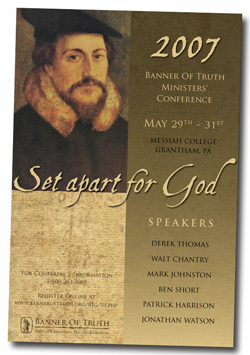 promote the conference, The Banner of Truth is offering our readers a 40-percent package discount on these three volumes:
 Tony Reinke