Personal Update (Newtcation Ends)

Today Newtcation ends. It’s been a wonderful several days spent mostly off-line and with a lot of time with the family at the local pool and lakes, and bowling, and attending little league softball and baseball games.

Two weeks steeped in Newton’s letters have been a tremendous blessing to my own soul. On most mornings I awoke to make new discoveries in the pages of the rarest published letters of Newton, many of them made available by the generosity and ingenuity of friends who volunteered university library credentials and iPad cameras to the cause. A lot of my Newtcation mornings looked something like this:
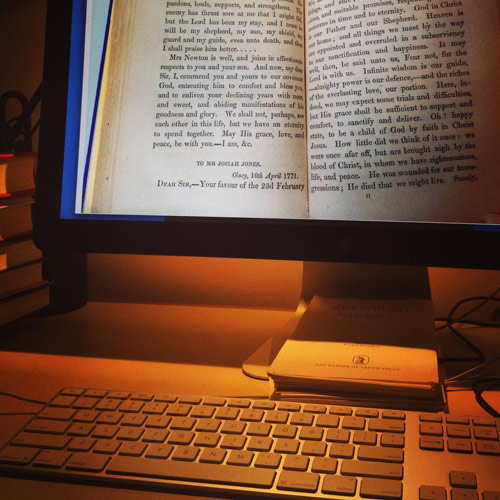
newtcation-1

I’m now emerging out of the 18th century and find myself playing catch-up on DOMA, Tsarnaev, Randy Travis, Metta World Peace, Trayvon, Chris Weidman, Sharknadoes, plane crashes in Alaska and SFO, unrest in Egypt, and wildfires in Arizona. So much has happened in the last two weeks.

Going off-line has been worth it. Yesterday I finished the first draft of the Newton book, which I began writing 9 months, 25 days ago. Over these past two weeks I’ve had time to write the final 20% of the book. At 87,606 words, the draft is far too long and will need to be trimmed in the next phase of re-writing (and re-re-writing) that begins now. In the coming months I will be trimming content, tightening sentences, and sharpening the language of the book. From my experience, this is the most enjoyable stage in the writing process.

newtcation

The manuscript, in its present form, has been passed along to Pastor John, who has kindly offered to read it (gulp) and pen the foreword. Piper’s enthusiasm over the years for Newton, and his popular biographical sketch, have all become significant factors in the enduring legacy of Newton and his works in the Church today. Irrespective of whether my book is any good, to have a foreword from him is not only an honor, but will also provide a push behind Newton’s legacy to extend its life for at least one more generation.

And of course Newtcation has reminded me of the amazing blessing I have been given in my wife. She was up before the kids to edit chapters, kept the kids busy after they awoke so I could write, and then served us all afternoon as we enjoyed family time together. The back of our minivan is a drink and snack taxi, stocked for whatever adventure we filled our afternoons with. I would post a picture of my precious wife here, but, in her words, “Your pictures of me are always so horrible.”

Alas, a lot of great memories will stay with me from Newtcation, but I look forward to getting back to work tomorrow. Thank you to everyone who prayed for me over these past two weeks as I completed research and writing the first draft of Newton on the Christian Life. I was sustained by God’s amazing grace all along.
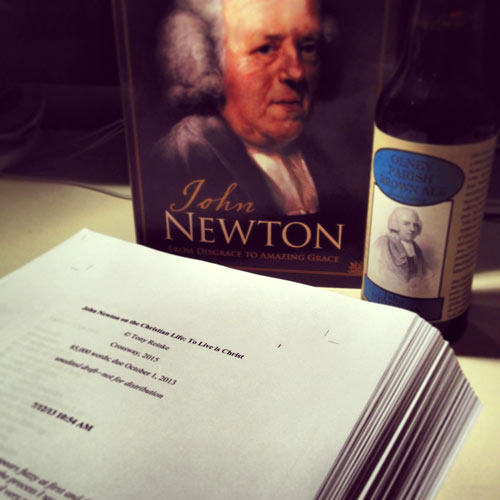
newtcation-2

And Yet I Pray On

A letter from John Newton to a friend, on prayer (August 15, 1776):

I sometimes think that the prayers of believers afford a stronger proof of a depraved nature than even the profaneness of those who know not the Lord. How strange is it, that when I have the fullest convictions that prayer is not only my duty — not only necessary as the appointed means of receiving these supplies, without which I can do nothing, but likewise the greatest honor and privilege to which I can be admitted in the present life — I should still find myself so unwilling to engage in it.

However, I think it is not prayer itself that I am weary of, but such prayers as mine. How can it be accounted prayer, when the heart is so little affected — when it is polluted with such a mixture of vile and vain imaginations — when I hardly know what I say myself — but I feel my mind collected one minute, the next, my thoughts are gone to the ends of the earth.

If what I express with my lips were written down, and the thoughts which at the same time are passing through my heart were likewise written between the lines, the whole taken together would be such an absurd and incoherent jumble — such a medley of inconsistency, that it might pass for the ravings of a lunatic.

When he points out to me the wildness of this jargon, and asks, is this a prayer fit to be presented to the holy heart-searching God? I am at a loss what to answer, till it is given to me to recollect that I am not under the law, but under grace — that my hope is to be placed, not in my own prayers, but in the righteousness and intercession of Jesus. The poorer and viler I am in myself, so much the more is the power and riches of his grace magnified in my behalf.

Therefore I must, and, the Lord being my helper, I will pray on, and admire his condescension and love, that he can and does take notice of such a creature — for the event shows, that those prayers which are even displeasing to myself, partial as I am in my own case, are acceptable to him, how else should they be answered?

And that I am still permitted to come to a throne of grace — still supported in my walk and in my work, and that mine enemies have not yet prevailed against me, and triumphed over me, affords a full proof that the Lord has heard and has accepted my poor prayers — yea, it is possible, that those very prayers of ours of which we are most ashamed, are the most pleasing to the Lord, and for that reason, because we are ashamed of them. When we are favored with what we call enlargement, we come away tolerably satisfied with ourselves, and think we have done well.

Personal Update (Newtcation)

Hello everyone!

I thought I’d drop a personal update as a means of soliciting your prayers. For the next few weeks I’ll be taking some time off from work to devote focused attention on my John Newton book, and to enjoy a staycation with the family. My wife is calling it Newt-cation. The family schedule has been cleared, and I hope to write in the mornings and early afternoons, and then laugh and veg and swim and tan with the fam the rest of the day.

These precious weeks will give time to really narrow my writing focus. I started the Newton book on September 16 of last year, and by researching and writing on Saturdays alone (as time allowed), I’ve managed to rough out 10 of the 14 chapters and to pen about 75% of the total 85,000 words. These next two weeks will give me the time necessary to finish up these four last chapters and to invest substantial time in refined research on a few areas of particular interests in Newton’s letters.

And unless the editors read my book, cringe, and change their minds, it’s scheduled to be published in the summer of 2015 in Crossway’s Theologians on the Christian Life series. There’s nobody I would rather write on (Newton), nobody I would rather write for (Crossway), and nobody I would rather write under (editors Justin Taylor and Steve Nichols).

Here’s how the growing TCL series is shaping up (so far):

The great delight in working on a project like this one is the opportunity to get intimately acquainted with a great Christian thinker from the past, especially when it comes to studying how they processed the intricate dynamics of the Christian life. Having been discipled by Newton for years now, and more rigorously for the past year, I find myself more and more thinking like him and applying the gospel to my everyday life in ways he models from his own life. I find it easy to get excited about Newton and I am eager to share the results of my research with you as soon as possible.

But for now I need patience, and discipline to write clearly, and so I would greatly appreciate your prayers as I try and wrap up the majority of the Newton manuscript in July. And so (as Newton would say it), I earnestly entreat all who know how to draw near to the Throne of Grace by Jesus Christ, to strive mightily in prayer for me, that I may stand fast in the faith, and increase in the knowledge of Jesus the Savior; and that for his sake I may labor, without fear, in the service to which he has been pleased to call me.

May the grace of our Lord Jesus Christ be with you all!

I am your affectionate friend, and servant in the Gospel of Christ,

Tony

Newton on Preaching Unsearchable Riches

The following story was shared by John Newton in a letter to his friend, a theological liberal minister, Thomas Scott, on November 17, 1775. Newton’s role in the theological formation (transformation) of Scott is a remarkable story worth studying in itself. But for now, here’s the story Newton shared with Scott, as published in Newton’s Works (1:596-98):

A most valued friend of mine, a Clergyman now living, had for many years given a rational assent to the Gospel. He labored with much earnestness upon your plan; was very exemplary in his whole conduct; preached almost incessantly (two or three times every day in the week for years), having a parish in the remote parts of Yorkshire, of great extent, and containing five or six different hamlets at some distance from each other.

He succeeded likewise with his people so far as to break them off from outward irregularities; and was mentioned, in a letter to the Society for propagating the Gospel (which I have seen in print) as the most perfect example of a parish priest which this nation, or perhaps this age, has produced. Thus he went on for many years, teaching his people what he knew, for he could teach them no more. He lived in such retirement and recess, that he was unacquainted with the persons and principles of any who are now branded as enthusiasts and methodists.

One day, reading Ephesians 3 in his Greek Testament, his thoughts were stopped by the word ανεξιχνιαστον [unsearchable], in verse 8. He was struck, and led to think with himself to this purpose: The Apostle, when speaking of the love and riches of Christ, uses remarkable expressions; he speaks of heights, and depths, and lengths, and breadths, and unsearchables, where I seem to find every thing plain, easy, and rational. He finds mysteries where I can perceive none. Surely, though I use the words Gospel, faith, and grace, with him, my ideas of them must be different from his.

This led him to a close examination of all his Epistles, and, by the blessing of God, brought on a total change in his views and preaching. He no longer set his people to keep a law of faith; to trust in their sincerity and endeavors, upon some general hope that Christ would help them out where they came short; but he preached Christ himself, as the end of the Law for righteousness to every one that believeth.

He felt himself, and laboured to convince others, that there is no hope for a sinner but merely in the blood of Jesus; and no possibility of his doing any works acceptable to God, till he himself be first made accepted in the Beloved. Nor did he labor in vain. Now his preaching effected, not only an outward reformation, but a real change of heart, in very many of his hearers. The word was received, as Paul expresses it, not with a rational assent only, but with demonstration and power, in the Holy Ghost, and in much assurance; and their endeavors to observe the Gospel precepts were abundantly more extensive, uniform, and successful, when they were brought to say, with the Apostle, “I am crucified with Christ: nevertheless I live, yet not I, but Christ liveth in me; and the life I live in the flesh, I live by faith in the Son of God.”

Bowing Before the God of Providence

Charles Spurgeon, in a sermon:

Did you ever hear Mr. Woolf tell the story of Aleppo [a large city in Syria] being swallowed up by an earthquake? Suddenly awakened one morning, he scarcely knew how, he went outside of Aleppo. He turned his head a moment; and where that great city had been there was a vacuum, and Aleppo had all been swallowed up.

Who did that? Who but God!

Have you never heard of the earthquake at Lisbon, and of the population of that great city being sucked down and consumed? Have you never heard of whole islands disappearing, being suddenly submerged with the inhabitants, and not a wreck left behind?

Did you never hear of tornadoes, and of ships with hundreds on board being driven to the bottom of the sea by the force of the wind, by the raging of the storm, or rather, by the resistless voice of him whom winds and waves obey?

Why, such fearful calamities happen so frequently, that we are wont to read almost every day of some heart-rending disaster, now an explosion in a coal-pit, then a collision on the railway, a steamer sinks within sight of shore.

Though some of these tragedies are to be traced to human carelessness, and others are purely accidental, yet there remain those which no prescience of mortals could forestall, and we rightly call them ‘visitations,’ for they are utterly unavoidable.

Hurricanes, tornadoes, and earthquakes will always occur, I suppose, as long as the world continues. Still, ‘the earth is the LORD’S, and the fulness thereof; the world and they that dwell therein.’ The God of Providence whom we adore baffles our little wisdom by the ills he permits, and the elements he lets loose, but I bow before him with a love that is not diminished by the convulsive shocks of nature, or the sorrows that taint our feeble race on land and ocean, at home and abroad, because I believe him to be good, immensely good, in the roughest tempests as well as in the clearest calm, though I cannot understand the way that he takes.

Source: C. H. Spurgeon’s Sermons Beyond Volume 63: An Authentic Supplement to the Metropolitan Tabernacle Pulpit: Forty-Five Forgotten Sermons Compiled from the Baptist Messenger (Day One, 2009), 245–246.

Idols Beneath It All

Acts 17:16:

Now while Paul was waiting for them at Athens, his spirit was provoked within him as he saw that the city was full of idols.

In his sermon, “A World Full of Idols” (March 29, 1998), Tim Keller said this:

What did he see? He saw idols under everything.

You say, “Of course he saw idols.” He was distressed because he saw idols. Go to Athens today, you’ll see idols everywhere. There’s Aphrodite, the goddess of beauty. There’s Ares, the god of power and war. There’s Apollo, the god of music and art. There’s Bacchus, the god of fraternities. You can go to all of these and say, “Of course, they were out there. They were statues. Everybody can see them.”

But that’s not what the word “see” means. The text could easily have used a simple Greek word for “see,” blepo [βλέπω] or something for “just take a look.” But the word Luke uses to describe what Paul was doing there is the word theoreo [θεωρέω], the word “to theorize” or “to get underneath.” This is the key to working out how to be a Christian in the public world.

Paul saw that underneath all the art, underneath all the business, underneath all the government, underneath all the philosophy, were idols. The real problem with the world is not the bad things, but the good things that have become the best things. He saw what we should see, and this is how it changes the way we do things, that under every personality are idols, under all psychological problems are idols, under every culture are idols, under all moral problems are idols, under all social problems are idols, under all intellectual problems are idols. …

Rather, you have to say, “Jesus Christ is my glory, is my beauty, is my goodness, is my righteousness, is my love, is my meaning.” Then what happens? You’re going to do things differently than other artists. You’re going to dance differently than other dancers. You’re going to do business differently than other businessmen and women.