Why Advent Should Be Slow

Slow is bad in the modern vernacular, but around this time of the year the slow celebration of Advent serves as a reminder of just how right and precious slow is the plan of God. Take the lesson from Octavius Winslow and the words he penned in his book The Glory of the Redeemer (1844):

The entire theocracy of the Israelites was interwoven with a system of symbols and types of the most significant and instructive character. It was thus the wisdom and the will of God that the revelation of Jesus to the Church should assume a consecutive and progressive form. Not a sudden but a gradual descent to the world, marked the advent of our adorable Redeemer.

The same principle of progressiveness is frequently seen in a saving discovery of Christ to the soul. Not by an immediate and instantaneous revelation, not by a single glance of the mind, is Jesus always made known and seen. Long and slow is often the process. “Unto you that fear my name shall the Sun of righteousness arise” [Malachi 4:2]. Observe, it is a gradation of light. The Sun rises – beam follows beam, light expands, Christ is more known; more known, He is more admired; more admired, He is more loved; and more loved, He is more implicitly obeyed and devotedly served. Thus, the “path of the just is as the shining light, which shines more and more unto the perfect day” [Proverbs 4:18].

Thus has been the revelation of Christ’s glory to the Church of God. In her infancy – her nonage – she was placed “under tutors and governors, until the time appointed by the Father.” Not prepared to sustain the sudden and full revelation, God disciplined and trained her by various types and ceremonies; thus, wisely, and, it must be admitted, graciously, shadowing forth His dear Son by gradual but increasingly clear and luminous discoveries, until the “fulness of time was come” [Galatians 4:4], when He appeared the great Antitype of all the types, the glowing substance of all the shadows, the full signification of all the symbols, the “brightness of the Father’s glory, the express image of His person” [Hebrews 1:3].

I will not be offended if you rush past this blog post on to the next thing in your busy day. But please don’t rush too fast past Advent this year. Take it in slowly, take it in at Godspeed.

Eschatological Joy, Daily Joy, and Spirit Indwelling

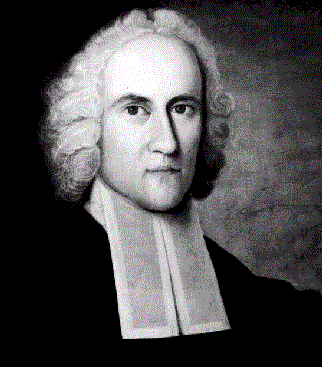
So often in Scripture the presence of joy comes along with the presence of the Holy Spirit (Acts 13:52; 1 Thess 1:6; Gal 5:22; Rom 14:17; 15:13). Jonathan Edwards picks up and develops this link between the Spirit and joy all over in his works, particularly when he writes on the Trinity, heaven, and on the religious affections.

The link between the indwelling of the Spirit and our joy is especially noteworthy in an except like this one taken from his Writings on the Trinity, Grace, and Faith (Yale 21:190):

What Christ purchased for us, was that we might have communion with God in his good, which consists in partaking of or having communion of the Holy Ghost. All the blessedness of the redeemed consists in partaking of the fullness of Christ, their head and Redeemer, which, I have observed, consists in partaking of the Spirit that is given him not by measure. This is the vital sap, which the branches derive from the true vine; this is the holy oil poured on the head, that goes down to the members.

Christ purchased for us that we should enjoy the love, but the love of God flows out in the proceeding of the Spirit; and he purchased for them that the love and joy of God should dwell in them, which is by the indwelling of the Holy Spirit.

The sum of all spiritual good which the saints have in this world, is that spring of living water within them which we read of, John 4:10–14; and those rivers of living waters flowing from within them which we read of, John 7:38–39, which we are there told is the Holy Spirit.

And the sum of all happiness in the other world, is that river of living waters which flows from the throne of God and the Lamb, which is the river of God’s pleasure and is the Holy Spirit; which is often compared in Scripture to water, to the rain and dew, and rivers and floods of waters (Isaiah 44:3, Isaiah 32:15, Isaiah 35:6–7, Isaiah 41:17–18 compared with John 4:14, and Isaiah 43:19–20).

Notice a few key points drawn together by Edwards:

  1. Our joy is expensive, and the high cost is purchased for us at the cross.
  2. The Spirit’s joy is Christ’s joy first, shared with us by virtue of our union with Christ.
  3. The indwelling presence of the Spirit is the origin of spiritual joy in our lives.
  4. And perhaps most interesting to me, joy — both our joy today and our joy eternal — are both deeply embedded in our union to Christ and in the purchased permanency of the Spirit’s indwelling in our lives now and forever. Which is why for Edwards there are such strong ties of continuity to be discovered between our present experience of joy in this world (no matter how disrupted and faulty and fallen), and our perfected joy that will be fully revealed in the next world.

Dying and Rising with Christ

One of the more stimulating reads from 2012 was for me a short 130-page book written 45 years ago by Robert Tannehill, Dying and Rising with Christ. For its brevity the book punches hard and achieves a sketch of the sweeping eschatological structure in Paul’s writings, something I appreciate in the writings of G. K. Beale.

Tannehill seems to make a few points about the Christian life that are worth highlighting here. First, the book is strong on the large-scale eschatological framework of the Christian life in Paul, as you can see on page 30:

Christ’s cross puts an end to the dominion of sin, and so to the “old man.” It is an inclusive event, for the existence of men was bound up with this old aeon, and what puts an end to it also puts an end to them as men of the old aeon. When Paul speaks of dying and rising with Christ, and associates it, as he does here, with the end of the old dominion and the foundation of the new, it is clear that he is thinking of the death and resurrection of Christ as eschatological events. And because they are eschatological events, affecting the old dominion as a whole, they are also inclusive events.

But I think Tannehill’s work is especially valuable on the flip side of our entrance into the new aeon, in our battle with the tug and pull of the old aeon in the ongoing “eschatological discord” (Beale). Tannehill explains the discord on page 127:

The connection which we have noted between dying and rising with Christ and Paul’s eschatology provides the key to understanding the relation between dying with Christ as a past event and as a continuing aspect of Christian existence. Through dying with Christ the Christian has been released from the old world and has entered the new. If this were all that Paul wished to say about God’s eschatological act, he could only speak of dying with Christ as something which has already happened to the Christians. But the old world has not yet accepted God’s judgment of it and claim upon it, and the Christian is still bound to this old world through his present body.

This means that the Christian is still exposed to the powers of the old aeon. Therefore, the new existence which is based upon the past death with Christ takes on the form of a continuing dying with Christ. To be sure, Paul speaks of dying with Christ as a present process particularly, though not exclusively, in connection with suffering. However, he makes clear that the dying with Christ which takes place in suffering is also a dying to the old world, the world of “flesh” and of trust in self. It is because the decisive break with the old world must continually be maintained and affirmed that what happened to the Christian in the death of Christ also determines the present structure of his life, so that dying with Christ is not only the basis of the new dominion but remains a present reality within it.

Tannehill seems to be on to something here, and he’s not the only one to point this out. For a further discussion on this dual dynamic of our dying and rising with Christ, and how these twin realities shape our perception of our daily Christian lives, see the second half of my recent interview with Constantine Campbell in the Authors on the Line series (iTunes). And if you are looking for a brilliant chapter on the eschatological shape of the Christian life, see Beale’s A New Testament Biblical Theology, pages 835–870.

Glorify!

Here’s a fine 135-word introduction to Christian Hedonism from the new children’s devotional by Sally Lloyd-Jones, Thoughts to Make Your Heart Sing (Zonderkidz, 2012), pages 52–53:

GLORIFY!

God tells us to glorify him. “Glorify” means “to make a big deal of.” When someone makes a big deal of you, it fills up your heart with joy.

But why does God need us to make a big deal of him? Why does he need us to get joy?

He doesn’t. In the beginning God the Father and Jesus, his Son, together with the Holy Spirit, were already there — a loving family, glorifying each other in this wonderful Dance of Joy.

No. God didn’t create us so he could get joy — he already had it.

He created us so he could share it.

He knows it’s the thing your heart most needs to be happy. When God says, “Glorify me!”, he’s really saying, “Be filled with Joy!”

He’s inviting us into his Forever Happiness.

Sorrowful, Yet Always Rejoicing

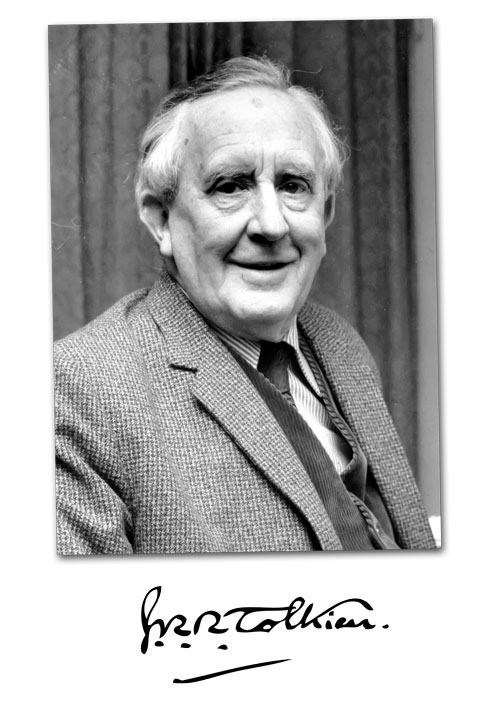
J. R. R. Tolkien, The Lord of the Rings (Houghton Mifflin, 2002), 767:

. . . Gandalf did not look at Pippin or speak a word to him as they went. Their guide brought them from the doors of the hall, and then led them across the Court of the Fountain into a lane between tall buildings of stone. After several turns they came to a house close to the wall of the citadel upon the north side, not far from the shoulder that linked the hill with the mountain. Within, upon the first floor above the street, up a wide carven stair, he showed them to a fair room, light and airy, with goodly hangings of dull gold sheen unfigured. It was sparely furnished, having but a small table, two chairs and a bench; but at either side there were curtained alcoves and well-clad beds within with vessels and basins for washing. There were three high narrow windows that looked northward over the great curve of Anduin, still shrouded in mists, towards the Emyn Muil and Rauros far away. Pippin had to climb on the bench to look out over the deep stone sill.

‘Are you angry with me, Gandalf?’ he said, as their guide went out and closed the door. ‘I did the best I could.’

‘You did indeed!’ said Gandalf, laughing suddenly; and he came and stood beside Pippin, putting his arm about the hobbit’s shoulders and gazing out of the window.

Pippin glanced in some wonder at the face now close beside his own, for the sound of that laugh had been gay and merry. Yet in the wizard’s face he saw at first only lines of care and sorrow; though as he looked more intently he perceived that under all there was a great joy: a fountain of mirth enough to set a kingdom laughing, were it to gush forth.

The ‘Now’ of Eschatological Joy (Take 2)

First we noticed how Luther connects the present experience of joy in the Christian life with eternal joy in heaven, and that by the gracious acting of the Holy Spirit. He does this at a fundamental level in his theological thinking. The same continuity emerges all over the writings of Jonathan Edwards, most profoundly introduced in his doctrine of the Trinity, but for our purposes here it is a point made particularly well in Religious Affections (Yale ed.), 2:235–236]. Note in this excerpt how closely Edwards ties joy to the indwelling Holy Spirit, and how our joy-experience now in the Christian life is a foretaste of the coming banquet. Or to say it another way, note how the indwelling Spirit becomes the link of continuity between our joy now and our joy eternal:

The inheritance that Christ has purchased for the elect, is the Spirit of God; not in any extraordinary gifts, but in his vital indwelling in the heart, exerting and communicating himself there, in his own proper, holy or divine nature: and this is the sum total of the inheritance that Christ purchased for the elect.

For so are things constituted in the affair of our redemption, that the Father provides the Savior, or purchaser, and the purchase is made of him; and the Son is the purchaser and the price; and the Holy Spirit is the great blessing or inheritance purchased, as is intimated, Galatians 3:13–14, and hence the Spirit is often spoken of as the sum of the blessings promised in the gospel (Luke 24:49, Acts 1:4 and ch. 2:38–39, Galatians 3:14, Ephesians 1:13). This inheritance was the grand legacy which Christ left his disciples and church, in his last will and testament (John, chs. 14, and 15, and 16). This is the sum of the blessings of eternal life, which shall be given in heaven. (Compare John 7:37–39 and John 4:14 with Revelation 21:6 and Revelation 22:1, 17).

Tis through the vital communications and indwelling of the Spirit, that the saints have all their light, life, holiness, beauty and joy in heaven: and ’tis through the vital communications and indwelling of the same Spirit, that the saints have all light, life, holiness, beauty and joy on earth; but only communicated in less measure.

And this vital indwelling of the Spirit in the saints, in this less measure and small beginning, is the “earnest of the Spirit” [II Corinthians 1:22], the “earnest of the future inheritance” [Ephesians 1:14], and “the firstfruits of the Spirit,” as the Apostle calls it, Romans 8:23, where, by the firstfruits of the Spirit, the Apostle undoubtedly means the same vital gracious principle, that he speaks of in all the preceding part of the chapter, which he calls Spirit, and sets in opposition to flesh or corruption.