——————————–
Mulling over Muller:
A Casual Tour through Post-Reformation Reformed Dogmatics
By John W. Tweeddale
——————————–
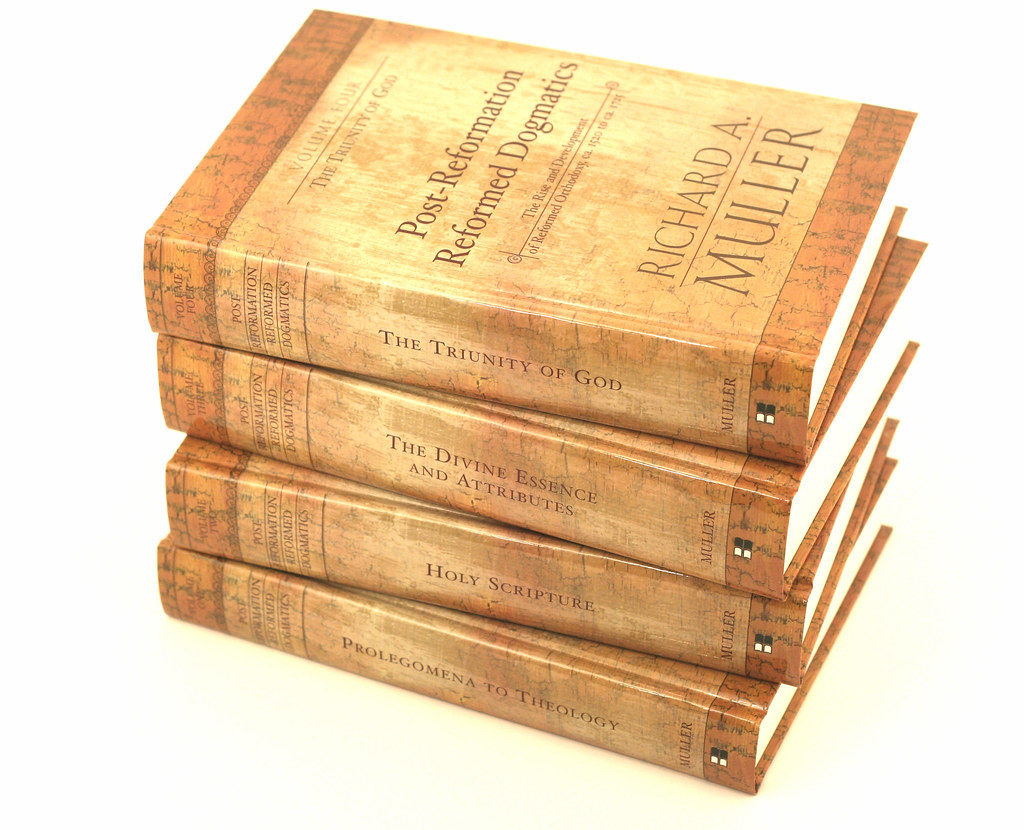
Last summer provided me a rare opportunity to read much of Richard A. Muller’s four-volume work, Post-Reformation Reformed Dogmatics. It was wonderful to discover the complex development behind the reformed tradition I often take for granted. Knowing I was fully unqualified to write a review on such a scholastic work, I reached out to John W. Tweeddale and he graciously accepted the invitation. John has spent much time researching Muller’s work, has provided excellent notes online and now provides a very helpful review. Although Muller’s work appears daunting and technical, John shows us how pastors, teachers and students can benefit. He gives us advice on how to best use Muller’s work and shows us the importance of it in contemporary church culture (like when John connects an understanding reformed theological roots to the growing concern over the emerging/emergent church concerns). We are thankful for his review.
John W. Tweeddale is a ministerial candidate in the Presbyterian Church in America (PCA) and graduated from William Carey University and Reformed Theological Seminary in Jackson, MS. While in Jackson, he interned at First Presbyterian Church. John is currently a PhD student at the University of Edinburgh where he is studying John Owen’s commentary on Hebrews. He has co-authored a reference book with Derek Thomas entitled, The Essential Commentaries for a Preacher’s Library, occasionally contributes to reformation21, and regularly contributes to The Conventicle blog. However, he says his greatest joy is being married to his wife Angela who he met at RTS.
-Tony
——————————–
A Practical Gift
Everyone knows that a wedding shower is for the bride. But occasionally, the groom is remembered with a salutary gift. Some men get power tools, others get electronic gadgets. I got books. But not just any books. These were four hefty tomes. When I opened to the inside cover of the first volume I found inscribed these amusing words: “A little light reading on the occasion of your wedding!”
This gift was anything but little or light. It was a peculiar present. Not that giving books to an eager and expecting groom is unusual, mind you. But I do believe I am the only man in history to receive Richard Muller’s Post-Reformation Reformed Dogmatics as a wedding present! However, lest you question the propriety of the giver, for a (soon-to-be-married) ministerial candidate planning to study the Puritans, it could not have been a better gift. Strange as it sounds, it has proved more practical than an iPod and even handier than a Leatherman.
You may be saying to yourself, “That’s great for you. But I’m a busy pastor. I enjoy reading the Puritans but I’m not a scholar. What’s all the fuss about Richard Muller? Why should I bother reading his books on reformed dogmatics? I need books on reformed pragmatics! I have sermons to prepare, meetings to attend, people to counsel. Do I really need another set on historical theology?” Great questions. Your time is precious. It is to be redeemed and not squandered. Therefore, when you read, you must read selectively and wisely, deeply and practically. It is precisely for this reason that I think you can be helped by Muller’s PRRD.
In what follows, I want to give you a causal tour through PRRD. As we meander along, I have three basic goals. I want to (1) give an overview of Muller’s work, (2) provide several reasons why I think PRRD is a valuable resource for pastors, elders, seminarians, and bible college students, and (3) suggest a reading plan for tackling this work. To state my intentions another way, I want to answer three questions: (1) what is the basic argument of PRRD; (2) why is reading PRRD important for your theological development and ministry; and (3) how can you as a busy minister, elder, or student best utilize your study time so as to gain maximal benefit when reading PRRD? My primary aim is not analytical but practical. So without any further delay, follow me.
Overview of Post-Reformation Reformed Dogmatics
Richard A. Muller is the P. J. Zondervan Professor of Historical Theology at Calvin Theological Seminary and has written extensively on the Reformation and post-Reformation periods. His books, articles, and reviews display a knack for historical detail, command of reformed theology, and mastery of a wide selection of sources. All of his writings are worth getting your hands on. However, his crowning achievement is his PRRD. It is the result of a career long investigation of “the rise and development of Reformed Orthodoxy” and is without question one of the most important works on the history of Reformed theology to emerge in the past twenty-five years. Anyone interested in the Reformers and their heirs must wrestle with these volumes.
Despite its importance, one of the most frequent complaints I hear about PRRD is its level of difficulty. With its Latin laced references (usually translated!), doctrinally detailed discussions, and heavy-going historical analysis, reading PRRD is not for the faint of heart. It takes hard work. But as Mortimer Adler taught us in his immensely practical guide How to Read a Book, the most profitable reading takes place when we engage books that move us from understanding less to understanding more. Reading PRRD is one of those books. It is not like reading the sports page or even a cosy devotional. It requires a more careful, active reading. So get a strong mug of coffee, take a seat at your desk, get a pad and pencil, and let’s jump in!
The basic argument of PRRD is simple and straightforward. Muller is mainly concerned with the relationship of the post-Reformation to the Reformation and to the wider context of western Christianity. He states, “the underlying theses of the present study concern the continuities and discontinuities in Reformed theology during the eras of the Reformation and Orthodoxy, running chronologically from approximately 1520 to approximately 1725” (PRRD, 1:37). In short, he contends that what began in the Reformation was continued, expanded, and developed by the post-Reformation. To better grasp Muller’s thesis, some definitions and details are in order.
1. Calvin/Calvinists
In your studies of the Reformers and Puritans, you have likely stumbled across the phrase “Calvin and Calvinism” or “Calvin vs. the Calvinists.” This distinction usually refers to a school of thought that sees fundamental discontinuity between Calvin and his followers (e.g. the Puritans). For example, Theodore Beza and William Perkins are sometimes represented as hardening Calvin’s doctrine of predestination by making it the “central dogma” of theology. This method is associated with individuals such as Basil Hall, Brian G. Armstrong, R. T. Kendall, Alan C. Clifford, and to some extent Alister McGrath.
Muller takes a different view. His line of attack is essentially three-fold. First, he argues that this interpretation is based upon an anachronistic and simplistic reading of the primary sources. Second, he suggests that while Calvin was an extremely significant leader, he was not the only Reformer later generations followed. In fact, Calvin was not a primary author of any Reformed confession (although traces of Calvin’s thought are evident in confessional statements such as Dort and Westminster). Third, he contends that our reading of the post-Reformation should not be forced into an either/or disjunction between Calvin and the Puritans. Instead, both Calvin and the Puritans must be placed within a wider historical context whereby similarities and differences are noted in both periods against the larger western catholic tradition, which stretches back to the medieval and patristic periods. On this point, Muller is developing the contributions of scholars such as Heiko Oberman and David Steinmetz. Others who take a similar approach to Muller are Carl Trueman, R. Scott Clark, and Willem van Asselt.
As a result of the confusion created by the “Calvin vs. the Calvinists” debate and the catholic and confessional contexts to the post-Reformation, Muller prefers the use of the more generic term “Reformed” over “Calvinist” (cf. PRRD, 1:30). This discussion lies behind most of PRRD and is crucial for understanding it. For a brief introduction to this whole debate, Paul Helm’s helpful little book Calvin and the Calvinists (Edinburgh: Banner of Truth, 1998) is a must.
2. Reformed/Protestant orthodoxy
Orthodoxy simply means “right teaching.” When fused with the term Protestant or Reformed, it refers to the historical era when the teachings of the Reformers became “codified” and “institutionalized” according to “confessional” standards. When Christendom split into Reformed and Lutheran branches, the boundaries of orthodoxy needed to be (re)established. Therefore, confessions were developed to establish ecclesiastical norms. In other words, much of the post-Reformation was a process of standardizing the “right teaching” of the Reformation in both the church and academy. Muller provocatively states, “The Reformation [was] incomplete without its confessional and doctrinal codification” (PRRD, 1:27).
For the sake of convenience, he divides Protestant orthodoxy into three periods: early orthodoxy (ca. 1565-1618-1640); high orthodoxy (ca. 1640-1685-1725); and late orthodoxy (after ca. 1725). A quick overview of PRRD, 1:30-32 will provide you with the facts and figures for each of these periods.
3. Reformed scholasticism/humanism
The term “scholasticism” is narrower and broader than “orthodoxy.” It indicates an academic style and method of discourse. Muller explains, “[Scholasticism] well describes the technical and academic side of this process of institutionalization and professionalization of Protestant doctrine in the universities of the late sixteenth and seventeenth centuries” (PRRD, 1:34).
This is a crucial point that needs to be firmly grasped. Scholasticism is a specific educational and literary category (as opposed to catechism, sermon, or confession). Technically it refers to a method of academic discourse and not to a specific theology or philosophy. So you can have Reformed scholasticism and Arminian scholasticism. Similar terms and methods are employed by both camps but their respective theologies are miles apart. In other words, scholasticism provides a common intellectual framework by which theological investigation can take place. Though this method has its roots in theologians like Thomas Aquinas, the scholasticism of the post-Reformation period is not identical to the scholasticism of the medieval period. For example, with its emphasis upon the ancient languages and employment of classical rhetoric, the roots of Protestant orthodoxy lie as much in Renaissance humanism as medieval scholasticism. We should then understand the scholasticism of Protestant orthodoxy as theologically and philosophically broad but methodologically narrow.
4. Muller’s methodology
As you can see, the relationship between the Reformation and post-Reformation is more complex than a simple 1-to-1 comparison and contrast. Muller warns against reducing these two periods to one person (e.g. Calvin) or one movement (e.g. the Puritans). Both continuities and discontinuities must be addressed on the basis of an examination of a broad spectrum of individuals, movements, and sources. Additionally, care must be taken to correctly identify the historical context and the literary genre of writings (e.g. textbook, catechism, confession, sermon, etc) within these periods. From this perspective, Protestant orthodoxy and scholasticism can be interpreted as “trajectories of intellectual history” (PRRD, 1:39) that dynamically developed out of the Patristic, Medieval, Renaissance, and Reformation periods.
5. A short summary
Having established his methodology and defined his terms, Muller attempts to develop his thesis along four lines: prolegomena to theology (vol. 1), Scripture (vol. 2), the essence and attributes of God (vol. 3), and the Triunity of God (vol. 4). Volume 1 investigates how the Reformed orthodox defined and did theology. The thrust of this work is to identify the fundamental presuppositions that lie behind the systems of theology developed in the post-Reformation. The next volume explores the relationship between prolegomena (vol. 1) and the formation of a doctrine of Scripture. Here we learn about the implications of Scripture as “the cognitive foundation of theology.” The last seventy-five pages or so have a superb discussion on biblical interpretation in the sixteenth and seventeenth centuries (PRRD, 2:442-524). Volumes 3 and 4 comprise a unit and explore different aspects of the doctrine of God as “the essential foundation of theology.” The last section in the final volume provides a summary of Muller’s findings for the entire project (PRRD, 4:382-420).
Together, these four volumes form a comprehensive survey of the theological methods (i.e. prolegomena) and two main principia (Scripture and God) developed during the post-Reformation. Upon these three topics (loci), the theological infrastructure known as Reformed orthodoxy was built. However, Muller’s study in no way exhausts everything we need to know about the history and theology of the post-Reformation. Indeed, in a rather understated way, he states that his study “barely scratched the surface” (PRRD, 4:15)! The burden for others will be to pick up where Muller left off by continuing to mine the deep caverns of Reformed orthodoxy. Topics such as Christology, anthropology, ecclesiology, hermeneutics, worship, and piety are only a sampling of subjects needing the same level of rigorous academic attention. Muller has set the standard. Who is up for the challenge?
Five Reasons for Owning Post-Reformation Reformed Dogmatics
The above discussion may seem awfully technical. You still may be saying to yourself, “Why should I mull over Muller?” Below are at least five reasons why I think PRRD is a valuable resource for pastors, elders, seminarians, and bible college students.
1. Knowing the past helps you to better know the present
The church has often grappled with the tension between continuation (preserving the theological heritage of the past, i.e. continuity) and contextualization (accommodating to the needs of the present, i.e. discontinuity). This was as true in the seventeenth century as in the twenty-first. The Reformed orthodox were masters at contextualizing without compromising the message of the Reformers in order to effectively meet the cultural demands of their day. To put the matter in a more up-to-date way, concerns expressed by emergent/emerging type are nothing new. Postmodernism does present a real challenge for communicating the gospel. But let’s not take a historically naive view of our problem. We are not the first to struggle with the difficulty of “Christ and culture.”
Reading PRRD will give you a detailed account of how previous Reformed Christians addressed this issue. The post-Reformation serves as an example of the historical and theological progress of the church on the one hand (discontinuity) and the preservation and maintenance of doctrinal integrity on the other (continuity). The point for us is not to return to the ‘good ol’ days’ of the seventeenth century but to remember that the past can provide us with lessons for the present. For an insightful study on this issue, including an examination of Muller’s PRRD and the emergent discussion, see Jeffrey Jue, “What’s Emerging in the Church: Postmodernity, the Emergent Church, and the Reformation” reformation21, issue 2 (September 2005), accessed at www.reformation21.org.
2. Deepens your knowledge of the treasure house of Reformed literature
PRRD is chock full of references to and quotations from a host of the greatest minds God has gifted the church. Many of them you know: Augustine, Aquinas, Luther, Calvin, Perkins, Bunyan, Owen, Turretin. Others you have probably heard about: Melancthon, Bucer, Bullinger, Musculus, Vermigli, Ramus, Cocceius, Olevianus. And still others you will perhaps meet for the first time: Viret, Hyperius, Zabarella, Zanchi, Junius, Polanus. With a bibliography exceeding one hundred and twenty pages in the fourth volume, PRRD provides the best one-stop reference for learning about the writings of the Reformation and post-Reformation. If you follow the wise counsel of C. S. Lewis and read at least one old book to every three new ones, PRRD will direct you to enough good old books to last you a lifetime (even if you don’t read Latin or Dutch!).
3. Defuses the Calvin/Calvinists myth
Despite dying the death of a thousand deaths, this straw man still hasn’t completely died! If you listen carefully this argument is essentially made by those who disparage Protestant scholasticism as the cradle of modernism and harbinger of rationalism. But the issue is more complex than that. Muller’s work shows with great documentation, clarity, and polemic that more links the intellectual and theological tapestry of the sixteenth and seventeenth centuries than chronology. Identifying the dawn of modernism within the periods of the Reformation and post-Reformation may have polemical value for some evangelicals, but it effectively deprives the evangelical world one of its richest treasures. Thankfully, PRRD is one work on demythologizing we can gladly hail. For more on this, see discussion on ‘Calvin/Calvinists’ above.
4. Develops theological clarity
One of the most beneficial aspects of reading PRRD is that it will strengthen your theological vocabulary and sharpen your theological clarity. I could give multiple examples, but here is one. A foundational category for the Reformed orthodox was the relationship between archetypal and ectypal theology. They believed that this distinction is essential for our knowledge claims about God. Archetypal theology (theologia archetypa) refers to God’s knowledge of himself while our knowledge of God is called ectypal theology (theologia ectypa). God is the ultimate Theologian. His knowledge is uncreated, complete, perfect, independent, and infinite. To use the language of Paul, it is past finding out (cf. Rom. 11:33). In contrast, we see through a glass darkly (I Cor. 13:12). Our knowledge is created, incomplete, imperfect, dependent, and finite. Our knowledge depends on God’s knowledge. While we can never know God as God knows God, we can know him to the extent that he has revealed himself in his word. This distinction preserves the incomprehensibility of God on the one hand and the knowability of God on the other. The secret things belong to God, but the things revealed belong to us (cf. Deut. 29:29).
What’s the point? For many in our day, the quest for knowledge has become the crisis of knowledge. Can we know God? If so, how do we know? Do we have to grope for God in the dark? Can human words really tell us about God? Or are we playing some sort of religious language game? These are pressing questions. But we must not fret. We need not throw our hands in the air and consign ourselves to silence. Reformed Christians have for centuries given careful thought to these issues. As Francis Schaeffer frequently stated, there is such a thing as “true truth.” God has graciously accommodated himself to our level by communicating to us with words. Baby talk as Calvin liked to put it. Although we can not know God exhaustively, we can know God truly as he has revealed himself in the inspired words, sentences, paragraphs, parables, poetry, and even propositions of Scripture. While we may want to adapt their language, the Reformed orthodox have given us a handy epistemological tool to engage a post-Enlightenment, post-propositional, postmodern world. For Muller’s discussion on archetypal/ectypal theology, see PRRD, 1:225-238.
5. Knowing the terms of the past helps you to better know the terms of the present
While running the risk of overstatement, we owe more to the period of Protestant orthodoxy for the formation of Protestant theology as we now know it than any other era in church history. It is common knowledge that the works of Hodge, Dabney, and Berkhof (to name a few) relied heavily on Francis Turretin and other Reformed scholastics. But the impact of the theological systems and definitions of the orthodox lies not only with those who live and minister within her confessional bounds. Even neo-orthodox theologians, most notably Karl Barth, maintained a level of sympathy for the structure of theology mapped out during the seventeenth century, although they have differed in substance. Indeed, you can hardly pick up a text on systematic theology (orthodox, neo-orthodox, or non-orthodox) without some trace of the post-Reformation. I can say it no better than Muller,
The contemporary relevance of Protestant orthodox theology arises from the fact that it remains the basis for normative Protestant theology in the present…The theology of Protestant orthodoxy, developed in the late sixteenth and seventeenth centuries as a final, dogmatic codification of the Reformation, occupies a position of considerable significance in the history of Protestant thought. Not only is this scholastic or orthodox teaching the historical link that binds us to the Reformation, it is also the form of theological system in and through which modern Protestantism has received most of its doctrinal principles and definition. Without detracting at all from the achievements of the great Reformers and the earliest codifiers of the doctrines of the Reformation…we need to recognize that not they, but rather, subsequent generations of “orthodox” or “scholastic” Protestants are responsible for the final form of such doctrinal issues as the definition of theology and the enunciation of its fundamental principles, the fully developed Protestant forms of the doctrine of the Trinity, the crucial Christological concept of the two states of Christ, penal substitutionary atonement, and the theme of the covenants of works and the covenant of grace (PRRD, 1:29, 37).
For those of us who belong to a confessional church, we should work hard to understand how and why the particular doctrines we confess were formulated in a particular way. While a greater awareness of Protestant orthodoxy will not solve our doctrinal disputes or prevent our theological differences, we should at least know the theological convictions and expressions entrusted to us. We will always have dissenters – whether it is open theism, the new perspectives on Paul, or rejection of penal substitution. But perhaps if we knew the reasons for the truths we confess we would not be so easily wooed by attempts to redefine classical Protestant orthodox thought, even when done in the name of evangelical and reformed. For those interested, PRRD is a great place to start.
Four Suggestions for Reading Post-Reformation Reformed Dogmatics
In closing, I want to offer four reading suggestions for tackling PRRD.
1. Keep the big picture in view
With four volumes, 2,163 pages, and over eight thousand footnotes, PRRD is overwhelming. The intimidation factor is high. But don’t give up. Not yet. You’ve read this far. As I mentioned earlier, Muller’s basic point is fairly simple and straightforward. Like looking for answers in a mathematics textbook, perhaps the best place to start is in the back of the book! Muller’s forty-page conclusion at the end of volume 4 provides an overview of the entire project (PRRD, 4: 382-420). In addition, the first hundred or so pages in volume 1 are indispensable for navigating your way through the heavier sections (PRRD, 1:27-146). If you get bogged down, a quick refresher of these pages should help keep you on track.
I’ve also found the extended outlines in the table of contents before each volume a huge help for getting the overall feel of Muller’s argument. If you’re still uncertain about jumping into the deep end of PRRD, you can dip your toe in Muller’s article “The Problem of Protestant Scholasticism – A Review” in Reformation and Scholasticism, edited by Willem J. van Asselt and Eef Dekker (Grand Rapids: Baker Academic, 2001).
2. Take advantage of helps
Another way to keep the big picture in view is to read reviews of Muller’s works. Roger Nicole’s “Post-Reformation Dogmatics: A Review Article” in Founders Journal (2004): 28-31 and Martin I. Klauber’s “Continuity and Discontinuity in Post-Reformation Reformed Theology: An Evaluation of the Muller Thesis,” in Journal of Evangelical Theological Society, 33 (1990): 467-475 are excellent summaries of PRRD. Both can be found online. Additionally, I am slowly posting notes on PRRD at The Conventicle blog.
3. Don’t read it like a biography
One factor that helped me was to recognize the genre of Muller’s writing. He is not writing a historical biography like David McCullough or a theology text like Wayne Grudem. PRRD is intellectual history at its best. This is a technical study. It is concerned with the history of Christian thought during the approximately two hundred years known as the Reformation and post-Reformation. Although Muller is chiefly concerned with the development of ideas, he is not unconcerned with more social-political matters. However, they play a minor role. So you need to put your thinking cap on when reading PRRD. For Muller’s thoughts on intellectual history, see PRRD, 1:16 (some may be interested in the more detailed discussion in James E. Bradley and Richard A. Muller, Church History: An Introduction to Research, Reference Works, and Methods [Grand Rapids: Eerdmans, 1995], 1-32).
4. Use it as a reference
Perhaps the best way to use PRRD is as a resource. It is a veritable goldmine of information. But like most reference tools, you won’t read it from cover to cover. Rather, take it one section at a time. Are you teaching a Sunday school on the person of Christ? Read PRRD, 4:275-332. Preaching a short series on the names of God? Spend some time in PRRD, 3:227-270. Interested in the history of sola Scriptura? Check out PRRD, 2:63-150. Writing a term paper on the relationship between philosophy and theology? You must read PRRD, 1:360-405. Unless you’re writing an article or paper, you probably won’t be quoting much of Muller. Nevertheless, the people you minister to will profit from you taking the time to fetch a pail of cold, refreshing water from the deep wells of Reformed orthodoxy – even if you have to find a more suitable cup.
Conclusion
We have finished our tour. More could be said. But I leave you with time to explore on your own. Although PRRD may not be little or light, I hope you see that it is one wedding present that I wouldn’t want to be without!

——————————-
Title: Post-Reformation Reformed Dogmatics: The Rise and Development of Reformed Orthodoxy, ca. 1520 to ca. 1725
Author: Richard A. Muller
Boards: hardcovers
Pages: 2,163
Reading level: 5.0/5.0 > advanced
Volumes: 4
Dust jackets: no
Binding: Smyth sewn
Paper: normal
Topical index: yes (in each volume)
Scriptural index: no
Text: perfect type
Publisher: Baker Academic; Grand Rapids, MI
Years: 1987/2003, 1993/2003, 2003, 2003
Price USD: $200.00 / $109.99 at CBD
ISBNs: set, 0801026180; vol. 1, 0801026172, 9780801026171; vol. 2, 0801026164, 9780801026164; vol. 3, 0801022940, 9780801022944; vol. 4, 0801022959, 9780801022951
 house that caused Augustine to pick up the Bible and find salvation in Christ. The phrase “take up and read” permanently symbolizes the life-changing potential of published truth.


 made right with a perfect God (justification). If you are having trouble communicating this concept to others, this book would be a great boost!
 Tony Reinke