Book review: John Gill’s Exposition of the Old and New Testaments

Book review: John Gill’s Exposition of the Old and New Testaments (9 vols)

Everyone in history lives within a historical context. I love Meet the Puritans by Beeke and Peterson primarily because it offers biographies to introduce the context behind the best Puritan writers.

Now for some specific context. In 1517, Martin Luther nailed the 95 Theses to signal a shift away from Roman Catholic traditionalism towards a thoroughly biblical theology. This reformation burst on the scene and continued to develop with the Puritans that followed. This Reformation and Post-Reformation period stressed the fact that understanding divine realities demands faith, the illumination of the Spirit and divine revelation (God’s Word). In 1588, William Whitaker wrote,

“It is only the external light of nature that is required to learn thoroughly the arts of philosophy; but to understand theology aright, there is need of the internal light of the Holy Spirit, because the things of faith are not subject to the teaching of mere human reason” (Disputations on Holy Scripture, p. 364).

Unfortunately, this emphasis upon the preciousness of God’s Word and the primacy of its divine truth did not last unhindered.

The Enlightenment – with the rise of mathematics, science and philosophy – introduced a new “rational” interpretation upon divinity. Beginning around 1725, the rise in “rationalism” attempted to reduce faith to what can be proven with philosophy and reason. Truth no longer rested upon faith, the Spirit and revelation, but upon “demonstrable evidence and rational necessity.” Clearly, this was a serious break from the former traditions.

Needless to say, the rise in “rationalism” brought significant biblical compromise into the church by de-emphasizing the Word and faith-filled, Spirit-illuminated interpretation. In their place was erected a philosophical understanding of divinity. But philosophical interpretations of divine truth, Paul tells us, simply miss the point of the biblical gospel (1 Cor. 1:18-2:16).

John Gill

It was in the midst of this rise in rationalism that some writers stood faithful to a Spirit-led, literal interpretation of Scripture as the sole object of faith. One of the most prominent of these men was Baptist John Gill (1697-1771).

Gill was a prolific author and well-known Old Testament scholar. An excellent overview of John Gill’s life and works comes to us in a sermon Spurgeon preached on August 16th, 1859 at the laying of the first stone of the new Tabernacle building. You can read the entire sermon at CCEL. Here is an excerpt,

“A man of profound learning and deep piety, he was notable as a divine for the exactness of his systematic theology in which he maintained the doctrines of grace against the innovations of Arminian teachers. His Body of Divinity has long been held in the highest repute. As the fervent exposition of an entire and harmonious creed, it has no rival. His famous treatise entitled The Cause of God And Truth, obtained for him the championship of the Calvinistic School of Divinity.”

The eulogy delivered upon Gill’s death by Augustus Toplady reminds us that Gill was both forceful and intellectually skillful.

“That his labors were indefatigable, his life exemplary … if any one can be supposed to have trod the whole circle of human learning, it was this great and eminent person. His attainments, both in abstruse and polite literature, were equally extensive and profound, and so far as the distinguishing doctrines of grace are concerned, he never besieged an error which he did not force from its stronghold, nor ever encountered an adversary whom he did not baffle and subdue.”

The Commentary

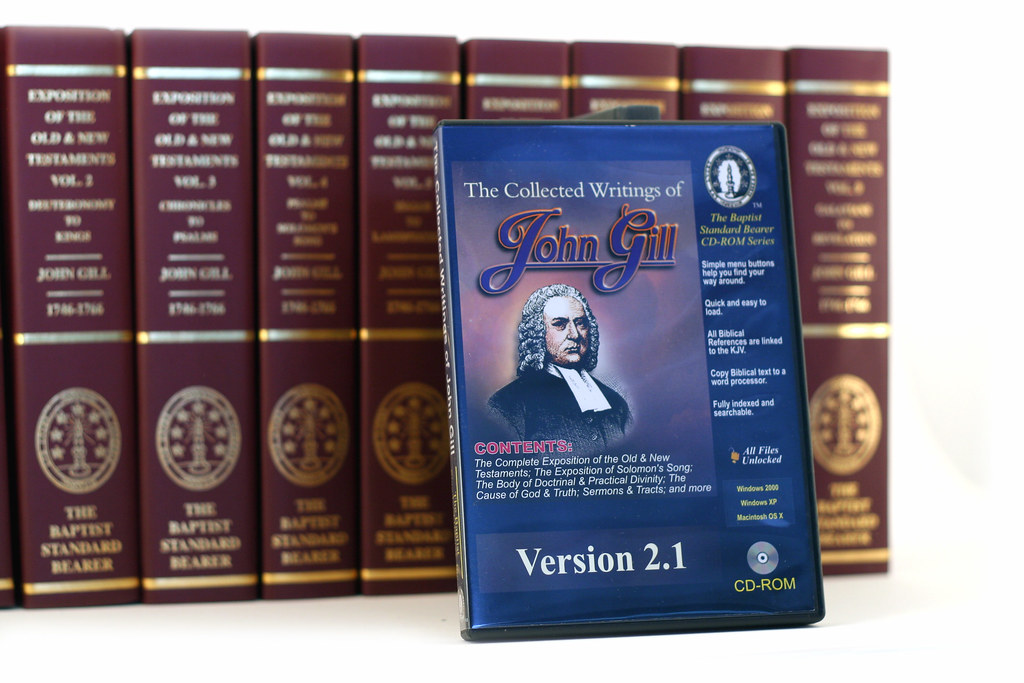
John Gill’s commentary is nine volumes long, including six volumes on the Old Testament and three on the New Testament. At first glance this specific printing is superb! The facsimile printing comes in a larger book format and in higher quality cloth binding than expected.

Gill follows the traditional commentary style of a short summary of the book, summary of each chapter, and then commentary on each individual verse following up to the next chapter.

John Gill was a forefather of the Metropolitan Tabernacle we now most associate with Charles Spurgeon. Spurgeon, who spent much time reading and critiquing commentaries, is quick to say that he was unaware of a better commentator of the Old Testament. Gill’s greatest asset was his expertise as a Hebrew scholar.

Spurgeon had his criticisms as well. He wrote publicly that Gill used too many straw-man arguments and held loose interpretations of the Parables. Spurgeon wrote,

“Very seldom does he allow himself to be run away with by imagination, except now and then when he tries to open up a parable, and finds a meaning in every circumstance and minute detail; or when he falls upon a text which is not congenial with his creed, and hacks and hews terribly to bring the word of God into a more systematic shape. Gill is the Coryphaeus of hyper-Calvinism, but if his followers never went beyond their master, they would not go very far astray.”

But the bottom-line, Spurgeon writes, is that “the world and the church take leave to question his dogmatism, but they both bow before his erudition [learning] … For good, sound, massive, sober sense in commenting, who can excel Gill?”

At another place, Spurgeon considered this commentary “remarkable for the copiousness of its glossary, the brilliance of its argument, his apprehension of prophecy, and the richness of his Hebrew scholarship. His preparations for the pulpit having, as is well known, furnished the materials for the press, we can but reflect on the priceless value of his ministry.”

In other words, the obvious power of his public preaching endures through the press. This was not a man addicted to scholarship, but a man driven by the conviction to preach through the whole counsel of God. His commentaries exemplify what was certainly a “priceless ministry.”

Extras

It is encouraging to see publishers incorporating electronic books with printed books. This is a trend we see have recently seen Crossway pull off with great success.

This commentary set from The Baptist Standard Bearer comes bundled with a CD-ROM of The Collected Writings of John Gill, which includes the full text of his commentary, nearly 100 of his sermons and his many books (including the massive, 2,000 page Complete Body of Doctrinal and Practical Divinity and the 1,000 page The Cause of God and Truth). It makes a very helpful and handy complement to the printed commentary because it makes searching and copy-and-pasting of Gill’s material very easy to incorporate in sermon prep.

The set also includes the Life and Writings of the Rev. John Gill, D.D., a short biography written by John Rippon.

Conclusion

Richard Muller writes of Gill that he “stands as perhaps the most erudite [or learned] of the eighteenth-century Dissenting theologies in the tradition of the older orthodoxy” (Post-Reformation Reformed Dogmatics, 3:150). “Erudite” being the same word used by Spurgeon.

There seems to be a consensus that Gill’s writings are firmly founded upon solid biblical scholarship. He shows a deep level of understanding with Scripture, allowing the bible to interpret itself. His wealth of insight into the Hebrew language, tradition and culture soaks both the Old and New Testaments. John Gill’s commentary is an excellent work, worthy of the beautiful edition now available.

Now 240 years later this work stands as an ebenezer of one man’s faithfulness to preach through the entire bible in light of a culture encouraging men and women to judge divine reality through empty philosophical “rationalism.” He was and remains through his works “a star of the first magnitude amidst surrounding darkness” (Spurgeon).

———————————————-

Title: John Gill’s Exposition of the Old and New Testaments
Author: John Gill [1697-1771]
Boards: cloth (maroon, guilded)
Pages: 7,370
Volumes: 9
Dust jacket: no
Binding: Smyth sewn
Paper: normal
Topical index: no
Scriptural index: no (unnecessary in commentary)
Text: facsimile of 1809 ed. (London: Mathews and Leigh)
Extras: Comes with CD-ROM of Gill’s extensive writings in digital format and Life and Writings of the Rev. John Gill, D.D. by John Rippon, clothbound, published by Gano Books.
Publisher: Printed in 2006 by The Baptist Standard Bearer, Inc.
Price USD: $300.00/$250.00 from Vision Forum
ISBNs: none

TSS book photo archive

Hello everyone. Over the past few months I have been photographing books for this blog. There are a number of pictures I have used, some I have not, but all of them I want to put to work. So, if you have a use for them, please feel free to copy them and use them. If you don’t have use for the pictures, you may (at the least) pick up some great Christmas book ideas.

Enter The Shepherd’s Scrapbook book photo archive here.

Book review: The Gospel Life series by Jeremiah Burroughs

Book review

The Gospel Life Series by Jeremiah Burroughs

As we have already discovered, Jeremiah Burroughs [1599-1646] was a first-rate bible expositor. His massive commentary on the book of Hosea is wonderful proof of this (we reviewed this commentary earlier this Summer).

However, unlike most of the Puritans recommended in our Puritan Study Series, Burroughs’ collected works do not exist. His works are largely scattered around, and for the purposes of the Puritan study, we will have to piece his works together.

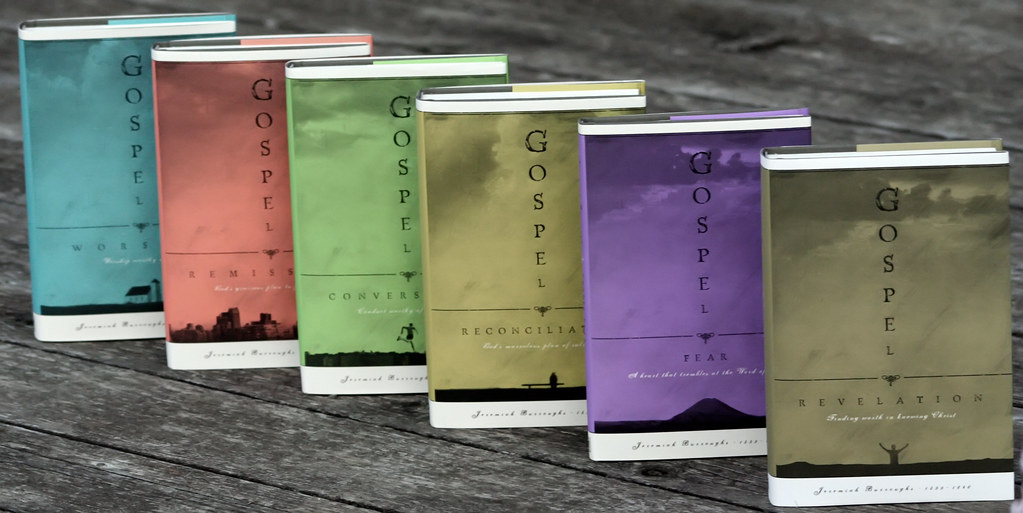
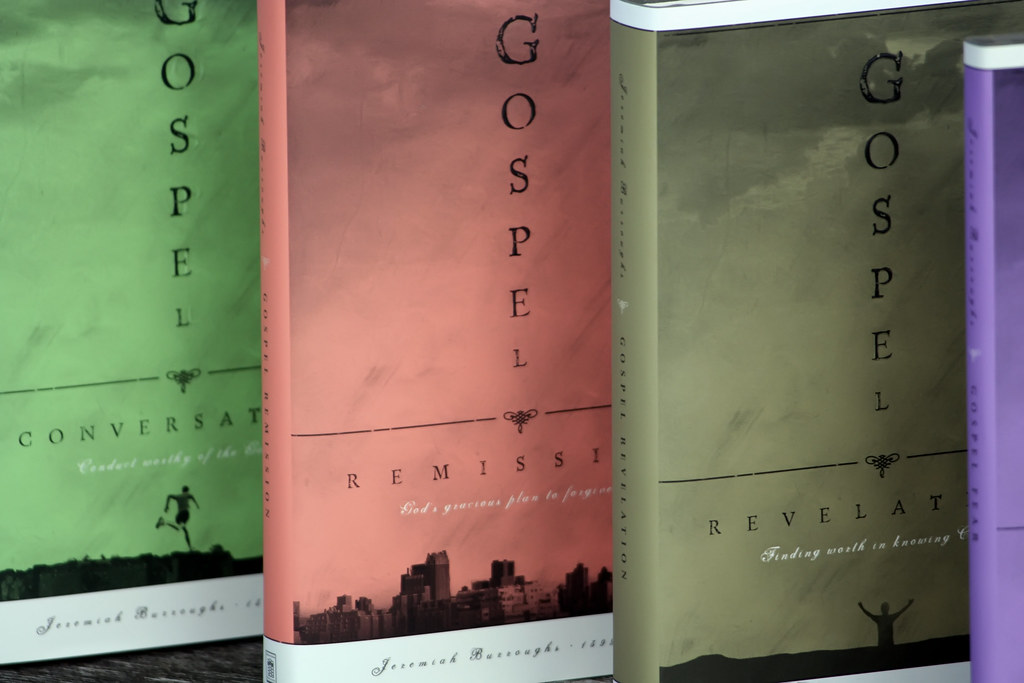
But one of the easiest ways to collect six of his books comes in a series published by Soli Deo Gloria titled, The Gospel Life Series.


These six volumes were not intended by Burroughs to be a set, though because the word “Gospel” occurs in all six, editor Don Kistler saw that they were all linked together in a common theme. Kistler re-typeset the volumes, updated the spelling, and edited for length. “I do not believe that any of Burroughs’ thoughts have been altered. I have tried to remain faithful to his words as well as to his intent throughout this edition” (3:v ).

The result is a series that covers the various facets of the Christian life, is easy to read, and will appeal to a larger community of readers than just Puritan nerds like me. This year, the sixth and final volume of the series was released.

Contents

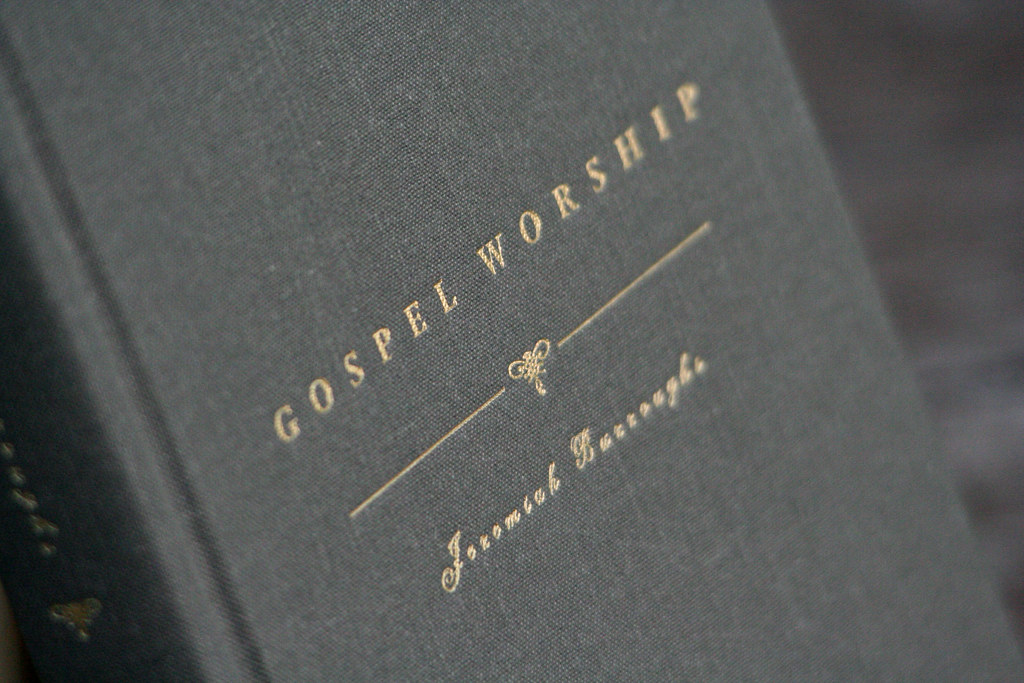
Vol. 1: Gospel Worship (1648/1990). In 14 sermons on Leviticus 10:3 (“Among those who are near me I will be sanctified”) Burroughs shows that we honor God when we draw near to Him in worship, in preparing for worship, in hearing the Word preached, in receiving the sacraments, and in prayer.

Vol. 2: Gospel Fear (1647/1991). In 7 sermons on Isaiah 66:2 (“But this is the one to whom I will look: he who is humble and contrite in spirit and trembles at my word”) and 2 Kings 22:19, Burroughs encourages us to cultivate a tender heart by cultivating a healthy fear of God.

Vol. 3: Gospel Conversation (1648/1995). Not conversation as in speech only, but the Puritan concept of conversation – of work, family, fellowship and all-around general conduct. Here are ten sermons to help us live the Cross-centered life. Most of the sermons are based upon Philippians 1:27 (“Only let your manner of life be worthy of the gospel of Christ”) and focus believers to be diligent in their walk. The Gospel must be the center of the Christian life, he argues.

Vol. 4: Gospel Revelation (1660/2006). In about 18 sermons, Burroughs explains the excellency of the eternal. God is excellent, Christ is excellent, and the nature of an eternal soul is excellent as well. It was here in the excellency of Jesus Christ (pages 51-182) that I came to a deep respect of Burroughs’ love for Christ. Truly, His name is called “Wonderful” (Isaiah 9:6). See “Example” below.

Vol. 5: Gospel Remission (1668 and 1674/1995). In 20 sermons Burroughs shows that the true blessedness of the human heart stems from the knowledge that God has perfectly pardoned my sin! The entire volume is built from Psalm 32:1 (“Blessed is the one whose transgression is forgiven / whose sin is covered”). “There is nothing in all the world that so much concerns us as to know how things stand with us in relation to God and our souls, whether we are pardoned or not. A mistake in this is a wonderful mistake, and yet how many thousands are there who venture the weight of this great business upon poor, weak, and slight grounds, yea, rather, on mere suggestions of their own heart” (p. 175).

Vol. 6: Gospel Reconciliation (1657/1997). Here are 18 sermons on 2 Corinthians 5:19-20 covering the who, what, when, where and why of reconciliation of sinners to God. This volume is filled with excellent encouragement for pastors to remain earnest in their preaching of the Cross.

Each of these volumes shows Burroughs to be a man deeply concerned that Christians live diligent Cross-centered lives. But, as with the great experiential preachers, there is a parallel theme of evangelism as well.

Example

The litmus test of all preachers and writers is this: Are they passionate about the beauty of Jesus Christ? Are they overwhelmed with His preciousness? Are they distracted with duties or are they first centered around a Man?

Burroughs argues that Jesus Christ is beautiful for 13 reasons (!): He is beautiful in His natures, Person, incarnation, His earthly works, His offices, endowments, miracles, as the revelation of God’s glory, in His humiliation, His conquest, exaltation, in the wonder of the saints towards Him, and in His eternal glory (4:59). Yes, Burroughs passes the test.

But he is not content that readers just admit they understand Christ’s greatness, but that they feel Christ’s greatness. He writes,

“When you ask your children what Christ was, you teach them that He was both God and man. Aye, but I appeal to you, when were your hearts taken with this as the greatest wonder in the world…” (4:61)?

It would be inconsistent to believe and not feel the power of the incarnation. After an exposition of Ephesians 1:17-18 and 3:14-20 he writes,

“Oh, what a shame it is that those who profess themselves to be Christian should understand so little of Jesus Christ! God expects that we should study the gospel, search into the gospel, so that we may see more of Christ. And the more we see, the more still we shall wonder; for Christ is an infinite depth, and the more we search into Him, the more we shall see cause to wonder … What I would especially observe is that Christians should not content themselves with a little knowledge of Christ, but they should labor to comprehend what is the length, breadth, depth, and height; they should labor to dive into the mysteries of the gospel” (4:171,173).

It is diving into the mysteries of the Gospel that sanctifies the heart. In other words, the Gospel is central to the Christian’s life!

“We should study Christ, and praise and bless God, and have our hearts enlarged for Jesus Christ. This is the duty of believers to whom God has revealed Christ as wonderful, that in their conversations they should hold out the wonderful glory of Jesus Christ. You should so walk before men as to manifest to all the world that your Savior is a wonderful Savior” (4:177).

All of these volumes contain such God-glorifying and Cross-centered experiential exhortations for the Christian.

Indexes

On the down side, there are no indexes in this series and they are not well-indexed in Martin either. So to use these volumes effectively will require some time. Soli Deo Gloria (and any Puritan publisher that does not include indexes) should consider releasing an electronic version of this set for those who purchase the printed set. This would prove very useful to exegetes like myself who need to sift through the volumes quickly.

For now, preachers who want to use Burroughs in sermon preparations will need to become familiar with the contents of each volume. The detailed contents pages in each volume will help much here.

Conclusion

The bottom line is this: The Gospel Life series is an exceptionally good resource of Puritan exposition. After 350 years, Burroughs still speaks powerfully through these volumes.

The publisher boasts that this book has a shelf life of 200-300 years. But even more important, Dr. Kistler’s editing of the text will make Burroughs accessible to readers for at least another 350. An excellent Puritan resource!

Boards: clothbound, hardcover (grey, gilded)
Volumes: 6
Pages: 1,710
Dust jackets: yes (once again, beautiful covers from SDG)
Binding: Smyth sewn
Paper: acid-free; normal
Text: edited, updated, perfect type
Topical Index: no (electronic file is much needed)
Textual index: no (electronic file is much needed)
Biography: yes (very short; end of Gospel Remission)
Publisher: Soli Deo Gloria
Price USD: $140.00 / $91.00 from publisher
ISBNs: 187761131x, 1877611913, 1573580147, 1877611123, 1567690696, 1573580422

Book review: Sermons on the Beatitudes by John Calvin, translated by Robert White (0851519342)

Book review:

Sermons on the Beatitudes by John Calvin (translated by Robert White)

John Calvin [1509-1564] was a great theologian. I know this from the Institutes of the Christian Religion. Calvin was a great commentator. That his cherished commentary remains printed and popular is evidence enough. But until recently I was unaware Calvin also excelled as a preacher [frequently Calvin has been criticized in church history for being a poor one].

The book, Sermons on the Beatitudes (translated by Robert White), marks my introduction to Calvin the preacher. This collection of recently translated material by the Banner of Truth is a short book (a little under 100 pages of five sermons and a little over 100 pages with the scriptural index and many helpful footnotes). The volume was assembled well and the translation is very sharp and clear.

Examples

Two examples show the tremendous heart Calvin had as a shepherd. The first expounds upon the words of Jesus that those who weep will be comforted:

“Jesus says blessed are those who weep, for in the end they will rejoice and be comforted. Here he affirms more or less what we have already learnt. For if we are poor in spirit, we cannon avoid weeping; we cannot be other than distressed. We are not, after all, without feelings, like those madmen I mentioned earlier, who expect us to remain as immovable as an anvil or a rock! Such a thing goes against our nature. We have instead to feel our miseries, which are meant to press us to the point where we bend and break: we can no longer hold our heads up, our breath is taken from us, we are, so to speak, dead men.”

“That is why our Lord in this passage [Matt. 5:1-4] associates weeping and poverty in spirit. It is as if he were saying: ‘When I tell you that nothing will take away your blessedness, however oppressed and afflicted you are, I do not mean that you should dumbly resist regardless of feelings, or that you should be like senseless blocks of wood. No! You will weep, you will experience want, dishonor, illness, and other kinds of affliction in this world. These things you will suffer; they will wound you to the very core and make you weep. But nothing will take your blessedness from you’” (p. 28).

These are the words of a man who experienced the weeping here explained. He experienced want, dishonor, much illness and afflictions. He was here preaching as a real man to real people through the real promises of God. Our hearts will be broken – we will feel the pain and the pain will be real. What experiential sensitivity and wonderful tenderness!

Much of the volume addresses the dangers of worldliness. This second example helps us to navigate through this temporary world through prosperity and trials. Notice his experiential understanding of the believer and unbeliever in similar situations.

“We should not cling to happiness or greet its passing with a hollow laugh, for it is fleeting. Nor should we exult when men applaud us, as if we had already attained our reward for a virtuous life on earth. No, we are determined to press on through good report and bad. Such is the measured and moderate path pursued by the believer. We do not get drowsy, still less intoxicated, when times are good. And we are always willing to abandon everything if God requires. This is not how it is with unbelievers. Prosperity goes immediately to their heads, fills them to bursting; they are so befuddled that not once do they spare a thought for God or the spiritual life. In time they grow hard, and when misfortune comes they grind their teeth and blaspheme against God” (pp. 78-79).

Each of these examples highlight Calvin’s heart, something we often miss in his theology and commentary.

Conclusion

As you probably already knew, Calvin was an incredibly gifted figure from the Protestant reformation. But these sermons shed new light on the tenderness and experiential-mindedness of Calvin the shepherd. He was as gifted in preaching as he was in commentating and writing theology. This volume, though very brief, is a gem!


Boards
: clothbound, hardcover (green, gilded)
Pages: 114
Dust jacket: yes
Binding: Smyth sewn
Text: recent translation, perfect type
Topical Index: no
Textual index: yes
Publisher: Banner of Truth Trust
Price USD: $20.00/$15.00 + free ship from BoT store
ISBNs: 0851519342, 9780851519340

More information on this book here.

————————–

Click here to access previous posts in the Humble Calvinism index.

————————–

Book review: The Works of John Flavel (0851510604)

tsslogo.jpgBook review
The Works of John Flavel (6 volumes)

“Some Puritans might be more learned than he, and some more quaint, but for all-around usefulness none was his equal.” Iain Murray on John Flavel

It’s no exaggeration to say the six volume Works of John Flavel are one of the most useful of all the Puritans. Comprised of 22 books and 116 sermons covering a wide range of issues, I have found Flavel’s works to be useful on all topics in my expositional work. A simple scan through Martin’s topical index (A Guide to the Puritans) will bear this out.

John Flavel’s (1628-1691) preaching was experiential and strong. His biographer writes, “He preached what he felt, what he had handled, what he had seen and tasted of the word of life, and they [his hearers] felt it also” (1:xii). One of his hearers said, “that person must have a very soft head, or a very hard heart, or both, that could sit under his ministry unaffected” (1:vi).

Flavel was known for his personal godliness, commitment to prayer, faithfulness under hard trials, and generosity towards the poor. He was aware of the controversial issues but chose not to jump into the debates, instead filling the role of peacemaker. He lived through the persecution of Puritan preachers (between 1662-1687) and was given a few years of freedom in his last years. Yet during this time of turmoil, Flavel (like Owen, Goodwin, Bunyan, Manton and the other great Puritans) continued to produce the precious works we now own, collect and use.

The glory of Christ

The great litmus test of a preacher or author is this: What do they say about the preciousness of Christ? I am amazed at the number of popular books published under the category ‘Christian’ that — while talking much on theology or marriage issues or child-raising or personal fulfillment — totally neglect the beauty of Christ. Not so with Flavel. To him, the knowledge of Christ is of utmost importance for joy eternal and joy now.

At the beginning of his famous collection of sermons titled, The Fountain of Life Opened Up: A Display of Christ in His Essential and Mediatorial Glory, Flavel writes,

“Knowledge is man’s excellency above the beasts that perish (Ps. 32:9). The knowledge of Christ is the Christian’s excellency above the Heathen (1 Cor. 1:23, 24). Practical and saving knowledge of Christ is the sincere Christian’s excellency above the self-cozening hypocrite (Heb. 6:4, 6). But methodical and well-digested knowledge of Christ is the strong Christian’s excellency above the weak (Heb. 5:12, 13, 14). A saving, though an immethodical knowledge of Christ, will bring us to heaven (John 17:2) but a regular and methodical, as well as a saving knowledge of him, will bring heaven to us (Col. 2:2, 3). For such is the excellency thereof, even above all other knowledge of Christ, that it renders the understanding judicious, the memory tenacious, and the heart highly and fixedly joyous” (1:21).

This paragraph ignites into 500 pages of sermons to build in the reader’s knowledge of Christ and bring the heart a high and fixed joy.

Content

Contrasted to men like John Owen and Thomas Goodwin, Flavel’s works are very easy to read. Like all Puritans, his content is dense, but his sermons and books flow gracefully.

The six-volume Banner of Truth edition is comprised of 22 books and 116 sermons. Volume one includes a short but helpful biography of Flavel’s life. A 500-page book, The Fountain of Life, follows and makes up most of the first volume. Spanning 42 hefty sermons, Flavel explores the beauty of Christ in His person and then in His work as the Mediator. He also explores the seven sayings of the Cross. As we saw earlier, a deep knowledge of Christ’s beauty brings heaven down to us and this he accomplishes in this first volume.

The second volume is a collection of 38 sermons. The first 35 comprise The Method of Grace in the Gospel Redemption, a series explaining how we are saved, why sinners should come to Christ, the benefits of Christ towards the believer, what happens to bring sinners up to the point of salvation (like conviction), distinguishing between the genuine and false believers, and the present and eternal state of the unregenerate. These sermons cover a broad landscape of evangelical themes. Three sermons in the nature of man’s soul complete volume two and continue into the first five sermons of volume three.

Volume three is given to a number of issues including the difference between sinful and non-sinful fear, God’s protection of His children in times of judgment upon the earth, the dangers of doctrinal error, and the importance of unity in the church around the Gospel.

Volume four includes 11 sermons delivered in England after the persecution of Puritans concluded in the late 1680s. In the midst of this evangelical freedom, England and its people should ever seek to repent, turn from sin and press close to Christ. “England hath now a day of special mercy: there is a wide door of opportunity opened to it; O that it might prove an effectual door! It is transporting and astonishing, that after all the high and horrid provocations, the atheism, profanes, and bitter enmity against light and reformation: the sweet voice is still heard in England, Behold, I stand at the door and knock” (4:3-4).

Following this, Divine Conduct or The Mystery of Providence highlights the many ways God has put each of us where we are from our birth, family heritage and spouse. God is in control and we should take note of His activities. How we encounter temptation is the theme of Antipharmacum Saluberrimum. Pressing close to Christ, not surprisingly, is where he begins. Two short books on the danger of “Popery” and one on letters of seamen saved from storms at sea close the volume.

Volume five includes a 200-page book, Husbandry Spiritualized: The heavenly use of earthly things based upon 1 Corinthians 3:9 (“You are God’s field”). In it Flavel takes the natural and common and teaches eternal truth. Like Divine Providence, it’s seeing God speaking in everyday life. Navigation Spiritualized: A new compass for seamen is a 100-page book spiritualizing sailing terms for the purpose of converting sailors. A Caution to Seamen follows on the prevalent sins of this profession like drunkenness and swearing. Another book for seamen and then a book on the important duty of watching over our own hearts follows. Books on discovering hypocrisy and another for those who mourn the loss of loved ones ends the volume.

The final volume includes several books. Preparations for Suffering teaches us to prepare and endure suffering and trials. Other topics include an exposition of the Westminster Shorter Catechism, twelve sacramental sermons for the Lord’s Supper, the necessity of conversion and personal reformation, importance of pastoral ministry and indexes.

Indexes

The subject index is adequate, spanning 40 pages. However, the textual index is limited to primary sermon texts (unnecessary if you use one of the two Puritan sermon indexes). Navigation through the works will certainly be hindered by this weakness but this should not detract from the value of Flavel.

Conclusion

Warmly devotional and diverse in content, John Flavel’s works are a ‘must-have’ for a Puritan library. He is one of the most readable and helpful of the Puritans and will be a great friend to your expositional preparations. Flavel will help you to see God’s work in the world, encourage evangelism, and (most importantly) point you towards the beauty of Christ in all topics.

Boards: clothbound, hardcover (burnt orange, gilded)
Volumes: 6
Pages: 3,700
Dust jackets: yes
Binding: Smyth sewn
Paper: normal, top edge painted (red)
End papers: front of each contains outline of all six volumes
Text: facsimile of 1820 version (W. Baynes and Son)
Topical Index: yes (good; end of vol. 6)
Textual index: yes (poor; end of vol. 6)
Biography: yes (short but excellent; vol. 1)
Publisher: Banner of Truth Trust
Price USD: $165/$123 at Monergism books
Indexed: yes, both Martin and PCA
ISBNs: 0851517234, 0851517226, 0851510604, 085151720x, 0851517196, 0851517188

Interview with author Kris Lundgaard

tsslogo.jpgKris Lundgaard is the author of two excellent books, ‘The Enemy Within and ‘Through the Looking Glass‘. Both of these books are adaptations of works by English Puritan John Owen [1616-1683]. Someone has suggested these books should be subtitled: “John Owen for Dummies” (not to be confused with John Owen’s original works that simply make most of us feel like dummies). On Saturday, October 14th Mr. Lundgaard will be speaking at Omaha Bible Church in Omaha, NE. He joins us today on The Shepherd’s Scrapbook to talk about John Owen, the battle with sin, and his new endeavors in the mission field.

—————–

TSS: It is wonderful to dialogue with you after having used your books for a number of years. The first question I must ask: How were you introduced to John Owen?

KL: In 1985 a friend in Little Rock gave me several volumes of the Banner of Truth edition of Owen’s Works. I thanked him and displayed them proudly on my shelf, not having any idea of their value. When I was in seminary a few years later, Dr. Douglas Kelly recommended Owen highly, but warned us that he was no easy read. His theory was that Owen must have thought in Latin, because his sentence construction was more Latin-like than English-like. J. I. Packer also came to RTS to teach a week-long course on the English Puritans, and he whetted my appetite further—but still I was unwilling to make the effort.

But around 1996 I got fed up with my own lack of progress against my flesh. I picked up Volume 6 of Owen out of desperation. I found out that the warnings were no idle threats—I could cover maybe eight pages in 45 minutes. I had to read with a dictionary in one hand and Owen in the other, and until I got the hang of his style I had to read many sentences several times over. But the value of Owen had been undersold: I was underlining more than half of every page. In his works on Temptation, Indwelling Sin, and Mortification, my heart was being laid bare. How did he know me so well?

But he didn’t just cut me up and leave me to pick up the pieces. He offered help, strong medicine—lots of strong medicine. And by God’s grace things began to change for me. I’ll always be grateful to Owen for that—I hope to tell him so when I see him.

TSS: Why does John Owen especially strike you as interesting?

KL: Owen’s ability to exegete my heart overwhelms me. He exposes my flesh’s defense strategies, which leaves me vulnerable—vulnerable to the gospel. He doesn’t just tear down; he builds up. And he helps me to see Christ more clearly, so that I may adore him more fully.

TSS: I find it very interesting that you were driven to John Owen out of desperation. There are probably readers out there who are not familiar with the Puritans, so they don’t know what types of desperate situations would warrant turning to the Puritans like John Owen. I know we all desperately need biblical wisdom but if you could exegete the heart, what types of heart conditions really “desperately” need to read Puritans like Owen?

KL: The desperation I have in mind is born out of the distance I feel between my desire to love God with all my heart and to love my neighbor as myself, and the feebleness of my actual love. I know there are others like me, whether or not they share the same weaknesses. Someone may be trapped and mastered by scandalous sexual sin, or the by seemingly unbreakable habit of offending people with a sharp, sarcastic wit. I don’t think there is a particular class of sinner that can only be helped by Puritans, or that the usefulness of the Puritan writings is limited to certain sinners. We all need help. Many will find the Puritans helpful.

TSS: Many readers today, I fear, will get buried when starting Owen’s full works. I get emails often from people who decided they wanted to read the full Owen books and want suggestions how to continue on past page 3. You have mentioned going slowly and using a dictionary. What type of dictionary? Do you have any suggestions to help people who are stuck or are people pretty much in over their heads?

KL: Any time we approach a writer from another era or another culture we have work to do. Shakespeare, for example, is hard going for high school sophomores—but those who are willing to stay with him, to read repeatedly, to learn his vocabulary in its Elizabethan context, to feel the rhythm of his poetry—those are the people who will discover the richness of his imagination. They will be rewarded their whole lives by rereading Hamlet and Macbeth and Julius Caesar. But I doubt anyone can hang with Shakespeare without help: movies, plays, and CDs of the plays help, as well as good footnotes and an enthusiastic (and skilled) teacher.

Of course there are no movies or plays of Owen’s works, and there are few footnotes in the reprints available; unless you go to seminary you are unlikely to find an enthusiastic (and skilled) teacher of Owen. But there are helps. There are some fine abridgments published by Banner of Truth that are a great place to start—and for many people they will be a great place to end. Sinclair Ferguson has written some introductory material to Owen (John Owen on the Christian Life), and even if you never read a Puritan you will be helped by J. I. Packer’s A Quest for Godliness: The Puritan Vision of the Christian Life.

TSS: Those are some excellent insights. Thank you… I think what makes your books so powerful is your candidness about your own personal sin. You have already shared a little but I wanted to ask you: You have been familiar with Owen’s works on sin now for a decade. How does the fight against sin change as the years go by? Easier? More joyful? More subtle? More Christ-centered?

KL: Your comment about my candidness about my own sin surprises me: although I opened The Enemy Within with a personal illustration from my own failure, I believe it’s the only such personal reference in the book. I never intended the book to be about me, though I wanted readers to know that the ideas I stole from Owen were as much for me as for anyone.

I suspect that everyone will find that his struggle with sin changes over time as he grows in wisdom. For me growth has been painfully slow, and it’s only when I stop and look carefully back over decades that I can see changes that remind me that God is at work. I wouldn’t say that anything has become easier, but I like your phrase “more joyful”—for it is increasingly so. The joy comes in times when I am less interested in figuring out how much I love God, and more delighted in the too-good-to-be-true truth that God loves me. And what has stirred me lately is that my increasing assurance of God’s love—built on more frequent reflection on the depths of the gospel of grace—steels me against temptation more than any fasting or self-discipline ever did.

TSS: I think the reason you appear so candid in my mind is how clearly you present your own sin in the opening of The Enemy Within. It was clear from those early pages that this was not a book about Owen, or about Owen’s book, not even just a book about sin, but the testimony of a man using Owen and his book to personally fight sin. There is a very personal aspect to both of your books, which comes from a sense of their sincerity, as though they are written to mentor the reader. The personal link between author and reader you build is quite rare…I like that you say you are still growing in grace. This gives me much to look forward to.

Speaking of John Owen, the Works of John Owen are accessible to pretty much anyone who wants them today. There are full versions, abridged versions and updated versions. You decided to completely re-write Owen’s works. Please explain how you ‘translated’ and why you were compelled to do so.

KL: When I discovered the value of Owen’s expositions of the scriptures and my heart, I wanted others to read him. And I didn’t want only pastors and antiquarians to read him—nor did I want only reformed Christians to read him. So I set out to find a way to strip away everything that would distract most readers today: Because it would wear most readers out, I reduced his redundancy; because it would divert attention from the main mission of battling the flesh, I eliminated his attacks against Roman Catholicism; because his vocabulary was elevated and antiquated (quick: tell me what “commination” is), I brought it down to earth and up to date; and because theological buzz-words tend to carry a lot of baggage with people, which would again distract from the mission, I avoided (where possible) highly charged words and stuck to biblical terminology (without compromising the theology).

Once I had done that, I decided I might as well just go all the way and completely repackage his ideas. In essence, I pretended his expositions were mine, and I figured out how I would try to get my (er, his) points across to my readers today. So I added my own illustrations and worked to express the kernel of his thoughts in the fewest words. Then I tried it out on real people to see what they thought, and from their comments I revised the manuscript.

TSS: So you have written books on the subjects on both the Glory of Christ (Through the Looking Glass) and the battle with sin (Enemy Within). Which work receives more attention?

KL: The Enemy Within has been more broadly received than I ever imagined, and Through the Looking Glass less.

TSS: Why do you think this is the case?

KL: I don’t have a clue. I find Owen’s meditations on the glory of Christ to be even more helpful against the flesh than his works on sin. I hope the reason is that there are other, far better works on Christ available—such as John Piper’s.

TSS: I’m uncertain of the ratio, but I would guess in the past 10 years there have been many more books printed on fighting sin (counseling, self-help, etc.) compared to those on the beauty of Christ… But you bring up an interesting point about the fight against sin. What particularly makes Owen’s work on the Glory of Christ “more helpful” in the fight against sin?

KL: His thesis is that we become what we worship (see Psalm 115:4-8 and 1 John 3:2). We all experience this—our lives are often shaped by the people and ideas that we admire and adore, whether or not we are conscious of the effects. Owen is able to linger over the beauty of Christ for hundreds of pages—and by so doing he trains me to reflect more fully on our dear Lord.

TSS: What other books and authors have most helped you meditate upon the beauty of Christ?

KL: I’m most stirred by the poetry of George Herbert [1593-1633]. I know that people don’t read much poetry these days—to their loss. For example, Herbert portrays his soul entering heaven as a conversation between a weary traveler and a gracious innkeeper whose name is Love. The pilgrim is burdened—especially with the sense that he is unworthy to approach Love and to rest. Love meets and overcomes every objection with a tenderness that is perfectly human, yet beyond anything we experience. In the final exchange the pilgrim finally agrees to come in, but only if he can serve. Love will have none of it—he insists that the traveler sit at the table and taste Love’s meat. Isn’t this what Jesus is like? The Son of Man came not to be served, but to serve….

TSS: That does sound like an incredible poem. Thank you. … Your books were especially helpful for me when I directed a college ministry in Omaha. Both of them are easy to read, fun (at times) and biblically sound. I found them to be excellent books for group studies. What advice do you have for pastors or ministry leaders who want to use your books with others? In what situations have they been most blessed?

KL: Thank you for your kind comments—it always encourages me to hear that the books have helped someone.

I think a leader who wants to use any book with a group should (as best he can) get to know his group well, and find out what’s going on in their lives. As he leads the discussion he should help people to avoid the trap of sticking to the abstract, safe zone. Groups need to get to where they can really help each other at their points of need, which demands a willingness to let others inside their hearts (at least a little) to see those unpleasant weaknesses. Of course, groups need to get to this point gradually, as they develop trust over time. Perhaps The Enemy Within isn’t a good book for a group to start with—because it naturally leads toward discussion that could be uncomfortable (or even unfair) among people who are not well acquainted.

TSS: A few questions about your ministry. Have you ever been a pastor? What has your role been in your church?

KL: I served as Associate Pastor of University Presbyterian Church in Las Cruces, New Mexico, from 1989 to 1997. Since then I’ve been a manager and program manager in the computer industry in Austin, Texas. My family and I worship and serve at Redeemer Presbyterian Church, where I teach and write.

TSS: On October 14th, you are coming to Omaha, Nebraska to lead a conference. How many conferences have you done?

KL: I have chosen not to do many—and this is the first in a long time.

TSS: We are certainly looking forward to this rare conference opportunity. Speaking of upcoming ministry… What’s next for Kris Lundgaard?

KL: My family and I were recently invited to join a mission team in Trnava, Slovakia. We have just started our training and raising support, and we are doing our best to learn a little Slovak with our two younger sons who will go to the field with us. We hope to be able to leave for Slovakia by the summer of 2007, God willing.

TSS: That seems like a big shift from a computer manager and Christian writer. What caused this change or have you always dreamed of missions work?

KL: I can’t say it’s always been a dream, even though I’ve had lots of delightful involvement in short-term missions in Eastern Europe since 1990. It’s really more a matter of God’s providence—as usual He’s weaving together loose threads that seem unconnected. In this case my loose threads are an undergraduate degree in English, seminary training and ministry experience, and management in the I/T industry.

Believe it or not, the team in Trnava is looking for just those skills. What the team probably doesn’t realize is that they’ll benefit even more from my wife’s overwhelming love and hard work. And I expect our two sons to make a powerful impact on their Slovak friends over the years.

TSS: How can our readers learn more about your missions efforts and how can we support your efforts financially?

KL: Anyone who is interested in the ministry in Slovakia could write to me—there are few things I’d rather talk about these days. You can reach me at barset@earthlink.net. If you write, please mention “Slovakia mission” in the subject line, so I’ll know to let you past the spam filter.

TSS: Excellent. We will be praying for your endeavors on the mission field. And we thank you for your diligence in writing. So many have been blessed on paper and I can imagine the same Lord will bless your ministry for the gospel in Slovakia. Thank you for your time and God bless!

————————————

Kris Lundgaard will be in Omaha, NE at Omaha Bible Church on Saturday October 14th to lead a conference titled “The Enemy Within”. Registration is open for men, women, and families. Mr. Lundgaard is scheduled to preach at the church on Sunday morning as well. Again, Lundgaard is the author of two excellent books, The Enemy Within: Straight Talk About the Power and Defeat of Sin (P&R, 1998 ) and Through the Looking Glass: Reflections on Christ That Change Us (P&R, 2000).

Book recommendations

Today, we have also been referencing two books written by John Owen and both original works are published by The Banner of Truth Trust. The entire 16-volume set of Owen’s works are a real treasure. Volume one of Owen’s Works contains the book ‘Meditations and Discourses on the Glory of Christ’ and volume six of the Works contains a number of books on the fight against sin. Volume six has been updated and will be released by Crossway in a few weeks under the title Overcoming Sin and Temptation.

A good introduction to Owen will be found in two other books — John Owen on the Christian Life by Sinclair B. Ferguson (BTT, 1987) and a more recent collection of essays titled John Owen: The Man and His Theology (P&R, 2003).

And as one final note: Mr. Lundgaard recommended that Christians should read good poetry. Soli Deo Gloria Publications has a volume of Puritan poetry that I enjoy and I think you may, too. The book is titled, Worthy is the Lamb: Puritan Poetry in Honor of the Savior (2004). Three of George Herbert’s poems appear in this book.

We close with the text of the poem Love (III) mentioned by Lundgaard…

Love bade me welcome: yet my soul drew back,
Guiltie of dust and sinne.
But quick-ey’d Love, observing me grow slack
From my first entrance in,
Drew nearer to me, sweetly questioning,
If I lack’d any thing.

A guest, I answer’d, worthy to be here:
Love said, You shall be he.
I the unkinde, ungratefull? Ah my deare,
I cannot look on thee.
Love took my hand, and smiling did reply,
Who made the eyes but I?

Truth Lord, but I have marr’d them: let my shame
Go where it doth deserve.
And know you not, sayes Love, who bore the blame?
My deare, then I will serve.
You must sit down, sayes Love, and taste my meat:
So I did sit and eat.