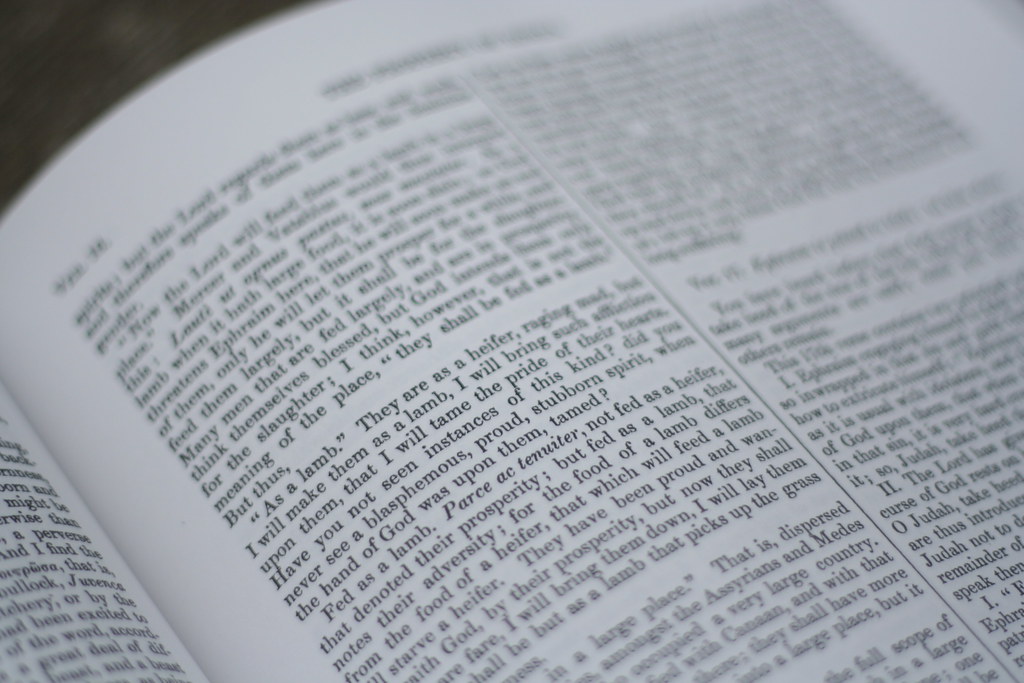
The Puritan Study (Part 1) The Delights and Pains of a Puritan Study

Part 1: The Delights and Pains of Puritan study

Here begins a several part study on building (and using) a Puritan library of your own. Of all the areas of my library, the Puritan section is the most useful.

The “Puritans” are a group of people I (very) loosely define as faithful Christians of the 16th and 17th centuries, as well as those who carried on the Puritan tradition into the 18th and 19th centuries. My definition includes John Bunyan and John Owen (true Puritans), Jonathan Edwards (post-Puritan), and Charles Spurgeon (who carried the Puritan tradition). Other names you may not be familiar with include Brooks, Boston, Burgess, Sibbes, Flavel, Reynolds, Ames, Manton, Rutherford, Newton and Clarkson. You will become more familiar with the names as we continue on.

This series is based upon two fundamental convictions.

First, the church today benefits most from leaders and preachers who are burdened to present expositional messages – sermons drawn from principles clearly demonstrated in scripture. The preacher is to “preach the Word” by taking every precaution in the name of accuracy and then exhorting and encouraging by earnest application.

Secondly, an efficient and workable library of the best Puritan literature is a great way to faithfully preach and apply scripture to the hearts of your hearers. The Puritans are no substitute for careful exegesis and use of contemporary commentaries. But once the foundational research is complete, the Puritans will open up new threads of understanding and application on your text. Pastors and congregations today truly need the Puritans.

J.I. Packer once wrote, “the great Puritan pastor-theologians – Owen, Baxter, Goodwin, Howe, Perkins, Sibbes, Brooks, Watson, Gurnall, Flavel, Bunyan, Manton, and others like them – were men of outstanding intellectual power, as well as spiritual insight. In them mental habits fostered by sober scholarship were linked with a flaming zeal for God and a minute acquaintance with the human heart. All their work displays this unique fusion of gifts and graces. In thought and outlook they were radically God-centered. Their appreciation of God’s sovereign majesty was profound, and their reverence in handling his written word was deep and constant. They were patient, thorough, and methodical in searching the Scriptures, and their grasp of the various threads and linkages in the web of revealed truth was firm and clear. They understood most richly the ways of God with men, the glory of Christ the Mediator, and the work of the Spirit in the believer and the church. And their knowledge was no mere theoretical orthodoxy…”

The delights of Puritans

I would not be writing this series if I were not personally acquainted with the great fruitfulness of Puritan study. The Puritans have matured my understanding of God, the Christian life, the idols of my heart, marriage and parenting. I have a deeper appreciation for the Cross, grace and the resurrection because of their words.

And here are a few other delightful benefits from the Puritans…

1. Cohesive biblical wisdom. As you can already see, the Puritans are an incredible source of biblical insight and application. They were skilled at seeing the big picture of the Christian life and then breaking that picture down into its various facets and details. Each sermon and every detail was presented in light of the big biblical themes and tied back to God Himself. What you will see in the coming weeks is that (as Packer would say) we “need” the Puritans. Even to this day there are no substitutes for their wisdom and perception in drawing us back to the big picture of God.

2. Well outlined sermons. Typical Puritan sermons provide the greatest help in my expositional research. These sermons are well outlined and very easy to navigate. Typically the whole purpose of the sermon is summarized in one nifty sentence towards the beginning of the sermon. And because these sermons are so well-organized, you can sift through them fairly quickly.

The pains of the Puritans

I won’t mislead you, there are a few pains involved in Puritan research.

1. Old words and Roman numerals. Four hundred year old literature comes with difficulties. There are words that are no longer in use today. And don’t think you can get along without memorizing Roman numerals. These are critical when you are researching Psalm lxxiii and verse 25. Be prepared to read a few sentences two or three times. Patience is important.

2. Puritan sermon style. There are some great Puritan commentaries. But for me, the most useful Puritan literature are the printed sermons (this series will focus specifically on these sermons). A typical Puritan sermon covers just one verse and rarely in the context of a broader book study. So here is the rub: The contemporary researcher (preaching through an entire book like Ephesians, for example) will need to collect and have a proper index to find Puritan literature on a given verse or topic. This is no small challenge and thankfully there are researchers who have given us great resources here (and some for free!). But if you can master this problem, and I will show you how, a library of Puritan sermons will come alive.

3. Errors. We must be on guard against the error of thinking that the Puritans were infallible. The Puritans had their errors. But this is the glory of old books. As C.S. Lewis once said, the errors in old books are easier to see than the errors in new books. Old errors are less deceptive, just as hindsight is 20/20.

For the delights and the pains, there are no substitutes for the Puritans. For every sermon I consult my trusted Puritan friends and grow from their wealth of wisdom and unparalleled seriousness with the bible. They will stretch you, challenge you and keep you accountable. But most importantly, they will cast a stern eye when you feel the pressure to compromise the biblical message.

——————

Next time… Part 2: The Rules of a Puritan Library

————————–

Click here to access all posts in the The Puritan Study series.

————————–

Book review: An Exposition of the Prophecy of Hosea by Jeremiah Burroughs (1892777940)

Hosea

Hosea was a prophet called to speak to the Northern Kingdom, and although the book is fairly short (14 chapters), Hosea’s ministry was not (more than 70 years). Israel’s Northern kingdom had grown both prosperous and idolatrous, and Hosea was called in to remind them of their unfaithfulness.

The prophecies of Hosea continue in relevance and importance today. Simultaneously, as a culture grows prosperous, the heart grows idolatrous – and quickly forgets about God and the eternal things to come.

Burroughs writes, “It is easy for a minister of God to deal plainly with people in the time of adversity, but when men are in their pride and jollity, to deal faithfully with them is very difficult. That their great prosperity raised up and hardened their hearts with pride against the prophet appears plainly” (5-6).

Jeremiah Burroughs (c. 1600-1646)

Recently, Reformation Heritage Books, Inc. reprinted Jeremiah Burroughs classic commentary: An Exposition of the Prophecy of Hosea. Burroughs remains one of the most popular Puritan writers because of his warm devotional heart, keen exegetical eye, and sensitive perception to the sinful human heart. And these skills mark every page of his commentary.

Here is just one example.

Early in the commentary, Burroughs displays tremendous humility at the prospect of interpreting Scripture,

“… to the interpretation of Scripture, a Scripture frame of heart is necessary, a heart holy and heavenly, suitable to the holiness and heavenliness which are in the word … And because the authority of Scripture is supreme, we desire the prayers of you all to God for us that his fear may fall upon our hearts, that seeing we are men full of error and evil, yet we may not bring any scripture to maintain any erroneous conceit of our own heads nor any evil of our own hearts: this we know to be a dreadful evil” (2).

How many commentaries begin with an author stating an awareness of the “errors” and “evils” of his own heart and their danger in interpretation?

The commentary

The commentary was originally published in 4 volumes and is now printed in one large 700-page paperback volume. The text is clean and easy to read.

Burroughs actually died before he finished writing the 13th chapter. Thomas Hall completed chapter 13 and another famous Puritan, Edward Reynolds, completed chapter 14.

Big-picture overviews and help in discerning the major movements of Hosea are not the strengths of this commentary (nor most Puritan commentaries for that matter).

This commentary is high in value because, (as in most Puritan commentaries) the authors are skilled at unpacking each and every verse with dozens of observations. At times I was lost in the sheer volume of application that poured from each and every verse. Burroughs exemplifies the Puritan conviction that every verse in the bible, “is profitable for doctrine, for reproof, for correction, for instruction in righteousness” (2 Tim. 3:16).

Hosea 6:6

“For I desired mercy, and not sacrifice; and the knowledge of God more than burnt offerings”

For Hosea 6:6, I give a few of Burrough’s observations as an example of what typifies this commentary.

Now, if you are used to blitzing through blog posts, I encourage you to stop. Just stop. You will need to print these excerpts to get the full effect. The Puritans are not conducive to speed reading. Take these in slowly:

Obs. 1. Carnal hearts which make little conscience of their duties, and are very cruel in their dealings towards men, yet may be contented to submit to instituted worship. This very scripture, ‘I will have mercy, and not sacrifice,’ is a secret rebuke to such people. … Because men may be exercised in instituted worship without any power of godliness, the outward act of performance is a very easy work to flesh and blood, there is little difficulty in it. Because it has the most show of the power of godliness; they seem to be as sincere as any in their worship, there is a great show in the flesh, in the outward man; whereas God’s worship is inward, soul worship, which carnal hearts cannot endure, nor do they desire it, it is outside worship which they prize.

Obs. 2. Carnal men think to satisfy their consciences by joining in outward ordinances. Thus did they in this place think to put off God and their own consciences, by living in the external acts of worship, while they continued in the love of known sin. What a deal of stir [provoking] had the prophet to convince these hypocrites of this their wickedness!

Obs. 4. The Lord has a high esteem of mercy; and it appears in this, that he will have it preferred before sacrifice, and this is called, a ‘sacrifice acceptable,’ and a sweet savor in God’s nostrils, Phil. 4:18. … O Christians! Imitate God in this, let your esteems of mercy be raised higher than ever before, from this that you have heard concerning its excellency. The works of mercy are glorious works, there is more in such than in those acts of religion which men think are more spiritual. I speak the more of this, because it is a scandal [testimony] which is laid upon godly men by the men of the world, that they are miserable and close-handed; now in this we should labor to convince the world by the practice of mercy.

Obs. 5. It is the Christian’s skill, when two duties come together, which to choose. This is a snare in which many Christians are caught and foiled; they think both must be done at the same time, whereas the one is the duty, the other not.

Obs. 6. Though the object of an action be spiritual, yet it is not a sufficient ground to prefer it before another action, whose object may be but natural. The ordinances of God have God for their object, and the enjoying of communion with him; yet in the performance of other actions which may be only natural, I may show more obedience to God than in offering up of sacrifice.

Obs. 7. If God’s own worship may be forborne in case of mercy, how much more men’s institutions and inventions!

Obs. 8. God will have mercy rather than disputing about sacrifices. Suppose there be a truth in that which is disputed about, yet God in this case will have mercy rather than sacrifice, rather than mercy shall be neglected he will have sacrifices omitted.

Obs. 9. Mercy must be preferred before our own wills and lusts. God is contented, that we may perform our duties to our brethren, to forbear his own ordinances; and shall we stand upon our wills and humors? O proud spirit, that exalteth thyself against the Lord; we must be content to deny ourselves very far for the public good, and for our brethren’s sake, since God is please to bear with men so far, as for a time to be without that honor, which he should have from men in their acknowledgment of him in public service.

Obs. 11. The duties of the first and second table are to be joined together. Mercy and sacrifice, knowledge of God and burnt-offerings, when in their place, are acceptable, therefore let us take heed of separating that which God has joined.

Obs. 12. The knowledge of God is a most excellent thing. This is that which sanctifies God’s name, and manifests him to be very glorious in the world. Paul accounted all things but loss and dung in comparison of the excellency of this knowledge of Christ. Instruct then your children and servants in this knowledge, else how can God have his glory from them? How few are there which glorify God as God! And the reason is, because of the ignorance which is in their minds, Eph. 4:18.

Obs. 13. Men may be very diligent in instituted worship, and yet very ignorant. None so acted in their instituted worship as these people, yet none so ignorant as they.

Obs. 14. Soul-worship must be preferred before all other worship. We must not give God a carrion service, a carcass without a soul.

All of these comments come from just 2 pages in the commentary! Multiply this times 350 and you see that this blog post is only a handful of application that originates from a mountain of truth. Spurgeon was right when he said this commentary is “A vast treasure-house of experimental exposition.”

Reformation Heritage Books has served expositors well in their commitment to reprinting a priceless commentary on Hosea that will certainly spur preachers on to put major significance on one minor prophet.


————–

Commentaries > OT > Minor Prophets > Hosea

————–

An Exposition of the Prophecy of Hosea, Jeremiah Burroughs, 9781892777942 , 1892777940, oversized paperback, 700 pages, Bible translation: KJV, $50.00/$38.00

Keeping your quotes in order

Frequently pastors ask me to explain my method of indexing quotes. You are looking at it, really.

1. Value blogs

One of the primary reasons for launching this blog was to allow myself enough categories to track quotes easily and to have the freedom of classifying quotes into multiple categories. You, too, may find it helpful to start your own blog simply for the purpose of keeping quotes in order.

But here are a few more suggestions to keeping your library well-indexed…

2. Value commentaries

I intentionally avoid a lot of “contemporary issues” books. There are thousands of books out there on the newest controversies, debates and methods. While these can be helpful, they can also be an overwhelming time-consumer and impossible to adequately index for a busy pastor. Start to collect a few hundred of these books and it becomes easy to forget what issues you have already covered.

So my goal has always been to spend more money on commentaries than on topical books. As an expositor, this has proven very helpful over the years. If you do not index well or don’t have the time, buy the very best commentaries you can. They need no indexing (and will hold their value better over time).

[Speaking of excellent commentaries, tomorrow we will look at Jeremiah Burroughs’ commentary on Hosea, recently re-printed by Reformation Heritage Books.]

3. Value a book with a good index

If you must, look for topical books with scriptural and subject indexes in the back. Someone has done the indexing for you.

4. Value an organized library

Be certain to group your topical books that cover the same issue. It may be nice to categorize your library by author, but it’s not practical. A few weeks ago I posted my library database here so you can see how I grouped my topical books (click here for the .pdf).

5. Value a database

Another useful tool is assembling a simple Excel database for quotes. Here is a .pdf version of my very small but growing index.

Hopefully these simple suggestions will help maximize your study time and feed your flocks more efficiently.

Book review: The Banner of Truth Magazine: Issues 1-16 (0851519199)

Iain Murray was just 24 years old when he began publishing a little magazine titled The Banner of Truth. The purpose of the magazine was to confront contemporary weakness in the church (loose doctrine, lazy preaching and pragmatic evangelism) and allow the Puritans and Reformers to speak to the issues.

In Sept. 1955 the first issue was released because “There are many today who regard truth and error as matters of small consequence; if a man lives rightly, they say, it matters not much what his beliefs and opinions are” (3).

Admittedly, some of the language in these early magazines is too sharp and the labels are sometimes too general. Fifty years after the first magazine, Murray admits regret on both counts. “When the magazine began I was only twenty-four years old, and it is doubtful if that is the age when one should attempt to be a reformer. Youth is ever possessed with more confidence than wisdom” (xiv). I think many of us can personally relate. Murray humbly presents these issues unedited.

The first 16 issues consist of 90 brief editorials, commentary excerpts and biographies. Subject matters range from a defense of the doctrines of Calvinism to evangelism, revival and family issues. Most of the book, and especially the first six issues, are largely given to defending a biblically accurate soteriology. But the seventh issue shifts to matters of the home and family, and from then many of the issues feature topics on growth in godliness.

In all, there is a good balance of doctrine and devotion covering a wide variety of issues and drawing from several writers of past centuries. Because of its diversity, the lack of subject index will make the volume a bit difficult to reference.

This collection of magazines has historical significance, too, as it traces the early desires of Murray to reprint the Puritan/Reformed thought to a new generation. We take for granted the wealth of Puritan reprints from the Banner of Truth Trust, but their books would not be printed until the magazine’s ninth issue. It is interesting to read Murray’s anticipation for Puritan and Reformed reprints for his generation.

I found this volume especially valuable because of the short biographical sketches on Martin Luther, Howell Harris, Robert Murray M’Cheyne, John Elias, John Knox, George Whitefield, Jonathan Edwards, Charles Hodge, A.W. Pink, Thomas Charles, Thomas Cranmer, John Angell James and Brownlow North. Murray’s lively biographical writing raises the leaders of former generations from history books and walks them into the contemporary age.

Over the past 50 years, Iain Murray has been a reformer, re-focusing the church upon the authority of Scripture, the biblical accuracy of Calvinism and the reliance upon the sovereignty of God in evangelism. Failures on these central topics have always been (and will ever be) dangers for the church. Murray reminds us not to forget the many faithful men who have gone before us in previous generations and to follow in their footsteps. This collection clarifies the message of the church, motivates faithfulness for pastors and points back to the legacies we now continue.

——————————–

Where this volume fits in my library (in ranking order):

Soteriology > Calvinism > explained and defended
Biography > Giants of the Faith
Ecclesiology > Dangers to the Church
Church History > Reformation
Christian family > Advice & Instruction

———————————

The Banner of Truth Magazine: Issues 1-16, Iain Murray, 0851519199, 9780851519197, 516 pages, clothbound, no index

New books

A number of new books have been printed that will make excellent additions to the preacher’s library. I’ll be passing along book reviews at The Shepherd’s Scrapbook in the next few weeks.

Tomorrow I’ll be reviewing the first volume of collected magazines published by The Banner of Truth. The early BoT magazines were an interesting diversity of themes, quotes, commentaries and biographies that I think many pastors will find useful.

In America, Reformation Heritage Books has recently reprinted Jeremiah Burroughs’ great commentary on Hosea and a must-read on sanctification titled, The Path of True Godliness, written by a Dutch Puritan. Plus there is a new children’s book that explains the substitutionary atonement very clearly for little hearts.

RHB has also released a new Octavius Winslow book, The Fullness of Christ, that looks very good (and I’m told it’s one of OW’s best).

Tentmaker Publications in the UK is printing The Works of Thomas Boston (12 volumes). I think Boston is one of the most important Puritans for the preacher today. These volumes are very well indexed and that makes them very useful in sermon prep.

And not to be outdone, P&R has recently released some excellent commentaries and we will look at a few P&R classics, too.

These and other books will be reviewed here in the coming weeks.

See you tomorrow….

-Tony

Tony’s Book Club pick #2: The Precious Things of God by Octavius Winslow (1877611611, book review)

Naturally, the most precious things to our hearts are not the most precious things to God. This distinction is what we commonly label ‘sin.’ Our hearts treasure the temporary, the cheap and the sinful. God treasures the eternal, the priceless and the holy. The Christian life is a path of aligning our affections with the precious things God treasures.

This brings me to both my favorite book and favorite author (apart from the bible): Octavius Winslow. I have yet to read a book by Winslow that has not pushed me closer to the heart of God. As for devotion and edification, no author rivals Winslow.

Octavius Winslow was a good friend of Spurgeon and it’s no secret why. Winslow is devotional, passionate and concrete. The Precious Things of God covers such a wide panorama of the Christian life that every Christian reader will be ministered to and the preacher will find in this one book a quote to fit almost any sermon on any topic.

Winslow writes with power because, like the Puritan legacy he follows, a simple understanding of the truths of God’s Word is insufficient. Like the hammer on the head of a nail, the experience of the truth drives itself into a permanent place in our lives.

In the preface Winslow writes, “We really know as much of the gospel of Christ, and of the Christ of the gospel, as by the power of the Holy Ghost we have the experience of it in our souls. All other acquaintance with Divine truth must be regarded as merely intellectual, theoretical, speculative, and of little worth” (p. iv).

Winslow’s goal (by God’s grace) is to give the readers an experience of God’s Word, and that is the motive behind this and his other works.

I have noticed that many well-meaning devotional works tend towards the abstract and vague. Winslow’s language remains concrete throughout. For example, take this excerpt about the crucifixion event:

“In that vital stream He [the Father] saw the life, the spiritual and eternal life, of His people. His everlasting love had found a fit and appropriate channel through which it could flow to the vilest sinner. Divine mercy, in her mission to our fallen planet, approached the Cross of Calvary, paused – gazed – and adored. Then dipping her wings in the crimson stream, pursued her flight through the world, proclaiming, in music such as angels had never heard, ‘Glory to God in the highest, and on earth peace and good will to men!’” (p. 169).

And the following quote recently came alive to me personally. Just two weeks ago, my 51-year-old neighbor Greg was driving home from work on his motorcycle when he did not see a drunk man pulling out onto a busy street. Greg slammed into the back of the vehicle and died from his injuries shortly thereafter. My heart broke when I heard that in the hour following the accident, his family was frantically trying to find a priest to come and give the last rites. Greg was dead before a priest arrived.

I’ve since been haunted by the scene of my neighbor on the pavement as his life was leaving his body. What was he thinking of? What was he hoping in?

A Winslow’s quote continues to come to mind when I consider this dreadful scene:

“All of earth’s attraction ceases, all of our creature-succor fails. Everything is failing – heart and strength failing – mental power failing – medical skill failing – human affection and sympathy failing; the film of death is on the eye, and the invisible realities of the spirit-world are unveiling to the mental view. Bending over you, the loved one who has accompanied you to the margin of the cold river, asks for a sign. You are too weak to conceive a thought, too low to breathe a word, too absorbed to bestow a responsive glance. You cannot now aver [verify] your faith in an elaborate creed, and you have no profound experience, or ecstatic emotions, or heavenly visions to describe. One brief, but all-emphatic, all-expressive sentence embodies the amount of all that you know, and believe, and feel; it is the profession of your faith, the sum of your experience, the ground of your hope – ‘Christ is precious to my soul!’ Enough! The dying Christian can give, and the inquiring friend can wish no more” (pp. 31-32).

Winslow’s book will help our lives end with those simple and profoundly supernatural words – Christ is precious to my soul!

—————–

The Precious Things of God is available on-line from a number of sources but I recommend the Soli Deo Gloria printed volume. It’s dark blue cloth binding is wonderful and fitting such a precious volume. (Update: the book is now officially out-of-print. I cannot tell you how affirming it is when you tell people it’s the best book you have read and the publisher stops printing it at the very same time =) Second-guessing my sanity, anyone?).

—————–

– Read The Precious Things of God online for free here.

– My friend Joe at StillTruth recently converted several Winslow books into Libronix format for Logos Bible software. A great free resource!

—————–

The Precious Things of God, Octavius Winslow, Soli Deo Gloria Publications, 1860/1994, 424 pages, 1877611611. (Out of print).