The Imitation of Christ

“Always, when the Scriptures exhort the believer to be as Christ, they point to the act of his love in the atonement for sin. This may seem strange since this act is his alone and we can and may recognize him as Mediator in this act alone, but the fact remains that the entire New Testament is in agreement on this point. This required conformity to an exclusive act of love would be a contradictory demand if it were a conformity to a law illustrated in the life of Christ: but it is possible nonetheless, and makes good sense, when it presupposes and flows from the Atonement. … The imitation of Christ could never be part of the Good News, or the Evangel of Grace, were it a Via Dolorosa whose goal was God’s grace; but because it receives its impetus from the revelation of God’s antecedent grace, a grace unapplied for and unsolicited, therefore it is a wonderfully enriching evangelical truth.”

—G. C. Berkouwer, Faith and Sanctification (Eerdmans, 1952), pages 149–150.
Good News, Doubled

Jesus died on the cross to atone for the guilt of our sin before a holy God. This is amazingly good news. But the cross of Christ also liberates us from our enslavement to sin’s power. Peter captures this when he writes, “He himself bore our sins in his body on the tree, that we might die to sin and live to righteousness” (1 Peter 2:24).

On one hand we rejoice in our legal justification before God. On the other hand we rejoice that we have been liberated from the tyranny of sin, liberated to obey, liberated to pursue godliness, liberated to holiness. This is good news. Or is it?

In a 1994 sermon, John Piper asked:

Does this feel like good news to you? Or does it feel like the good news of the cross is being given with one hand and taken away with the other. Does it feel like good news that the message of the cross on the one hand is a lifting of guilt and on the other hand is a laying on of burden? …

There are many people today who feel the first work of the cross as liberating good news and who feel the second as burdensome bad news. For them, the grace of the cross is one thing: liberation from guilt and shame. And when they hear that the grace of the cross is not just liberation from the guilt of sin, but is also liberation from the power of sin, it doesn’t feel as good. …

Yet, he writes,

the design of the cross to liberate from the enslaving power of sin as well as the guilt of sin does not diminish the good news; it doubles it.

Plugged In

Another gem from the writings of Dr. J.I. Packer. This one is from his book Growing in Christ (Crossway, 1996), page 120:

God’s eternal Son became Jesus the Christ by incarnation; to put away our sins he tasted death by crucifixion; he resumed bodily life for all eternity by resurrection; and he reentered heaven’s glory by ascension. This is the Christ-event. It is truly historical, for it happened in Palestine 2,000 years ago. Equally true, however, it is trans-historical, in the sense of not being bounded by space and time as other events are: it can touch and involve in itself any person at any time anywhere. Faith in Jesus occasions that involving touch, so that in terms of rock-bottom reality every believer has actually died and risen, and now lives and reigns, with Jesus and through Jesus. This is the new creation aspect of our link with Jesus. …. The way to express it is that in the Jesus to whom we go in faith the power of the whole Christ-event resides, and that in saving us he not only sets us right with God, but also, so to speak, plugs us in to his own dying, rising, and reigning. Thus we live in joyful fellowship with him, knowing ourselves justified by faith through his death, and finding therewith freedom from sin’s tyranny and foretastes of heaven on earth through the transforming power within us that his dying and rising exerts. This is an over-short statement of an overwhelming truth.

The magnitude of Christ’s work is mind-numbing. And the thought that I am now “plugged in” to his completed work causes me to marvel at God’s grace!

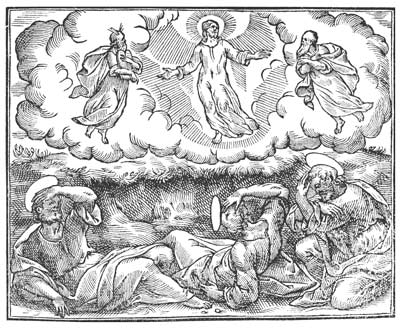
Mt Sinai + Mt Transfiguration

I find it interesting how Mark’s version of the Mount of Transfiguration echoes the Mount Sinai episode in the Old Testament. At least seven parallels surface:

  • The most obvious is that Moses is present at both Mount Sinai and the Mount of Transfiguration (Ex, Mark 9:4)
  • Both accounts take place on a high mountain (Ex 24:12–15, Mark 9:2)
  • In both cases a cloud covers the mountain (Ex 24:15–16, Mark 9:7)
  • A six-day interval leads up to the climactic events (Ex 24:16, Mark 9:2)
  • In both cases God speaks from the mountain on the seventh day (Ex 24:16, Mark 9:2,7)
  • At Mt Sinai, Moses’ face shines (Ex 34:29–35); at Mt Transfiguration, Jesus’ clothes shine (Mark 9:3)
  • The fear of the people in seeing Moses is paralleled by the fear of the disciples (Ex 34:30, Mark 9:6).

And another interesting connection links Moses and Jesus together in the Transfiguration. In the OT Moses says to look forward to a coming prophet—a new prophet—and when he comes, listen to him. Compare this to God’s words at the Mount of Transfiguration:

  • Moses: “The LORD your God will raise up for you a prophet like me from among you, from your brothers—it is to him you shall listen” (Deut 18:15).
  • God: “This is my beloved Son; listen to him” (Mark 9:7).

Exactly what Mark intended us to understand through this parallelism is not immediately clear. But it does seem to indicate two things:

  1. As God delivered revelation through Moses at Sinai, so now Jesus is a new revelation of God. Everyone should be listening.
  2. Jesus’ redemptive work is the outworking of an ancient redemptive lineage. After his transfiguration, Jesus turns his thoughts and his words to his approaching death and resurrection (see Mark 9:10-11, 31). This work is firmly rooted in the OT promises.

William Lane, in his commentary on Mark (NICNT), summarizes the data well when he concludes:

When the cloud lifted, Moses and Elijah had vanished. Jesus alone remained as the sole bearer of God’s new revelation to be disclosed in the cross and resurrection. Moses and Elijah had also followed the path of obedience, but having borne witness to Jesus’ character and mission, they can help him no more. The way to the cross demanded the submission of the Son and Jesus must set out upon it alone.