Book Review: The Complete Works of Thomas Boston (12 volumes)

Book Review

The Complete Works of Thomas Boston (12 volumes)

[note: The following review compliments The Puritan Study, a series on incorporating Puritan literature into expositional preaching.]

Thomas Boston (1676-1732) is not only one of my favorite Puritan authors, but has also proven himself to be one of the most important and useful Puritans in my expositional research.

Known for his excellent books like “The Crook in the Lot” and “The Art of Man-Fishing,” his works are both excellent examples of Boston’s deep understanding of the Christian life and his firm commitment to obedience to Scripture.

As a preacher I love Boston for both his depth and breadth. Depth, in his ability to apply texts so personally and powerfully to his hearers. Breadth, in the fact that he preached on almost every biblical theme. It seems every time I flip through Martin’s topical index (A Guide to the Puritans) I discover Boston preached a sermon on my current topic. Preachers will find Boston’s breadth and depth to be very useful for every sermon, no matter the sermon topic or text.

Incredible sensitivity towards applying the scriptures to his hearers, and tremendous balance and diversity of content make Boston an often-used resource in my expositional research. But what I also find impressive about Boston was his pastoral work in Ettrick, which, prior to his arrival, was an unstable and worldly town. As Dr. Joel Beeke writes in the introduction, “When Boston arrived in Ettrick, the town had less than 400 people. The roads were nearly impassable. The parsonage was dilapidated. Church services were irregular. When a service was held, the people often talked throughout it. Spiritual barrenness, pride, deceit, swearing, and fornication abounded” (p. I-5). What happened over the next 25 years was the result of Spirit-blessed preaching now preserved for us in these volumes.

Contents

The works of Thomas Boston (published by Tentmaker) include 7,400 pages of books, sermons and his own memoirs.

Volumes one and two comprise “An Illustration of the Doctrines of the Christian Religion” organized by the Shorter Catechism. These volumes are affectionate and deeply applicable on the main subjects like the authority of scripture, the trinity, creation, Christ, sin, justification, the Ten Commandments, self-examination, prayer, an experimental knowledge of Chirst, etc. These volumes are a treat to those of us who have seen systematic theology lacking experimental warmth and deep application. Boston abhors the thought.

Volume three is a collection of 37 sermons and two books: “The Crook in the Lot” and “The Unity of the Body of Christ.” Volume four includes 40 sermons and the book “The Distinguishing Characters of Real Christians.” Volume five includes books on discerning genuine believers from the false and “The Art of Man-fishing.” Volume six includes 16 sermons and a number of Q&As on various topics. Volume seven includes nine sermons and more theology similar to volume one and two, including discourses on “The Evil and Danger of Schism” (on 1 Cor. 1:10), “The Necessity and Foundations of a Throne of Grace for the Behoof of Poor Sinners, Pointed out and Illustrated” (on Psalm 89:14). Volume eight includes “Man’s Fourfold State” on the state of innocence, the state of nature (or sinfulness), the state of grace and the eternal state. Volume nine and ten are comprised of 88 sermons. Volume eleven includes diverse material on the covenant of grace and prayer. And the final volume comprises Boston’s excellent “Memoirs” where you can read more about his 25- year pastorate at Ettrick.

Example

One of my favorite sections of Boston is a little book titled, “A Soliloquy on the Art of Man-Fishing” in volume five. It is a great reminder of the duty and pleasures of the work of evangelism. At times through this short book I have been lost in his language. Here is one section I especially enjoyed:

“I find in my heart a flame of desires, Matt. 5:6. [1] After the righteousness of Christ. My soul earnestly desires to be stripped naked of my own righteousness, which is as rags, and to be clothed and adorned with the robe of his righteousness. This wedding garment my soul affects; so shall I be found without spot, when the Master of the feast comes in to see the guests. My soul is satisfied, and acquiesces in justification by an imputed righteousness, though, alas! My base heart would fain have a home-spun garment of its own sometimes. [2] After communion with him, Ps. 42:1. When I want it, my soul though sometimes careless, yet, at other times, cries out, O that I knew where I might find him! I have found much sweetness, in communion with God, especially at the sacrament of the Lord’s supper, in prayer and meditation, hearing the word, faithfully and seriously preached, and in preaching it myself, when the candle of the Lord shines on my tabernacle; then was it a sweet exercise to my soul. I endeavor to keep it up when I have it, by watching over my heart, and sending up prayers to God. When I want it, I cry to him for it, though, alas! I have been a long time very careless. Sometimes my soul longs for the day, when my minority [earthly life] shall be over-past, and I be entered heir to the inheritance incorruptible, undefiled, and that fadeth not away; to be quit of this evil world; to be dissolved, and to be with Christ, which is best of all; especially at three times. (1.) When I get more than ordinarily near God, when my soul is satisfied as with marrow and fat, when my heart is nobilitated, and tramples on the world. (2.) When I am wrestling and groaning under the body of sin and death, the evil heart: then fain would I be there, where Satan cannot tempt, and sin cannot enter; yea, when I have been much forsaken, at least as to comfort … (3.) When I preach, and see that the gospel hath not success, but people are unconcerned, and go on in their abominations” (5:17).

Boston opens his soul to answer the question: At what time is my heart aflame? It comes, he writes, as a result of my deep love for the imputed righteousness from Jesus. It comes when I have enjoyed the presence of God in a special season. And later, my heart is aflame for God’s presence in heaven when I am reminded of my own sin and weaknesses and long for eternity.

For Boston, knowing and preaching the truth alone are insufficient. He wants to see the effects of the Spirit at work as confirmation of his work. This expectation that the Word of God will become reality in the world is the experiential mark on all of Thomas Boston’s sermons and books.

For the expositor of God’s Word, these volumes (and especially the many sermons) make this set a priceless gem. Boston is a Puritan friend who is exegetically faithful and sensitive of the human heart. His depth and breadth make him one of the very few writers that will help you prepare any sermon on any text for any audience.

Binding: clothbound (maroon)
Volumes: 12
Pages: 7,400
Dust jackets: Yes
Binding: Smyth sewn
Paper: oversized and heavy weight
Text: facsimile printing of 1853 version (William Tegg & Co. of London)
Topical Index: yes (end of vol. 11)
Textual index: no
Biography: yes (“Memoirs” in vol. 12)
Publisher: Tentmaker (United Kingdom)
Price USD: $325.00 at RHB; $250.00 at TPB; $250.00 at Amazon
Want more information? An excellent introduction to Thomas Boston and his writing will be found in Christian Focus’ recent re-publication of “The Art of Manfishing.” J.I. Packer’s short introduction at the beginning of this book is beneficial. An extended biography and bibliography is included in Beeke’s new book “Meet the Puritans,” available by Christmas from Reformation Heritage Books.


The Puritan Study (Part 9) The Strategy of Building a Puritan Study

Part 9: The Strategy of Building a Puritan Library

I assume many of you are like me, lacking access to a solid library of Puritan literature. Here in my hometown we have no seminary and it is rare to find a fellow believer who has even heard of Spurgeon, not to mention Boston, Manton and Goodwin.

So building a Puritan library was my responsibility. I just started buying Puritans that I had indexes for and especially the Puritans published by The Banner of Truth. I learned from both my successes and mistakes.

The Strategy

First, I assume you already spend a fair amount of money on books right now. If you are like me, you probably look around your library with regret at some of the volumes that serve no purpose in your expositional research. For years, my library suffered from a clear game plan.

A poorly planned library will lack important reference books like commentaries and Puritan sermons. It will be heavy on contemporary controversies and issues books. Read blogs if you want to be up-to-date on the current trends in the church. Buy commentaries and Puritans if you want a solid expositional library.

A solid library that helps support the preacher or writer in their expositional work is no accident.

This post will help you define your own personal game plan.

Bottom line

The Puritan Study I have described in this series comes to a grand total of $1,500.00. That sounds like a lot but it figures out to $1.40 a day for 3 years (which is about what I spend at Starbucks). And to have this entire library in three years is pretty fast!

I’ve broken down my list of Puritans into $500 segments. Again, this list is ordered by availability and usefulness of each author. Your first $500 will be the best-spent money. The second and third $500 increments are important but not immediate.

(Note: What follows is a simple strategy for building a Puritan library. Specific reviews of each author and set will follow the Puritan Study series. Pictures of each set can be seen here. Updated (3/17/07): Note that most of these resources can be found at a more reasonable price through Monergism Books. Please check them before making any purchases.)

Here is my strategy, broken into three phases…

// THE FIRST $500

1. Charles Haddon Spurgeon (63 sermon vols.; CD-Rom)

I cannot begin with any more important preacher than Charles (C.H.) Spurgeon. The Puritans thoroughly impact everything Spurgeon preached or wrote. Look at his commentary on the Psalms (The Treasury of David) and you will see why Spurgeon is a priceless Puritan resource. He is the great Puritan synthesizer. Spurgeon’s complete works total about 150 volumes and you can download them all for $15.00 or buy the CD-Rom for $20.00 from Ages software. (If you have extra money, I would recommend buying some printed volumes from Pilgrim Publications but especially his autobiography and the classic book on pastoral ministry, Lectures to My Students.) [Read Piper’s biography of Spurgeon here]

2. Jonathan Edwards (2 vol. works; printed)

An extraordinarily rich resource! These two volumes of works by Jonathan Edwards are gems to the Puritan researcher. I would recommend the Banner of Truth volumes for their sturdy binding. You can buy volumes one and two here in the Banner of Truth editions or a cheaper version. The complementary text files can be found online for free. [Read Piper’s biography of Edwards here]

3. John Bunyan (3 vol. works; printed)

John Bunyan is most famous for his novel, The Pilgrim’s Progress. But he was also an incredibly gifted (and imaginative) preacher. These three clothbound volumes from the Banner of Truth are well built and come with an excellent topical index. You can find them for about $89.00. All of the associated text files can be found online for free. [Read Piper’s biography of Bunyan here]

4. Thomas Boston (12 vol. works; printed)

Jonathan Edwards considered Thomas Boston, “a truly great divine.” Boston is one of my personal favorites. These precious volumes have provided me many years of sermon quotes and exegetical thoughts on God’s Word. The entire 12-volume set has been recently published by Tentmaker in a beautiful cloth binding and is available in the United States for $325.00 here or $250.00 here. Worth every penny! You can buy the incredible Memoirs alone. [Read our full review of this set here]

5. Thomas Manton (22 vol. works; CD-Rom)

A set that is simply too large to make affordable in print format. The CD-Rom of Manton’s complete 22-volume set can be purchased for only $10.00. A great price for a must-have set of works! The first three volumes are avaliable in print.

// THE SECOND $500

6. John Owen (16 vol. but especially vols. 1,2 and 6; printed)

All of John Owen’s 16-volumes works are excellent. I especially have found volumes one, two, six and seven of great use. You can add other volumes in the future but these three are essential. The volumes are clothbound (as you would expect from the Banner of Truth) and run about $25.00 each or $75.00 total. The text files are available online for free but you will want to read these volumes cover-to-cover, making the printed works a must. [Read Piper’s biography of Owen here]

7. John Flavel (6 vol. works; printed)

Another excellent Puritan I have used on several occasions. Your meditations and sermons will be greatly blessed by Flavel. The Banner of Truth volumes are clothbound and beautiful. They sell for $150.00.

8. Richard Sibbes (7 vol. works; printed)

The “sweet dropper,” Sibbes was an incredible Puritan preacher. The Banner of Truth volumes are clothbound and run $126.00.

9. Jeremiah Burroughs (misc. books; printed)

Burroughs is the most difficult author on the list because his works are not collected and published by various companies. Several of his works comprise the Gospel Life series ($91.00). The six titles include Gospel Worship, Gospel Fear, Gospel Conversation, Gospel Revelation, Gospel Remission, and Gospel Reconciliation. Beyond this there are other Burroughs titles in print including The Sinfulness of Sin or The Evil of Evil ($17.00), The Excellency of a Gracious Spirit, Hope ($15.00), Irenicum to the Lovers of Truth and Peace ($22.00), The Rare Jewel of Christian Contentment ($6.25), The Saints’ Happiness, The Saints’ Treasury and A Treatise of Earthly-Mindedness. All told, it would be easy to spend $180.00 on Burroughs alone. Still, his works are indexed and very valuable.

10. Thomas Brooks (6 vol. works; printed)

The Complete Works of Thomas Brooks in six volumes is available in cloth binding from Banner of Truth for $140.00. One Puritan scholar says of Brooks, “He had a body of divinity in his head and the power of it in his heart.” Incredible material!

// THE THIRD $500

11. Thomas Goodwin (12 vol. works; printed)

Reformation Heritage Books has recently reprinted the paperback version of Goodwin’s 12 volume works. This is a great service to the Puritan community and can be purchased for $240.00. I have yet to read a Puritan that glorifies the person and works of Christ more than Goodwin. [read our full review here]

12. John Newton (6 vol. works; printed)

“Amazing grace, how sweet the sound, that saved a wretch like me” are the words of John Newton. An excellent preacher, his complete works are available in cloth binding for $144.00. [Read Piper’s biography of Newton here]

13. David Clarkson (3 vol. works; printed)

Not as experiential as the authors above, but well indexed and valuable. The works of David Clarkson are available for $62.00.

14. Edward Reynolds (vols. 1,4,5,6 of 6 vol. works; printed)

Like Burroughs, the complete works of Reynolds are not available. Today there are five volumes in print: Commentary on Ecclesiastes, Meditations on the Holy Sacrament of the Lord’s Last Supper, Preaching Christ, Sinfulness Of Sin and Treatise on the Passions and Faculties of the Soul. All these valuable volumes can be purchased for about $115.00. Spurgeon wrote, “Reynolds was a man of vast learning and thoroughly evangelical spirit.” The digital files are beginning to appear on Google books for free download.

Conclusion

By this point you may feel totally overwhelmed (and broke). Remember, this is a long-term goal.

I don’t even think it would be beneficial to buy all these works at once! Slowly add works as you grow comfortable with the ones you already have.

If you follow this plan you will spend your money wisely and have a storehouse of expositional material at arm’s-reach. This is my promise to you: Even if the Lord blesses you with 30 more years of expositional ministry, you will never exhaust the Puritan Study you built in three years.

————–
Next time … Part 10: Concluding Thoughts, part 1
—————

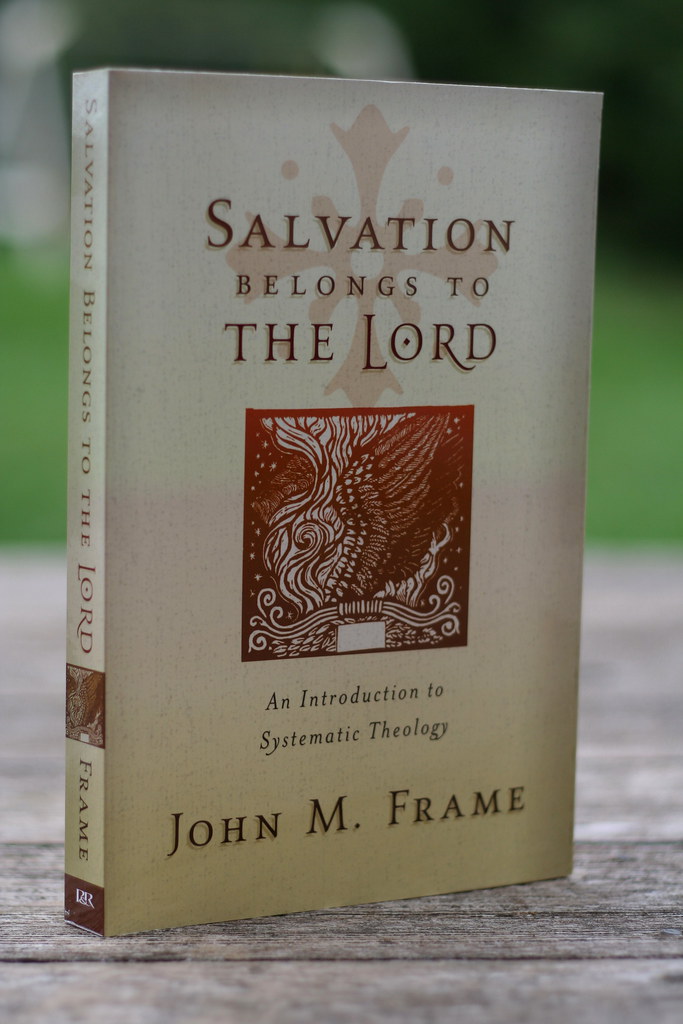
Book review: Salvation belongs to the Lord by John M. Frame (1596380187)

Book review:

Salvation belongs to the Lord by John M. Frame

God is in sovereign control. He has the right to tell people what to do and what not to do. He is powerful, wonderful, holy and awesome (in the true sense of the word). This big-God matrix frames everything else in John Frame’s new systematic theology, Salvation Belongs to the Lord.

Written in a warm, conversational, and engaging style for readers, Frame explains the main subjects of systematic theology. It is a great book for beginners, though the content is consistent with seminary level courses.

The content is very similar to Wayne Grudem’s, Systematic Theology. Frame considers Grudem “The best one-volume systematic theology written in recent years” (p. 351), and quotes him in many areas. The two however, do not agree on all things. Frame writes from a cessational perspective and Grudem from the charismatic.

The book is divided into two halves: (1) objective and unrepeated and (2) the subjective and the repeated. For example, the division is between the incarnation of Christ (unrepeated in history) and regeneration (repeated over and over in history with each believer).

I especially enjoyed the section on the church. He argues for a plurality of elders in each church, and his section on church discipline is very clear and helpful. Frame explains not only how to do church discipline, but why church discipline is important. He writes,

“There are at least three purposes of discipline. The first is to restore a sinning believer (Matt. 18:15; 1 Cor. 5:5; Gal. 6:1; 1 Tim. 1:20; James 5:20) … church discipline is not a cruel thing but a loving thing. Second, discipline exists to deter such sins by others, to instruct the congregation as to what is and is not acceptable (Heb. 12:15; 1 Cor. 5:2, 6-7; 1 Tim. 5:20). Third, discipline exists to protect the honor of Christ and his church (Rom. 2:24; 1 Cor. 6:6; Eph. 5:27). When churches ignore sin, the world despises them and the reputation of Jesus Christ himself is dragged through the mud” (p. 243).

This excerpt reveals the biblical depth, firm convictions, and pastoral concern of Frame in engaging and contemporary words. The entire book is marked with these characteristics.

The book is solidly reformed, quotes frequently from the Westminster Confessions, and uses the ESV translation. Frame is not shy about rebuffing falsehoods like Roman Catholic ‘justification’ and annihilationalism. He argues for padobaptism and sides with Postmillinialists. Frame displays a full awareness of the distinctions between errors that undercut the central tenants of biblical Christianity (justification) from secondary issues (like spiritual gifts and eschatology). He is strong and resolute on the first, and open and fair on the second.

John Frame has given us a wonderful gift. Such a high view of God’s holiness and Lordship; such a reminder of God’s presence with us; such an enjoyable read! I heartily recommend John Frame’s Salvation Belongs to the Lord.

Binding: Paperback
Pages: 383
Topical Index: yes (excellent)
Textual index: yes (excellent)
Bibliography: yes (excellent)
Photos: 0
Charts: 1
Reading level: Adult / moderate
Publisher: P&R
Price: $24.99
Where this book fits into my library:
(1) Systematic Theology > General

Salvation belongs to the Lord, John M. Frame, 978-1-59638-018-9, 9781596380189, 1596380187, 1-59638-018-7

Book Announcement: Meet the Puritans

Book Announcement: Meet the Puritans

Puritan Reformed Theological Seminary in Grand Rapids, Michigan continues to set itself apart as a superior place to study Puritan literature. The seminary itself houses the Puritan Resource Center, one of the world’s largest collections of seventeenth and eighteenth century antiquarian volumes written by Puritans.

But the people of PRTS are completing another project that is certain to further distinguish the school as the premier facility for Puritan research.

PRTS President Joel R. Beeke and author Randall J. Pederson are putting the final touches on a new book project titled, Meet the Puritans. The book includes short biographies and a bibliography of over 140 Puritan authors! The hefty, 950-page book will serve pastors who want short introductions to Puritan authors, short summaries of each Puritan work and information about when those works were last printed.

This excellent resource should be available before Christmas from Reformation Heritage Books. (Hint, hint, if my wife is reading this.)

The Puritan Study (Part 8) To Quote or not to Quote?

Part 8: To Quote or not to Quote?

“The great Puritan preacher Jeremiah Burroughs once said of this passage …”

If you think this is the only way (or the best way) to integrate the Puritans into your sermon, this post is for you.

That was me a few years ago. I was introduced to the Puritans and fell in love, going bonkers quoting this Puritan and that Puritan. My listeners, (unfortunate college students), were forced to endure 150-word quotes by John Owen. I’m certain as soon as I said “In the words of one Puritan…” they began thinking about their homework or dinner or (living off 3 hours of sleep each night) simply blacked out.

In this post we answer the questions regarding the best use of the Puritan quotations.

Authority

First, it must be stated that there is both a good way and a very poor way to use the Puritans.

The poor way is to force a Puritan thought or quote on a text that does not complement the clear meaning of the biblical text. The quote may be good and it may be biblical, but if it does not fit with the text it appears the preacher is forcing another authority upon the text for his own end. Your hearers know when you are not being straight with them, and they will dismiss you and your quote.

The best use of the Puritans (or any other source for that matter) is to reinforce the plain meaning of a text. We should let the text stand on its own and bring in quotations and thoughts that drive the thought home. Another way to say this: The text of scripture should authenticate the Puritan quote, not the other way around.

For example, let the biblical text teach on the importance of God’s perfect holiness. Let John Owen then come along and instruct the Christian to find their delight and affection in that perfect holiness of God.

I can say after several years of preaching experience, no source will better help you reinforce the plain meaning of scripture than the Puritans. They cherish what God cherishes, delight in what God delights, and hate what He hates. If ever there were people suited for complementing the text of scripture, the Puritans are it.

Narrow the quotes

After studying our printed Puritans, e-Puritans, and online Puritan sources, we have a mountain of material that may fit our sermon. What do we do?

It is essential (before writing your sermon notes) to carefully sift through the quotations for the most appropriate. I have found that 10 quotes per sermon is more than enough for me. And in selecting only the 10 best, there are dozens of other excellent quotations that hit the cutting-room floor. You may have a ton of great material, but the truth is that your sermon will become more powerful the more focused it becomes.

Buffer zone

As an aside, I formerly pasted directly all interesting quotations into my Microsoft Word sermon note file and then tried to incorporate all the material into my sermon. I would discourage this practice. It’s important that preachers use a buffer between what you find in your research and your sermon notes themselves.

For me, I use a Moleskine notebook for my quotes. When I write my sermon out (usually in about one day) I consult this notebook. I am amazed how many quotes simply do not fit my sermon! Had I started typing out my sermon with 50 quotes and points from various day’s thoughts, I could never write a clear sermon. It would be confusing and broken. Use a buffer.

Now what?

Let’s say we have our 10 best quotations that fit our sermon notes well. No what? We have three separate options.

(1) Directly quote
. I am still committed to directly quoting the Puritans (even to college students). My series of photo cards entitled “Quotes from Dead Guys with Cool Hair” was an attempt to introduce my students to the Puritans. The cards were geared towards issues in the college life and were well received.

Here are some examples of direct quotes.

In a sermon on Galatians 6:12-15, Thomas Manton provided me an excellent quotation to explain the reciprocating crucifixion of the believer to the world and the world to the believer. It’s from my sermon delivered on 12/17/04,

Manton: “And truly to eye our pattern, Christ, hanging and dying on the cross will pierce the world to the very heart. He was contented to be the most despicable object upon earth in the eyes of men. If Christians be not ashamed of their head and glorious chief, this spectacle should kill all our worldly affections, and make us despise all the honor, and riches, and pomp, and pleasure of the world, the favor or frowns, the love or wrath, the praise or dispraise of men, so far as it is opposite to the kingdom of Christ. When it is crucified to us, we should be crucified to it.”

In a sermon to college students I wanted to convey the importance of redeeming the time. This quote is from my sermon delivered 10/21/05 on Ephesians 5:15-16,

Richard Baxter: “1. To redeem time is to see that we cast none of it away in vain; but use every minute of it as a most precious thing, and spend it wholly in the way of duty. 2. That we be not only doing good, but doing the best and greatest good which we are able and have a call to do. 3. That we do not only the best things, but do them in the best manner and in the greatest measure, and do as much good as possibly we can. 4. That we watch for special opportunities. 5. That we presently take them then they fall, and improve them when we take them. 6. That we part with all that is to be parted with, to save our time … This is the true redeeming of our time.”

These were both excellent quotations. In both cases, I took a little liberty in updating spelling for clarity.

Print handouts

Once I started quoting Puritans directly in sermons I began using sermon handouts. This practice has worked well for me over the years. Handouts provide great freedom by allowing you to quote lengthier Puritan quotes.

Handouts also give the preacher the freedom to skip over quotes. Let your people read them at home. I quoted eight different authors in my sermon on Ephesians 5:15-16 (download notes here), though I doubt I read more than four of them.

Be certain when you print notes that you define difficult words for your hearers in aggregations [that is ‘brackets’].

(2) Paraphrase quote. Often the Puritan quotes are excellent but could be better stated for clarity and conciseness. This is where paraphrasing comes in. Paraphrasing is simply the act of restating an idea with new words.

The best examples I can give come from my book entitled, Come Unto Me: God’s Invitation to the World, where I used hundreds of quotes and paraphrases from the Puritan sermons.

I thought this quote by Spurgeon too difficult for a non-Christian. So I paraphrased it.

Charles Spurgeon: “The gospel was brought near to us, earnest hearts were set a praying for us, the text was written which would convert us; and as I have already said, the blood was spilt which cleanses us, and the Spirit of God was given, who should renew us. All this was done while as yet we had no breathings of soul after God” (Sermons 23:216).

Paraphrase: “During the same period as the ungodly were in a state of spiritual rebellion towards God, Christ gave Himself on the Cross to die for those who were undeserving. The blood of Christ was shed, the text of the bible was written, the actions of God were moving all while the sinner was loving the sin which alienates himself from God!”

I really liked Thomas Boston’s likening a worldly man’s pursuit of wealth to a blind mole, but I didn’t like the wording.

Thomas Boston: “Hence the carnal man, I may say, never gets up his back, but on his belly doth he go, and labours, as if he were a slave condemned to the mines, to dig in the bowels of the earth; like the blind moles, his constant labor is in the earth, and he never opens his eyes till he is dying.”

Paraphrase: “The soul that pursues wealth spends its short life digging deeply into the dark mines of worldliness, like the blind mole tunneling deep into the temporal world.”

If you love the thought, but are having difficulty with the wording of a quote, paraphrase it.

(3) Create your own thought. Ironically, as I mature in preaching I find myself doing more of this. I find a great quotation by John Owen and by the time I’m getting ready to insert the thought into my sermon I find his quote has catapulted my thoughts further into the text and I cut the quote itself.

I did this in the last post with the quote from John Owen. His thought led me to my own. Frequently, the more useful the Puritans become in your life and ministry, the less you will mention them.

Psalm 73 sermon

An interesting thing happened to me recently to illustrate the point. When I was asked to preach on Psalm 73 (title: Depression, Worldliness and the Presence of God), I used more Puritan resources than on any other sermon I can recall (over 200 printed pages). However, I only quoted one Puritan, an excerpt from Jonathan Edwards’ sermon Sinner in the Hands of an Angry God. As you will see in the sermon notes, Edwards’ thoughts are authenticated by the text.

I was amazed how many people asked me after the sermon for that title so they could read the entire sermon by Jonathan Edwards (although the church bookstore 20-feet away carries a paperback version of the sermon). This reminds us that pulpit promotion increases interest. Even if you have a bookstore full of Puritans, you still need to tell your people who they are any why they are important. Sermons are great place for this.

Now, back to the Psalm 73 sermon. I only quoted one Puritan although there were many paraphrases of the Puritans throughout the entire sermon and many thoughts catapulted from my Puritan research. All of the comments I received were encouragements for how deeply the text had taken hold of me. “You grasped the text, or rather, the text grasped you,” one said. Another said, “The sermon was text-driven.” Certainly, I let the text drive everything else but the reality is that its depth also drew from the meditations of 14 faithful Puritan preachers.

What I learned was this: The more you use Puritan literature and the less you directly quote Puritan literature the more impressed your hearers will be with God’s Word. It wasn’t that I didn’t use other sources, but that I carefully discerned the important Puritan sources from the not-so-important, let scripture authenticate the Puritan quotes, and then internalized those quotes. The final product was deeply biblical and very mature because it was deeply Puritan.

Conclusion

I hope my intention in this post has become clear by now. We want to use the Puritans, but not so our hearers are impressed with our scholarship. Nor should our intention be to impress people with the wisdom of the Puritans themselves. Our goal must be to use the power of the Puritan sermons to display the power of God’s Word.

When our hearers walk away from our sermons impressed with the power of God’s Word (rather than impressed with us or our Puritan library) we have used the Puritans correctly.

Would Jonathan Edwards have it any other way?

—————
Next time … Part 9: The Strategy of Building a Puritan Study
—————