The Puritan Study (Part 7) Using the Christian Classics Ethereal Library

Part 7: Using the Christian Classics Ethereal Library

I don’t like clothes. At least not for my birthday.

When it’s my birthday I hope for books: old used books, new shrink-wrapped books, leather-bound, clothbound or paperback books. It’s all the same. My family and friends, however, don’t buy me books because few people know what I need or want and I’m not about to tell them. So I get shirts and polos and (with a winter birthday) a lot of fleece and sweatshirts. These are nice and generous gifts, but they are not as delightful as free books.

If you have never walked into the Christian Classics Ethereal Library, you are in for a special treat. There they offer hundreds of free books. Good ones. Some you want, some you need (and some to leave on the shelf). The point is: these books are downloadable, searchable and delightful as they are free!

Who’s Who at the CCEL

Many of the Puritans we have talked about on the digital shelves of the CCEL include Charles Spurgeon, John Owen, Jonathan Edwards, John Bunyan, Thomas Boston, John Flavel and Thomas Manton.

Beyond our Puritan Study, there are several other helpful references including the works of Augustine, Alexander MacLaren, Horatius Bonar, John Calvin, Stephen Charnock, John Foxe, William Gurnall, Matthew Henry, Charles Hodge, Martin Luther, A.W. Pink, Samuel Rutherford, Thomas Watson, Richard Baxter and Isaac Watts.

Take time to browse around and become familiar with the depth of free books available. There is also a very helpful topical index to locate books on given topics (click “Browse” > “Browse by Topics”).

Searches

We covered a majority of the tricks to electronic searches in the last post. Use those same textual and phrase searches here.

From my own experience at the CCEL, it seems the phrase searches are most fruitful because the various authors use too many different formats for verse references (ex.: ‘Ps. xvi. 11.’ / ‘Psal. 16: 11’).

An added bonus of the CCEL (as opposed to computer files) is that searches can

be done on the entire CCEL library with one click. Search on “pleasures for ever” and you will be searching their entire database!

But you can also run specific searches. Here is one example of a search I ran specifically of author John Owen and the phrase “Psa. xvi. 11” (see screenshot to the right).

There are several types of specific searches you can perform on the CCEL and they have a helpful search guide that does not bear repeating here.

Search Examples

After about 5 minutes of searching, here are three examples I found on a phrase search of “presence is fulness of joy.” Also, I’ve included a little information how I would use the quotations (though the next post in this series will address this topic more fully).

(i) John Owen teaches us that true faith is revealed when we seek the presence of God, knowing (again by faith) that it’s in His presence that our greatest joy springs. By contrast a weak faith would reveal itself in the heart by a lack of anticipation of God’s eternal presence, and a greater display of worldliness. This second point is not found here in Owen, but made obvious from a moment’s meditation upon Owen’s quote. I personally would not quote this passage to my listeners.

John Owen – “When the soul hath a view by faith (which nothing else can give it) of the goodness of God as manifested in Christ — that is of the essential excellencies of his nature as exerting themselves in him — it reacheth after him with its most earnest embraces, and is restless until it comes unto perfect fruition. It sees in God the fountain of life, and would drink of the “river of his pleasures,” Ps. xxxvi. 8, 9 — that in his “presence is fulness of joy, and at his right hand are pleasures for evermore,” Ps. xvi. 11. It longs and pants to drink of that fountain — to bathe itself in that river of pleasures; and wherein it comes short of present enjoyment, it lives in hopes that when we “awake, it shall be satisfied with his likeness,” Ps. xvii. 15. There is nothing grievous unto a soul filled with this love, but what keeps it from the full enjoyment of these excellencies of God. What doth so naturally and necessarily, it groans under. Such is our present state in the body, wherein, in some sense, we are “absent from the Lord,” 2 Cor. v. 4, 8, 9. And what doth so morally, in the deviations of its will and affections, as sin — it hates and abhors and loathes itself for. Under the conduct of this love, the whole tendency of the soul is unto the enjoyment of God; — it would be lost in itself, and found in him, — nothing in itself, and all in him. Absolute complacency herein — that God is what he is, that he should be what he is, and nothing else, and that as such we may be united unto him, and enjoy Him according to the capacity of our natures is the life of divine love.” (from Christologia, chapter 13)

(ii) Puritan John Flavel emphasizes both the joy Christ must have experienced in the presence of God in His earthly life, and also the depth of Christ’s sacrifice through the incarnation. Maybe not points I would bring out in a sermon on Psalm 16:11, and certainly not a quotation I would read to my hearers, but it is still an interesting thought that reminds me to tie every sermon back to Christ and the Cross.

John Flavel – “(1.) We cannot but conceive it to be a state of matchless happiness, if we consider the persons enjoying and delighting in each other: he [Christ] was with God, John 1: 1. God, you know, is the fountain, ocean and centre of all delights and joys: Psal. 16: 11, “In thy presence is fulness of joy.” To be wrapt up in the soul and bosom of all delights, as Christ was, must needs be a state transcending apprehension; to have the fountain of love and delight letting out itself so immediately, and fully, and ever lastingly, upon this only begotten darling of his soul, so as it never did communicate itself to any; judge what a state of transcendent felicity this must be. Great persons have great delights.” (from Fountain of Life Opened Up, sermon 2)

(iii) Puritan Richard Baxter (whose printed works are a bit hard to find) is a highly recommended source of sermon material. Notice there is no biblical text reference in this passage (common in some Puritans). His point here is that without revelation we cannot understand that we have access to the full pleasures of God. This is an invitation from God in His own language, highlighting the importance of revelation. If the preacher were to update a few words and read the second half of this quote with increasing speed and volume it would beautifully illustrate the power of this concept – we are invited to experience the full joy of God’s presence!

Richard Baxter – “Thou wilt show me the path of life; in thy presence is fulness of joy; at thy right hand there are pleasures for evermore.” What presumption would it have been, once, to have thought or spoken of such a thing, if God had not spoken it before us! I durst not have thought of the saints’ preferment in this life, as Scripture sets it forth, had it not been the express truth of God. How unbecoming to talk of being sons of God—speaking to him—having fellowship with him—dwelling in him and he in us—if this had not been God’s own language! How much less durst we have once thought of shining forth as the sun—of being joint heirs with Christ—of judging the world—of sitting on Christ’s throne—of being one in him and the Father—if we had not all this from the mouth, and under the hand of God! But hath he said, and shall he not do it? Hath he spoken, and shall he not make it good?—Yes, as the Lord God is true, thus shall it be done to the man whom Christ delighteth to honor.” (from,Saints’ Everlasting Rest, chapter 1)

Discriminate

Some searches will produce hundreds of references. You need to scan for authors you trust and avoid trying to look at every reference. This highlights the importance of taking several hours to become familiar with the resources at the CCEL. The more you know about who is referenced there, the less likely you will be to jump at the first search result you see. Take your time. Especially become familiar with the authors I mentioned at the beginning.

Quote? Paraphrase?

So now you have 300 Puritan quotations and a sermon to preach in three days. What do you do with all the material? Paraphrase? Quote directly? Next time we will answer the question: To Quote or Not to Quote?

—————
Next time … Part 8: To Quote or not to Quote?
—————

The Puritan Study (Part 6) Electronic searches.

Part 6: Electronic searches.

What would the Puritans think of the Internet, CD-Roms, DVDs and pdfs?

We know the Puritans were innovative. They broke new ground, always seeking to reform the church and re-think ministry. It is fitting that at least one Puritan scholar warns preachers today from lazily copying the style and language of Puritans who lived 300 years ago. “It would be very un-Puritan,” he said. To be Puritanically minded today is to re-think how we can best communicate the message of the Cross to our generation (rather than resting on the language and methods of a previous generation).

We can presume, therefore, that the Puritans would be enthusiastic in the ways their works can be condensed into digital numbers and stored in a tiny little part of a hard drive.

Without question, the digital age has made the Puritans more accessible today than during any other generation. These digital files are essential to any efficient library of Puritan literature.

Precision in Electronic searches

Electronic text searches are precise. For fun, misspell a word in a Google search (like “recieve”) and you can find everyone on the Internet who needs a dictionary. This precision also means we can find information very quickly.

This speed and precision are great, but they pose challenges when we try to search old language like the Puritans. Precision is critical.

E-search awareness

In an earlier post, we talked briefly about the awareness required when performing a text search. The Puritans used Roman numerals for biblical chapters (ex.: “Ps./Psa. xvi. 11.”). They also used the language and spelling of the King James Version. These points are very important when running a text search of the Puritans.

Defining the search

Knowing exactly what you are looking for is the first key in conducting a text search of the Puritans. Let’s break our passage down in light of this. Here again is our text in the ESV (which I preach from) and the KJV (which they preached from):

ESV Psalm 16:11 You make known to me the path of life; in your presence there is fullness of joy; at your right hand are pleasures forevermore.

KJV Psalm 16:11 Thou wilt shew me the path of life: in thy presence is fulness of joy; at thy right hand there are pleasures for evermore.

In our printed book searches, we were concerned with finding scriptural references in sermons and then looking into topical indexes. When we search the Puritan e-books, we are also looking for scriptural references but also a new option – phrase searches.

Here are the details on the two searches most useful in e-Puritan literature:

(a) Scripture reference searches. Like I said earlier, the Puritans used Roman numerals. There are programmers who are going through these old works and tagging the files so they can be searched without needing to use the Roman numerals. But this helpful technology has not hit most Puritan works yet, so precision is the key. On our passage in Psalm 16:11 we will want to search for “Psa. (or “Ps.” depending upon the author) xvi. 11”.

(b) Phrase searches. The Puritans are filled with biblical phrases and language of the KJV. We can find these biblical phrases littered throughout their sermons. It is essential that we become familiar with the language of the KJV and pick out specific phrases we seek to research (the shorter the phrase, the easier to find).

For our purposes in this post we will search for three phrases in Psalm 16:11. These include, “Thou wilt shew me the path of life,” “fulness of joy,” and “pleasures for evermore.”

So going into our searches we have our list.

Again, technology will make all of this searching more helpful and useful in the coming years. For now, I must open up specific works on my computer. Let’s begin with a Puritan, Jonathan Edwards, whose printed works lack both a textual and topical index. To navigate these works we must search the text files (free from the CCEL here).

Jonathan Edwards

With our computers open, let’s conduct a text search of the 2-volume works of Jonathan Edwards. I’ve opened the files and run searches on each of our phrases.

Here are the search terms we are looking for and their frequency in the two volumes.

The results (“phrase”, vol. 1 / vol. 2):

Psa. xvi. 11” = 0/1.
Thou wilt shew me the path of life” = 0/0
fulness of joy” = 4/6
pleasures for evermore” = 0/7

Notice what happens in Edwards’ works. He only mentions Psalm 16:11 by name one time in the entire 2-volumes! It would be easy to think Edwards placed little emphasis on this passage when, in fact, he did. We know this because Edwards actually references the passage 17 times!

This search illustrates beautifully the importance of phrase searches in the Puritans (and consequently why we must use electronic books). If we were simply looking in our printed indexes we would never find these references. Only e-books give us the precision and speed to search on single phrases.

For the Puritans, the biblical language permeates everything they write. Those seventeen references in Edwards to phrases of Psalm 16:11 contain some very helpful quotes like this one on the content of our pleasures forever,

Edwards, 2:893: “There they shall dwell in habitations of sweet delight and pleasure in paradise; there they shall drink of those rivers of pleasures for evermore; there they shall dwell in perfect light and perfect love; there they shall see and converse with God and Christ, and with angels and glorious spirits, and shall contemplate the wonderful love of God to men in sending his only Son; there shall they contemplate the glorious love of God to them, the love he had to them before the foundation of the world. There shall they see and know what love Christ had to them, that influenced him to lay down his life for them; and shall behold the beauty and excellency of Christ, and see face to face, and know even as they are known.”

What a beautiful quote! It takes Psalm 16:11 and focuses our attention back to the Cross.

Not only are these electronic search principles important with the files we store on our hard drive, but they are also important for searches we conduct on the Internet. One growing source of Puritan text files is providing pastors with a wealth of content to search. The website is the Christian Classics Ethereal Library. It’s free and next time I will show you how to maximize this Website in your Puritan research.

—————
Next time … Part 7: Using the Christian Classics Ethereal Library.
—————

The Puritan Study (Part 5) Print book searches

Part 5: Print book searches

We have spoken much about the Puritan literature; today we begin looking at real research. In the next post we will specifically cover e-Puritan searches, but today we are concerned with using printed Puritans.

Printed indexes

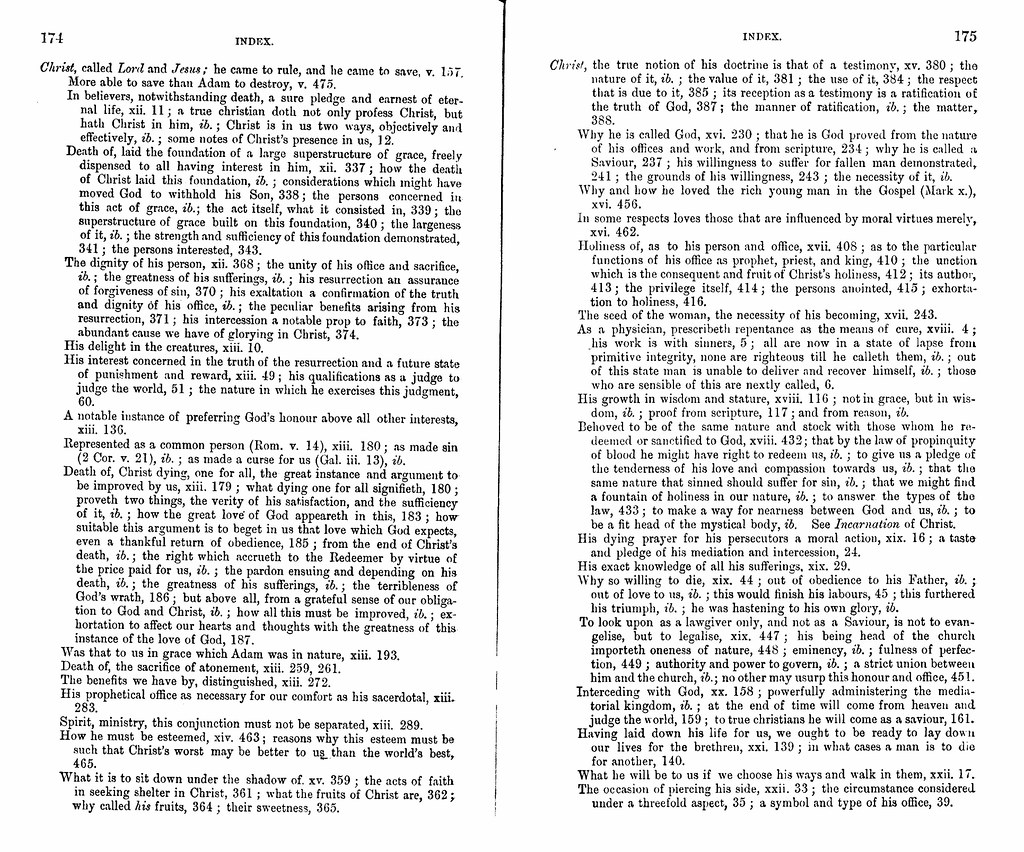
One of the most important resources available to the Puritan researcher are the printed indexes. This is true in both the works of a single author and in the Puritan index by Robert Martin (A Guide to the Puritans).

Thomas Manton

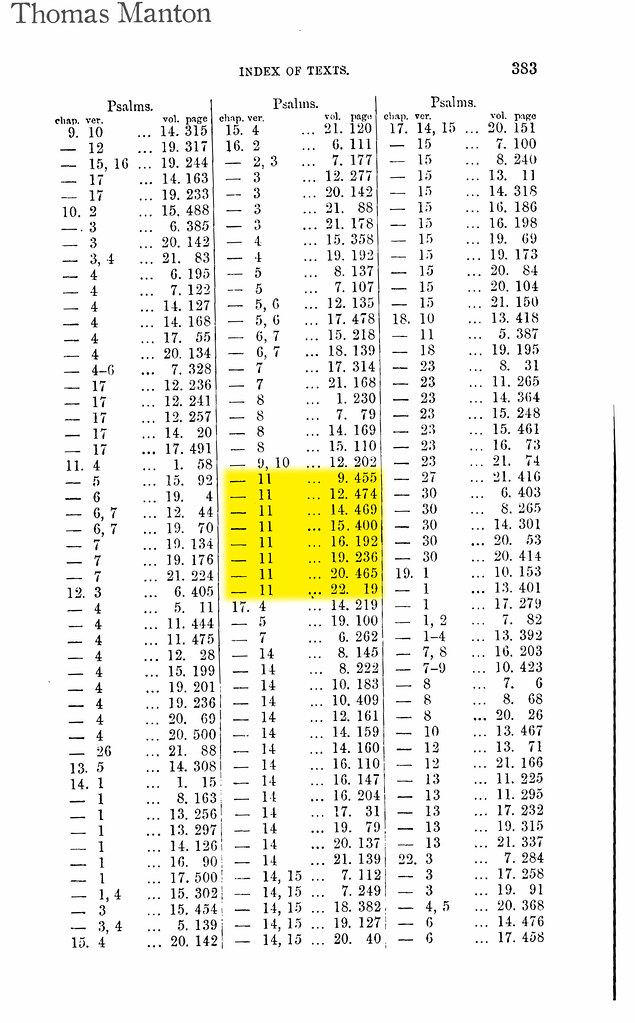
There are two reasons why Puritan Thomas Manton is my homeboy. First, his sermons are filled with rich exposition and pastoral warmth. When I really need a quote to convey a deeper truth, Manton is my source. And second, whoever edited his complete works did an incredible job (and an incredible service to preachers today) by including a detailed index. His 22-volume works (available on CD-Rom) conclude with over 300 pages of textual and topical indexes! A dream for the researcher.

From the screenshot to the right, you can see two pages from Manton’s topical index.

But Manton is not alone. The Complete Works of John Bunyan, Thomas Brooks, John Flavel and Richard Sibbes all come with excellent topical indexes.

Topical index

As an aside, I was speaking with a close friend recently who admitted that keeping a list of quotations was very difficult for him. One of the great difficulties to making an effective index of quotations is an inability to view an individual quote within the big framework. Some will read a quote about the power of the Cross without thinking how it would be properly indexed (ex. Christ > the Cross > effects of > power in believer).

To me, this is why the Puritans are liberating. Once you determine the general content of your sermon, you can go searching for great quotations! Surrounding yourself with quality Puritan literature will lessen the importance of a lengthy quote index.

As another example, I don’t have many quotations indexed on the sobering topic of God’s eternal judgment upon sinners. And I don’t need to. All I need to remember is that Jonathan Edwards preached a few incredible sermons (like Sinners in the Hands of an Angry God) and John Bunyan preached another very quotable sermon on the same subject (A Few Sighs from Hell). Allow a little time to read and soak these sermons in and you will have all the quotes you could imagine on the subject.
This makes the topical Puritan index by Robert Martin, A Guide to the Puritans, especially important. Because while I knew that Edwards and Bunyan preached on the subject of God’s judgment, I was unaware that John Flavel (3:129-153), Thomas Boston (8:347-375) and Thomas Brooks (5:113-145) had also preached important sermons on the subject.

The wealth of Puritan sermons make personal quote indexes unnecessary.

Back to Psalm 16:11

As we began in Part 4, we are researching Psalm 16:11 as an example. And in studying our text we have three avenues of research open to us with these printed volumes.

(i) Primary text as sermon text
. Of our 14 top Puritans, none preached sermons where Psalm 16:11 was their primary passage (Why not? I cannot say). If you are searching on a text and you find two or more sermons where your text is the primary text, you may have all the content necissary for your Puritan research. But our problem here is a common one. On Psalm 16:11 we will need to dig deeper.

(ii) Primary text as indexed text. I will use the scripture index from Manton as an example. If you look to the screenshot to the right you will see that Psalm 16:11 was a topic of concern for Manton throughout his ministry. We see this especially in the following works in the following places: (volume: printed page) 9:455; 12:474; 14:469; 15:400; 16:192; 19:236; 20:465; 22:19. And these references come from just one of our 14 Puritan friends.

(iii) Cross-reference text as sermon text. If you need more information from the cross-references, follow the steps for (ii) except with other texts like Ps. 36:8.

You can use these principles on any text or topic study. Just find the biblical passages and track down the references in the scripture index or look up the topic in the topic index. The printed editions of the Puritan works remain important for these indexes.

Examples

Now a few references from Manton that I found as a result of my research.

Manton, 9:455 – “What can be found in the creature is but a drop to the ocean in comparison of what a believer findeth in God himself. God is to them an overflowing fountain of all felicity … Here (in this life) it admits of increase and decrease; but there the soul is so filled that it cannot receive any more: Ps. xvii. 15, ‘As for me, I will behold thy face in righteousness; I shall be satisfied when I awake with thy likeness.’ … In heaven the soul shall be filled with unspeakable joy and delight. What delight is to the sense, that joy is to the mind. Three things are necessary to delight – a faculty, or power of the soul capable of pleasure; and then the thing itself; which being brought to the mind, doth stir up delight. As in bodily things, colors, fruits, tastes, pleasure consists in the near union and conjunction of these things. The more noble the faculty, the more excellent the object; the nearer the conjunction, the greater the delight and pleasure. Now in heaven our faculties are perfected: God is the subject, and there is a near conjunction. Oh! What embraces between him and the soul!”

Manton, 22:19 – “The tree of life is gone, when paradise was defaced by the flood; but God hath provided a better life by the death of his Son, that we should live for ever, both in body and soul, eternally in heaven. Nothing else be this deserveth to be called life. The bodily life is short; it is a dying life or a living death. It floweth from us as fast as it cometh to us; but this never fadeth, but endureth for ever. The bodily life is subject to pain and misery, but the heavenly, full of joy and endless glory. The bodily life is supported with meats and drinks, but there God is all in all. The bodily life is consistent with sin, but this life is pure and perfect” (references to 1 John 3:2, Jude 2-4 and Psalm 16:11).

The options of what we now do with the quotations will be the subject of a later post. My point here is to show that it took just five minutes to find these two references from the works of Manton. I have six others references remaining in the works of Manton and another 13 Puritans I have yet to open.

By using these printed scriptural and topical indexes, it should be obvious that Puritan sermons provide the valuable depth we need in our sermon preparation.

—————
Next time … Part 6: Electronic searches.
—————

The Puritan Study (Part 4) Why our effective use of the Puritans begins with our Bibles

Part 4: Why our effective use of the Puritans begins with our Bibles

In this installment I will be showing you how the Puritans are made useful by our initial use of the bible. In the next two parts we will be looking more specifically at how to search printed books and then how to search electronic books.

Starting with the bible

The big problem with Puritan sermons is that most of us preach differently than the Puritans. They preached on one verse and often jumped all over scripture. We seek to preach through books of the bible and in 4-8 verses (or more) at a time.

A proper use of the bible is really one of the most important keys to unlocking the wisdom of the Puritans.

King James Version

Whether you use the KJV in your sermons or not, use of the Puritans requires an understanding of the KJV. No exceptions. The wording of this translation permeates all Puritan language.

Here is an example of how important the KJV is in Puritan research.

Psalm 16:11

I personally preach from the ESV. But when I study the Puritan sermons, I keep the KJV close.

For today, and in the following weeks, I selected Psalm 16:11 as the example passage we will be researching.

ESV Psalm 16:11 You make known to me the path of life; in your presence there is fullness of joy; at your right hand are pleasures forevermore.

KJV Psalm 16:11 Thou wilt shew me the path of life: in thy presence is fulness of joy; at thy right hand there are pleasures for evermore.

When we look at electronic searches, I will break these translation distinctions down a little more. But what is important here is to note the difference in language. First, the Puritans would not say “in your presence” (ESV) but “in thy presence” (KJV). And even the spelling is different (“fullness” vs. “fulness” or “forevermore” vs. “for evermore”). These may seem like small distinctions, but they make a huge difference in electronic searches. Being aware of this will greatly enhance your Puritan research accuracy.

Breaking the passage down

The Puritans often scatter biblical phrases in their works. So while the Puritans only preached on one text, by the time they were done preaching the sermon on that one verse, several dozen other references were been brought in. In other words, a sermon on Psalm 36:8 (“They shall be abundantly satisfied with the fatness of thy house; and thou shalt make them drink of the river of thy pleasures”) will probably reference Psalm 16:11 (“in thy presence is fulness of joy; at thy right hand there are pleasures for evermore”).

Before we find these cross-references, we need to break our sermon text into its various parts. In Psalm 16:11 I see three principles that are especially interesting to me …

KJV Psalm 16:11 (a) Thou wilt shew me the path of life: (b) in thy presence is fulness of joy; (c) at thy right hand there are pleasures for evermore.

(a) What is the nature of this path of life? Why does God have to show it to me?
(b) What does it mean to be in God’s presence? Can I live in His presence now?
(c) What are these pleasures forever? Can I find an illustration? Can I experience these pleasures now?

You may have many more questions but these are the three questions I will ask my Puritan friends as I study Psalm 16:11.

But we are not yet ready to invite our Puritan friends over.

Cross-references

I don’t use the Puritan sermons for their keen exegetical insights into the text (I let contemporary Hebrew and Greek scholars make those). My main use of the Puritans is for their explanation and application of broad biblical themes. They make concepts come alive in cross-referencing, illustration and application.

It is especially important that we find other biblical texts that say the same thing. The Puritans can make the same conclusion from many different angles using many different texts. Their one-text-at-a-time preaching style is misleading. The Puritans were experts at keeping the big picture in view and bringing in other passages from Genesis to Revelation.

Here are some cross-references that I believe will help me understand Psalm 16:11 better and will open up new paths in my Puritan research. I found them using the Thompson’s Chain Reference Bible and the Treasury of Scripture Knowledge.

(a) The path of life… Prov. 2:19; Prov. 5:6; Prov. 12:28; Matt. 7:14; Acts 2:28
(b) To be in God’s presence… Ps. 17:15; Ps. 21:6; Matt. 5:8; Eph. 3:19; Jude 24; Rev. 7:15-17
(c) The pleasures forever… Ps. 36:8

The Puritans

Now we are ready to search the Puritan sermons. From our observations of the biblical text we have four research options. Beginning with the most important to the least, here are the four research options in order.

(i) Primary text as sermon text. Example: A full sermon on Psalm 16:11.
(ii) Primary text as indexed text. Example: A sermon on Ps. 38:6 that references Ps. 16:11.
(iii) Cross-reference text as sermon text. Example: A full sermon on Ps. 38:6.
(iv) Cross-reference text as indexed text. Example: A sermon on Jude 24 that references Ps. 38:6.

Printed volumes are most helpful for my research in levels (i), (ii) and (iii). I can comfortably read a full sermon on a text (i and iii). And the text index at the end of a printed volume helps a lot in the search (ii). Electronic searches are helpful in all four, but especially in search (iv) when I want to search several resources quickly.

[Note: Often I have enough research material from searches (i) and (ii) that I don’t need to proceed into levels (iii) and (iv).]

Two searches

There are two types of searches … We can search printed works (or those .pdf picture files) and we can also perform electronic text searches. Depending upon your library, you may have more printed works or more electronic books (ideally we want both electronic files and the printed books together).

In the next two posts we will discuss the specifics of the print and electronic searches.

—————
Next time … Part 5: Print book searches.
—————

Understanding Legalism

tsslogo.jpgI am growing increasingly alarmed by the ways I hear the term ‘legalism’ defined. And since the term ‘legalism’ is a very serious one, I want to take time to look at this growing and serious concern.

The term ‘legalism’ is on my mind because of several recent events. The first was conversation with a woman who had decided it was okay that her daughter skip church for soccer games. “I don’t want to be legalistic about church,” she said. Another encounter was with a man who defined legalism as “living by lots of rules.” And the third encounter was over an issue concerning alcohol and how those who say Christians should not drink are legalists.

I’m not saying these people are right or wrong in their convictions. What I am saying is that each statement sadly reveals a misunderstanding about legalism. Legalism is a danger whether you are biblically right or wrong.

Rules are not the problem

Legalism is not concerned primarily with living by rules or not living by rules — whether you attend church every week or not, whether you drink wine or not.

Jesus says, ‘take every precaution you need to prevent your heart from sinning.’ “If your right eye causes you to sin, tear it out and throw it away. For it is better that you lose one of your members than that your whole body be thrown into hell” (Matt. 5:29).

If you apply the entire bible to the Christian life you can end up with a long list of helpful rules and reminders (like the “one anothers”). Count how many times the phrase “do not” occurs in the Proverbs. It’s no wonder that Jonathan Edwards came up with his long list of resolutions.

Rules are not the problem.

A false gospel

Legalism is a soteriological problem (that is, a false gospel). Legalism is the damning lie that says God’s pleasure in me is dependent upon my obedience.

It is legalism that causes the Pharisee to look proudly into the sky in the presence of a tax collector. It is legalism that causes a missionary in Africa to think God is more pleased with him than the Christian businessman in America. And it is legalism that causes the preacher behind the pulpit to think God is more pleased with him than the tatooed Christian teenager sitting in the back row.

The common salvation (Jude 3)

Legalism is the lie that God will find more pleasure in me because my obedience is greater than others. It is the failure to remember that God’s pleasure in us comes outside of us (in Christ). Legalism causes the heart to forget that God sings over us because of the work He has done, not what we have done (Zeph. 3:15-17).

Believers are all pleasing to God because the righteousness of Christ covers us equally in the sight of God. Any imagined superiority to other Christians (not rules) is the sure sign of the legalist.

The irony of legalism

The great irony (and danger) of legalism is this … If you think God is more pleased with you because you take your child to a soccer game instead of church, if you think God is more pleased with you because you do not live by rules, and if you think God is more pleased with you because you do drink alcohol – you are just as legalistic as the man who thinks that perfect church attendance, lists of rules and abstaining from alcohol makes him more pleasing to God.

Whether our convictions are biblical or unbiblical is another issue altogether. Legalism is not so much objective (are my convictions biblical or not?) but subjective (what do my convictions get me?). So legalism is just as dangerous whether your convictions are biblically accurate or not.

Sadly, churches that do not train their sheep to boast only in the righteousness of the Cross of Christ, but are frequently carried into other controversies and debates, create a breeding ground for self-righteous legalists. And this is true even if the church is right every time on every debate.

But even more sad, legalists will never experience the joy of regarding all other Christians more highly than themselves (Phil. 2:3).
—————-

Related: The Grand Canyon of God’s Grace

—————-