Humble Calvinism: (5) The Institutes > The all-sufficient God of Scripture (1.2)

02spurgeonhumcalvinism.jpg

Part 5: The all-sufficient God of Scripture (1.2)

So we lay in the dust of a dark cave in our filthy rages, covering our eyes to flee the presence of a perfect God. We are shattered. Our self-sufficiency has been replaced with a dread of God and our self-righteousness has been muffled by hopelessness. We lay in naked perversity before the holy God of the universe.

01spurgeoncalvin3.jpgIf we understand God and understand ourselves we become painfully aware of our empty hearts. In the last chapter Calvin wrote, “Each of us must, then, be so stung by the consciousness of his own unhappiness as to attain at least some knowledge of God” (p. 36). As sinners we become aware of our insufficiency. We cannot produce our own joy. We must fearfully seek our joy in the all-sufficient, unchanging God of Scripture.

Seeking the sufficient God (1.2.1)

Piety forms the foundation for all of Calvin’s theology. Piety is “that reverence joined with love to God which the knowledge of his benefits induces” (p. 41). Prior to understanding God’s motives and plans we must love and fear Him.

We will not run towards God until we are convinced that our joy depends upon it! Calvin writes, “it will not suffice simply to hold that there is One whom all ought to honor and adore, unless we are also persuaded that he is the fountain of every good, and that we must seek nothing elsewhere than in him … unless they [men] establish their complete happiness in him, they will never give themselves truly and sincerely to him” (p. 40).

It is here that Calvin showcases his experiential understanding of faith. We worship what promises to satisfy us. If we believe sex will satisfy us we worship sexual sin. If we think a beautiful appearance will bring us satisfaction we worship the outward beauty of others. If we think religion will satisfy us we worship our self-righteousness. We worship what holds the promise of our satisfaction. We will only come to God after being fully convinced our entire good rests in Him alone.

True piety is expecting full joy from God alone. Here Calvin says we seek knowledge of God by recognizing His all-sufficiency. So the act of seeking this all-sufficient God is not to be confused with saving grace. “It is one thing to feel that God as our Maker supports us by his power, governs us by his providence, nourishes us by his goodness, and attends us with all sorts of blessings – and another thing to embrace the grace of reconciliation offered to us in Christ” (p. 40).

But don’t miss this! Calvin has not yet brought us to the place where sinners are reconciled to God. That will come later. A conviction that God is our all-sufficient source of joy is not saving faith. It’s no wonder that Calvin lays great importance upon the sovereign grace of God opening the eyes of blind sinners like myself.

Seeking the revealed God (1.2.2)

Piety is seeking our sufficiency in the true God (not a god of our imagination). Piety involves a fear of God because God is what He is and not what the sinner deems appropriate.

Calvin uses one especially powerful example: Do we truly believe the “punishment of the impious and wicked and the reward of life eternal for the righteous equally pertain to God’s glory” (p. 43)? Clearly Calvin is building from Romans 9:22-23.

The god I naturally imagine is a politician polishing his persuasive speeches because his success rests upon a popular applause. This politician/god gets no glory from his enemies. Not so with God. Impenetrable divine wisdom uses the judgment of unrepentant sinners to exalt God’s own glory.

True piety pursues this sovereign God of Scripture, not the democratic god of my imagination. Calvin writes, “the pious mind does not dream up for itself any god it pleases, but contemplates the one and only true God. And it does not attach to him whatever it pleases, but is content to hold him to be as he manifests himself” (p. 42).

Without seeking the Scriptural God, a true fear will be replaced by “vague general veneration” of God (p. 43). Sinners can show respect for God without a fear of God. Here’s where the mere outward display of veneration in religious ceremonies becomes dangerous. A sinner may tip his hat at God without fearing Him. Without a genuine fear of God there is no genuine piety and without piety we will never truly know the saving knowledge of God.

We must fear and seek after God as He reveals Himself. Again, seeing this in the backdrop of my blinding, deadening sin I cry out as a helpless sinner dependent upon the sovereign work of God!

Calvinistic meditations …

1. A genuine fear of God authenticates our pursuit of the one, true God
. True piety fears God because God is altogether different than we naturally imagine. The god of my imagination is a lot like myself. I don’t fear those who are like me (I only fear people who are larger than me!). “You thought I was altogether like you. But I will rebuke you and accuse you to your face” (Psalm 50:21, NIV). What shock must overwhelm the damned soul to be trampled under the winepress of God’s wrath after thinking He was a 5-foot-8 pushover.

Use your fear of God to gauge how well your imagined god is replaced by the sovereign God! It’s good to ask: Do I live with a healthy fear of God or a “vague general veneration” of God? Fear is piety, vague veneration is pride.

2. We must never rest content in general notions of God as our source of all joy. Every sinner using natural revelation and a natural sense of the divine can make this conclusion. It is something altogether different when sinners confess Christ is our “wisdom and our righteousness and sanctification and redemption” (1 Cor. 1:30).

In a secularized culture, the church naturally lowers its expectations of faith. If someone believes God is the source of their entire good, can’t we assume that they are genuine Christians? No. What false religion advertises an insufficient god? Believing God is all-sufficient is not itself saving. Salvation comes through faith in the very specific revelation we call the gospel. Jesus Christ died my death to pay for my sin by bearing my wrath to free me from the power of my sin.

The Reformed/Puritan tradition used the phrase “almost Christian” to designate those drawn to the all-sufficient God but who had not “closed” with Christ. When a vague understanding of God’s sufficiency is mistaken for saving faith in the Cross the phrase “almost Christian” becomes foreign, the doctrinal core of the gospel becomes vague, religious relativism runs rampant and the church begins reading books by mystics because they mistake an author’s seeking of joy alone in God with authentic Christianity. Humble Calvinism will not allow it.

We must not grow content with an ecumenical journey of desire but press on in pursuit of an all-satisfying righteousness that comes by faith alone, in Christ alone, from the Cross of Christ alone!

————————–

Click here to access previous posts in the Humble Calvinism index.

————————–
Humble Calvinism: Series index

02spurgeonhumcalvinism.jpg

Humble Calvinism: Full series index

——————————–

“A world-class theologian, a revered exegete, a renowned teacher, an ecclesiastical statesman, an influential Reformer — he was all of these and more. His name was John Calvin.”– Steven J. Lawson, The Expository Genius of John Calvin

——————————–

Humble Calvinism > Full Posts

1. John Calvin (1509-1564)
2. Why John Calvin?
(Why Calvinism? Why now?)
3. The Institutes > Intro
4. The Institutes > Knowing God and knowing self (1.1)
5. The Institutes > The all-sufficient God of Scripture (1.2)
6. The Institutes > The implanted knowledge of God (1.3)
7. The Institutes > Weaving a wicker basket god (1.4)
8. The Institutes > ‘Radical’ depravity (1.5)
9. The Institutes > Clinging to a thread (1.6)
10. The Institutes > The self-authenticated Word (1.7)
11. The Institutes > Proofs of Scripture’s authenticity (1.8 )
12. The Institutes > The “mutual bond” of God’s power and Word (1.9)calvininstitutes.jpg
13. The Institutes > Experiencing God (1.10)
14. The Institutes > The idol factory (1.11)
15. The Institutes > God is One (1.12)
16. The Institutes > God is Three (1.13)
17. The Institutes > Viewing God’s Theater (1.14)
18. The Institutes > The Spirit’s Application of the Gospel (3.1)
19. The Institutes > What is Faith? Pt. 1 (3.2.1-5)

——————————–

Books

1. Humble Calvinism Essentials (Institutes and McGrath bio)
2. New book > Calvin: The preacher A good corrective by Lawson
3. Review > Sermons on the Beatitudes by Calvin
4. Review > Calvin’s Teaching on Job by Derek Thomas
5. Review > Chosen for Life by Sam Storms
6. Quote > The importance of Calvinism by Steven Lawson
7. Quote > Calvinism and the redemption of counseling
by David Powlison

(Tim Challies has made the world fully aware of my biblio-photographic nerdiness. Thanks Tim for the humility. I need more of it!)

——————————–

Misc. articles and posts

1. D. Clair Davis > “What’s so good about being a Calvinist?
2. Journaling > A Day in the Life of a Humble Calvinist

3. 2007 Banner of Truth Ministers’ Conference details
4. Bonar > The Humble Calvinist in the work of God
5. Packer > Humble Calvinism and evangelism
6. Calvin > The weight, beauty and comfort of the Gospel
7. Kuyper > This all-embracing predestination

——————————–

tssimagecards.gif

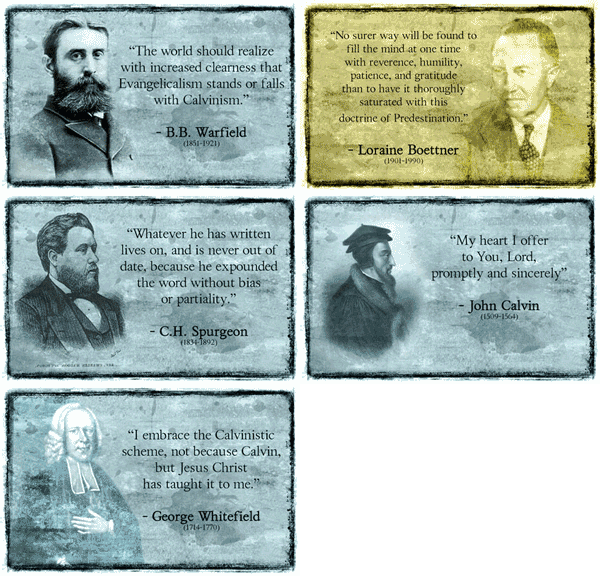
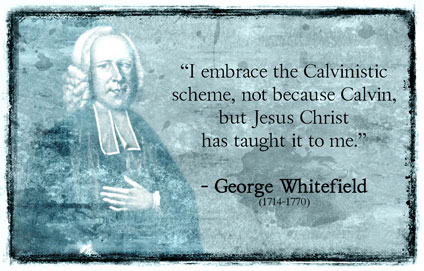
Humble Calvinism image cards: B.B. Warfield, John Calvin, Loraine Boettner, George Whitefield. Do you have a great Calvinism quote? Post it in the comments at the bottom of this post and it may become an image card.

——————————–

Reviews and notes

– The banner graphic was lifted straight from the creative minds of Sovereign Grace Ministries New Attitude group. Thanks for the graphic inspiration and the spiritual inspiration to live out humble orthodoxy! (2007.01.09)

02spurgeoncalvinsig.jpg

Humble Calvinism: Books > Essentials

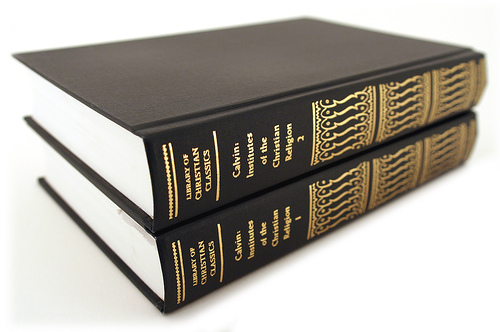
We will be looking at a number of books by and about John Calvin in the next few months. At this stage, the following three volumes are most important. I’m tracing Calvin’s thought using the Institutes of the Christian Religion (1559 edition) in the form of the 1960 McNeill and Battles translation (because I’m told its the best). The 2-volume work is published by Westminster John Knox Press (ISBNs 9780664220280, 0664220282). I’m told the cloth version pictured below is no longer available.

calvininstitutes.jpg

I am told this hardcover edition (no dust jackets) is the standard issue now …

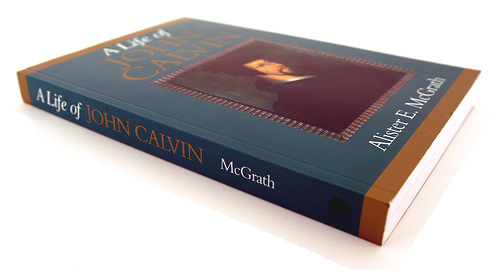
A Life of John Calvin is an excellent biography by Alister McGrath. It has been very useful in understanding Calvin’s life, his theological development, the central themes of his theology and the broader cultural impact of Calvinism. A Life is a limiting title for the scope of the book. It was published by Blackwell in 1990 (ISBNs 0631189475, 9780631189473).

calvinbio.jpg

————————–

Click here to access previous posts in the Humble Calvinism index.

————————–
 

Humble Calvinism: (4) The Institutes > Knowing God and Knowing Self (1.1)

02spurgeonhumcalvinism.jpg

Part 4: Knowing God and Knowing Self (1.1)

Most systematic theological presentations of Christianity begin with a study of the character and attributes of God. Calvin begins with a bigger question: How do we know anything about God? Without this first step, nothing else will make sense to us!

1. Grasping personal misery (1.1.1)

To start, we must wrap our minds around the misery and sinfulness of our own hearts. 01spurgeoncalvin1.jpgCalvin will not let us jump into the Institutes on an intellectual mission. Our hearts must be prepared to learn eternal truth, and we will not learn about God until we see the depth of our own blackened hearts. Remember piety is the foundation for all knowledge of God.
A humble self-understanding leads us to seek after God. Calvin writes “We cannot seriously aspire to him before we become displeased with ourselves … The knowledge of ourselves not only arouses us to seek God, but also, as it were, leads us by the hand to find him” (p. 37). Our own nakedness, ignorance, vanity, poverty, infirmity, depravity and corruption – when rightly understood – will both humble us and grab us by the hand to flee for refuge in Him! Theology is learned when a sinner runs towards God for mercy.

In one word, only when a sinner is “so stung by the consciousness of his own unhappiness” will he flee to God (p. 36). So where do we find such knowledge?

2. Looking upward, looking outward (1.1.2)

Naturally we think of ourselves as righteous and wise. For Calvin, hypocrisy is an “empty image of righteousness” rather than a true righteousness that “abundantly satisfies us” (pp. 37-38). The prayer of the hypocrite is, “God I thank you that I am not like others.”

The solution is to stop looking around at other sinners. Calvin says, first look directly into the blazing sun then look around at the world. After looking at the sun, our vision is clouded and skewed but this clouded vision is actually the greater clarity with which we can actually discern the things of this earth. Everything on earth looks differently after staring into the sun directly.

God is the sun. Look at His perfect righteousness and glory and then, “what [was] masquerading earlier as righteousness was pleasing in us will soon grow filthy in its consummate wickedness” (p. 38).

It’s by staring into the sun that our vision changes and we see, with our spiritual eyes, the depth of our depravity. This depravity becomes foundational in our search to understand God and His motives.

3. Nothing compares (1.1.3)

Scripture teaches us that when sinners see God, they unwind like a cheap sweater.

Job was a favorite book for Calvin. For him, the fact that God’s purity and glory “overwhelms men with the realization of their own stupidity, impotence, and corruption” was a major theme of the book (p. 39).

But it’s not just Job. It’s Abraham (Gen. 18:27), Elijah (1 King 19:13) and Isaiah (Isa. 6:5). The common theme of sinners who see the glory of God revealed is to face certain death! See Judges 6:22-23 and 13:22, Isaiah 6:5, Ezekiel 1:28 and 2:1 (read them all here).

We sinners are confounded and humbled when we compare ourselves to Him! We can only be rotten worms (see biblical passages here).

Thus we read in Isaiah, “Enter into the rock and hide in the dust from before the terror of the Lord, and from the splendor of his majesty” (Isa. 2:10). It’s when we are face-down in a cave that we truly understand God, and rightly understand ourselves. This fear is the beginning of theological wisdom (Ps. 111:10; Pro. 1:7; 9:10).

Calvinistic meditations …

It’s not that we don’t look outside of ourselves to understand ourselves. In school we look at the grades of others to gauge our intelligence. We look at the appearance of others to gauge our beauty. We look to the houses and cars of others to gauge our status in the world. We naturally look outside ourselves. The problem for Calvin was not that sinners fail to compare themselves to outside standards, but that we naturally compare ourselves to a hypocritical worldly standard. We must not only look outward, but upward. To learn who we are we must lay in the dust under the cliff rocks and expect sudden death because of God’s glory!

Calvin says look directly at the sun and be undone by God’s majesty. Be undone by His perfections, His unapproachable-ness, His justice. And for preachers and teachers who want to communicate God’s truth, Calvin says to us, “Preacher, you must start here. You must be concerned, not merely to ‘prove’ truth to the unregenerate but point sinners to look at the sun.” Until sinners are undone they cannot know God! We must first become “displeased with ourselves.”

Our goal is not to write theology to intellectually prove God exists, our goal is to see sinners doubled over under their sinfulness, hiding in a cave, clothed in filthy rags, likening themselves to dust and worms. By God’s grace let your hearers see God’s full majesty of God! Let them first stare into the sun and then help them to drink Grace and mercy from the Cross!

If there was one message contemporary American evangelicalism needs, it’s this one. Without fear of God there is no knowledge of God (Ps. 111:10; Pro. 1:7; 9:10). Theology built without a fear of God is a temple of straw built to an unknown god on a foundation of sand.

So this is where Calvin begins. If the first 5 pages do not grab us the last 1,400 wont either. This is the beginning of understanding God and his motives. If we do not personally start here, frightened worms of God’s glory laying face-down in a cave, we can stop reading and slide the Institutes back on our shelves. We will not understand God because we will have fundamentally misunderstood ourselves.

————————–

Click here to access previous posts in the Humble Calvinism index.

————————–