
Jonathan Edwards and Supralapsarianism

Today we received a question from TSS reader, Jason Dalton. He asks:

Dear Tony,

I’ve been listening to J.I. Packer’s RTS “History and Theology of the Puritans” on iTunes U that you graciously pointed out awhile back. It is very enjoyable, and I am very grateful to RTS for making it free to the public. Thank you for letting more people know about it.

Dr. Packer goes on a bit of a long tangent about supralapsarianism and infralapsarianism in the lectures and comes down very strongly against supralapsarianism.

I still have much to learn on the subject, but I believe I would label myself as a supralapsarian. My hero is John Piper, and it is from him that I have come to believe that God’s glory and Him displaying all facets of that glory is the most preeminent goal in all the universe.

Seeing from your post that Jonathan Edwards liked William Perkins, did Jonathan Edwards consider himself a supralapsarian, do you know? Do you think John Piper would consider himself a supralapsarian?

Thank you for any knowledge you might be able to pass on. Thank you for all your work. God has used it to bless me.

Jason Dalton

Great question, Jason!

Let me define the terms for those interested in this question but lost in the terminology. It’s a question of timing. What did God decree first, second, etc.? A supralapsarian believes that God first decrees (or elected) some for salvation, then decreed creation, the fall and then redemption. He elects some and then decrees to create them, decrees the fall and redemption to establish this relationship with the elect. An infralapsarian however believes God first decrees creation, then the fall, then election and redemption. So the question is this: Did God decree the elect before decreeing the fall (supralapsarian) or does He decree election after decreeing the fall (infralapsarian)?

This is a noteworthy distinction although some of my favorite theologians simply throw their hands in the air and say the order of decrees is not revealed in Scripture (see John Frame for example).

Now, about your question specifically. Yes, William Perkins was supralapsarian and, yes, Edwards liked Perkins. I’m uncertain of Piper’s official position, though.

From what I’ve read Jonathan Edwards reacted against the supralapsarian position. I say that based upon John Gerstner’s conclusion in his multi-volume work The Rational Biblical Theology of Jonathan Edwards (Ligonier: 1992). Gerstner writes:

“he [Edwards] refutes the fundamental argument of the supralapsarians. They contend that the last thing in execution was always the first in intention. That is, the actual reprobation and salvation of some proved that this was the original intention behind the creation, fall, salvation and damnation. Edwards critiques this … man was not created that he should be converted or reprobated. … God decreed the fall of man, yet Edwards sees this as an anti-supralapsarian. As we shall show in the Edwardsian doctrine of man, the Holy Spirit was Edwards’ donum superadditum. Adam’s failure to call upon Him was the occasion of the fall. God did not first harden Adam’s heart; this wicked deed was Adam’s own doing” (2:161, 164).

Clear as mud? Great question. Does anyone else have insight into answering this question?

Tony

Our holiness and zeal purchased in the Cross

tsslogo.jpgI’ll never forget the glorious day God opened my eyes to see that everything in the Christian life centers around the Cross. It was reminiscent of viewing the massive Rocky Mountains for the first time — having my breath taken away by the size and grandeur of their jagged features, snow-topped summits, and cloud-ripping peaks.

About four years after my conversion, I was preparing to deliver a short message on Titus 3:4-7. The intention was to study this passage to prepare an evangelistic message on a local college campus. The passage reads:

4 But when the goodness and loving kindness of God our Savior appeared, 5 he saved us, not because of works done by us in righteousness, but according to his own mercy, by the washing of regeneration and renewal of the Holy Spirit, 6 whom he poured out on us richly through Jesus Christ our Savior, 7 so that being justified by his grace we might become heirs according to the hope of eternal life.

God’s glorious grace saves us purely on the basis of His own mercy, apart from anything we could ever merit from Him. The works we do in ‘righteousness’ are nothing in His sight. We are redeemed in Christ alone, and we can be justified in Him alone. On the basis of the Cross and God’s grace alone, we can possess the hope of eternal life.

These glorious truths sounds pretty evangelistic. Well, kinda.

As an expositor I was trying to come to grips with this passage and the context (which did not seem evangelistic). These passages are embedded between a call for obedience before and a call for obedience after. Listen to the next verse: “The saying is trustworthy, and I want you to insist on these things, so that those who have believed in God may be careful to devote themselves to good works. These things are excellent and profitable for people” (v. 8).

Over the course of that week of study and meditation, God kindly revealed to me that the Cross is bigger than evangelism and conversion! Being reminded of the Cross is for “those who have believed.” From here God showed me the dangers of forgetting the Cross and how the Cross is central to the everyday life of the Christian, producing joy and earnest obedience.

As you can imagine, I was shocked and surprised at these discoveries. Preparation on the passage continued but within a new understanding of the Cross in the Christian life. I would later title the message, A Gospel Tract for Believers.

When I want to be amazed at the Cross, I return to Titus.

The Purchase of the Cross

Recently I was back in Titus, being amazed again. This time our gracious God opened my eyes to the beauty of the completed work of Christ on the Cross. Listen to Titus 2:11-14:

11 For the grace of God has appeared, bringing salvation for all people, 12 training us to renounce ungodliness and worldly passions, and to live self-controlled, upright, and godly lives in the present age, 13 waiting for our blessed hope, the appearing of the glory of our great God and Savior Jesus Christ, 14 who gave himself for us to redeem us from all lawlessness and to purify for himself a people for his own possession who are zealous for good works.

That final verse made my jaw drop because here Paul unfolds the purchase of Christ at the Cross. These are what Christ bought in His sacrificial death for sinners! We are told that Christ “gave Himself” in order to redeem and purify a people zealous for good works. In other words, our redemption, sanctification and even our zeal-ification were all purchased in the Cross!

1. Purchased holiness

Titus 2 seems to parallel Ephesians 5:25-26, “Husbands, love your wives, as Christ loved the church and gave himself up for her, that he might sanctify her, having cleansed her by the washing of water with the word.” Here is Christ purifying His Bride (the Church). This model for husbands in the spiritual leadership of their wives shows that our sanctification is not merely the fruit of hard work. Our sanctification is the fruit of Christ’s direct work.

Puritan John Owen recognized a pattern in the NT picture of sanctification, that our washing/sanctification is through blood (Heb. 9:13-14; 1 John 1:7; Rev. 1:5). Not only at the beginning of the Christian life and in justification does blood cleanse us, but at all points of sanctification Christ’s blood sanctifies us. Which means the Cross is ever at the center of our sanctification.

And so in his commentary on Hebrews 2, Owen attacks those who believe holiness is attained merely by following the moral example of Christ. “And they who place this sanctification merely on the doctrine and example of Christ, besides that they consider not at all the design and scope of the place, so they reject the principal end and the most blessed effect of the death and blood-shedding of the Lord Jesus.”

Christ is certainly our example, but all of our moral purity is (most importantly) the purchase of Christ on the Cross!

I find it interesting that this theme of Christ purchasing our sanctification is not a major one in Owen’s works on mortification and indwelling sin, nor a major theme in Communion with God or the Glory of Christ. The theme does find prominence – of all places – in Owen’s classic defense of definite atonement in The Death of Death.

To show the atonement cannot have been achieved for all sinners, Owen argues the application of the atonement would also be applied to all. “So that our sanctification, with all other effects of free grace, are the immediate procurement of the death of Christ. And of the things that have been spoken this is the sum: Sanctification and holiness is the certain fruit and effect of the death of Christ in all them for whom he died.”

I know some of you will disagree with Owen’s overall argument on limited atonement. What I want you to see instead here is the precious wisdom Owen understands so well — that the work of the atonement reaches far beyond mere redemption and justification. Whoever Christ died for will be sanctified and will be holy because this sanctification and holiness has been purchased at the Cross.

Thus we can say with Paul, Christ is our righteousness and sanctification (1 Cor. 1:30). Christ purchased it all.

2. Purchased zeal-ification

And not only our sanctification and mortification (death to sin), but all of our Christian zeal was also purchased in the Cross!

Jonathan Edwards preached a sermon on Titus 2:14 and his overall point was to reveal that all genuine Christians are zealous people. At the beginning he says, “Zeal is an essential virtue of a Christian. This is evident from the text because in the text it is mentioned as what belongs to the description of a true Christian and part of his distinguishing character. Also because it’s mentioned as a virtue that Christ purchased for all his elect.”

Edwards understood that ministry zeal is not the product of our self-sustained efforts, nor the effect of getting ourselves emotionally pumped up before a sermon, or pep-talking a congregation into service and evangelism. Ultimately, all zeal in the Christian life is purchased at the Cross.

How sad is our tendency to separate the work of Christ on the Cross from our ministry zeal and faithfulness. I know I’m guilty here. Examples of this can be seen in contemporary writings. On 1 Thessalonians 2:19, one author writes:

“This is why, when Paul looks ahead to the future and asks, as well one might, what God will say on the last day, he holds up as his joy and crown, not the merits and death of Jesus, but the churches he has planted who remain faithful to the gospel. The path from initial faith to final resurrection (and resurrection we must remind ourselves, constitutes rescue, that is salvation, from death itself) lies through holy and faithful Spirit-led service, including suffering” (N.T. Wright, Fresh Perspective, 148).

This could not be further from the truth. Paul understood the faithful ministry zeal of churches to be the working out of a zeal Christ purchased at the Cross. The Cross will be forever the centerpiece of glory because without it there would be no ministry zeal, no successful church plants, no faithfulness to the message of the Cross. We must resist the temptation to disconnect the merits of Christ from our ministry zeal.

Without the Cross, there is no zeal.

Conclusions

1. Self-sufficiency abated. This understanding of our mortification, sanctification and zeal-ification protects us from self-sufficiency. Our sufficiency is from God (2 Cor. 3:5). Or to put it another way, our sufficiency is in God’s grace, by His Spirit, and through the work of His Son on the Cross.

2. Confidence engendered. Few things more encourage ministry zeal and the pursuit of sanctification than the knowledge that Christ already purchased these gifts of grace! We have the confidence to pursue and kill sin because we are being washed in His blood. We have the confidence to pray for fervent zeal because it’s a zeal already fully purchased by Christ.

3. Legalism killed. Legalism is seeking to appease God through personal obedience. At its heart is the awful idea that I bring to God something I’ve achieved in my own strength that pleases Him more than His Son. This legalism is killed when we reflect on the Cross of Christ, where He purchased all our holiness and zeal.

It sounds awkward, but the bottom line is that we are simply becoming what’s already been paid for. We should continue praying for holiness, sanctification, victory over indwelling sin, and that God would inflame our passions and zeal. But in these prayers we are merely asking that God would apply, by His Holy Spirit, what Christ has already purchased for us on the Cross.

——————–

Related post: What is Legalism? (a very simple, working definition)

Related post: Cross-centered obedience (how the diligent pursuit of personal obedience presses us into the Cross and comforts our souls)

Wheaton museums

tss-road-trip.jpgWHEATON, IL — Last Thursday morning I headed out from downtown Chicago. About 30 miles West sits an old but beautiful college town made famous for Wheaton College. Before crossing the busy train tracks to the South (to meet with Justin Taylor), my first goal was to browse two local campus museums. On the NW corner of campus sits the Wade Center, and to the SW sits the Billy Graham Center.

Marion E. Wade Center

I am told the Wade Center houses personal libraries and manuscripts from several authors, including C.S. Lewis and J.R.R. Tolkien. The center does feature a main room of various treasures including the wood desks of Lewis and Tolkien. Tolkien’s desk is very tiny and modest. Lewis’ is a bit larger, but also very plain. Perhaps most popular, the Center features Lewis’ childhood wardrobe thought to be the inspiration behind the magical doorway into Narnia. Lewis’ grandfather handcrafted the elegantly chiseled wardrobe.

I was warned by a sign on the wall that photographs were not to be taken of anything but the desks and wardrobe and none of which could be published. The receptionist pointed to the sign and the curator stopped by to make sure I saw the sign. So for a photographic tour I have nothing for you but you can see pictures on the Wade Center website.

Billy Graham Center Museum

South of the Wade Center sits the massive photo-friendly Billy Graham Center Museum. Behind the Roman column exterior, the museum is shaped with hallways connecting large and dark circular rooms of various sizes. Much of the museum is taken up with artwork. The entrance to the museum features a 10-foot tall original painting of Christ by Warner Sallman and one dark room is devoted to a large three-dimensional crystal crucifix.

Most interesting was the “History of Evangelism in America” exhibit featuring a nice display on Jonathan Edwards and the Great Awakening.

IMG_7098.ed.jpg

IMG_7086.ed.jpg

The exhibit included an original 1746 edition of the Religious Affections.

IMG_7081.ed.jpg

IMG_7084.ed.jpg

As expected, the museum is chiefly devoted to the life and international evangelistic ministry of Billy Graham. Various items from his life and ministry were on display including his traveling pulpit, a childhood Bible, and dozens of photographs.

IMG_7138.ed.jpg

The marriage of Billy and Ruth Graham was sweet. Ruth, who passed away this year, must have been a hoot.

IMG_7140.ed.jpg

What especially caught my attention was Graham’s personal copy of John Stott’s The Cross of Christ with underlining on the first page of the seventh chapter. This simple book illustrates the power the publishing world to impact evangelism and the preaching of God’s Word. A book well-digested by a preacher is broadcast to souls that would otherwise never read the book. This underlining illustrates an interesting dynamic.

IMG_7137.ed.jpg

I left the museum with a sense I had passed through a display of holy relics. I decided not to publish photographs the many paintings of Christ or the crystal crucifix. But overall the Billy Graham Center Museum was positive and the history of evangelism in America was excellent.

Conclusion

I would not make it a special trip, but if you travel to Wheaton a quick stop to both museums will be enlightening. And both museums are free.

But enough of museums. History is being written as we speak. I headed South over the nearby train tracks to the Good News Publishers and Crossway Books building surrounded by neighborhoods. It’s known as the home of the English Standard Version and home to uber blogger Justin Taylor. …

Tragedy and the voice of God

tsslogo.jpgOn the evening of Wednesday, December 8th, 1742, John Lyman’s Northampton home burned to the ground. Tragically, his two young daughters perished in the fire.

So far as I can tell, John Lyman was a normal citizen of the town and his story would have long been forgotten except for a man silhouetted in background of the smoldering remains. Looking intently into the scene was a local pastor, Jonathan Edwards.

And he was not alone.

Edwards had walked to the consumed home after gathering his children and a number of local children. His purpose was pastoral, to bring these young souls close to the voice of God.

That same day (Thursday) Edwards preached on Micah 6:9. His sermon had two main points: “I. God’s voice sometimes cries to a city or town in the awful rebukes of his providence. II. The men of wisdom shall see God’s name.” In the rising embers of tragedy, Edwards was encouraging his children to listen for God’s voice. The wise will see, the wise will hear.

Surveying the 35W bridge collapsed here in Minnesota was a similar experience. All the victims have been removed from the scene. The cars are gone and work is well under way to remove the concrete and steel. The once carefully-guarded scene is now open for the public, and Saturday I took my wife and kids downtown to walk over a parallel bridge and look 60-feet down into the valley of destruction.

Personally, it was an opportunity for my son (Jonathan Edwards) to see the extent of the damage and be freshly reminded of frailty. Thirteen people died here including a pregnant mother, her unborn child, and two-year-old daughter. No one, not even the youngest, are exempt from the wages of sin (Rom. 6:23).

Some will see the tragedy and close their ears. Some will flatly deny God is here. But He is here, He has acted, His is working and continues speaking. My prayer is that God was actively speaking to my son and into the lives of the children overlooking the scene.

Edwards reminds us to use tragedy to love young souls. God is speaking and the wise shall hear His voice.

Does He speak to you?

IMG_6750.ed.jpg

IMG_6811.ed.jpg

IMG_6768.ed.jpg

IMG_6747.ed.jpg

IMG_6751.ed.jpg

IMG_6829.ed.jpg

—————

Related: President Bush in MN – pictures
Related: Minneapolis Bridge Collapse: The Morning After

Piper on Edwards on video

tss-jonathan-edwards.jpgIf you have not listened to John Piper on Jonathan Edwards in a message entitled A God-Entranced Vision of All Things: Why We Need Jonathan Edwards 300 Years Later you are missing one great message! And if you’ve never seen the video, that’s because it’s been unavailable.

Until now.

Today DG released several conference videos from the years (see here). The priceless message A God-Entranced Vision of All Things can be read, heard and watched here.

Evangelicalism today in America is basking in the sunlight of ominously hollow success. Evangelical industries of television and radio and publishing and music recordings, as well as hundreds of growing megachurches and some public figures and political movements, give outward impressions of vitality and strength. But David Wells and Os Guinness and others have warned of the hollowing out of evangelicalism from within…

What is missing is the mind-shaping knowledge and the all-transforming enjoyment of the weight of the glory of God. The glory of God-holy, righteous, all-sovereign, all-wise, all-good-is missing. God rests lightly on the church in America. He is not felt as a weighty concern. David Wells puts it starkly, “It is this God, majestic and holy in his being, this God whose love knows no bounds because his holiness knows no limits, who has disappeared from the modern evangelical world.” It is an overstatement. But not without warrant.

What Edwards saw in God and in the universe because of God, through the lens of Scripture, was breathtaking. To read him, after you catch your breath, is to breathe the uncommon air of the Himalayas of revelation. And the refreshment that you get from this high, clear, God-entranced air does not take out of the valleys of suffering in this world, but fits you to spend your life there for the sake of love with invincible and worshipful joy.

Signs of the Spirit by Sam Storms

Book review
Signs of the Spirit by Sam Storms

Published in 1746, Jonathan Edwards’ Religious Affections remains the great masterpiece on biblical discernment. Edwards exposes the inner workings of the soul, using Scripture to make concrete the contrast between the fleeting affections of a hard hypocritical heart and the enduring affections of a softened and converted heart. The precise dissection of the soul in Religious Affections is one of the enduring characteristics of Edwards intellectual brilliance and a precision warranted from such delicate matters. But many contemporary readers (like this one) have found Edwards’ intellectual precision difficult to read.
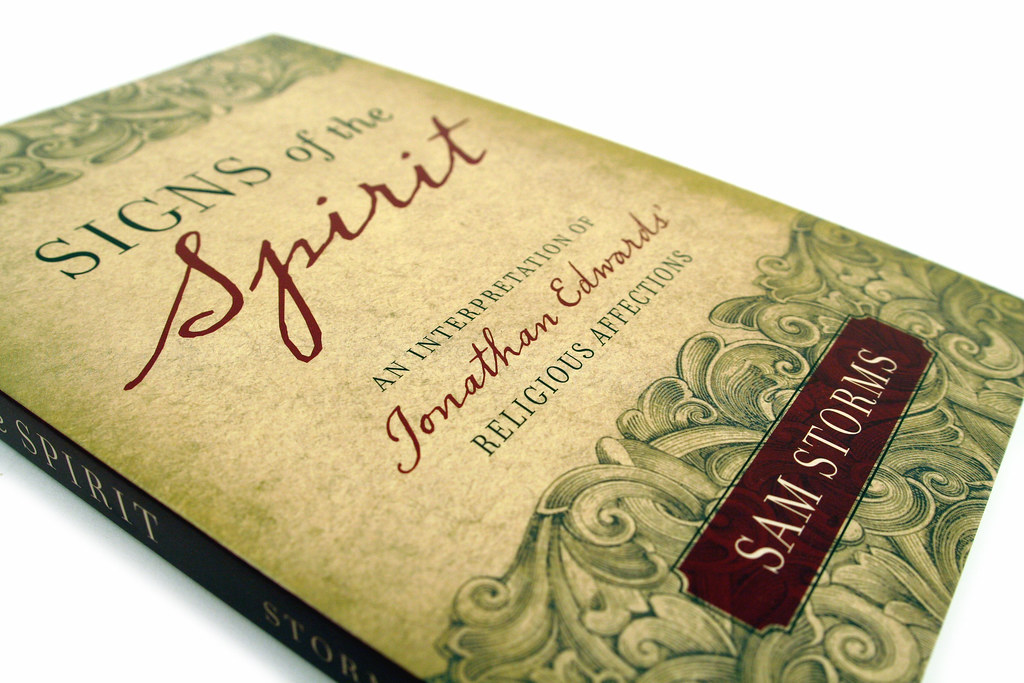
In his new release, Signs of the Spirit: An Interpretation of Jonathan Edwards’ ‘Religious Affections’ (Crossway: 2007), Sam Storms has written an excellent guide through Edwards’ rich arguments. Storms is noted for his study of Edwards and has worked through the Religious Affections at least 10 times (p. 12).

But Storms is not enthralled with the genius of Edwards. He begins the book with clear, foundational biblical exposition and carries biblical proof throughout the entire work. Genuine discernment of the true work of God finds its basis in God’s Word, not Edwards. Storms’ careful biblical development deserves applause.

From here Storms builds a historical backdrop to Religious Affections and then defines affections, finally concluding that affections are the “warm and fervid inclinations that reveal the fundamental orientation of the human heart” (p. 44). Storms follows the design of Edwards in explaining the 12 signs that don’t necessarily authenticate the work of God in the soul and the 12 signs that do authenticate the genuine work of God in the soul. Genuine God-given affections are lit by the flame of God Himself, an enduring flame that displays itself in genuine love and admiration of God as He exists in His spectacular beauty. True religious affections will reveal themselves by causing us to hate sin and pursue Christ-likeness, driving our appetite for more of God and to pursue the sweetness in the Person and Work of Christ.

Edwards’ personal testimony of these religious affections comprise the final 80 pages.

Religious Affections is always relevant but especially in our day when “Christianity” is often defined by outward affiliations, church strategies, and cultural relevance. Edwards’ reminder to our era is that genuine Christianity is marked by a radical soul transformation. Christianity is not defined pragmatically by what it offers and what we get. More important than marketing Christianity as a list of exclusive benefits, Edwards understands that a true work of God begins with a vision of God in His unspotted glory and supreme majesty.

“We must, therefore, be careful that our primary joy is in God, as he is in and of himself, and not in our experience of God. That we have been made recipients of his grace and are enabled to behold his beauty is a marvelous thing indeed. But it is secondary and consequential to a recognition of God’s inherent excellency. What brings you greatest and most immediate delight: your experience of a revelation of Christ, or Christ revealed?” (p. 92)

Discerning this genuine work of God is essential for every generation of Christians, and Edwards’ timeless truth has now been made more accessible. But don’t misunderstand. If reading Religious Affections is climbing the face of Mount Everest, reading Sam Storms’ interpretation is climbing the rock wall at REI. There is a harness, air conditioning, engineered footholds and an attendant holding the rope, but you’ll still sweat.

Storms’ timing is excellent. Our generation needs Edwards to help us ground our discernment between the facade of inauthentic Christian profession and the genuine work of God in the soul.

“I doubt if there is a more pressing and urgent issue for the church today than determining ‘what are the distinguishing qualifications of those that are in favor with God, and entitled to his eternal rewards.’ Or to put it in other words, what is the nature of true spirituality and those features in the human soul that are acceptable in the sight of God?” (p. 37)

I think he’s right.

Title: Signs of the Spirit: An Interpretation of Jonathan Edwards’ ‘Religious Affections’
Author: Sam Storms
Reading level: 3.5/5.0 > moderately difficult
Boards: paperback
Pages: 238
Volumes: 1
Dust jacket: none
Binding: glue
Paper: normal
Topical index: yes
Scriptural index: yes
Text: perfect type
Publisher: Crossway
Year: 2007
Price USD: $15.99 from Crossway (includes free PDF)
ISBNs: 9781581349320, 1581349327