The Puritan Study (Part 8) To Quote or not to Quote?

Part 8: To Quote or not to Quote?

“The great Puritan preacher Jeremiah Burroughs once said of this passage …”

If you think this is the only way (or the best way) to integrate the Puritans into your sermon, this post is for you.

That was me a few years ago. I was introduced to the Puritans and fell in love, going bonkers quoting this Puritan and that Puritan. My listeners, (unfortunate college students), were forced to endure 150-word quotes by John Owen. I’m certain as soon as I said “In the words of one Puritan…” they began thinking about their homework or dinner or (living off 3 hours of sleep each night) simply blacked out.

In this post we answer the questions regarding the best use of the Puritan quotations.

Authority

First, it must be stated that there is both a good way and a very poor way to use the Puritans.

The poor way is to force a Puritan thought or quote on a text that does not complement the clear meaning of the biblical text. The quote may be good and it may be biblical, but if it does not fit with the text it appears the preacher is forcing another authority upon the text for his own end. Your hearers know when you are not being straight with them, and they will dismiss you and your quote.

The best use of the Puritans (or any other source for that matter) is to reinforce the plain meaning of a text. We should let the text stand on its own and bring in quotations and thoughts that drive the thought home. Another way to say this: The text of scripture should authenticate the Puritan quote, not the other way around.

For example, let the biblical text teach on the importance of God’s perfect holiness. Let John Owen then come along and instruct the Christian to find their delight and affection in that perfect holiness of God.

I can say after several years of preaching experience, no source will better help you reinforce the plain meaning of scripture than the Puritans. They cherish what God cherishes, delight in what God delights, and hate what He hates. If ever there were people suited for complementing the text of scripture, the Puritans are it.

Narrow the quotes

After studying our printed Puritans, e-Puritans, and online Puritan sources, we have a mountain of material that may fit our sermon. What do we do?

It is essential (before writing your sermon notes) to carefully sift through the quotations for the most appropriate. I have found that 10 quotes per sermon is more than enough for me. And in selecting only the 10 best, there are dozens of other excellent quotations that hit the cutting-room floor. You may have a ton of great material, but the truth is that your sermon will become more powerful the more focused it becomes.

Buffer zone

As an aside, I formerly pasted directly all interesting quotations into my Microsoft Word sermon note file and then tried to incorporate all the material into my sermon. I would discourage this practice. It’s important that preachers use a buffer between what you find in your research and your sermon notes themselves.

For me, I use a Moleskine notebook for my quotes. When I write my sermon out (usually in about one day) I consult this notebook. I am amazed how many quotes simply do not fit my sermon! Had I started typing out my sermon with 50 quotes and points from various day’s thoughts, I could never write a clear sermon. It would be confusing and broken. Use a buffer.

Now what?

Let’s say we have our 10 best quotations that fit our sermon notes well. No what? We have three separate options.

(1) Directly quote
. I am still committed to directly quoting the Puritans (even to college students). My series of photo cards entitled “Quotes from Dead Guys with Cool Hair” was an attempt to introduce my students to the Puritans. The cards were geared towards issues in the college life and were well received.

Here are some examples of direct quotes.

In a sermon on Galatians 6:12-15, Thomas Manton provided me an excellent quotation to explain the reciprocating crucifixion of the believer to the world and the world to the believer. It’s from my sermon delivered on 12/17/04,

Manton: “And truly to eye our pattern, Christ, hanging and dying on the cross will pierce the world to the very heart. He was contented to be the most despicable object upon earth in the eyes of men. If Christians be not ashamed of their head and glorious chief, this spectacle should kill all our worldly affections, and make us despise all the honor, and riches, and pomp, and pleasure of the world, the favor or frowns, the love or wrath, the praise or dispraise of men, so far as it is opposite to the kingdom of Christ. When it is crucified to us, we should be crucified to it.”

In a sermon to college students I wanted to convey the importance of redeeming the time. This quote is from my sermon delivered 10/21/05 on Ephesians 5:15-16,

Richard Baxter: “1. To redeem time is to see that we cast none of it away in vain; but use every minute of it as a most precious thing, and spend it wholly in the way of duty. 2. That we be not only doing good, but doing the best and greatest good which we are able and have a call to do. 3. That we do not only the best things, but do them in the best manner and in the greatest measure, and do as much good as possibly we can. 4. That we watch for special opportunities. 5. That we presently take them then they fall, and improve them when we take them. 6. That we part with all that is to be parted with, to save our time … This is the true redeeming of our time.”

These were both excellent quotations. In both cases, I took a little liberty in updating spelling for clarity.

Print handouts

Once I started quoting Puritans directly in sermons I began using sermon handouts. This practice has worked well for me over the years. Handouts provide great freedom by allowing you to quote lengthier Puritan quotes.

Handouts also give the preacher the freedom to skip over quotes. Let your people read them at home. I quoted eight different authors in my sermon on Ephesians 5:15-16 (download notes here), though I doubt I read more than four of them.

Be certain when you print notes that you define difficult words for your hearers in aggregations [that is ‘brackets’].

(2) Paraphrase quote. Often the Puritan quotes are excellent but could be better stated for clarity and conciseness. This is where paraphrasing comes in. Paraphrasing is simply the act of restating an idea with new words.

The best examples I can give come from my book entitled, Come Unto Me: God’s Invitation to the World, where I used hundreds of quotes and paraphrases from the Puritan sermons.

I thought this quote by Spurgeon too difficult for a non-Christian. So I paraphrased it.

Charles Spurgeon: “The gospel was brought near to us, earnest hearts were set a praying for us, the text was written which would convert us; and as I have already said, the blood was spilt which cleanses us, and the Spirit of God was given, who should renew us. All this was done while as yet we had no breathings of soul after God” (Sermons 23:216).

Paraphrase: “During the same period as the ungodly were in a state of spiritual rebellion towards God, Christ gave Himself on the Cross to die for those who were undeserving. The blood of Christ was shed, the text of the bible was written, the actions of God were moving all while the sinner was loving the sin which alienates himself from God!”

I really liked Thomas Boston’s likening a worldly man’s pursuit of wealth to a blind mole, but I didn’t like the wording.

Thomas Boston: “Hence the carnal man, I may say, never gets up his back, but on his belly doth he go, and labours, as if he were a slave condemned to the mines, to dig in the bowels of the earth; like the blind moles, his constant labor is in the earth, and he never opens his eyes till he is dying.”

Paraphrase: “The soul that pursues wealth spends its short life digging deeply into the dark mines of worldliness, like the blind mole tunneling deep into the temporal world.”

If you love the thought, but are having difficulty with the wording of a quote, paraphrase it.

(3) Create your own thought. Ironically, as I mature in preaching I find myself doing more of this. I find a great quotation by John Owen and by the time I’m getting ready to insert the thought into my sermon I find his quote has catapulted my thoughts further into the text and I cut the quote itself.

I did this in the last post with the quote from John Owen. His thought led me to my own. Frequently, the more useful the Puritans become in your life and ministry, the less you will mention them.

Psalm 73 sermon

An interesting thing happened to me recently to illustrate the point. When I was asked to preach on Psalm 73 (title: Depression, Worldliness and the Presence of God), I used more Puritan resources than on any other sermon I can recall (over 200 printed pages). However, I only quoted one Puritan, an excerpt from Jonathan Edwards’ sermon Sinner in the Hands of an Angry God. As you will see in the sermon notes, Edwards’ thoughts are authenticated by the text.

I was amazed how many people asked me after the sermon for that title so they could read the entire sermon by Jonathan Edwards (although the church bookstore 20-feet away carries a paperback version of the sermon). This reminds us that pulpit promotion increases interest. Even if you have a bookstore full of Puritans, you still need to tell your people who they are any why they are important. Sermons are great place for this.

Now, back to the Psalm 73 sermon. I only quoted one Puritan although there were many paraphrases of the Puritans throughout the entire sermon and many thoughts catapulted from my Puritan research. All of the comments I received were encouragements for how deeply the text had taken hold of me. “You grasped the text, or rather, the text grasped you,” one said. Another said, “The sermon was text-driven.” Certainly, I let the text drive everything else but the reality is that its depth also drew from the meditations of 14 faithful Puritan preachers.

What I learned was this: The more you use Puritan literature and the less you directly quote Puritan literature the more impressed your hearers will be with God’s Word. It wasn’t that I didn’t use other sources, but that I carefully discerned the important Puritan sources from the not-so-important, let scripture authenticate the Puritan quotes, and then internalized those quotes. The final product was deeply biblical and very mature because it was deeply Puritan.

Conclusion

I hope my intention in this post has become clear by now. We want to use the Puritans, but not so our hearers are impressed with our scholarship. Nor should our intention be to impress people with the wisdom of the Puritans themselves. Our goal must be to use the power of the Puritan sermons to display the power of God’s Word.

When our hearers walk away from our sermons impressed with the power of God’s Word (rather than impressed with us or our Puritan library) we have used the Puritans correctly.

Would Jonathan Edwards have it any other way?

—————
Next time … Part 9: The Strategy of Building a Puritan Study
—————

The Puritan Study (Part 6) Electronic searches.

Part 6: Electronic searches.

What would the Puritans think of the Internet, CD-Roms, DVDs and pdfs?

We know the Puritans were innovative. They broke new ground, always seeking to reform the church and re-think ministry. It is fitting that at least one Puritan scholar warns preachers today from lazily copying the style and language of Puritans who lived 300 years ago. “It would be very un-Puritan,” he said. To be Puritanically minded today is to re-think how we can best communicate the message of the Cross to our generation (rather than resting on the language and methods of a previous generation).

We can presume, therefore, that the Puritans would be enthusiastic in the ways their works can be condensed into digital numbers and stored in a tiny little part of a hard drive.

Without question, the digital age has made the Puritans more accessible today than during any other generation. These digital files are essential to any efficient library of Puritan literature.

Precision in Electronic searches

Electronic text searches are precise. For fun, misspell a word in a Google search (like “recieve”) and you can find everyone on the Internet who needs a dictionary. This precision also means we can find information very quickly.

This speed and precision are great, but they pose challenges when we try to search old language like the Puritans. Precision is critical.

E-search awareness

In an earlier post, we talked briefly about the awareness required when performing a text search. The Puritans used Roman numerals for biblical chapters (ex.: “Ps./Psa. xvi. 11.”). They also used the language and spelling of the King James Version. These points are very important when running a text search of the Puritans.

Defining the search

Knowing exactly what you are looking for is the first key in conducting a text search of the Puritans. Let’s break our passage down in light of this. Here again is our text in the ESV (which I preach from) and the KJV (which they preached from):

ESV Psalm 16:11 You make known to me the path of life; in your presence there is fullness of joy; at your right hand are pleasures forevermore.

KJV Psalm 16:11 Thou wilt shew me the path of life: in thy presence is fulness of joy; at thy right hand there are pleasures for evermore.

In our printed book searches, we were concerned with finding scriptural references in sermons and then looking into topical indexes. When we search the Puritan e-books, we are also looking for scriptural references but also a new option – phrase searches.

Here are the details on the two searches most useful in e-Puritan literature:

(a) Scripture reference searches. Like I said earlier, the Puritans used Roman numerals. There are programmers who are going through these old works and tagging the files so they can be searched without needing to use the Roman numerals. But this helpful technology has not hit most Puritan works yet, so precision is the key. On our passage in Psalm 16:11 we will want to search for “Psa. (or “Ps.” depending upon the author) xvi. 11”.

(b) Phrase searches. The Puritans are filled with biblical phrases and language of the KJV. We can find these biblical phrases littered throughout their sermons. It is essential that we become familiar with the language of the KJV and pick out specific phrases we seek to research (the shorter the phrase, the easier to find).

For our purposes in this post we will search for three phrases in Psalm 16:11. These include, “Thou wilt shew me the path of life,” “fulness of joy,” and “pleasures for evermore.”

So going into our searches we have our list.

Again, technology will make all of this searching more helpful and useful in the coming years. For now, I must open up specific works on my computer. Let’s begin with a Puritan, Jonathan Edwards, whose printed works lack both a textual and topical index. To navigate these works we must search the text files (free from the CCEL here).

Jonathan Edwards

With our computers open, let’s conduct a text search of the 2-volume works of Jonathan Edwards. I’ve opened the files and run searches on each of our phrases.

Here are the search terms we are looking for and their frequency in the two volumes.

The results (“phrase”, vol. 1 / vol. 2):

Psa. xvi. 11” = 0/1.
Thou wilt shew me the path of life” = 0/0
fulness of joy” = 4/6
pleasures for evermore” = 0/7

Notice what happens in Edwards’ works. He only mentions Psalm 16:11 by name one time in the entire 2-volumes! It would be easy to think Edwards placed little emphasis on this passage when, in fact, he did. We know this because Edwards actually references the passage 17 times!

This search illustrates beautifully the importance of phrase searches in the Puritans (and consequently why we must use electronic books). If we were simply looking in our printed indexes we would never find these references. Only e-books give us the precision and speed to search on single phrases.

For the Puritans, the biblical language permeates everything they write. Those seventeen references in Edwards to phrases of Psalm 16:11 contain some very helpful quotes like this one on the content of our pleasures forever,

Edwards, 2:893: “There they shall dwell in habitations of sweet delight and pleasure in paradise; there they shall drink of those rivers of pleasures for evermore; there they shall dwell in perfect light and perfect love; there they shall see and converse with God and Christ, and with angels and glorious spirits, and shall contemplate the wonderful love of God to men in sending his only Son; there shall they contemplate the glorious love of God to them, the love he had to them before the foundation of the world. There shall they see and know what love Christ had to them, that influenced him to lay down his life for them; and shall behold the beauty and excellency of Christ, and see face to face, and know even as they are known.”

What a beautiful quote! It takes Psalm 16:11 and focuses our attention back to the Cross.

Not only are these electronic search principles important with the files we store on our hard drive, but they are also important for searches we conduct on the Internet. One growing source of Puritan text files is providing pastors with a wealth of content to search. The website is the Christian Classics Ethereal Library. It’s free and next time I will show you how to maximize this Website in your Puritan research.

—————
Next time … Part 7: Using the Christian Classics Ethereal Library.
—————

Favorite books

I am often asked to list my favorite books. So this week I’m going to give you my top 20 and reviews of my top 5. Drum roll, please. Here are my (ever changing) top 20 favorites …

————————-

1. Holy Bible, English Standard Version. Newer translation that is excellent in many ways.

2. The Precious Things of God, by Octavius Winslow. No book more relishes in the preciousness of the eternal things. I’ll give a fuller recommendation later in the week.

3. The Everlasting Righteousness, by Horatius Bonar. Many great books have been written on justification (how sinners are made right with God). But this one, written over a century ago, is my favorite, the most passionate and the most quotable.

4. The Knowledge of the Holy, by A.W. Tozer. “Low views of God destroy the gospel for all who hold them.” Fabulous book for those who want a grand view of God. A tiny book with a heavy message.

5. The Glory of Christ (Vol. 1 of Works), by John Owen. Few things are better than to look at the depth of Christ’s beauty. Though Owen is not easy to read he is very valuable.

6. George Whitefield, 2 vols., by Arnold Dallimore. This is my favorite biography ever. Very readable. This set of books will inflame a desire to be extinguished for Christ.

7. The New Park Street Pulpit (1855-1860), 6 vols., by C.H. Spurgeon. The early sermons of the greatest preacher in church history. All of his books and sermons are recommended but these volumes are especially precious. There is a youthful zeal to the early sermons.

8. The Works of John Bunyan, 3 vols., by John Bunyan. Bunyan was an uneducated man who was imprisoned for his non-conformist preaching of the gospel. Few have plumbed the depths of the human heart deeper than him. He remains one of the greatest preachers and maybe the most famous writer (The Pilgrims Progress) in church history. These three volumes contain all of his works and require diligence and patience. To the patient these volumes contain a lifetime of treasures!

9. The Letters of Samuel Rutherford, by Samuel Rutherford. Rutherford, in my opinion, is one of the most overlooked Puritan authors. He wrote so many beautiful books and preached so many Christ-exalting sermons yet few are in print. This collection of beautiful letters was written with great spiritual insight. The Banner of Truth just released an unabridged version unavailable for many years. It will be of great use for pastors wondering how to address the Cross to specific pastoral situations.

10. Spurgeon by Arnold Dallimore. My favorite biographer (Dallimore) + my Christian “hero” (Spurgeon) = a classic! Spurgeon focused on preaching, caring for widows and orphans, training pastors for the future, etc. A man who extinguished himself for the gospel!

11. Communion with God (Vol. 2 of Works), by John Owen. Deep scholarship with a burning affection for Christ. How do we relate and respond to God personally? This is the question that he answers thoroughly.

12. The Works of Jonathan Edwards, 2 vols., by Jonathan Edwards. The greatest American theologian. These two works contain many of his best sermons and books. A lifetime of eternal gems are here contained for the patient reader. Though I also recommend preachers purchase a few of the Yale edition volumes (Donald Whitney especially suggests vol. 14).

13. Jonathan Edwards: A Life by George M. Marsden. A fabulous biography whose author shows tremendous spiritual sensitivity while looking at the life of America’s great theologian/preacher.

14. God’s Passion for His Glory by John Piper and Jonathan Edwards. Not one of Edward’s easiest books to work through but a very powerful one. God does everything for Himself. Gets to the heart of the most important reality we can ever comprehend – that God loves nothing more than Himself. (A special thanks to my friend Rick Gamache for his editing of the book).

15. The Holiness of God by R.C. Sproul. A classic book that allows the heaviness of God to come down upon the reader.

16. Transforming Grace by Jerry Bridges. A transforming book.

17. The Message of the Old Testament: Promises Made by Mark Dever. A new book of Dever’s sermon manuscripts covering a broad and sweeping overview of the Old Testament. This book has drawn the Old Testament together for me in great ways. I now see the cohesive big picture like never before!

18. The Confessions by Augustine (Maria Boulding translation). Great classic and from what I am told this is the first true autobiography in history. In this book a sinner’s soul is honestly opened for all to see.

19. Systematic Theology by Wayne Grudem. I like Reymond, Erickson and others, but this is my favorite systematic. I also really like what Jeff Purswell did in editing it into the book Bible Doctrine.

20. Lectures to My Students by C.H. Spurgeon. No pastor should be allowed to lead a church who has not read it at least 10 times.

Now you tell me. What are your top 5 favorite books ???

Building a Blank Bible (part 3): The Blank Bible

… So here I was with three cut up ESVs. One is now lost, two remain and no successful blank bible. I needed a bible with a more comfortable binding and maybe even the option of adding more pages this time.

I made several calls to binding experts around town but none of them responded in confidence that a 2,100 page bible could be rebound without pages falling out and other future problems.

The future of the “Karalee’s/Jonathan Edwards’ Blank Bible” was looking doubtful. But maybe I was overlooking the simple solutions?

I could use a 3-hole binding system, but three-hole binders can get very big, bulky and awkward and the rings are always in the way of notetaking. The goal here is compact. And I don’t think the bible paper would last long with such a simple binding.

After one week of deliberation I decided to pursue one very common solution for my next attempt: Spiral binding. This was not a new option to me. Being someone who enjoys reading at the gym while doing cardio, I have cut bindings off and spiral bound several books so they lay flat (‘Industrious’ some would say. ‘Nerdy’ others would say).

So I took another cut ESV and had blank pages made. Then I inserted the blank pages. Here was my strategy …

Gen-Lev = 1 blank page between each page
Josh-Job = 1 blank page between each page
Ps-SS = 1 blank page between each page
Isa 40-66 = 1 blank page between each page
Jer-Eze = 1 blank page between each page
Matt-Acts = 1 blank page between each page
Rom = 2 blank pages between each page
1 Cor – 2 Cor = 1 blank page between each page
Gal – Eph = 2 blank pages between each page
Phil – Rev = 1 blank page between each page
Each OT book has at least 2 pages at the beginning of the book.

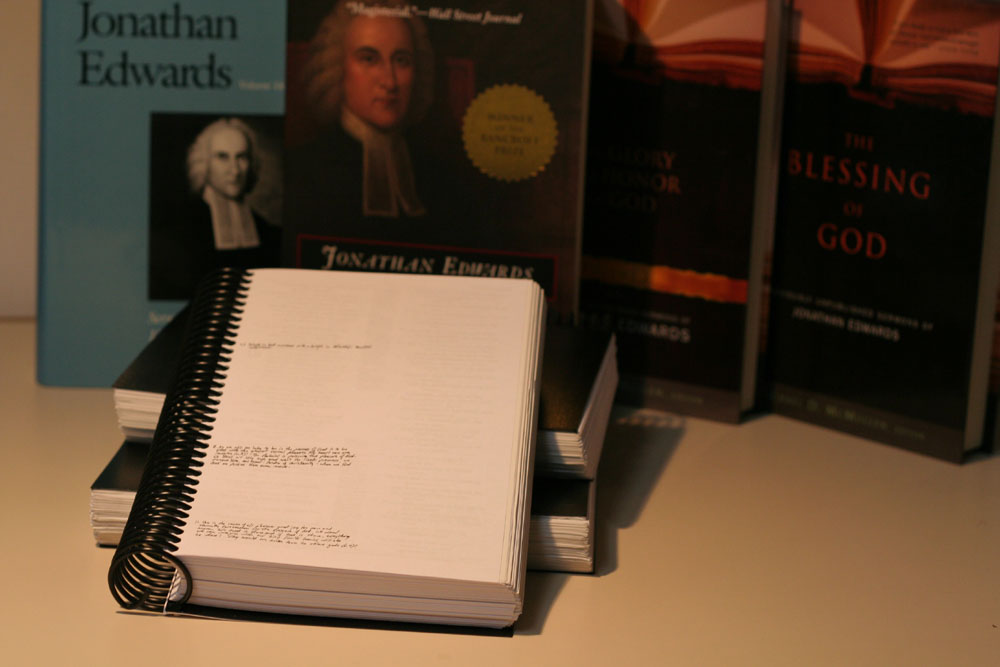
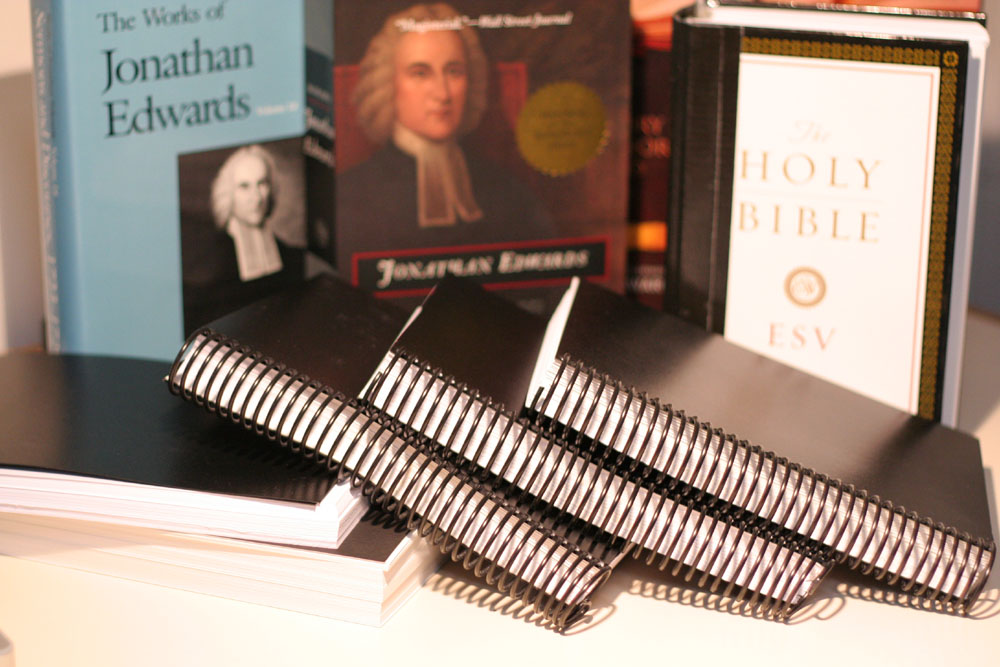
Then back to the office supply store. It took me about 90 minutes to spiral binding punch my Blank Bible (not to be confused with comb binding). Although I searched online and found some 3” spiral binding coils, they were expensive and required a bulk purchase. So I decided to stick with the 1-1/4” coils, the largest common size. This split the growing bible into three volumes (a perfect separation into Gen-Job, Pss-Mal, Matt-Rev). I now appreciate the three-volume format more than at the time.

It was simple to punch and coil the volumes. The final dimensions: 3” thick weighing 3 lbs. 13 oz (I used this ESV bible in all attempts – excellent paper for a project like this).

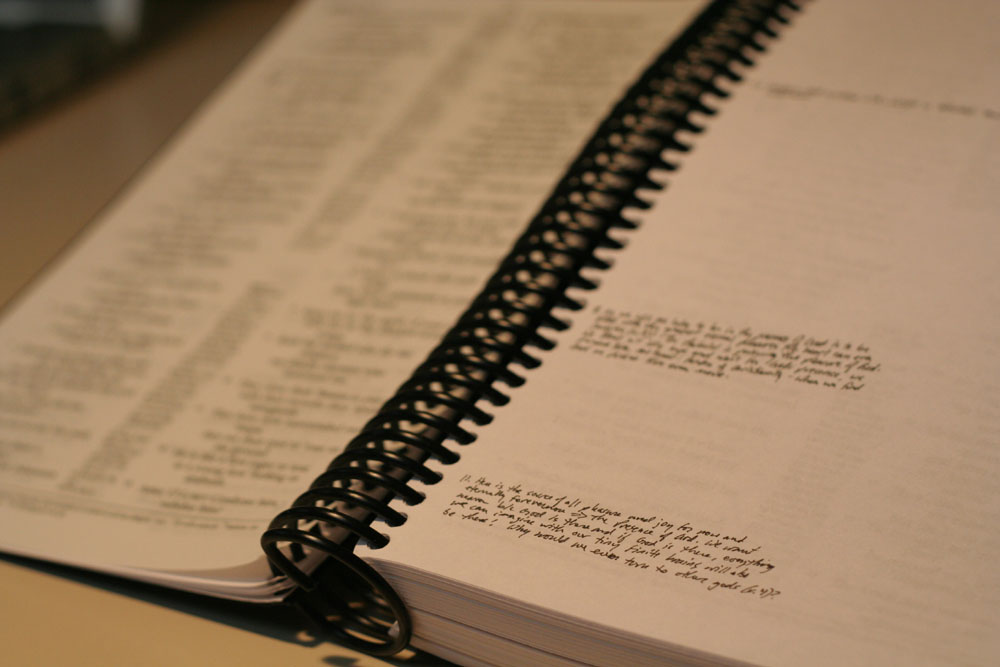
Here is a picture of my first successful “Blank Bible.”

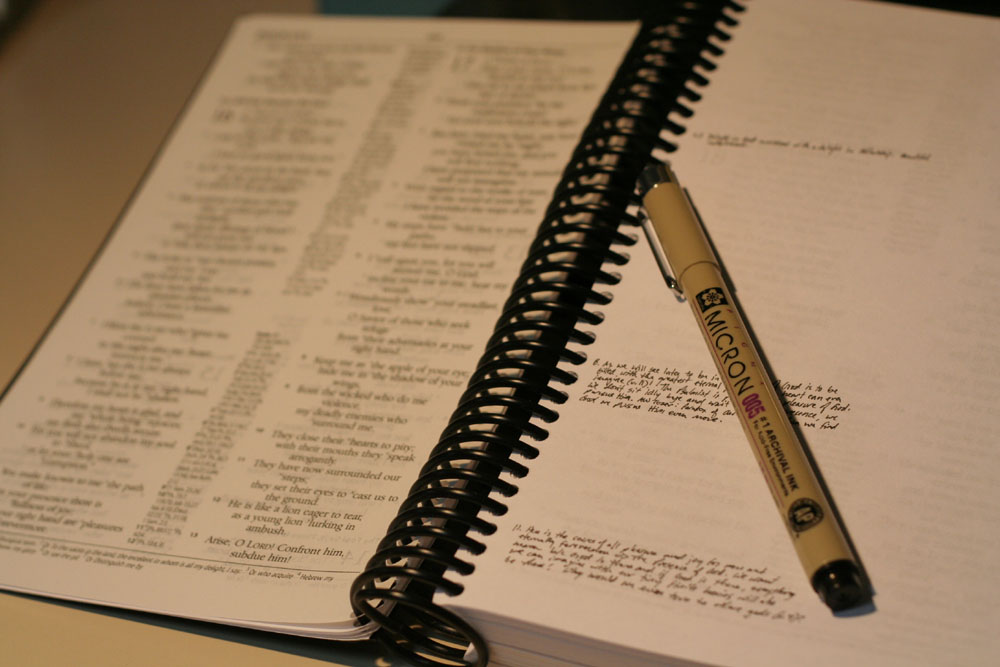
The spiral coils handle very well with the thin bible paper, and they allow the bible great freedom in movement. In general, the bible is very comfy. Taking notes in this bible is graceful, as opposed to the last attempted Blank Bible and even 3-ring bound bibles. I can completely open the bible, giving me full use of each blank page. Because the binding is removable, I can add/replace/subtract pages in the future. Overall, this bible is a good fit for me.


Speaking of note taking (which is really what this bible is all about), I use a special Pigma Micron 005 pen. They come in several colors, are not expensive and available at most art and scrapbook stores.

So this is the story of my Blank Bible. I’m not done, though. In the future I want to try a 3” binding coil to see how the bible feels as a single volume. And I am working with a local university claiming they can bind the bible using an old sewing technique. I’m not sold yet, but it seems to me that even with all these options I will probably return to my 3-volume coil bound bible.

Your turn. What would Edwards say? (Besides the fact that I used a lot of very nice, clean paper). Let me know below. How can the Blank Bible be improved? Why would this fit or not fit your needs? Any ideas or suggestions?

Building a Blank Bible (part 2): The Failure

The impending arrival of my precious wife’s birthday in April is what started this all. I had been kicking around the idea of the “Karalee’s Blank Bible” for the special occasion.

Since my wife and I are in the process of transitioning into a Sovereign Grace Ministries church, I decided the blank bible would need to be an English Standard Version. I chose the hardcover version with fairly thick paper.

The first step was to cut the cover off with a utility knife so all that was left were the pages and a thick line of plastic glue on the binding.

Cutting off the binding is the next step is really the key to the entire project. For a carpenter, I chose to use my table saw. I sandwiched the pages of the ESV bible tightly between two boards and set the guide on the table saw to take just 1/8th of an inch off the binding. This was enough to get the glue off completely. Without the boards pressing the binding tight, the saw would mangle the binding edge pretty badly. So it’s critical to tighten the binding down when it’s being cut off.

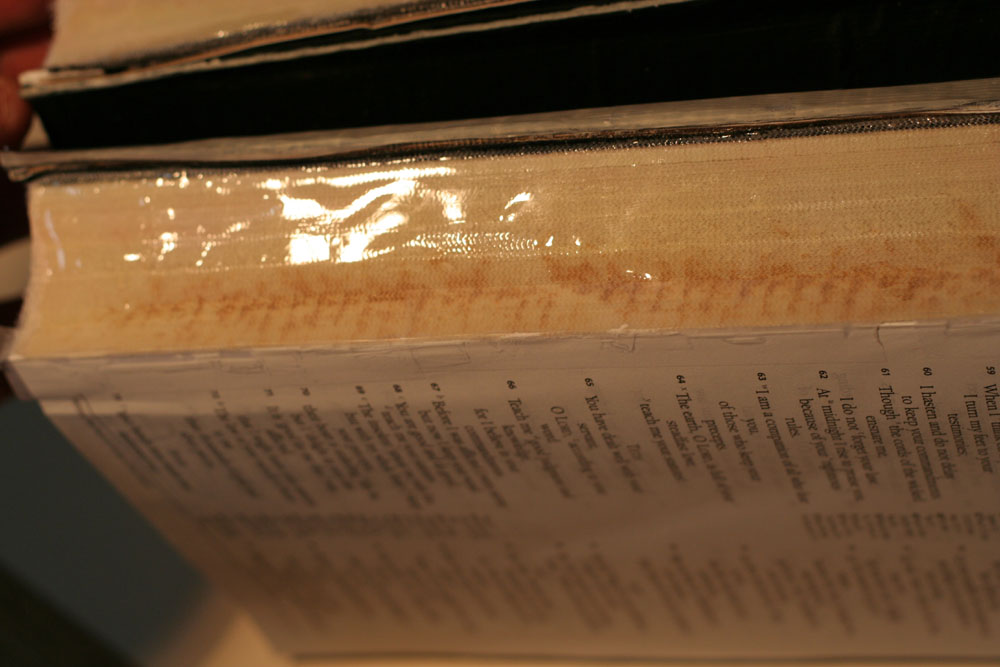
You can see from the following picture what the binding looked like when I was done cutting (bottom stack – bible; top stack – blank pages).


I have also tried bringing books to Kinko’s to have them cut the binding with a knife. This does not work because the knife only works with paper that freely moves (like a ream of paper). The binding of a book holds and binds in the knife causing the knife to stair-step cut the book. Sadly, I had a Greek interlinear mangled this way.

Okay, once the binding is off I go to a local office supply store. I pick out a ream of acid-free paper and show them the exact size of my bible (now cut and with loose pages). The smiley attendant behind the counter uses a big paper knife to cut the new blank pages to the exact dimensions of my bible. Then I go home and in about 45-minutes insert blank pages where I wanted them in the bible. (It does take a little concentration to keep the pages in order.)

Be careful not to forget pages or you will end up with a Jefferson Bible and not an Edwards Bible. Big difference. More about how and where I inserted blank pages tomorrow.

For “Karalee’s Blank Bible” I clamped all the pages together so the binding edge was easy to work with. Here is where my regret begins.

I chose to work with a 2-part epoxy mix that would glue the binding of the pages together. It’s a very strong mix and for a few days did a great job holding the binding together. Two days after the birthday I noticed a few cracks beginning to develop and after four days, the bible had completely split in two areas.

There were two prominent problems:

1. The binding was too stiff and the bible was simply not comfortable to use.

2. The binding was too risky. The bible could crack at any place depending upon how well each piece of paper was glued. Most books are bound as several little books and then bound into one big book so the demands from each page are minimal. With this binding each page must be glued well and must hold well over time. Too much to ask from paper.

I was certain I had figured out the best way to remove the binding and a good process to get blank pages cut and a good plan for where to insert blank pages in the bible. But the “Karalee’ Blank Bible” was not an heirloom-worthy project.

So back to the drawing board I went …

Building a Blank Bible (part 1)

As promised, this week I’ll be showing you how to build your very own Blank Bible. But first, why would you want one? I don’t know of any publishers who make them and it’s a little time consuming to build. So why go through the work?

Well, there are several reasons actually.

The most important reason being you can keep those precious biblical insights close to the texts they originate. I have a drawer full of notes I’ve scratched out while listening to sermons over the years. And even at times I’ve used a Moleskine notebook for the same purpose. However, notecards and notebooks are scattered and disorganized. Unless I specifically recall a sermon on a certain text, the notes are largely forgotten in a large stack.

Owning one Bible with enough room to hold your personal notes close to the Biblical texts means the next time you study Ephesians you will have the notes from a Bible study on Ephesians five years ago.

Second, a Blank Bible is a great place to collect the fruit of your own meditation. Don’t fill the Blank Bible with notes you can find in any commentary. Make the notes in this bible flow from your own personal reflection and let the commentaries point out the exegetical and technical stuff.

Third, it’s a simple fact that we remember things better if we think about them and write our recollections down. Journaling is a good example of this and the Blank Bible affords enough space.

Fourth, just as Jonathan Edward’s Blank Bible is now a national treasure, your insights may also be treasured by someone else. Whether you leave the Bible to your spouse or children or grandchildren, when you are gone your Bible will continue to speak. So think and write clearly.

Tomorrow … the first attempt at the Blank Bible. And since there will be a second I’ll assume you already know the first was a failure.