Breakout 1 > 2007 Sovereign Grace Leaders Conference

Thursday morning (4/12/07)
Breakout seminar #1
Rick Gamache: “Watch Your Devotional Life”

GAITHERSBURG, MD – Over the past few months I have come to see my pastor Rick Gamache as the most gifted leader and preacher I have had the privilege of seeing up close. And although I see him all the time, I wasn’t about to miss his breakout session incj-mahaney.jpg the Pastors College classroom. No regrets.

As he and associate pastor Mark Alderton preach through Acts on Sunday morning at Sovereign Grace Fellowship (Minneapolis, MN), they have especially pointed out the correlations between the Apostolic church and the contemporary Sovereign Grace church. Recently a sermon on Acts 6 outlined the role of deacons and thus the role of pastors. Acts 6:1-7 also became the primary text for Gamache’s breakout seminar, Watch your Devotional Life: The Pastor’s Communion with God. The text reads,

1 Now in these days when the disciples were increasing in number, a complaint by the Hellenists arose against the Hebrews because their widows were being neglected in the daily distribution. 2 And the twelve summoned the full number of the disciples and said, “It is not right that we should give up preaching the word of God to serve tables. 3 Therefore, brothers, pick out from among you seven men of good repute, full of the Spirit and of wisdom, whom we will appoint to this duty. 4 But we will devote ourselves to prayer and to the ministry of the word. 5 And what they said pleased the whole gathering, and they chose Stephen, a man full of faith and of the Holy Spirit, and Philip, and Prochorus, and Nicanor, and Timon, and Parmenas, and Nicolaus, a proselyte of Antioch. 6 These they set before the apostles, and they prayed and laid their hands on them. 7 And the word of God continued to increase, and the number of the disciples multiplied greatly in Jerusalem, and a great many of the priests became obedient to the faith.”

Pastors are mainly devoted to preaching and prayer. So the exhortation is for pastors to watch their preaching and prayer. This particular session was an exhortation for pastors to guard their prayer life.

Only three out of 10 pastors pray for 15 minutes each day. But here in Acts “the twelve” call out seven Spirit-filled deacons to care for the widows. This would free the Apostles to “devote” themselves to their leadership/pastoral task. The term “devote” (προσκαρτερησομεν) here is a strong word in the text. Even at the expense of other ministry opportunities, they were to “devote” themselves to a narrowed focus.

This priority is especially astonishing given the importance needy widows occupy in the New Testament. “Religion that is pure and undefiled before God, the Father, is this: to visit orphans and widows in their affliction” (James 1:27). By finding deacons to care for the widows highlights the significance of prayer in the pastoral life. The feeding of the widows was a threat to the Apostles — not because it was intrinsically a bad ministry — but because it hindered their primary duty. This reveals that the early leaders of the church did not have short prayer times in mind since it demanded a clearing of the schedule. They spent a lot of time at preaching and public/private prayer. This made it necessary to say “no” to other ministry opportunities. For example, being devoted to my wife does not mean I spend all my time with her. But it does mean she is a chief priority and because of this I must say ‘no’ to many good things. The same is true of prayer in the pastoral life.

Not only does Scripture call us to be “devoted” to prayer (Acts 1:14, 2:42), but Paul commands us to prayer (Rom. 12:12, Col. 4:2). A life devoted to prayer is the call of all Christians, and especially pastors. We need to watch it! Good ministry opportunities crowd in and demand time, but we must not let ministry become its own worst enemy. C.H. Spurgeon once said in a sermon,

“Sometimes we think we are too busy to pray. That is a great mistake, for praying is a saving of time. You remember Luther’s remark, ‘I have so much to do today that I shall never get through it with less than three hours’ prayer.’ … If we have no time we must make time, for if God has given us time for secondary duties, He must have given us time for primary ones, and to draw near to Him is a primary duty, and we must let nothing set in on one side. You other engagements will run smoothly if you do not forget your engagement with God” (Spurgeon, Sermons, vol. 18).

It would not be a Sovereign Grace conference unless every session was connected to the Cross. Gamache reminded us that our access to God in prayer comes through the work of Christ alone (Heb. 10:19-22). We must confess our inability to draw near to God based upon our own merits. The holiness of God does not consume us because of the Cross!

Neglecting the invitation is spiritual foolishness. We are called to ask, seek and knock (Luke 11:9-13). God promises to act when we pray. There is a cause-and-effect relationship to prayer. God says, “I will let your prayers effect My universe.” Amazing! Spurgeon writes: “We do not bow the knee merely because it is a duty, and a commendable spiritual exercise, but because we believe that, into the ear of the eternal God, we speak our wants, and that His ear is linked with a heart of feeling for us, and a hand working on our behalf. To us, true prayer is true power” (An All-Around Ministry, p. 13).

Psalm 50 shows the relationship of a breathtaking God and our drawing near to Him. In the first 14 verses we see a glimpse of the power and majesty of God. In verse 15 we are summoned: “and call upon me in the day of trouble; I will deliver you, and you shall glorify me.” When we pray, we get the help and God gets the glory.

Pursuing the ministry without prayer is pride. Pastors are called to labor to “save some” (1 Cor. 9:22). The harvest is ready but the workers are few (Luke 10:1-8). Without God working in me, I will watch sinners run headlong to hell and my heart will be unmoved. God must be at work in our ministry and affections. Pastors are called to “stir up one another to love and good works” (Heb. 10:24) and work for “your progress and joy in the faith” (Phil. 1:25). These callings make the pastor feel really needy! We are incapable of eternal fruit without the work of God. Thus, “Prayer is a means of crushing my self-sufficiency.”

“My life as a pastor is a life of war.” Seasons of blessing can lull us into a peacetime mentality. We can easily forget our dependence. “We will not drift into prayer but we will drift into prayerlessness.”

Gamache concluded with some practical advice for watching our prayer lives.

1. Structured and unstructured prayers. Sometimes we should just spill our hearts out to our Daddy. And there are times prayers will be shaped by prayer folders. Structure your prayer around Scripture as you are reading. There is a connection between prayer and the abiding Word in our hearts. Jesus said, “If you abide in me, and my words abide in you, ask whatever you wish, and it will be done for you” (John 15:7). Also, there is a connection between knowing His will in Scripture and praying according to that will: “And this is the confidence that we have toward him, that if we ask anything according to his will he hears us” (1 John 5:14). Also, the Word and prayer are interconnected because the Word produces faith (Rom. 10:17) and that faith is essential to prayer (Matt. 21:22).

2. Expressing deep needs and high joy in prayer. We praise God in prayer as He meets us in our darkest despair and when He meets us in our delights!

3. Long and short prayers. Quick outbursts of prayer throughout the day and longer prayers that “linger.” Spurgeon says, “pray until you pray.” Linger in prayer until you enter into the spirit of prayer. Pray for prayer.

4. Spontaneous and scheduled prayers. Learn to pray throughout the day and also plan your prayers.

In all, it was an excellent breakout session and I was blessed to be there. Prayer is no strength of mine and I’m better encouraged and equipped to pursue prayer more faithfully. I’m motivated to excel, not out of guilt or condemnation of failure, but because prayer is our access to the fountain of God’s blessing!

But what most comes to mind when I recall this session is that prayer is the means of “crushing my self-sufficiency.” And prayer seems to be an excellent gauge of my understanding of the immensity of the pastoral task and my own utter dependency upon God.

—————

Related 2007 SGM LC sessions:


1. 2007 Sovereign Grace Ministries Leadership Conference

2. R.C. Sproul: “The Holiness of God”

3. Rick Gamache: “Watch Your Devotional Life”

4. Mark Dever: “Watch the Past: Living Lessons from Dead Theologians”

5. David Powlison: “‘In the Last Analysis…’ Look out for Introspection”

6. C.J. Mahaney: “Trinitarian Pastoral Ministry”

7. 2007 Conference photographs

The need of every age: Further biblical discovery

We cannot talk of Owen this week without hearing from him. A while back I found this excellent encouragement for preachers going into Sunday. Go deeper and deeper into Scripture. Go deeper than your sources. I’m certain he would say, ‘go deeper than John Owen’ …

“The joint consent of the fathers or ancient doctors of the church is also pretended as a rule of Scripture interpretation [in Roman Catholic interpretation]. But those who make this plea are apparently influenced by their supposed interest so to do. No man of ingenuity who hath ever read or considered them, or any of them, with attention and judgment, can abide by this pretense; for it is utterly impossible they should be an authentic rule unto others who so disagree among themselves, as they will be found to do, not, it may be, so much in articles of faith, as in their exposition of Scripture, which is the matter under consideration. About the former they express themselves diversely; in the latter they really differ, and that frequently. Those who seem most earnestly to press this dogma upon us are those of the church of Rome; and yet it is hard to find one learned man among them who hath undertaken to expound or write commentaries on the Scripture, but on all occasions he gives us the different senses, expositions, and interpretations of the fathers, of the same places and texts, and that where any difficulty occurs in a manner perpetually. But the pretense of the authoritative determination of the fathers in points of religion hath been so disproved, and the vanity of it so fully discovered, as that it is altogether needless farther to insist upon it. … Of those who designedly wrote comments and expositions on any part of the Scripture, Origen was the first, whose fooleries and mistakes, occasioned by the prepossession of his mind with platonical philosophy, confidence of his own great abilities (which, indeed, were singular and admirable), with the curiosity of a speculative mind, discouraged not others from endeavoring with more sobriety and better success to write entire expositions on some parts of the Scripture: such among the Greeks were Chrysostom, Theodoret, Aretine, Oecumenius, Theophylact; and among the Latins, Jerome, Ambrose, Austin, and others. These have been followed, used, improved, by others innumerable, in succeeding ages. Especially since the Reformation hath the work been carried on with general success, and to the great advantage of the church; yet hath it not proceeded so far but that the best, most useful, and profitable labor in the Lord’s vineyard, which any holy and learned man can engage himself in, is to endeavor the contribution of farther light in the opening and exposition of Scripture, or any part thereof.”

– John Owen (1678), Works 4:227-228

The Puritan Study (Part 11) Concluding Thoughts, part 2

Part 11: Concluding Thoughts, part 2

Finally, the conclusion of the Puritan Study comes today. I wish I could continue on in this study but I must move on. Thank you for all the very kind emails and helpful suggestions throughout this series. Seeing others come to a deeper appreciation of the Puritan literature has been an incredible encouragement to me.

Here is a collection of final thoughts …

Expositional Puritans

I think it’s worth noting again that in this series of blog posts I have emphasized the most important Puritan resources for expositional research. Other Puritans are useful on a number of issues.

I like Baxter, Burgess, Watson and other Puritans. But these and other Puritans simply have not helped me when I’m under pressure to preach and write expositionally on a certain text. Spurgeon, Bunyan, Owen, Boston, Manton and the men I have promoted, however, have proven faithful in these situations.

If you are more interested in systematic theology, or apologetics, or church history, you will find other Puritans to be of great help. Here, we were concerned with the most effective Puritans for expositional sermon preparation and ranked these authors in order of availability and usefulness.

Dutch ‘Puritans’

I was hoping to use this series to begin introducing you to the Dutch ‘Puritans’ (they are not really called ‘Puritans,’ but ‘the Dutch Second Reformation Divines’). These authors ministered during the same period of time as the English Puritans we know well, but their works were originally published in Dutch. Thanks to the recent work of the Dutch Reformed Translation Society, these works are now being made available in updated English. After some time reading these Dutch works, it’s clear these authors were as mature and experiential as their English counterparts.

Among others, the Dutch ‘Puritans’ include Wilhelmus à Brakel, Willem Teellinck and Herman Witsius (whose works have been in English for a few years now). Teellinck’s book on living a holy life (The Path of True Godliness) is very valuable and will be the subject of an upcoming book review.

These Dutch authors are very powerful and, although many of them will not be indexed and easily accessed, an introduction to their works was warranted at the end of this Puritan study. More information this winter …

Tough and Tender

John Piper once said, “one of my great desires is to see Christian pastors be as strong and durable as redwood trees, and as tender and fragrant as a field of clover.” This ideal finds its origin in the words and works of Jesus Himself. He knew when to be tough and when to be tender. He was strong and resolute but loving, kind, and compassionate, too. Many Puritans remind me of men who were uncompromising and stable in their convictions. They were a forest of redwood trees. But these preachers often displayed a compassionate tenderness like a fragrant field of clovers, too. An excellent pattern for preachers today.

The Presence of God

Many things draw me to the Puritans, but one of the most important is their pursuit of God. They see the Psalms as a blueprint for the Christian life – striving and praying for the presence of God to draw near (see Pss. 16, 42, 73). You can spot authors who read much of the Puritans because they, too, have a healthy and well-developed desire to pursue the presence of God (see A.W. Tozer, Martyn Lloyd-Jones, John Piper, etc.).

Personal change

I did not realize what was happening, but for several years as I have used the Puritan literature, I thought I was just borrowing a few quotes and thoughts along the way. Now it is obvious that over those years I was being changed.

What I love most about the Puritans is how they have been used in changing me. I treat the Word with more sobriety and seriousness now. My application of the text is much more mature. I am more articulate in pointing my hearer’s affections towards the things God sees as precious (like His Son, His holiness, His justice, love and grace).

Specifically, three areas of my life have been changed due to my Puritan Study …

(i) In catching the Puritan hermeneutic. The Puritans interpret every passage in light of the big picture of God’s glory in the Cross of Christ. Everything comes back to this. As expositors we are apt to get wrapped up in our four verses and lazily forget this big picture. The Puritans, especially in their application, make it clear that every text must be brought back to this big picture. Sadly, very few expositors today do this consistently (Piper and a few others, however, excel here). I pray that we would all catch this Puritan hermeneutic. Spurgeon reminded preachers that every sermon must find a way back to the Cross. This was the Apostle Paul’s point exactly (Gal. 6:14, 1 Cor. 1:22-25; 2:2; Phil. 3:8).

(ii) In catching the Puritan experiential style.
When publishers want a good definition of ‘experiential preaching’ they turn to Puritan scholars. In the book, Feed My Sheep: A Passionate Plea for Preaching (Soli Deo Gloria, 1573581445), Dr. Joel Beeke writes: “Experiential or experimental preaching addresses the vital matter of how a Christian experiences the truth of Christian doctrine in his life … Experimental preaching seeks to explain in terms of biblical truth how matters ought to go, how they do go, and what is the goal of the Christian life … Experimental preaching is discriminatory preaching. It clearly defines the difference between a Christian and a non-Christian, opening the kingdom of heaven to one and shutting it against the other” (pp. 95-96). The Puritans understood that a sermon lacking powerful application is an incomplete sermon. The Puritans are unparalleled here.

(iii) In catching the Puritan earnestness. The Christian life is a struggle of balance. The same is true in the pulpit. It is easy to focus on strengthening marriages, helping others raise children, and overall improvements in godliness while lacking earnestness. We can get the idea that the purpose of the pulpit is only for long-term sanctified changes. We need the Puritan earnestness to remind those who have never experienced the grace of God in their own hearts (the ‘almost Christian’ sitting in the pew), that they teeter on the brink of God’s judgment. There may not be a tomorrow. Each of us will be in heaven or hell very shortly. Nothing guarantees the sinner one more day to repent. Now is the time. Today is the day of salvation. Plead with sinners. The Puritans balanced these two sides of preaching and teach us to use the same sermon to both strengthen Christian marriages (long term) and to plead with sinners earnestly (now).

Conclusion

In the end, the ultimate benefit of a (well-used) Puritan library is how it changes you. Because of the Puritans, I view the bible differently, more seriously. They have taught me deep thoughts so I am not easily distracted with the empty and hollow ‘Christian’ thoughts today. They have taught me to treasure Christ. They have pointed out the sin in my heart. They have encouraged me in the task of preaching. And they have been faithful friends pointing me back to the scriptures when I begin to wander around. ‘Be serious because God’s thoughts are weighty,’ is the Puritan message I hear every time I use their works.

So keep at it. Work hard. Study diligently. Learn new terms. Don’t be intimidated by 200-word sentences. Grasp the concepts. Learn from the Puritan big-picture. And one day you will realize that God’s Spirit has taken the Puritan Study from your shelves and into your heart and changed you forever. All for His eternal glory.

Soli Deo Gloria!

The Puritan Study (Part 9) The Strategy of Building a Puritan Study

Part 9: The Strategy of Building a Puritan Library

I assume many of you are like me, lacking access to a solid library of Puritan literature. Here in my hometown we have no seminary and it is rare to find a fellow believer who has even heard of Spurgeon, not to mention Boston, Manton and Goodwin.

So building a Puritan library was my responsibility. I just started buying Puritans that I had indexes for and especially the Puritans published by The Banner of Truth. I learned from both my successes and mistakes.

The Strategy

First, I assume you already spend a fair amount of money on books right now. If you are like me, you probably look around your library with regret at some of the volumes that serve no purpose in your expositional research. For years, my library suffered from a clear game plan.

A poorly planned library will lack important reference books like commentaries and Puritan sermons. It will be heavy on contemporary controversies and issues books. Read blogs if you want to be up-to-date on the current trends in the church. Buy commentaries and Puritans if you want a solid expositional library.

A solid library that helps support the preacher or writer in their expositional work is no accident.

This post will help you define your own personal game plan.

Bottom line

The Puritan Study I have described in this series comes to a grand total of $1,500.00. That sounds like a lot but it figures out to $1.40 a day for 3 years (which is about what I spend at Starbucks). And to have this entire library in three years is pretty fast!

I’ve broken down my list of Puritans into $500 segments. Again, this list is ordered by availability and usefulness of each author. Your first $500 will be the best-spent money. The second and third $500 increments are important but not immediate.

(Note: What follows is a simple strategy for building a Puritan library. Specific reviews of each author and set will follow the Puritan Study series. Pictures of each set can be seen here. Updated (3/17/07): Note that most of these resources can be found at a more reasonable price through Monergism Books. Please check them before making any purchases.)

Here is my strategy, broken into three phases…

// THE FIRST $500

1. Charles Haddon Spurgeon (63 sermon vols.; CD-Rom)

I cannot begin with any more important preacher than Charles (C.H.) Spurgeon. The Puritans thoroughly impact everything Spurgeon preached or wrote. Look at his commentary on the Psalms (The Treasury of David) and you will see why Spurgeon is a priceless Puritan resource. He is the great Puritan synthesizer. Spurgeon’s complete works total about 150 volumes and you can download them all for $15.00 or buy the CD-Rom for $20.00 from Ages software. (If you have extra money, I would recommend buying some printed volumes from Pilgrim Publications but especially his autobiography and the classic book on pastoral ministry, Lectures to My Students.) [Read Piper’s biography of Spurgeon here]

2. Jonathan Edwards (2 vol. works; printed)

An extraordinarily rich resource! These two volumes of works by Jonathan Edwards are gems to the Puritan researcher. I would recommend the Banner of Truth volumes for their sturdy binding. You can buy volumes one and two here in the Banner of Truth editions or a cheaper version. The complementary text files can be found online for free. [Read Piper’s biography of Edwards here]

3. John Bunyan (3 vol. works; printed)

John Bunyan is most famous for his novel, The Pilgrim’s Progress. But he was also an incredibly gifted (and imaginative) preacher. These three clothbound volumes from the Banner of Truth are well built and come with an excellent topical index. You can find them for about $89.00. All of the associated text files can be found online for free. [Read Piper’s biography of Bunyan here]

4. Thomas Boston (12 vol. works; printed)

Jonathan Edwards considered Thomas Boston, “a truly great divine.” Boston is one of my personal favorites. These precious volumes have provided me many years of sermon quotes and exegetical thoughts on God’s Word. The entire 12-volume set has been recently published by Tentmaker in a beautiful cloth binding and is available in the United States for $325.00 here or $250.00 here. Worth every penny! You can buy the incredible Memoirs alone. [Read our full review of this set here]

5. Thomas Manton (22 vol. works; CD-Rom)

A set that is simply too large to make affordable in print format. The CD-Rom of Manton’s complete 22-volume set can be purchased for only $10.00. A great price for a must-have set of works! The first three volumes are avaliable in print.

// THE SECOND $500

6. John Owen (16 vol. but especially vols. 1,2 and 6; printed)

All of John Owen’s 16-volumes works are excellent. I especially have found volumes one, two, six and seven of great use. You can add other volumes in the future but these three are essential. The volumes are clothbound (as you would expect from the Banner of Truth) and run about $25.00 each or $75.00 total. The text files are available online for free but you will want to read these volumes cover-to-cover, making the printed works a must. [Read Piper’s biography of Owen here]

7. John Flavel (6 vol. works; printed)

Another excellent Puritan I have used on several occasions. Your meditations and sermons will be greatly blessed by Flavel. The Banner of Truth volumes are clothbound and beautiful. They sell for $150.00.

8. Richard Sibbes (7 vol. works; printed)

The “sweet dropper,” Sibbes was an incredible Puritan preacher. The Banner of Truth volumes are clothbound and run $126.00.

9. Jeremiah Burroughs (misc. books; printed)

Burroughs is the most difficult author on the list because his works are not collected and published by various companies. Several of his works comprise the Gospel Life series ($91.00). The six titles include Gospel Worship, Gospel Fear, Gospel Conversation, Gospel Revelation, Gospel Remission, and Gospel Reconciliation. Beyond this there are other Burroughs titles in print including The Sinfulness of Sin or The Evil of Evil ($17.00), The Excellency of a Gracious Spirit, Hope ($15.00), Irenicum to the Lovers of Truth and Peace ($22.00), The Rare Jewel of Christian Contentment ($6.25), The Saints’ Happiness, The Saints’ Treasury and A Treatise of Earthly-Mindedness. All told, it would be easy to spend $180.00 on Burroughs alone. Still, his works are indexed and very valuable.

10. Thomas Brooks (6 vol. works; printed)

The Complete Works of Thomas Brooks in six volumes is available in cloth binding from Banner of Truth for $140.00. One Puritan scholar says of Brooks, “He had a body of divinity in his head and the power of it in his heart.” Incredible material!

// THE THIRD $500

11. Thomas Goodwin (12 vol. works; printed)

Reformation Heritage Books has recently reprinted the paperback version of Goodwin’s 12 volume works. This is a great service to the Puritan community and can be purchased for $240.00. I have yet to read a Puritan that glorifies the person and works of Christ more than Goodwin. [read our full review here]

12. John Newton (6 vol. works; printed)

“Amazing grace, how sweet the sound, that saved a wretch like me” are the words of John Newton. An excellent preacher, his complete works are available in cloth binding for $144.00. [Read Piper’s biography of Newton here]

13. David Clarkson (3 vol. works; printed)

Not as experiential as the authors above, but well indexed and valuable. The works of David Clarkson are available for $62.00.

14. Edward Reynolds (vols. 1,4,5,6 of 6 vol. works; printed)

Like Burroughs, the complete works of Reynolds are not available. Today there are five volumes in print: Commentary on Ecclesiastes, Meditations on the Holy Sacrament of the Lord’s Last Supper, Preaching Christ, Sinfulness Of Sin and Treatise on the Passions and Faculties of the Soul. All these valuable volumes can be purchased for about $115.00. Spurgeon wrote, “Reynolds was a man of vast learning and thoroughly evangelical spirit.” The digital files are beginning to appear on Google books for free download.

Conclusion

By this point you may feel totally overwhelmed (and broke). Remember, this is a long-term goal.

I don’t even think it would be beneficial to buy all these works at once! Slowly add works as you grow comfortable with the ones you already have.

If you follow this plan you will spend your money wisely and have a storehouse of expositional material at arm’s-reach. This is my promise to you: Even if the Lord blesses you with 30 more years of expositional ministry, you will never exhaust the Puritan Study you built in three years.

————–
Next time … Part 10: Concluding Thoughts, part 1
—————

The Puritan Study (Part 5) Print book searches

Part 5: Print book searches

We have spoken much about the Puritan literature; today we begin looking at real research. In the next post we will specifically cover e-Puritan searches, but today we are concerned with using printed Puritans.

Printed indexes

One of the most important resources available to the Puritan researcher are the printed indexes. This is true in both the works of a single author and in the Puritan index by Robert Martin (A Guide to the Puritans).

Thomas Manton

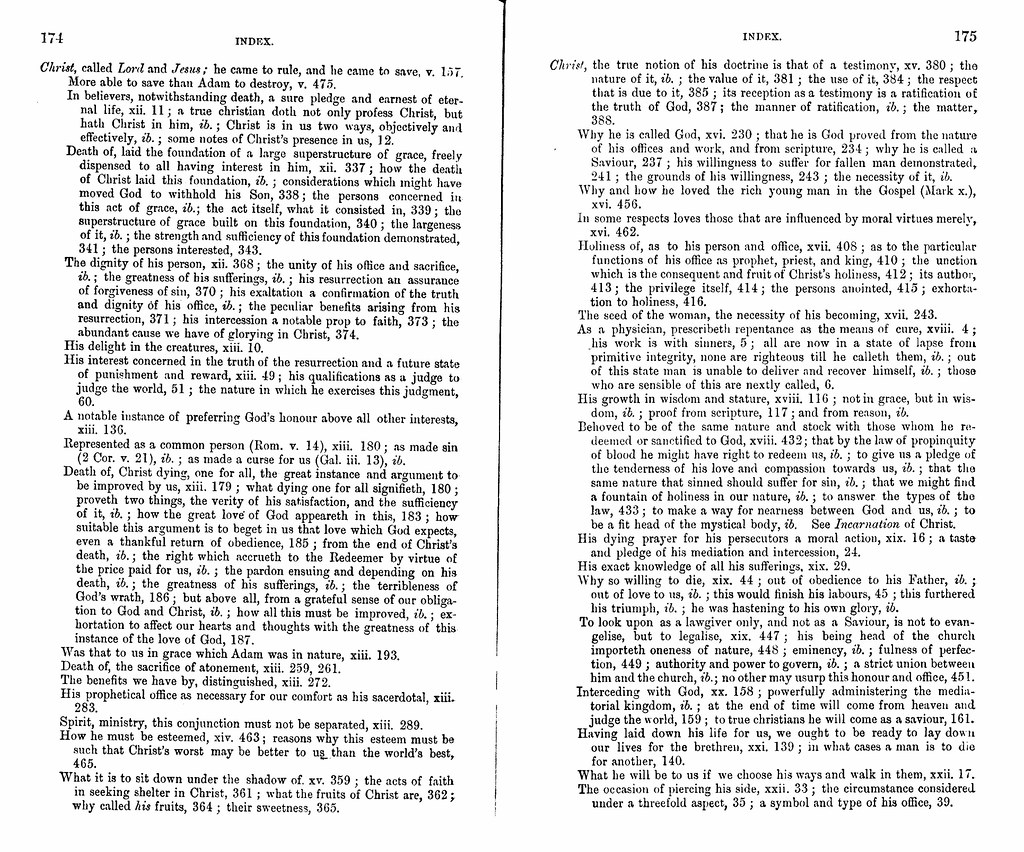
There are two reasons why Puritan Thomas Manton is my homeboy. First, his sermons are filled with rich exposition and pastoral warmth. When I really need a quote to convey a deeper truth, Manton is my source. And second, whoever edited his complete works did an incredible job (and an incredible service to preachers today) by including a detailed index. His 22-volume works (available on CD-Rom) conclude with over 300 pages of textual and topical indexes! A dream for the researcher.

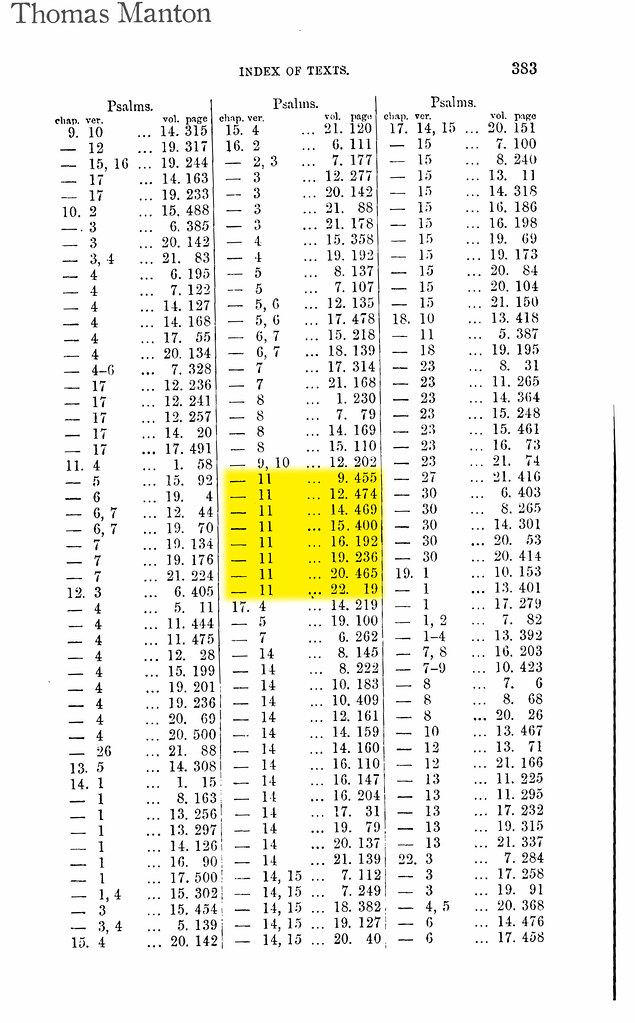
From the screenshot to the right, you can see two pages from Manton’s topical index.

But Manton is not alone. The Complete Works of John Bunyan, Thomas Brooks, John Flavel and Richard Sibbes all come with excellent topical indexes.

Topical index

As an aside, I was speaking with a close friend recently who admitted that keeping a list of quotations was very difficult for him. One of the great difficulties to making an effective index of quotations is an inability to view an individual quote within the big framework. Some will read a quote about the power of the Cross without thinking how it would be properly indexed (ex. Christ > the Cross > effects of > power in believer).

To me, this is why the Puritans are liberating. Once you determine the general content of your sermon, you can go searching for great quotations! Surrounding yourself with quality Puritan literature will lessen the importance of a lengthy quote index.

As another example, I don’t have many quotations indexed on the sobering topic of God’s eternal judgment upon sinners. And I don’t need to. All I need to remember is that Jonathan Edwards preached a few incredible sermons (like Sinners in the Hands of an Angry God) and John Bunyan preached another very quotable sermon on the same subject (A Few Sighs from Hell). Allow a little time to read and soak these sermons in and you will have all the quotes you could imagine on the subject.
This makes the topical Puritan index by Robert Martin, A Guide to the Puritans, especially important. Because while I knew that Edwards and Bunyan preached on the subject of God’s judgment, I was unaware that John Flavel (3:129-153), Thomas Boston (8:347-375) and Thomas Brooks (5:113-145) had also preached important sermons on the subject.

The wealth of Puritan sermons make personal quote indexes unnecessary.

Back to Psalm 16:11

As we began in Part 4, we are researching Psalm 16:11 as an example. And in studying our text we have three avenues of research open to us with these printed volumes.

(i) Primary text as sermon text
. Of our 14 top Puritans, none preached sermons where Psalm 16:11 was their primary passage (Why not? I cannot say). If you are searching on a text and you find two or more sermons where your text is the primary text, you may have all the content necissary for your Puritan research. But our problem here is a common one. On Psalm 16:11 we will need to dig deeper.

(ii) Primary text as indexed text. I will use the scripture index from Manton as an example. If you look to the screenshot to the right you will see that Psalm 16:11 was a topic of concern for Manton throughout his ministry. We see this especially in the following works in the following places: (volume: printed page) 9:455; 12:474; 14:469; 15:400; 16:192; 19:236; 20:465; 22:19. And these references come from just one of our 14 Puritan friends.

(iii) Cross-reference text as sermon text. If you need more information from the cross-references, follow the steps for (ii) except with other texts like Ps. 36:8.

You can use these principles on any text or topic study. Just find the biblical passages and track down the references in the scripture index or look up the topic in the topic index. The printed editions of the Puritan works remain important for these indexes.

Examples

Now a few references from Manton that I found as a result of my research.

Manton, 9:455 – “What can be found in the creature is but a drop to the ocean in comparison of what a believer findeth in God himself. God is to them an overflowing fountain of all felicity … Here (in this life) it admits of increase and decrease; but there the soul is so filled that it cannot receive any more: Ps. xvii. 15, ‘As for me, I will behold thy face in righteousness; I shall be satisfied when I awake with thy likeness.’ … In heaven the soul shall be filled with unspeakable joy and delight. What delight is to the sense, that joy is to the mind. Three things are necessary to delight – a faculty, or power of the soul capable of pleasure; and then the thing itself; which being brought to the mind, doth stir up delight. As in bodily things, colors, fruits, tastes, pleasure consists in the near union and conjunction of these things. The more noble the faculty, the more excellent the object; the nearer the conjunction, the greater the delight and pleasure. Now in heaven our faculties are perfected: God is the subject, and there is a near conjunction. Oh! What embraces between him and the soul!”

Manton, 22:19 – “The tree of life is gone, when paradise was defaced by the flood; but God hath provided a better life by the death of his Son, that we should live for ever, both in body and soul, eternally in heaven. Nothing else be this deserveth to be called life. The bodily life is short; it is a dying life or a living death. It floweth from us as fast as it cometh to us; but this never fadeth, but endureth for ever. The bodily life is subject to pain and misery, but the heavenly, full of joy and endless glory. The bodily life is supported with meats and drinks, but there God is all in all. The bodily life is consistent with sin, but this life is pure and perfect” (references to 1 John 3:2, Jude 2-4 and Psalm 16:11).

The options of what we now do with the quotations will be the subject of a later post. My point here is to show that it took just five minutes to find these two references from the works of Manton. I have six others references remaining in the works of Manton and another 13 Puritans I have yet to open.

By using these printed scriptural and topical indexes, it should be obvious that Puritan sermons provide the valuable depth we need in our sermon preparation.

—————
Next time … Part 6: Electronic searches.
—————

The Puritan Study (Part 4) Why our effective use of the Puritans begins with our Bibles

Part 4: Why our effective use of the Puritans begins with our Bibles

In this installment I will be showing you how the Puritans are made useful by our initial use of the bible. In the next two parts we will be looking more specifically at how to search printed books and then how to search electronic books.

Starting with the bible

The big problem with Puritan sermons is that most of us preach differently than the Puritans. They preached on one verse and often jumped all over scripture. We seek to preach through books of the bible and in 4-8 verses (or more) at a time.

A proper use of the bible is really one of the most important keys to unlocking the wisdom of the Puritans.

King James Version

Whether you use the KJV in your sermons or not, use of the Puritans requires an understanding of the KJV. No exceptions. The wording of this translation permeates all Puritan language.

Here is an example of how important the KJV is in Puritan research.

Psalm 16:11

I personally preach from the ESV. But when I study the Puritan sermons, I keep the KJV close.

For today, and in the following weeks, I selected Psalm 16:11 as the example passage we will be researching.

ESV Psalm 16:11 You make known to me the path of life; in your presence there is fullness of joy; at your right hand are pleasures forevermore.

KJV Psalm 16:11 Thou wilt shew me the path of life: in thy presence is fulness of joy; at thy right hand there are pleasures for evermore.

When we look at electronic searches, I will break these translation distinctions down a little more. But what is important here is to note the difference in language. First, the Puritans would not say “in your presence” (ESV) but “in thy presence” (KJV). And even the spelling is different (“fullness” vs. “fulness” or “forevermore” vs. “for evermore”). These may seem like small distinctions, but they make a huge difference in electronic searches. Being aware of this will greatly enhance your Puritan research accuracy.

Breaking the passage down

The Puritans often scatter biblical phrases in their works. So while the Puritans only preached on one text, by the time they were done preaching the sermon on that one verse, several dozen other references were been brought in. In other words, a sermon on Psalm 36:8 (“They shall be abundantly satisfied with the fatness of thy house; and thou shalt make them drink of the river of thy pleasures”) will probably reference Psalm 16:11 (“in thy presence is fulness of joy; at thy right hand there are pleasures for evermore”).

Before we find these cross-references, we need to break our sermon text into its various parts. In Psalm 16:11 I see three principles that are especially interesting to me …

KJV Psalm 16:11 (a) Thou wilt shew me the path of life: (b) in thy presence is fulness of joy; (c) at thy right hand there are pleasures for evermore.

(a) What is the nature of this path of life? Why does God have to show it to me?
(b) What does it mean to be in God’s presence? Can I live in His presence now?
(c) What are these pleasures forever? Can I find an illustration? Can I experience these pleasures now?

You may have many more questions but these are the three questions I will ask my Puritan friends as I study Psalm 16:11.

But we are not yet ready to invite our Puritan friends over.

Cross-references

I don’t use the Puritan sermons for their keen exegetical insights into the text (I let contemporary Hebrew and Greek scholars make those). My main use of the Puritans is for their explanation and application of broad biblical themes. They make concepts come alive in cross-referencing, illustration and application.

It is especially important that we find other biblical texts that say the same thing. The Puritans can make the same conclusion from many different angles using many different texts. Their one-text-at-a-time preaching style is misleading. The Puritans were experts at keeping the big picture in view and bringing in other passages from Genesis to Revelation.

Here are some cross-references that I believe will help me understand Psalm 16:11 better and will open up new paths in my Puritan research. I found them using the Thompson’s Chain Reference Bible and the Treasury of Scripture Knowledge.

(a) The path of life… Prov. 2:19; Prov. 5:6; Prov. 12:28; Matt. 7:14; Acts 2:28
(b) To be in God’s presence… Ps. 17:15; Ps. 21:6; Matt. 5:8; Eph. 3:19; Jude 24; Rev. 7:15-17
(c) The pleasures forever… Ps. 36:8

The Puritans

Now we are ready to search the Puritan sermons. From our observations of the biblical text we have four research options. Beginning with the most important to the least, here are the four research options in order.

(i) Primary text as sermon text. Example: A full sermon on Psalm 16:11.
(ii) Primary text as indexed text. Example: A sermon on Ps. 38:6 that references Ps. 16:11.
(iii) Cross-reference text as sermon text. Example: A full sermon on Ps. 38:6.
(iv) Cross-reference text as indexed text. Example: A sermon on Jude 24 that references Ps. 38:6.

Printed volumes are most helpful for my research in levels (i), (ii) and (iii). I can comfortably read a full sermon on a text (i and iii). And the text index at the end of a printed volume helps a lot in the search (ii). Electronic searches are helpful in all four, but especially in search (iv) when I want to search several resources quickly.

[Note: Often I have enough research material from searches (i) and (ii) that I don’t need to proceed into levels (iii) and (iv).]

Two searches

There are two types of searches … We can search printed works (or those .pdf picture files) and we can also perform electronic text searches. Depending upon your library, you may have more printed works or more electronic books (ideally we want both electronic files and the printed books together).

In the next two posts we will discuss the specifics of the print and electronic searches.

—————
Next time … Part 5: Print book searches.
—————