Book review: The Life and Works of Horatius Bonar (Lux Publications)

Book review:

The Life and Works of Horatius Bonar (Lux Publications)

I build my Christian library around dead guys — not because I think everything old is better — but because I love reading literary affection towards Christ. There was a time when people wrote books (and read books!) simply on the beauty of Christ. No, I’m not kidding.

For the Puritans, the attention shown to every doctrine helps sculpt theological art that cannot help but point our affections towards Christ. The great examples are men like John Owen, John Bunyan, Jonathan Edwards and Samuel Rutherford.

// 1808-1894

But I am likewise growing fond of a pocket of writers contained in the nineteenth century with similar passions. I speak of Charles Spurgeon [1834-1892] who was — and I believe remains — the greatest preacher in church history. By sheer mass of published material he is unrivaled. Another man, Octavius Winslow [1808-1878], has become my favorite writer. His deeply devotional writing reminds me of Spurgeon, but is a bit more concise and pointed. His Precious Things of God and The Fullness of Christ are treasures! William G.T. Shedd [1820-1894] was a great theologian and preacher whose works remain in print today (if you’ve read them you know why). And then there is Andrew Bonar [1810-1892], a capable writer himself, he focused much of his time making sure the life of M’Cheyne and the letters and sermons of Puritan Samuel Rutherford were not forgotten. And he wrote a heartwarming commentary on the book of Leviticus. Can you believe it?

Worthy to be named as one of the preeminent men of the 19th century is Andrew’s brother, Horatius Bonar [1808-1889]. Horatius was a prolific preacher, author, editor and writer of over 600 hymns! His diverse literary talents remind me of Bunyan, his focus on the Cross and his ability to confront doctrinal concerns of the day remind me of Spurgeon.

// Books

Horatius Bonar wrote my favorite book on my favorite topic, The Everlasting Righteousness. In it, he succeeds in simple and passionate explanation of how sinners are made right with a perfect God (justification). If you are having trouble communicating this concept to others, this book would be a great boost!

And there is God’s Way of Holiness, which exhorts believers to fight hard against sin and take holiness seriously. “It is to a new life that God is calling us; not some new steps in life, some new habits or ways or motives or prospects, but to a new life.”

He also wrote books like “The Rent Veil,” “The Blood of the Cross,” and “God’s Way of Peace.” Each of these books grabs the reader to turn our eyes from the hollow worldliness around us towards the eternal beauty of Christ.

His books drip with the blood of Christ as the only foundation for eternal life, as the greatest pursuit of the Christian life and the focus of our eternal delight. No topic, no sermon, no theme, no hymn veers too far from the blood of Christ.

// Cross

Characteristic of these eminent men of an earlier century, Horatius Bonar can (at length) focus his attention on the Cross. No matter the subject. When we need strength for the Christian journey, Christ is our meat and drink. His blood is “a refuge” for “a troubled conscience and a wounded spirit” and “a resting place” for the “sad and weary.” We look to the cross of Christ to be saved and to be comforted.

Bonar writes,

“The cross has many aspects, and embodies marvelous truths; all these connected with the Son of God. We learn much of Him in looking to that cross, and reading all its mysteries. No wonder that Paul should so glory in that cross. It contains so much of that which meets the whole case of every needy sinner. It brings out so much of the riches of the grace of God and exhibits to us, in Him who was crucified, the free love of God, that free and perfect love which casteth out fear. The cross contains peace, and the sight of the cross draws forth that peace, and fills our souls with it. The cross contains health, and the sight of it brings all that health into us. The cross is like the sun in the sky, which contains everything which our earth needs for light, and warmth, and health, and gladness. We look, and we are saved. We look, and we are comforted. There is the blood of the great sin-offering, the blood that cleanseth from all sin. There is the fountain opened for sin and for uncleanness. There is the well of living water, springing up into everlasting life. That cross is both death and life; condemnation and pardon, weakness and strength, shame and glory. It kills, and makes alive; it wounds, and it heals. It is wrath, and it is love; it is terror, and it is tenderness; it is righteousness, and it is grace. It is Satan’s victory, and it is Satan’s overthrow; it is the world’s triumph, and it is the world’s destruction. It saves in crucifying, and it crucifies in saving. All hell is there, and all heaven is there; rebellion is there, and reconciliation is there. That cross seems the embodiment of man’s unpardonable sin, and consequent rejection and banishment; yet it is the embodiment of an eternal pardon, the meeting place between God and the sinner, the link that is to bind earth and heaven together for evermore.”

-Horatius Bonar, The Christian Treasury in The Life and Works of Horatius Bonar (CD-Rom, Lux Publications) pp. 729. (Posted with permission from publisher.)

// Life and Works of Bonar

So my excitement was justified when I recently learned that Lux Publications released The Life and Works of Horatius Bonar on CD-Rom. The CD contains biographies, photographs, hymns, sermons, books, articles and unpublished manuscripts. At over 13,000 pages long, this set is easily the largest collection of Horatius Bonar works available today.

The library of works comes in 146 indexed pdf files. The biggest drawback to this collection is the inability for researchers to run text searches on all the works at once. This would be very beneficial.

Even without this search capacity, I was struck with the care taken to compile these works into electronic form. For the first time in decades, these rare works are now preserved for a new generation of readers.

Bottom line: This is an affordable and superb resource for digging deeper into the beauty of Christ and will be easy to integrate into sermon preparation and devotion time. If you are not familiar with Horatius Bonar, I would encourage you to read him.

———————————–

UPDATE: For two weeks I was unable to open the index files on my Mac but later successfully opened them on my PC. Even on my Mac, opening and searching these files through Adobe Reader 6.0 was a breeze. Contrary to my initial review, this CD-Rom is very easy to search. For more tips on how to search electronic works efficiently, please read our series on The Puritan Study and especially part 6.

———————————–

Related: Tony’s Book Club pick #3: The Everlasting Righteousness by Horatius Bonar
Related: Preach Christ and Him crucified
Related: “Round the cross”: Bonar and the Centrality of the Cross
Related: “Go as a sinner”: Bonar on humbly approaching Christ
Related: “Overlaying the Gospel”: Bonar on the temptation to be ashamed of the Gospel

Learning to Read: The Importance of Critical Thinking

Learning to Read: The Importance of Critical Thinking

I frequently get emails from my readers who want to become better readers. How, they ask, do you read so much? Let me assure you, I am no genius! (Caught off-guard, I will not be capable of producing my wife’s birth date). I know more of carpentry, concrete, and drywall than of libraries. Being born into a blue-collar family, I have accepted the fact that reading skills will be the product of supernatural grace and hard work.

Reading for most of us, like writing, is hard work. Don’t let anyone give you the impression that great writers sit and let the words flow like a waterfall onto the page. E.B. White’s famous children’s book Charolette’s Web – certainly one of the best-written books ever – underwent six major rewrites! This is astonishing, given it is an easy book for children to read and that it was written by a literary genius.

By God’s grace, the defining period of my personal growth in reading and writing came during my undergraduate studies in the liberal arts program at Bellevue University (Bellevue, NE). There I was introduced to people of every background and thought and was expected to interpret all of the discussions, readings and lectures within the concepts and principles of the critical thinking circle (developed by http://www.criticalthinking.org).

The bottom line of what I learned in those two intense years: To read and write well we must be critical thinkers and being critical thinkers demands that we successfully ask the eight specific questions of the critical thinking circle.

Back to the topic of reading.

In their short little book, How to Read a Paragraph, authors Richard Paul and Linda Elder write:

“Skilled readers do not read blindly, but purposely. They have an agenda, goal, or objective. Their purpose, together with the nature of what they are reading, determines how they read. They read in different ways in different situations for different purposes. … When we read, we translate words into meanings. The author has previously translated ideas and experiences into words. We must take those same words and re-translate them into the author’s original meaning using our own ideas and experiences as aids.”

Before I learned critical thinking I thought the key to unlocking the meaning of a book was reading each and every word. No! Unlocking the meaning and purpose of a book is first related to asking the right questions and engaging the thoughts of others.

We must come to a book with the understanding that the author was driven by an idea and wants desperately to convince you of his thought. The publisher thought the idea was worthy to print. So what is the main thought? Is there substance behind the thought? What does the next chapter build from or what has the last chapter established up to this point? What information, concepts, and presumptions does the author bring to the table? Is it clear? Is it fair? Who or what is the author arguing against (sometimes not stated)?

These type of questions are critical in reading critically.

I could go on, but there are a number of excellent and free resources on their website to explain this better. I especially like Critical Thinking & The Art of Close Reading. You can read these and other articles for free here.

Although these resources are not Christian and certainly not without errors (stay away from the booklet on “Media Bias”), I do frequently reference and recommend the following critical thinking booklets:

1. The Miniature Guide to Critical Thinking: Concepts & Tools (foundation of the rest)
2. The Thinker’s Guide on How to Read a Paragraph
3. The Thinker’s Guide on How to Write a Paragraph
4. The Miniature Guide to The Art of Asking Essential Questions

These resources may not immediately make you a faster reader, but they will make you a better and more confident reader. The speed will come with time as your confidence builds and you naturally ask the critical thinking questions of each book.

My own grace-given personal success within a liberal arts education was a great reminder that reading skills and the Spirit-illuminated, faithful exegesis of Scripture, are advanced – not hindered – by clear critical thinking!

Tolle, lege!

DIY: Blank Bible (part 3) Slicing and Stuffing

DIY: Blank Bible (part 3) Slicing and Stuffing

[read parts 1 and 2 here]

By this point you have cut the binding off your bible. It now sits in a pile of loose pages. The next two steps are slicing and stuffing.

Slicing

We need to get blank pages cut exactly to fit our bibles. So measure the size of your loose pages. A good and accurate dimension is essential for the office supply store to cut blank pages. For the interlinear, I will need paper cut exactly 6-5/16” by 9-5/16.” If you are unsure how to measure (or if you are not skilled in fractions) you can take your bible into the store and let the friendly associate take the measurements.

If your bible is 1,000 pages long (and double-sided) there are 500 individual sheets of paper. You will need 500 blank sheets if you insert a blank page between each bible page. The total size of the bible would be 2,000 pages. Don’t even try carrying that to church!

On to paper… I am not too picky on the paper I use. Just make certain it’s acid-free. The thinnest paper I can easily access is 20 lb, and the ream comes in 500 sheets. Brightness does not matter because most bibles are off-white anyways.

Now to the office supply store. If your blank pages are less than half the size of a sheet of paper (8-1/2”x11”) you can get 1,000 sheets out of one ream. The classic reference ESV in the first project was like this. However, the interlinear pages are larger. I will need 550 blank sheets and so I will need to purchase two reams.

Using a paper cutter, the office supply store can cut the ream of paper down to your exact dimensions. Once you have them cut, it’s time to return home.

Stuffing

It’s time to assemble your blank bible. For the first blank bible I did not put a blank page in every page of the Old Testament narratives, and I put 2 blank pages in the books of Romans, Galatians and Ephesians. It just depends upon the density of note taking you are going to need. For the interlinear I will be inserting one blank page between every bible page.

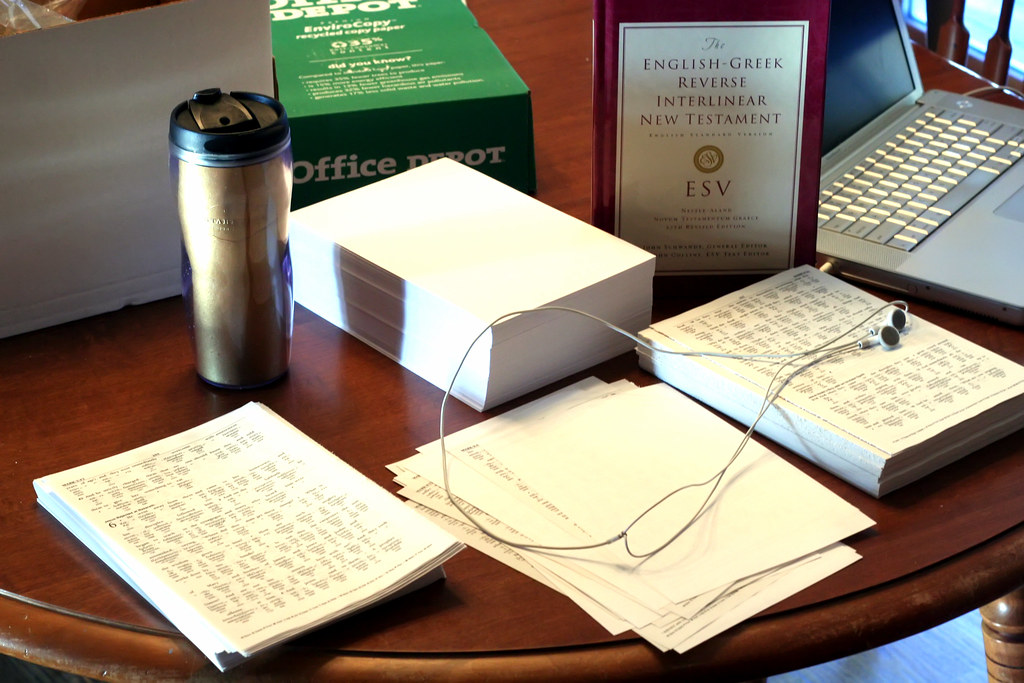
I usually set up something like this…

As you can see I have coffee and iTunes (these help deaden the painful shoulder cramps). To the back-center I place my stack of blank pages from the office supply store.

Closest to me I make three piles. To the right are the bible pages themselves. The middle pile is where I bring the blank pages and the bible pages together. With my left hand I pull down a blank page onto the pile and simultaneously with my right hand I flip a bible page from the right stack down on top of the blank page. When I’ve stacked 40-50 pages I neatly align them and stack them (without flipping them) to the pile on the far left. Because the bible paper is thinner than the blank pages, its necessary to occasionally take time to carefully align the pages together.

It’s important to always be aware of the binding edge of the bible pages. In the far right the binding edge is on the left. The middle pile its on the right. And on the far left stack its also on the right. The bible pages flow from right to left. From the first stack they are turned (like a book) onto the middle pile. But the stacks are not turned again when going from the middle to the left piles. In other words, page one of the bible would be on the top of the right pile, but the bottom of the middle and left piles. Make sense? Good.

As you can see, the interlinear bible is going to be much larger than the 3 volume blank bible we made earlier. This will be a New Testament for the serious bible student!

It is awesome to know that God, through His Spirit, can fill every blank page through humble meditation as the “living and active” Word of God comes alive. Each blank page represents our anticipation that God will open up His Word to reveal more of the width and height and depth and length of God’s love in the Cross!

——————————–

Coming up next, the conclusion … DIY: Blank Bible (part 4) Punching and Binding

Book of the Year, 2006: Meet the Puritans by Joel R. Beeke and Randall J. Pederson (9781601780003, 1601780001)

Book of the Year, 2006
Meet the Puritans
by Joel R. Beeke and Randall J. Pederson

This was a great year for Christian publishing. We saw the first installment of Justin Taylor’s edited version of John Owen, Overcoming Sin and Temptation. John Piper’s What Jesus Demands from the World was also excellent. Suffering and the Sovereignty of God, edited by Piper and Taylor and Evangelical Feminism: A New Path to Liberalism? by Wayne Grudem were also very good. We saw the release of the The ESV English-Greek Reverse Interlinear New Testament: English Standard Version. [Can someone at Crossway please give Justin Taylor a vacation already?] John Calvin’s excellent Sermons on the Beatitudes was released by Banner of Truth. Steven Lawson released the first volume of A Long Line of Godly Men, titled Foundations of Grace, which covers the history of the doctrines of grace in what is certain to become his greatest accomplishment. Reformation Heritage Books released the Works of Thomas Goodwin (12 volumes) in paperback form, containing much rich teaching on the beauty of Christ. No doubt, the second best book published this year was Mark Dever’s incredible, The Message of the Old Testament: Promises Made. Perhaps no book has better opened up the Old Testament storyline.

Each of these books are tremendous accomplishments in themselves. I thank the publishers and their devoted writers, editors, administrators and warehouse managers who seek to magnify Christ in their publishing endevors. Thank you!

With all respect for these books released in 2006, none topped Meet the Puritans by Joel Beeke and Randall Pederson. We had the honor of announcing this book to the public a few months ago. By any standard, this volume is a monumental accomplishment.

It’s endorsed by Packer, Piper, MacArthur, Sproul, Duncan, Mohler, Ferguson… and the recommendations go on and on. It’s packed with terse information, illustrations, great biographies on more than 140 individual Puritan authors, overviews of over 700 individual Puritan volumes, a list of all the known reprints published beween 1956 and 2005, excellent articles ,and a glossary of terms used. At 900 pages, its a deep well of information. As clothbound, it’s made to endure years of use.
Important helps include chapters on who the Puritans are, why we should read them, and short histories of the English, Scottish and Dutch Puritans. I found the short history of the resurgence of Puritan literature in the 20th century especially interesting.

Here is just one quote, taken from the section explaining why we should read the Puritans today:

“With the Spirit’s blessing, Puritan writings can enrich your life as a Christian in many ways as they open the Scriptures and apply them practically, probing your conscience, indicting your sins, leading you to repentance, shaping your faith, guiding your conduct, comforting you in Christ and conforming you to Him, and bringing you into full assurance of salvation and a lifestyle of gratitude to the triune God for His great salvation” (xix).

Perfect for the beginner and the more advanced reader, Meet the Puritans will help guide and direct your way through the forest of Puritan authors.

In summary, I cannot say it better than our friend, Dr. Ligon Duncan:

“Joel Beeke and Randall Pederson have produced a tremendous gift to and resource for all who want an entryway into the study of the Puritans. They not only provide accurate biographical and theological introduction to every Puritan whose works have been reprinted in the last fifty years, but also combine with their helpful summaries an insightful analysis. If this were not enough, they’ve added major appendices that include the so-called ‘Scottish Puritans’ (that is, the great Scottish theologians who were contemporaries of and like-minded brethren in doctrine and piety with the English Puritans) as well as the Dutch Further Reformation divines. Meet the Puritans, With a Guide to Modern Reprints is a must have. I know of nothing like it. If you are looking for a reliable window into the life, theology, piety and ministry of the Puritans — this is it.”

Like I said, a monumental work!

—————————————

FREE: Reformation Heritage Books graciously provided The Shepherd’s Scrapbook with a special peak into the book… Here is one of the 140+ biographies in this volume: Dutch ‘Puritan’ Willem Teellinck, pp. 782-791 [download .pdf file].

SPECIAL DISCOUNT: Purchase Meet the Puritans directly from Reformation Heritage Books for the special discounted price of $22.50 between November 21st and 30th. You need to do two things. First, call the bookstore directly (1-616-977-0599 ext. 2). Second, tell them you are “a friend of The Shepherd’s Scrapbook.” [While you are there, consider buying The Path of True Godliness, the incredible book on pursuing godliness by Teellinck you can read about in the free chapter above].

Meet the Puritans (details)

Boards: clothbound, hardcover (blue, silver gilding)
Pages: 900
Dust jacket: yes
Binding
: Smyth sewn
Paper: normal
Text: perfect type
Publisher: Reformation Heritage Books
Price USD
: $35.00/$22.50 for a limited time (see discount above)
ISBNs: 9781601780003, 1601780001

Book review: The Gospel Life series by Jeremiah Burroughs

Book review

The Gospel Life Series by Jeremiah Burroughs

As we have already discovered, Jeremiah Burroughs [1599-1646] was a first-rate bible expositor. His massive commentary on the book of Hosea is wonderful proof of this (we reviewed this commentary earlier this Summer).

However, unlike most of the Puritans recommended in our Puritan Study Series, Burroughs’ collected works do not exist. His works are largely scattered around, and for the purposes of the Puritan study, we will have to piece his works together.

But one of the easiest ways to collect six of his books comes in a series published by Soli Deo Gloria titled, The Gospel Life Series.


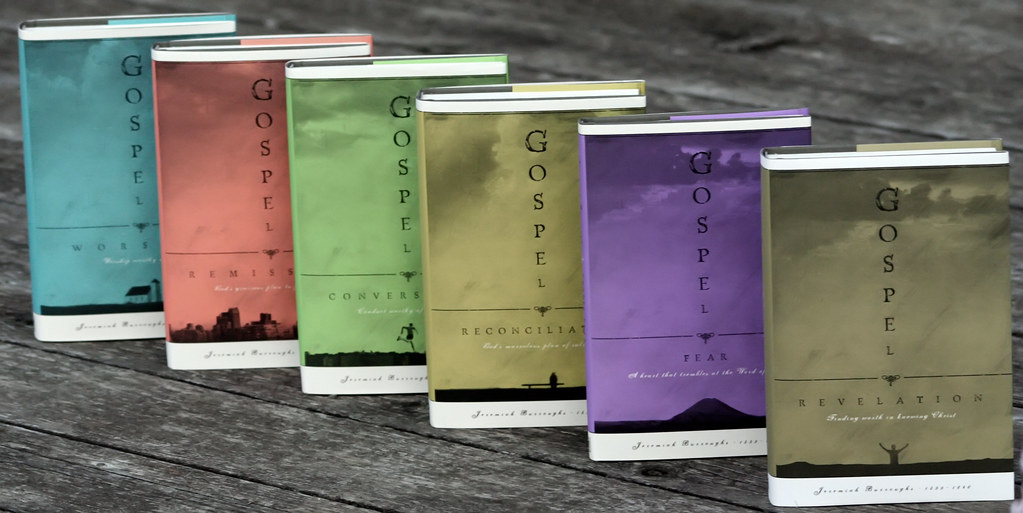
These six volumes were not intended by Burroughs to be a set, though because the word “Gospel” occurs in all six, editor Don Kistler saw that they were all linked together in a common theme. Kistler re-typeset the volumes, updated the spelling, and edited for length. “I do not believe that any of Burroughs’ thoughts have been altered. I have tried to remain faithful to his words as well as to his intent throughout this edition” (3:v ).

The result is a series that covers the various facets of the Christian life, is easy to read, and will appeal to a larger community of readers than just Puritan nerds like me. This year, the sixth and final volume of the series was released.

Contents

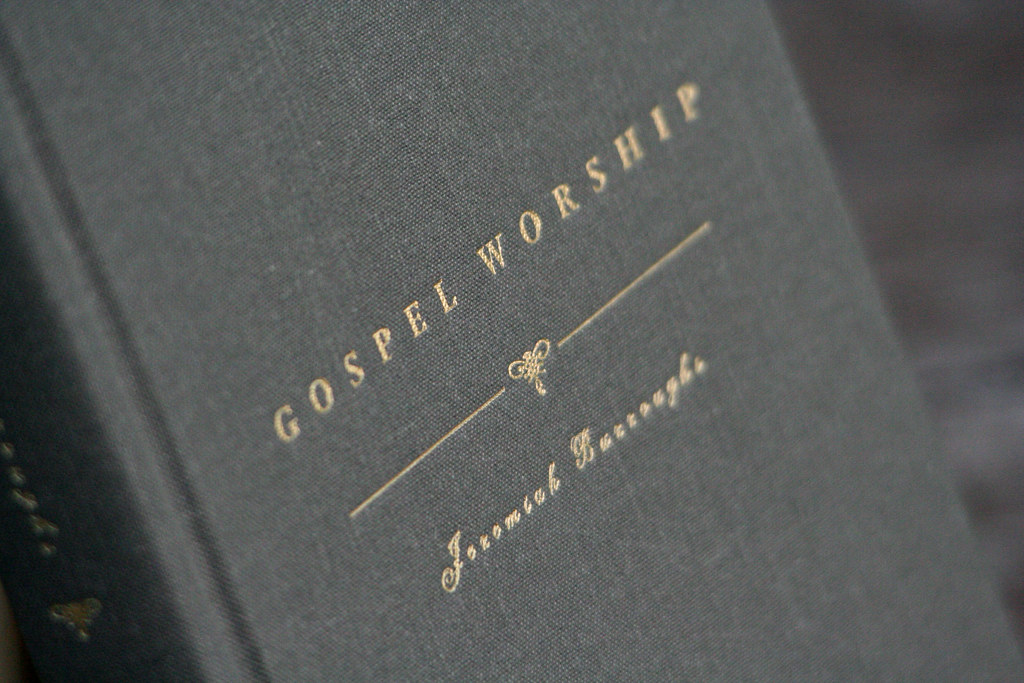
Vol. 1: Gospel Worship (1648/1990). In 14 sermons on Leviticus 10:3 (“Among those who are near me I will be sanctified”) Burroughs shows that we honor God when we draw near to Him in worship, in preparing for worship, in hearing the Word preached, in receiving the sacraments, and in prayer.

Vol. 2: Gospel Fear (1647/1991). In 7 sermons on Isaiah 66:2 (“But this is the one to whom I will look: he who is humble and contrite in spirit and trembles at my word”) and 2 Kings 22:19, Burroughs encourages us to cultivate a tender heart by cultivating a healthy fear of God.

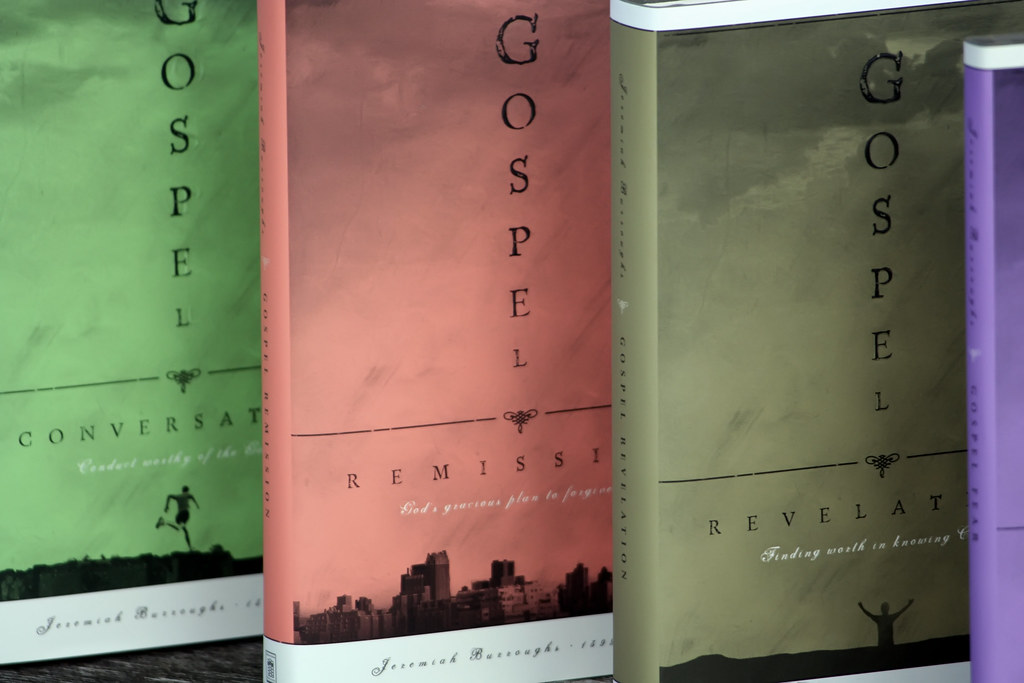
Vol. 3: Gospel Conversation (1648/1995). Not conversation as in speech only, but the Puritan concept of conversation – of work, family, fellowship and all-around general conduct. Here are ten sermons to help us live the Cross-centered life. Most of the sermons are based upon Philippians 1:27 (“Only let your manner of life be worthy of the gospel of Christ”) and focus believers to be diligent in their walk. The Gospel must be the center of the Christian life, he argues.

Vol. 4: Gospel Revelation (1660/2006). In about 18 sermons, Burroughs explains the excellency of the eternal. God is excellent, Christ is excellent, and the nature of an eternal soul is excellent as well. It was here in the excellency of Jesus Christ (pages 51-182) that I came to a deep respect of Burroughs’ love for Christ. Truly, His name is called “Wonderful” (Isaiah 9:6). See “Example” below.

Vol. 5: Gospel Remission (1668 and 1674/1995). In 20 sermons Burroughs shows that the true blessedness of the human heart stems from the knowledge that God has perfectly pardoned my sin! The entire volume is built from Psalm 32:1 (“Blessed is the one whose transgression is forgiven / whose sin is covered”). “There is nothing in all the world that so much concerns us as to know how things stand with us in relation to God and our souls, whether we are pardoned or not. A mistake in this is a wonderful mistake, and yet how many thousands are there who venture the weight of this great business upon poor, weak, and slight grounds, yea, rather, on mere suggestions of their own heart” (p. 175).
Vol. 6: Gospel Reconciliation (1657/1997). Here are 18 sermons on 2 Corinthians 5:19-20 covering the who, what, when, where and why of reconciliation of sinners to God. This volume is filled with excellent encouragement for pastors to remain earnest in their preaching of the Cross.

Each of these volumes shows Burroughs to be a man deeply concerned that Christians live diligent Cross-centered lives. But, as with the great experiential preachers, there is a parallel theme of evangelism as well.

Example

The litmus test of all preachers and writers is this: Are they passionate about the beauty of Jesus Christ? Are they overwhelmed with His preciousness? Are they distracted with duties or are they first centered around a Man?

Burroughs argues that Jesus Christ is beautiful for 13 reasons (!): He is beautiful in His natures, Person, incarnation, His earthly works, His offices, endowments, miracles, as the revelation of God’s glory, in His humiliation, His conquest, exaltation, in the wonder of the saints towards Him, and in His eternal glory (4:59). Yes, Burroughs passes the test.

But he is not content that readers just admit they understand Christ’s greatness, but that they feel Christ’s greatness. He writes,

“When you ask your children what Christ was, you teach them that He was both God and man. Aye, but I appeal to you, when were your hearts taken with this as the greatest wonder in the world…” (4:61)?

It would be inconsistent to believe and not feel the power of the incarnation. After an exposition of Ephesians 1:17-18 and 3:14-20 he writes,

“Oh, what a shame it is that those who profess themselves to be Christian should understand so little of Jesus Christ! God expects that we should study the gospel, search into the gospel, so that we may see more of Christ. And the more we see, the more still we shall wonder; for Christ is an infinite depth, and the more we search into Him, the more we shall see cause to wonder … What I would especially observe is that Christians should not content themselves with a little knowledge of Christ, but they should labor to comprehend what is the length, breadth, depth, and height; they should labor to dive into the mysteries of the gospel” (4:171,173).

It is diving into the mysteries of the Gospel that sanctifies the heart. In other words, the Gospel is central to the Christian’s life!

“We should study Christ, and praise and bless God, and have our hearts enlarged for Jesus Christ. This is the duty of believers to whom God has revealed Christ as wonderful, that in their conversations they should hold out the wonderful glory of Jesus Christ. You should so walk before men as to manifest to all the world that your Savior is a wonderful Savior” (4:177).

All of these volumes contain such God-glorifying and Cross-centered experiential exhortations for the Christian.

Indexes

On the down side, there are no indexes in this series and they are not well-indexed in Martin either. So to use these volumes effectively will require some time. Soli Deo Gloria (and any Puritan publisher that does not include indexes) should consider releasing an electronic version of this set for those who purchase the printed set. This would prove very useful to exegetes like myself who need to sift through the volumes quickly.

For now, preachers who want to use Burroughs in sermon preparations will need to become familiar with the contents of each volume. The detailed contents pages in each volume will help much here.

Conclusion

The bottom line is this: The Gospel Life series is an exceptionally good resource of Puritan exposition. After 350 years, Burroughs still speaks powerfully through these volumes.

The publisher boasts that this book has a shelf life of 200-300 years. But even more important, Dr. Kistler’s editing of the text will make Burroughs accessible to readers for at least another 350. An excellent Puritan resource!

Boards: clothbound, hardcover (grey, gilded)
Volumes: 6
Pages: 1,710
Dust jackets: yes (once again, beautiful covers from SDG)
Binding: Smyth sewn
Paper: acid-free; normal
Text: edited, updated, perfect type
Topical Index: no (electronic file is much needed)
Textual index: no (electronic file is much needed)
Biography: yes (very short; end of Gospel Remission)
Publisher: Soli Deo Gloria
Price USD: $140.00 / $91.00 from publisher
ISBNs: 187761131x, 1877611913, 1573580147, 1877611123, 1567690696, 1573580422

The Puritan Study (Part 11) Concluding Thoughts, part 2

Part 11: Concluding Thoughts, part 2

Finally, the conclusion of the Puritan Study comes today. I wish I could continue on in this study but I must move on. Thank you for all the very kind emails and helpful suggestions throughout this series. Seeing others come to a deeper appreciation of the Puritan literature has been an incredible encouragement to me.

Here is a collection of final thoughts …

Expositional Puritans

I think it’s worth noting again that in this series of blog posts I have emphasized the most important Puritan resources for expositional research. Other Puritans are useful on a number of issues.

I like Baxter, Burgess, Watson and other Puritans. But these and other Puritans simply have not helped me when I’m under pressure to preach and write expositionally on a certain text. Spurgeon, Bunyan, Owen, Boston, Manton and the men I have promoted, however, have proven faithful in these situations.

If you are more interested in systematic theology, or apologetics, or church history, you will find other Puritans to be of great help. Here, we were concerned with the most effective Puritans for expositional sermon preparation and ranked these authors in order of availability and usefulness.

Dutch ‘Puritans’

I was hoping to use this series to begin introducing you to the Dutch ‘Puritans’ (they are not really called ‘Puritans,’ but ‘the Dutch Second Reformation Divines’). These authors ministered during the same period of time as the English Puritans we know well, but their works were originally published in Dutch. Thanks to the recent work of the Dutch Reformed Translation Society, these works are now being made available in updated English. After some time reading these Dutch works, it’s clear these authors were as mature and experiential as their English counterparts.

Among others, the Dutch ‘Puritans’ include Wilhelmus à Brakel, Willem Teellinck and Herman Witsius (whose works have been in English for a few years now). Teellinck’s book on living a holy life (The Path of True Godliness) is very valuable and will be the subject of an upcoming book review.

These Dutch authors are very powerful and, although many of them will not be indexed and easily accessed, an introduction to their works was warranted at the end of this Puritan study. More information this winter …

Tough and Tender

John Piper once said, “one of my great desires is to see Christian pastors be as strong and durable as redwood trees, and as tender and fragrant as a field of clover.” This ideal finds its origin in the words and works of Jesus Himself. He knew when to be tough and when to be tender. He was strong and resolute but loving, kind, and compassionate, too. Many Puritans remind me of men who were uncompromising and stable in their convictions. They were a forest of redwood trees. But these preachers often displayed a compassionate tenderness like a fragrant field of clovers, too. An excellent pattern for preachers today.

The Presence of God

Many things draw me to the Puritans, but one of the most important is their pursuit of God. They see the Psalms as a blueprint for the Christian life – striving and praying for the presence of God to draw near (see Pss. 16, 42, 73). You can spot authors who read much of the Puritans because they, too, have a healthy and well-developed desire to pursue the presence of God (see A.W. Tozer, Martyn Lloyd-Jones, John Piper, etc.).

Personal change

I did not realize what was happening, but for several years as I have used the Puritan literature, I thought I was just borrowing a few quotes and thoughts along the way. Now it is obvious that over those years I was being changed.

What I love most about the Puritans is how they have been used in changing me. I treat the Word with more sobriety and seriousness now. My application of the text is much more mature. I am more articulate in pointing my hearer’s affections towards the things God sees as precious (like His Son, His holiness, His justice, love and grace).

Specifically, three areas of my life have been changed due to my Puritan Study …

(i) In catching the Puritan hermeneutic. The Puritans interpret every passage in light of the big picture of God’s glory in the Cross of Christ. Everything comes back to this. As expositors we are apt to get wrapped up in our four verses and lazily forget this big picture. The Puritans, especially in their application, make it clear that every text must be brought back to this big picture. Sadly, very few expositors today do this consistently (Piper and a few others, however, excel here). I pray that we would all catch this Puritan hermeneutic. Spurgeon reminded preachers that every sermon must find a way back to the Cross. This was the Apostle Paul’s point exactly (Gal. 6:14, 1 Cor. 1:22-25; 2:2; Phil. 3:8).

(ii) In catching the Puritan experiential style.
When publishers want a good definition of ‘experiential preaching’ they turn to Puritan scholars. In the book, Feed My Sheep: A Passionate Plea for Preaching (Soli Deo Gloria, 1573581445), Dr. Joel Beeke writes: “Experiential or experimental preaching addresses the vital matter of how a Christian experiences the truth of Christian doctrine in his life … Experimental preaching seeks to explain in terms of biblical truth how matters ought to go, how they do go, and what is the goal of the Christian life … Experimental preaching is discriminatory preaching. It clearly defines the difference between a Christian and a non-Christian, opening the kingdom of heaven to one and shutting it against the other” (pp. 95-96). The Puritans understood that a sermon lacking powerful application is an incomplete sermon. The Puritans are unparalleled here.

(iii) In catching the Puritan earnestness. The Christian life is a struggle of balance. The same is true in the pulpit. It is easy to focus on strengthening marriages, helping others raise children, and overall improvements in godliness while lacking earnestness. We can get the idea that the purpose of the pulpit is only for long-term sanctified changes. We need the Puritan earnestness to remind those who have never experienced the grace of God in their own hearts (the ‘almost Christian’ sitting in the pew), that they teeter on the brink of God’s judgment. There may not be a tomorrow. Each of us will be in heaven or hell very shortly. Nothing guarantees the sinner one more day to repent. Now is the time. Today is the day of salvation. Plead with sinners. The Puritans balanced these two sides of preaching and teach us to use the same sermon to both strengthen Christian marriages (long term) and to plead with sinners earnestly (now).

Conclusion

In the end, the ultimate benefit of a (well-used) Puritan library is how it changes you. Because of the Puritans, I view the bible differently, more seriously. They have taught me deep thoughts so I am not easily distracted with the empty and hollow ‘Christian’ thoughts today. They have taught me to treasure Christ. They have pointed out the sin in my heart. They have encouraged me in the task of preaching. And they have been faithful friends pointing me back to the scriptures when I begin to wander around. ‘Be serious because God’s thoughts are weighty,’ is the Puritan message I hear every time I use their works.

So keep at it. Work hard. Study diligently. Learn new terms. Don’t be intimidated by 200-word sentences. Grasp the concepts. Learn from the Puritan big-picture. And one day you will realize that God’s Spirit has taken the Puritan Study from your shelves and into your heart and changed you forever. All for His eternal glory.

Soli Deo Gloria!