Book review
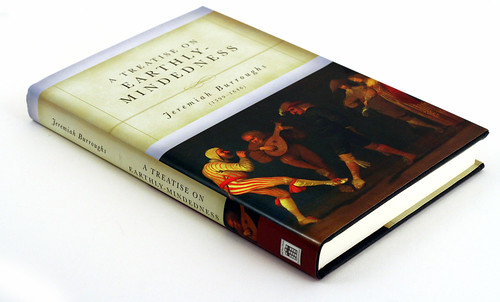
A Treatise on Earthly-Mindedness
by Jeremiah Burroughs

Jeremiah Burroughs (1599-1646) is one of my favorite Puritan authors and (I dare say) one of the most overlooked.
In his extensive writings, Burroughs authored a very helpful book on discerning worldliness in a book now titled A Treatise on Earthly -Mindedness. It was retypeset and edited by Don Kistler and published in 1991 by Soli Deo Gloria.
Burroughs builds his argument from Paul’s sobering ‘enemies of the Cross’ statement — “their end is destruction, their god is their belly, and they glory in their shame, with minds set on earthly things. But our citizenship is in heaven, and from it we await a Savior, the Lord Jesus Christ” (Phil. 3:19-20).
Contents
Burroughs first discerns the seriousness and dangers of worldly thinking (pp. 3-92). His goal in this first section is to call this earthly-mindedness what it really is – adultery, idolatry and enmity. This earthly-mindedness suffocates the work of grace, opens the soul to further temptations (1 Tim. 6:9), stifles the hearing of preaching, breeds foolish lusts in the soul, spreads roots for future apostasy, deadens the heart for prayer, dishonors God, hinders our preparations for death, and ultimately drowns the soul into perdition.
The second section covers the implications of our citizenship in heaven (Phil. 3:20), and is filled with helpful practical advice on to living as foreigners in our sojourning through life on earth (pp. 93-178). This theme continues in the final section which helps discern what walking with God looks like in everyday life (pp. 179-259). The final chapter contains very useful wisdom on walking with God when His presence seems distant (pp. 254-259).
Grace
Throughout his works, Burroughs avoided a common Puritan pitfall. The Puritans frequently narrowed in so tightly on a particular topic that surrounding contexts and connections were forgotten. It’s not uncommon to read a Puritan on the topic of sin continue on and on without any mention of the Cross, God’s grace, and living in freedom and victory over sin. Even some of the great Puritan classics (such as the works of Richard Baxter and The Life of God in the Soul of Man by Henry Scougal) woefully assume the Cross.
Burroughs is quite the opposite. He’s hardly begun a lengthy diagnosis of worldliness in the heart before breaking into a short digression on the glorious work of grace in conversion (pp. 29-30)! This work of God transforms enemies of the Cross into those who now have quickened souls. Those once veiled by sin and blinded by the world now see the light of God’s glory! We are new creatures, creatures no longer content with worldliness but now transcending the circumstances of the world and clinging to eternal hope. This new life enlarges our heart and our spiritual appetite becomes so large that no earthly means could fill it. This grace severs our grip on the world, and we begin to experience God’s sanctifying grace in our souls. For Burroughs, even when discovering the depth and darkness of sinfulness in the heart, God’s grace is ever in view.
With careful pastoral balance, Burroughs encourages us to pursue excellence in our earthly calling, while exhorting us to carefully avoid the snares of worldly-mindedness.
“Considering what has been delivered, I beseech you, lay it seriously upon your heart, especially you who are young beginners in the way of religion, lest it proves to be with you as it has with many who are digging veins of gold and silver underground. While they are digging in those mines for riches, the earth, many times, falls upon them and buries them, so that they never come up out of the mine again. … Keep wide open some place to heaven, or otherwise, if you dig too deep, noxious gas vapors will come up from the earth, if it doesn’t fall on you first. There will be noxious gas vapors to choke you if there is not a wide hole to let in the air that comes from heaven to you. Those who are digging in mines are very careful to leave a place open for fresh air to come in. And so, though you may follow your calling and do the work God sets you here for as others do, be as diligent in your calling as any. But still keep a passage open to heaven so that there may be fresh gales of grace come into your soul” (p. 85).
Conclusion
Fitting of Burrough’s classic, Soli Deo Gloria published A Treatise on Earthly -Mindedness with an attractive dust-jacketed, durable cloth cover and Smyth-sewn binding. It’s an excellent work for those of us who sometimes find ourselves surrounded by the cares of this world, asphyxiating on temporal toxins rather than breathing fresh grace.
Title: A Treatise on Earthly-Mindedness
Author: Jeremiah Burroughs (1599-1646)
Editor: Don Kistler
Reading level: 2.0/5.0 > easy thanks to excellent editing (includes nice section and subpoint headings)
Boards: hardcover, embossed
Pages: 259
Volumes: 1
Dust jacket: yes
Binding: Smyth sewn
Paper: white and clean
Topical index: no (would have been very useful)
Scriptural index: no (would have been very useful)
Text: perfect type
Publisher: Ligonier; Soli Deo Gloria
Year: original ed., 1649; edited ed., 1991
Price USD: $18.00 from Ligonier
ISBN: 1877611387
 “In his struggles with penance and confession, he [Martin Luther the monk-scholar] wrestled with Psalm 19:12, ‘Clear thou me from hidden faults’ (ASV). Luther’s problem was never whether his sins were large ones or small ones, but whether in fact he had confessed every single one. What about the sins he could not remember? What about the sins committed in his sleep? Luther anticipated Freud by recognizing a depth-dimension to the human person and by refusing to limit the effects of sin to the conscious mind alone. Such a radical reading of the human situation could only be answered with an even more radical reading of divine grace. …
 As you know, I love sermon jams. Sermon jams are where sermonic highlight meets background music. Sermon jams are excellent for the gym, excellent for personal devotion, excellent to share with other listeners less likely to listen to entire sermons, and overall just an excellent way to reach the lost and share the faith.
 Tony Reinke