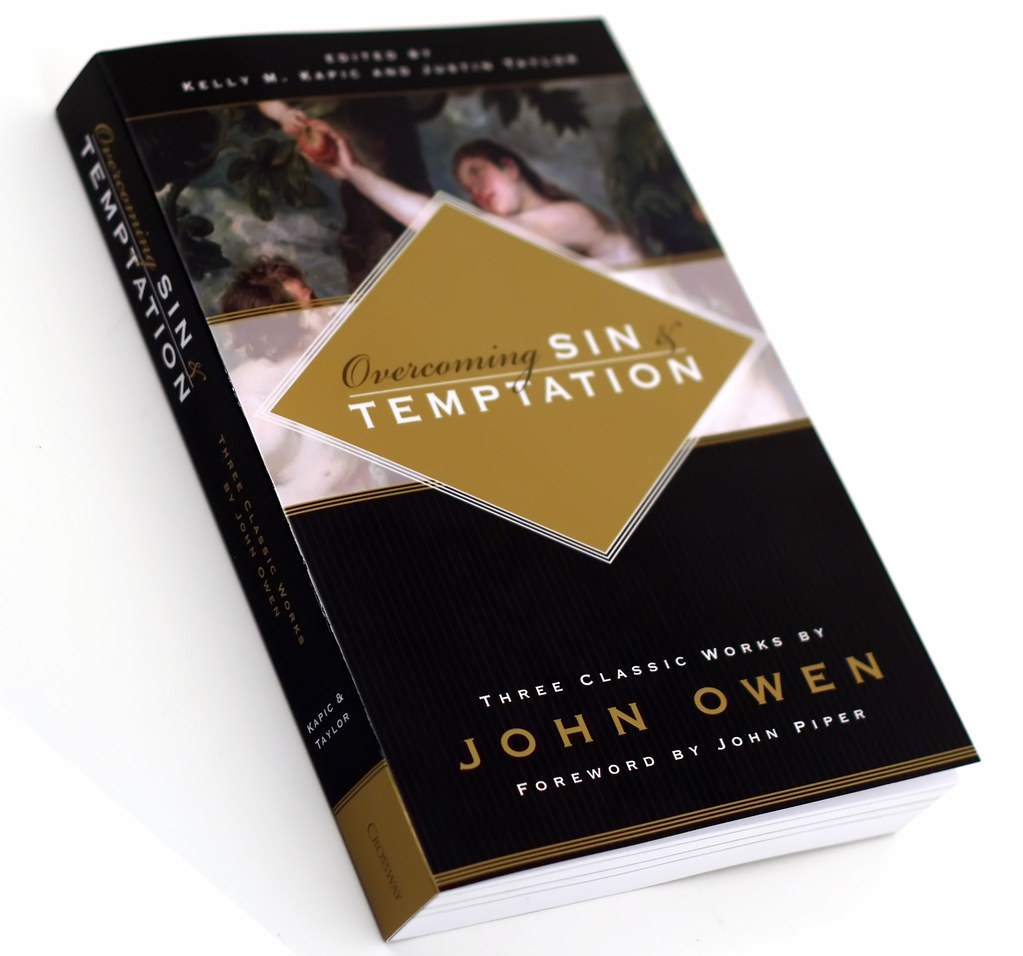
Overcoming Sin and Temptation by John Owen

Christmas gift idea:

Overcoming Sin and Temptation by John Owen

“As I look across the Christian landscape, I think it is fair to say con­cerning sin, ‘They have healed the wound of my people lightly’ (Jer. 6:14; 8:11, ESV). I take this to refer to leaders who should be helping the church know and feel the seriousness of indwelling sin (Rom. 7:20), and how to fight it and kill it (Rom. 8:13). Instead the depth and complexity and ugli­ness and danger of sin in professing Christians is either minimized—since we are already justified—or psychologized as a symptom of woundedness rather than corruption. This is a tragically light healing. I call it a tragedy because by making life easier for ourselves in minimizing the nature and seriousness of our sin, we become greater victims of it.”

– John Piper, foreword (p. 11)

—————————————————

Title: Overcoming Sin and Temptation
Author: John Owen [1616-1683]
Editors: Kelly M. Kapic and Justin Taylor
Contributors: John Piper
Rating (1-10): 10 (excellent)
Reading Level (1-10): 9 (tough)
Boards: paper
Pages: 462
Dust jacket: no
Binding: glue
Paper: normal
Topical index: yes
Scriptural index: yes
Text: perfect type
Extras: Excellent outlines, glossary, overviews, introductions and biography.
Publisher: Crossway
Price USD: $19.99
ISBNs: 9781581346497, 1581346492

Confess your sins to one another (part 7)

With men it is confess and have execution,
but with God confess and have mercy.
We should never lay open our sins but for mercy.
So it honors God;
and when he is honored,
he honors the soul with inward peace and tranquility.
We can never have peace in our souls
till we have dealt roundly with our sins,
and favour them not a whit [bit];
till we have ripened our confession to be a thorough confession.
What is the difference between a Christian and another man?
Another person slubbers [is careless] over his sins
and he thinks if he comes to the congregation,
and follows the minister,
it will serve the turn [end].
But a Christian knows that religion is another manner of matter,
another kind of work than so.
He must deal thoroughly and seriously,
and lay open his sin as the chief enemy in the world,
and labor to raise all the hatred he can against it,
and make it the object of his bitter displeasure,
as being that that hath done him more hurt than all the world besides;
and so he confess it
with all the aggravations of hatred
and envy that he can…
That we in our confessions
(in our fastings especially)
ought to rank ourselves among the rest of sinners.
Perhaps we are not guilty of some sins that they have been guilty of.
God has been merciful to us and kept us in obedience in some things.
But, alas!
There is none of us all
but we have had a hand in the sins of the times.

Richard Sibbes, Works 6:188-189

Confess your sins to one another (part 6)

“Confession is an act of mortification,
it is as it were the vomit of the soul;
it breeds a dislike of the sweetest morsels
when they are cast up in loathsome ejections;
sin is sweet in commission,
but bitter in the remembrance.
God’s children find that their hatred
is never more keen and exasperated against sin
than in confessing.”

Thomas Manton, Works, 4:457

“Like a dog that returns to his vomit is a fool who repeats his folly.” (Proverbs 26:11, ESV)

Confess your sins to one another (part 5)

I am grateful for my friend Travis who is working diligently to produce an electronic copy of the great (and forgotten) Puritan book: Anthony Burgess, Spiritual Refining, part 2. To commemorate his progress I wanted to post one of the many quotes that stand out in this priceless work. One especially fits in our series of learning to confess sins to one another.

This excerpt shows why, when we look for sermons to tickle our ears, we have thus failed to understand the purpose of the Word and preaching. The same is true of friendships.

Burgess writes,

“That one main end of the Word of God,
and preaching,
is to discover this deceitful heart.
It’s to make us know ourselves;
compared therefore to a glass,
that will show a deformed man all his unloveliness,
and this is a glass,
not to the face but the heart;
all those hidden and unknown lusts may there be brought to light.
And the Ministry that is compared to light;
as the sunbeams discover those many thousands of motes in the air,
which the darkness concealed;
thus the Ministry,
in a powerful and soul-saving way dispensed,
will make thee see thyself to be that beast,
that devil,
yea to have that dunghill,
that hell in thy heart,
thou didst not perceive:
look then for this benefit by preaching,
not what may fit thy ear,
may please thy fancy,
but what may discover the dark corners of thy soul,
what may bring glorious light into thy breast;
that thou mayest cry out;
O Lord, how long have I lived and did not know myself!
I thought all was well,
everything was in quiet;
but now I am like the Syrian army,
that being by the Prophet stricken blind,
and thought they were guided to their own camp,
as soon as ever they had their eyes opened,
they found themselves in the midst of the enemy’s camp:
Thus thy eyes being opened,
thou seest thyself to be in the power of all thy sins,
all thy enemies and the curses of God.”

Anthony Burgess [d. 1664]
Spiritual Refining, Part II: A Treatise of Sin, pp. 19-20

O, that we would likewise no longer be superficial in our friendships but be willing to dive into difficult conversations for the purpose of discovering the “dark corners of thy soul.” Confess your sins to one another, Paul says. What an excellent standard for true friendship.

Psalm 14:1 – “No God”

I think many of us know Psalm 14:1 by heart: “The fool says in his heart, ‘There is no God.’” But apparently I did not know the meaning of this verse by heart. Actually the two words, “there is” are not in the Hebrew text. The verse should more accurately be translated: “The fool says in his heart, ‘No God.’” It’s not that the fool does not believe in God’s existence but that for him/her God is unnecessary. As Lawson writes,

“The term is a synonym for sinner, and it describes everyone who has no place for God in his or her life. The fool’s problem is that his heart refuses the knowledge of God. To be sure, he is not an intellectual atheist, denying the existence of God, but a practical atheist, living as if there were no God (Pss. 53:1; 74:18,22; Isa. 32:6).”  [Holman Old Testament Commentary: Psalms 1-75, p. 75]

Sin makes man a destroyer

“Man is a suicide – he has destroyed himself; a homicide – his influence destroys others; a deicide – he would, were it in his power, annihilate the very being of God. What a proof of this have we in the crucifixion of the Son of God! When God brought himself as near to man as Infinity could approach, he exclaimed, ‘This is the Heir; come, let us kill him!’ and they proceeded to consummate the crime by nailing him to the tree.”

Octavius Winslow, No Condemnation in Christ Jesus (Banner of Truth: 1853/1991), p. 93. Online edition.