2011 Books of the Year

Because I try to stay on top of new theology book releases from Christian publishers, when I choose my books of the year, they are mostly from the field of Christian books. I do read many other books published by “secular” presses throughout the year, but I rarely read them in the same year they are published. This year, for example, I finally got around to reading Laura Hillenbrand’s incredible book Unbroken, although it was a 2010 release. And I do plan to read Walter Isaacson’s 2011 release Steve Jobs, but probably not for another year or so. So when I choose my favorite books for 2011 they are Christian books.

Choosing my top two favorites published in 2011 was no challenge. Here they are:

First, A New Testament Biblical Theology: The Unfolding of the Old Testament in the New by G. K. Beale. The theme of “inaugurated eschatology” is not a new one in theology, but there doesn’t seem to have been many attempts to center a full theology of the Bible around the theme. Enter Beale. Beale’s work is a massive and excellent contribution, arguing that eschatology is not something relegated merely to the future. For Beale, the end-time new creation has already begun, a fact that permeates our Bibles. And he’s spot on.

Second, The Theology of Jonathan Edwards by Michael J. McClymond and Gerald R. McDermott. In the last few years Yale has completed their online archive of the writings of Jonathan Edwards, so it was only a matter of time before we saw attempts to bring theological synthesis to his writings. This is the first major attempt. I’m certain more will follow in the future, but this one is a gem — readable, enjoyable, and a comprehensive look at the many God-centered facets of Edwards’ thinking. “One might interpret the whole of Edwards’s theology as the gradual, complex outworking of a vision of God’s beauty.” Bingo! In this sense McClymond and McDermott “get” Edwards’s theology.

And here is my full top-ten list:

  1. Greg Beale, A New Testament Biblical Theology: The Unfolding of the Old Testament in the New (Baker)
  2. McClymond and McDermott, The Theology of Jonathan Edwards (Oxford)
  3. Tim Keller, The Meaning of Marriage: Facing the Complexities of Commitment with the Wisdom of God (Dutton)
  4. Michael Horton, The Christian Faith: A Systematic Theology for Pilgrims on the Way (Zondervan)
  5. Herman Bavinck, Reformed Dogmatics: Abridged in One Volume (Baker)
  6. John Frame, The Doctrine of the Word of God (P&R), technically released at the end of 2010.
  7. Jared Wilson, Gospel-Wakefulness (Crossway)
  8. Tim Keller, King’s Cross: The Story of the World in the Life of Jesus (Dutton)
  9. Russell Moore, Tempted and Tried: Temptation and the Triumph of Christ (Crossway)
  10. DeYoung and Gilbert, What Is the Mission of the Church?: Making Sense of Social Justice, Shalom, and the Great Commission (Crossway)

On a related note, you can also find my books of the year for 2006, 2007, 2008, and 2010.

Gospel Firepower

Some say evangelism is like tossing lit matches into upright kegs. Most kegs are filled with water, some are filled with gunpowder. C.S. Lewis was thinking gunpowder when he wrote this (Letters, 3:324–325):

My feeling about people in whose conversion I have been allowed to play a part is always mixed with awe and even fear; such as a boy might feel on first being allowed to fire a rifle. The disproportion between his puny finger on the trigger and the thunder and lightning which follow is alarming. And the seriousness with which the other party takes my words always raises the doubt whether I have taken them seriously enough myself.

The Tapestry of Scripture

That list of biblical references running down the gutter of each page the ESV Study Bible is a compilation of thousands of cross-references that point to other thematically related parts of Scripture. All told the ESVSB has 80,000 of those cross-references.

There’s a history to who actually made those connections. The references found in the ESVSB were compiled by a team of Bible scholars from Oxford and Cambridge Universities over 100 years ago. Their work was first used in the English Revised Version (RV), a version that appeared in 1881.

A few years back Lutheran pastor Christoph Römhild wondered if an infographic could capture cross-references like these for the purpose of visualizing the tapestry of Scripture. He contacted Chris Harrison, who said yes, and together they created this:

Each bar along the bottom represents a chapter from Genesis (left) to Revelation (right). The length of the bar correspond to the length of the chapter (Psalm 119 is easy to find in the middle). The cross-references are arched and colored by arch length. In all this graphic represents 63,779 colorful cross-references (I’m unsure how they arrived at this number, cross-referencing being something of an art — the Thompson’s Chain-Reference Bible has over 100,000, for example).

Beautiful graphic, isn’t it? This is a wonderful visual reminder of the thematic unity of Scripture, and it serves as a great personal reminder to read every verse in light of the bigger biblical storyline.

You can find a large version of the graphic and more information here.

Here I Stand

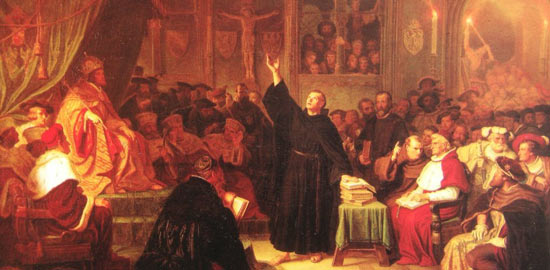
When I think of Luther’s dramatic “here I stand” statement before the Diet of Worms in 1521, I think of …

… Roland Bainton’s excellent biography

[When Luther concluded the statemet he] “threw up his arms in the gesture of a victorious knight, and slipped out of the darkened hall, amid the hisses of the Spainiards, and went to his lodging.” (181)

… Niall MacGinnis’ fired passion (1953) …

… Joseph Fiennes’ quiet resilience (2003) …

… and Curt Allen’s track off his album The Process of the Pardon. Listen here:

Here I Stand (lyrics)

Verse 1

Let my life be a wordsmith, the word is a gift
What I’ve heard made me observe every verb from my lips
When you come from the curbs, where nervous don’t exist
And your heart is just hard to your sin, it did this
You need a reality check, in actuality vexed is God’s person
When what’s out of His neck is treated like strep
To those that respect stand firm even if you squirm
Learn what’s correct, cause your Diet of Worms is next

Hook

Here I stand, the Bible in my hand, let my life testify Jesus Christ is a man
And fully God, in the cross it’s fully our declaration, legal justification
Here I stand, the Bible in my hand is God’s word, it’s infallible
Disagreement is laughable. Denying this authority is Scripture hating
Planting my flag, I ask: What is your reformation?

Verse 2

Now every so often a heresy will say
That it killed what we feel, putting nails in the coffin
For real, not an option. They all been contested
And next is Paul, and it’s called the new perspective
So here’s the perspective: It’s some that would say
That justification’s not what we know it today
It should blow you away, what they say is insanity
That justification means a part of God’s family
It doesn’t mean that you righteous despite this
Exegesis that strengthens many believers
It gets deeper and hostile, they say
That the gospel is not about how you are saved!
What a grave mistake that you make when
Righteousness imputed to what you did is fake
It undermines the very nature of truth
That grace has now declared us righteous when we see His face

Hook

Verse 3

Now just when you thought it was safe, some depict a negative view of Scriptures
That wrongly pictures God’s Word unreliable, filled with inconsistencies
Though inconsistently brought, it ought not to really be an item
But it’s sad that we gotta fight ‘em, dag what they brag
Affects the word as ad infinitum. Apparently, many find issues with inerrancy
That Scripture makes mistakes, the debate innately tears at the foundation of
Can we trust with our life and observe a word that we not even sure is right?
’Cause it might say something that is wrong is an accusation that is far too strong
What God breathed along through the men that would pen His works
Yeah, there are quirks, but trust in the whole Bible extends the church
Where problems in the Scriptures, search, be a Berean
’Cause the Word that’s infallible, inerrant we believe in

Hook

© 2008 Curt “Voice” Allen, posted here by permission of the artist.

More Book Updates

The book is now out and many of you are reading it or have recently completed it. Thank you for all the emails and comments and Twitter encouragements over the last week. Watching pithy quotes from the book spread on Twitter is really neat way to see what statements struck a chord with readers. I appreciate the emails telling me stories of families reading Lit! together, homeschool families looking to incorporate the book into their curriculum, pastors buying up copies to give out to people in their churches who struggle with reading, and college ministry directors leading discipleship reading groups through the book. This is exactly why I wrote it in the first place, so you can imagine how those notes warm my heart! Thank you for them and please keep them coming.

Here are a couple of book updates. On Tuesday two interviews were published online. My written interview with John Starke, “Death to Dostoevsky by Angry Birds,” was published on the TGC website. And my 12-minute video interview recorded with Justin Taylor in June went live as well. You can watch it here:

[vimeo:http://vimeo.com/25778066%5D

As Arthur Krystal wrote, “Like most writers, I seem to be smarter in print than in person.” Yes, and thinner and handsomer, too.

Some other fun interviews are in the works. I’ll let you know when they’re up.

Blessings!

Tony

Sabbath rest in a 24/7 culture

Without qualification Eichrodt makes the point that in OT history the weekly practice of setting aside one day for rest was unique to Israel. In other words, Israelites lived in a 24/7 world where trade was happening 24/7. To take one day off each week would result in compounded business implications for faithful Israelite businessmen over the long term. Writes Goldengay: “Not to trade on the sabbath seriously reduces opportunity to succeed in business. The prophet [Isaiah] does not promise that people will do so well on the other six days that they will not lose out, in the manner of the Israelites in the wilderness who found enough manna on Friday to last two days. The exhortation does not even promise that people will do well enough, even if not as well as the most successful foreigners who are free to trade on the sabbath. It does promise, specifically to eunuchs and foreigners who accept this discipline, the joy of making their mark within the people of God and of participating in the worship of the temple (Is 56:1–8).” In other words, taking a day to gather with the people of God will cost you–it will cost you financially because that’s one day you cannot trade, and it will cost you in productivity because that’s one day out of the field or mill or workshop. All the while the Israelites must have been aware that their neighbors were using Saturday to make money. But for those foreigners willing to turn away from the 24/7 attitude of their culture, to walk by faith, and to observe the Sabbath rest, to these God promises (through Isaiah) a fruitful place among the People of God and a truckload of spiritual and eternal blessings.