Bolt on Bavinck

In anticipation of the release of Herman Bavinck’s Reformed Dogmatics as an ebook for Logos, Kent Hendricks asked leading Bavinck scholar John Bolt four questions:

  • Who was Herman Bavinck?
  • What is the mission and role of the Dutch Translation Society in translating the works of Bavinck and other theologians?
  • The translation project took a decade to complete. Can you describe the process? What was your role in the translation and editorial process?
  • You write in the introduction to Bavinck’s Prolegomena in volume 1 that “the Gereformeerd Dogmatiek represents the concluding high point of some four centuries of remarkably productive Dutch Reformed theological reflection,” including “Voetius, De Moor, Vitringa, van Mastricht, Witsius, and Walaeus.” How does Bavinck both reflect and develop the theological system of his predecessors?

Read Bolt’s answers here.

Love for others

This excerpt from John Calvin reminds me a bit of the quote I posted earlier in the week from James Davidson Hunter. In The Institutes, Calvin writes (2.8.55; McNeil/Battles, 1:419):

“…we ought to embrace the whole human race without exception in a single feeling of love; here there is no distinction between barbarian and Greek, worthy and unworthy, friend and enemy, since all should be contemplated in God, not in themselves. When we turn aside from such contemplation, it is no wonder we become entangled in many errors. Therefore, if we rightly direct our love, we must first turn our eyes not to man, the sight of whom would more often engender hate than love, but to God, who bids us extend to all men the love we bear to him, that this may be an unchanging principle: Whatever the character of the man, we must yet love him because we love God.”

The ascent to morality maturity

C.S. Lewis, closes his essay “Man or Rabbit?” [now published in God in the Dock (Eerdmans, 1970), pp 108–113] with this image:

“’When that which is perfect is come, then that which is in part shall be done away’ [1 Cor 13:10]. The idea of reaching ‘a good life’ without Christ is based on a double error. Firstly, we cannot do it; and secondly, in setting up ‘a good life’ as our final goal, we have missed the very point of our existence. Morality is a mountain which we cannot climb by our own efforts; and if we could we should only perish in the ice and unbreathable air of the summit, lacking those wings with which the rest of the journey has to be accomplished. For it is from there that the real ascent begins. The ropes and axes are ‘done away’ and the rest is a matter of flying.”

Mt Sinai + Mt Transfiguration

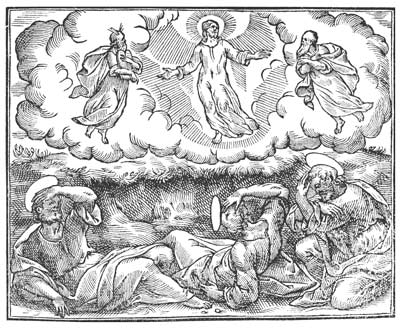
I find it interesting how Mark’s version of the Mount of Transfiguration echoes the Mount Sinai episode in the Old Testament. At least seven parallels surface:

  • The most obvious is that Moses is present at both Mount Sinai and the Mount of Transfiguration (Ex, Mark 9:4)
  • Both accounts take place on a high mountain (Ex 24:12–15, Mark 9:2)
  • In both cases a cloud covers the mountain (Ex 24:15–16, Mark 9:7)
  • A six-day interval leads up to the climactic events (Ex 24:16, Mark 9:2)
  • In both cases God speaks from the mountain on the seventh day (Ex 24:16, Mark 9:2,7)
  • At Mt Sinai, Moses’ face shines (Ex 34:29–35); at Mt Transfiguration, Jesus’ clothes shine (Mark 9:3)
  • The fear of the people in seeing Moses is paralleled by the fear of the disciples (Ex 34:30, Mark 9:6).

And another interesting connection links Moses and Jesus together in the Transfiguration. In the OT Moses says to look forward to a coming prophet—a new prophet—and when he comes, listen to him. Compare this to God’s words at the Mount of Transfiguration:

  • Moses: “The LORD your God will raise up for you a prophet like me from among you, from your brothers—it is to him you shall listen” (Deut 18:15).
  • God: “This is my beloved Son; listen to him” (Mark 9:7).

Exactly what Mark intended us to understand through this parallelism is not immediately clear. But it does seem to indicate two things:

  1. As God delivered revelation through Moses at Sinai, so now Jesus is a new revelation of God. Everyone should be listening.
  2. Jesus’ redemptive work is the outworking of an ancient redemptive lineage. After his transfiguration, Jesus turns his thoughts and his words to his approaching death and resurrection (see Mark 9:10-11, 31). This work is firmly rooted in the OT promises.

William Lane, in his commentary on Mark (NICNT), summarizes the data well when he concludes:

When the cloud lifted, Moses and Elijah had vanished. Jesus alone remained as the sole bearer of God’s new revelation to be disclosed in the cross and resurrection. Moses and Elijah had also followed the path of obedience, but having borne witness to Jesus’ character and mission, they can help him no more. The way to the cross demanded the submission of the Son and Jesus must set out upon it alone.

Parodies of eschatological hope

It was inevitable that I would read James Davidson Hunter’s book To Change the World: The Irony, Tragedy, and Possibility of Christianity in the Late Modern World (Oxford, 2010). The book has generated a lot of buzz in the blogotubes and for a time I’m pretty certain one of my friends was doing his morning devotions from it. So I read it and I’m glad I did. Hunter is an exceptional writer.

Personally, I am hesitant to embrace or endorse his overall vision for cultural engagement mostly because I’ve left the entire discussion of cultural engagement to those with much larger brains than my own. But one of Hunter’s points resonates with me.

On pages 234–235 Hunter writes the following (bold/italics his):

Let me finally stress that any good that is generated by Christians is only the net effect of caring for something more than the good created. If there are benevolent consequences of our engagement with the world, in other words, it is precisely because it is not rooted in a desire to change the world for the better but rather because it is an expression of a desire to honor the creator of all goodness, beauty, and truth, a manifestation of our loving obedience to God, and a fulfillment of God’s command to love our neighbor.

It is clear at this point that the very source of affirmation—its motive, its logic, and its telos—contains the second moment in the dialectic: antithesis. Antithesis is rooted in a recognition of the totality of the fall. In this light, all human effort falls short of its intended potential, all human aspirations exist under judgment, and all human achievement is measured by the standards of the coming kingdom.

In the present historical context, this means that Christians recognize that all social organizations exist as parodies of eschatological hope. And so it is that the city is a poor imitation of heavenly community; the modern state, a deformed version of the ecclesia; the market, a distortion of consummation; modern entertainment, a caricature of joy; schooling, a misrepresentation of true formation; liberalism, a crass simulacrum of freedom; and the sovereignty we accord to the self, a parody of God himself.

As these institutions and ideals become ends in themselves, they become the objects of idolatry. The shalom of God—which is to say, the presence of God himself—is the antithesis to all such imitations. Always and everywhere he relativizes the pretensions of all social institutions to power, fellowship, joy, freedom, and authority. Always and everywhere his presence declares that human endeavor is never the final word.
Looking in the wrong end of the funnel

In her Washington Post column today, “Does God play favorites?” (5/9, A17), Kathleen Parker argues that Christian prayers are no more special than the prayers of say a Hindu or a Muslim because “new brain research supports the likelihood that one man’s prayer is as good as any other’s.” To back this up she introduces NPR reporter Barbara Bradley Hagerty and her book Fingerprints of God a book that shows neurologically that “whether one is a Sikh, a Catholic nun, a Buddhist monk or a Sufi Muslim, the brain reacts to focused prayer and meditation much in the same way. The same parts light up and the same parts go dark during deep meditation.” I don’t doubt it. But she makes a fundamental mistake.

A drunk man blabbing in the street and a man filled with the Spirit of God and speaking the gospel in a foreign language apparently have some similarities to an observer. But they are doing very different things (Acts 2:5–13). Similarly, an act in the bedroom that is borne out of sinful lust between an unmarried couple as compared to the same act in the bedroom that originates from marital love and faithfulness are two radically different acts, even if they are physically indistinguishable. The physical appearance of the act often does not distinguish the sinfulness or the holiness of the act itself. This is what C.S. Lewis called “transposition,” when higher and more complex elements of the spirit world are acted out in a less complex material world they often don’t look particularly unique to the human eye. Or, as Lewis explained, when you take a book that was written in a very complex language and translate that book into a much more simplified language you must (out of necessity) give certain words multiple meanings. The same is true spiritually. The prayers that are pleasing to God—those prayers that are mediated by the blood of Jesus Christ and are reinterpreted and amplified by the voice of the Holy Spirit (Heb. 10:19–22, Rom. 8:26) are prayers that may in fact look exactly the same in a neurological scan as all other prayers and meditations that are not sanctified by the blood of Christ and not prayed through the Spirit.

To understand spiritual complexities we don’t study the simplified translation, we study the original book. In seeking to understand the spiritual world we must look down from heaven to earth rather than from earth up into the heavens. This is only possible through God’s revelation. God’s word is the only source that will help us make spiritual sense of physical acts that appear to be similar. And this is why brain activity can never determine the spiritual value of one’s prayers and meditation. It’s to attempt to understand spirituality by looking in the wrong end of the funnel.

For more on transposition see Lewis’ marvelous essay in The Weight of Glory (pages 91–115).